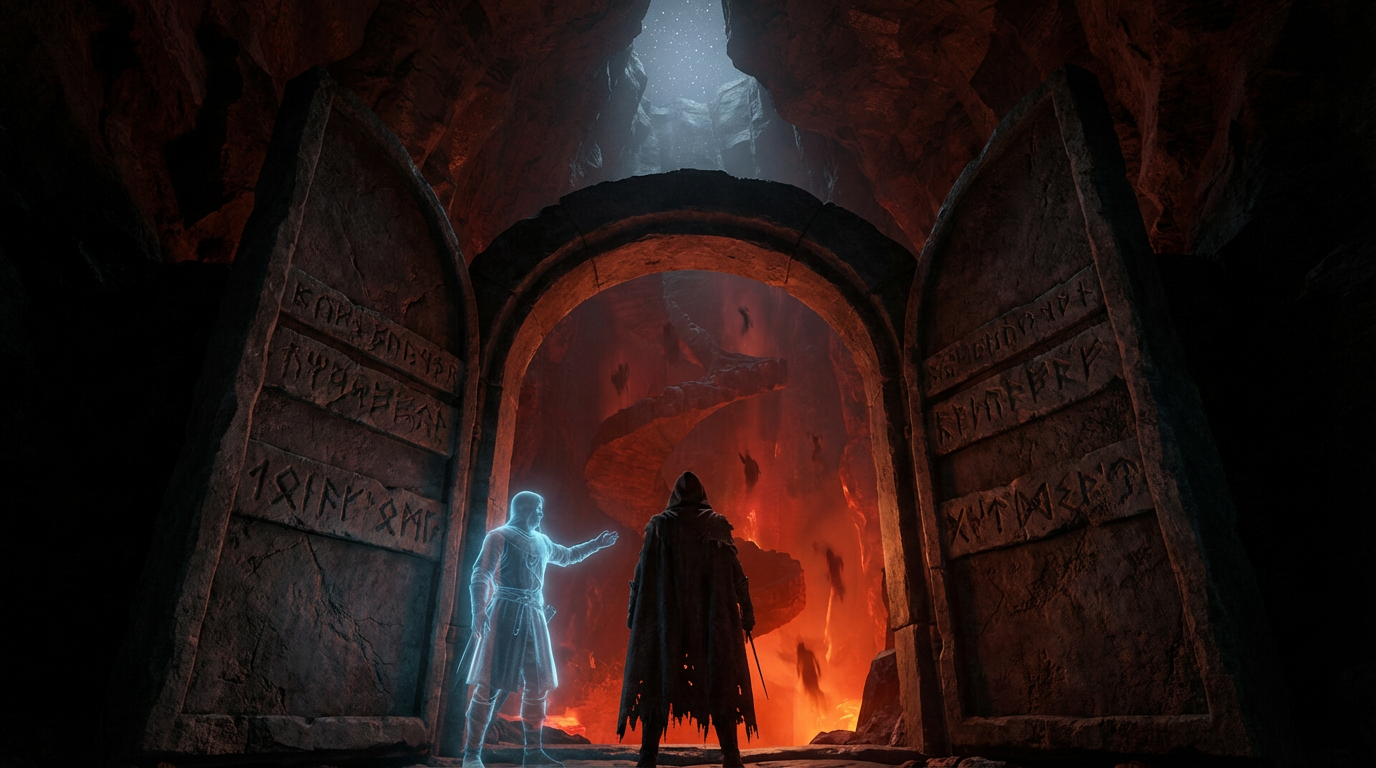
An excerpt from the original text.(complete · 999 words)
“Through me you pass into the city of woe:
Through me you pass into eternal pain:
Through me among the people lost for aye.
Justice the founder of my fabric mov’d:
To rear me was the task of power divine,
Supremest wisdom, and primeval love.
Before me things create were none, save things
Eternal, and eternal I endure.
All hope abandon ye who enter here.”

Such characters in colour dim I mark’d
Over a portal’s lofty arch inscrib’d:
Whereat I thus: “Master, these words import
Hard meaning.” He as one prepar’d replied:
“Here thou must all distrust behind thee leave;
Here be vile fear extinguish’d. We are come
Where I have told thee we shall see the souls
To misery doom’d, who intellectual good
Have lost.” And when his hand he had stretch’d forth
To mine, with pleasant looks, whence I was cheer’d,
Into that secret place he led me on.

Here sighs with lamentations and loud moans
Resounded through the air pierc’d by no star,
That e’en I wept at entering. Various tongues,
Horrible languages, outcries of woe,
Accents of anger, voices deep and hoarse,
With hands together smote that swell’d the sounds,
Made up a tumult, that for ever whirls
Round through that air with solid darkness stain’d,
Like to the sand that in the whirlwind flies.

I then, with error yet encompass’d, cried:
“O master! What is this I hear? What race
Are these, who seem so overcome with woe?”

He thus to me: “This miserable fate
Suffer the wretched souls of those, who liv’d
Without or praise or blame, with that ill band
Of angels mix’d, who nor rebellious prov’d
Nor yet were true to God, but for themselves
Were only. From his bounds Heaven drove them forth,
Not to impair his lustre, nor the depth
Of Hell receives them, lest th’ accursed tribe
Should glory thence with exultation vain.”

I then: “Master! what doth aggrieve them thus,
That they lament so loud?” He straight replied:
“That will I tell thee briefly. These of death
No hope may entertain: and their blind life
So meanly passes, that all other lots
They envy. Fame of them the world hath none,
Nor suffers; mercy and justice scorn them both.
Speak not of them, but look, and pass them by.”

And I, who straightway look’d, beheld a flag,
Which whirling ran around so rapidly,
That it no pause obtain’d: and following came
Such a long train of spirits, I should ne’er
Have thought, that death so many had despoil’d.

When some of these I recogniz’d, I saw
And knew the shade of him, who to base fear
Yielding, abjur’d his high estate. Forthwith
I understood for certain this the tribe
Of those ill spirits both to God displeasing
And to his foes. These wretches, who ne’er lived,
Went on in nakedness, and sorely stung
By wasps and hornets, which bedew’d their cheeks
With blood, that mix’d with tears dropp’d to their feet,
And by disgustful worms was gather’d there.

Then looking farther onwards I beheld
A throng upon the shore of a great stream:
Whereat I thus: “Sir! grant me now to know
Whom here we view, and whence impell’d they seem
So eager to pass o’er, as I discern
Through the blear light?” He thus to me in few:
“This shalt thou know, soon as our steps arrive
Beside the woeful tide of Acheron.”

Then with eyes downward cast and fill’d with shame,
Fearing my words offensive to his ear,
Till we had reach’d the river, I from speech
Abstain’d. And lo! toward us in a bark
Comes on an old man hoary white with eld,
Crying, “Woe to you wicked spirits! hope not
Ever to see the sky again. I come
To take you to the other shore across,
Into eternal darkness, there to dwell
In fierce heat and in ice. And thou, who there
Standest, live spirit! get thee hence, and leave
These who are dead.” But soon as he beheld
I left them not, “By other way,” said he,
“By other haven shalt thou come to shore,
Not by this passage; thee a nimbler boat
Must carry.” Then to him thus spake my guide:
“Charon! thyself torment not: so ’tis will’d,
Where will and power are one: ask thou no more.”

Straightway in silence fell the shaggy cheeks
Of him the boatman o’er the livid lake,
Around whose eyes glar’d wheeling flames. Meanwhile
Those spirits, faint and naked, color chang’d,
And gnash’d their teeth, soon as the cruel words
They heard. God and their parents they blasphem’d,
The human kind, the place, the time, and seed
That did engender them and give them birth.

Then all together sorely wailing drew
To the curs’d strand, that every man must pass
Who fears not God. Charon, demoniac form,
With eyes of burning coal, collects them all,
Beck’ning, and each, that lingers, with his oar
Strikes. As fall off the light autumnal leaves,
One still another following, till the bough
Strews all its honours on the earth beneath;
E’en in like manner Adam’s evil brood
Cast themselves one by one down from the shore,
Each at a beck, as falcon at his call.

Thus go they over through the umber’d wave,
And ever they on the opposing bank
Be landed, on this side another throng
Still gathers. “Son,” thus spake the courteous guide,
“Those, who die subject to the wrath of God,
All here together come from every clime,
And to o’erpass the river are not loth:
For so heaven’s justice goads them on, that fear
Is turn’d into desire. Hence ne’er hath past
Good spirit. If of thee Charon complain,
Now mayst thou know the import of his words.”

This said, the gloomy region trembling shook
So terribly, that yet with clammy dews
Fear chills my brow. The sad earth gave a blast,
That, lightening, shot forth a vermilion flame,
Which all my senses conquer’d quite, and I
Down dropp’d, as one with sudden slumber seiz’d.
Master this chapter. Complete your experience
Purchase the complete book to access all chapters and support classic literature
As an Amazon Associate, we earn a small commission from qualifying purchases at no additional cost to you.
Available in paperback, hardcover, and e-book formats
Let's Analyse the Pattern
Understanding when you're approaching a point of no return and recognizing that avoiding choice is itself a consequential choice.
Why This Matters
Connect literature to life
This chapter teaches how to identify when you're approaching a decision point that will fundamentally change your life trajectory.
Practice This Today
This week, notice when someone asks you to 'just this once' compromise your values—that's usually a threshold moment disguised as a small favor.
Now let's explore the literary elements.
Key Quotes & Analysis
"Abandon all hope, ye who enter here"
Context: The warning carved above the entrance to Hell that Dante reads upon arrival
This isn't just dramatic poetry - it's a warning about crossing thresholds where there's no going back. Some decisions in life are permanent, and we need to understand that before we make them. The inscription forces people to acknowledge what they're choosing.
In Today's Words:
Once you go down this path, there's no coming back
"Here thou must all distrust behind thee leave; Here be vile fear extinguish'd"
Context: Virgil's advice to Dante as they prepare to enter Hell
Virgil is telling Dante that growth requires courage and trust in the process. You can't transform while clinging to old fears and doubts. Sometimes we have to take leaps of faith with our guides, even when the path looks terrifying.
In Today's Words:
You've got to trust the process and stop being scared if you want to get through this
"This miserable fate is borne by the wretched souls of those who lived without disgrace and without praise"
Context: Virgil explaining who the lukewarm souls are and why they're being punished
This reveals that neutrality itself is a choice with consequences. These people thought they were playing it safe by never taking sides, but they actually chose cowardice. In life's important moments, there is no neutral ground.
In Today's Words:
These are the people who never stood for anything, and now they're paying for it
Thematic Threads
Personal Growth
In This Chapter
Dante must literally die to his old self (fainting) to begin transformation
Development
Introduced here as the fundamental requirement for change
In Your Life:
Real growth often requires letting go of comfortable identities that no longer serve you
Identity
In This Chapter
The lukewarm souls lost their identity by refusing to develop one through moral choices
Development
Introduced here as consequence of avoiding defining moments
In Your Life:
Your identity forms through the stands you take, not just the roles you play
Class
In This Chapter
Charon initially refuses Dante passage based on his living status, showing social barriers
Development
Introduced here as gatekeeping that can be overcome with proper authority
In Your Life:
Sometimes you need someone with credibility to vouch for you to access new opportunities
Social Expectations
In This Chapter
The cowardly figure who gave up authority shows how social pressure can lead to moral abdication
Development
Introduced here as the cost of prioritizing reputation over responsibility
In Your Life:
Choosing what looks safe socially can lead to personal spiritual death
Human Relationships
In This Chapter
Virgil's protective guidance shows how the right mentor can navigate impossible situations
Development
Introduced here as essential for successful transformation
In Your Life:
Major life changes require guides who have successfully made similar journeys
You now have the context. Time to form your own thoughts.
Discussion Questions
- 1
What does the inscription 'Abandon all hope, ye who enter here' really mean, and why does Dante include this warning at Hell's entrance?
analysis • surface - 2
Why are the lukewarm souls—people who were neither good nor evil—punished so harshly? What does this suggest about the consequences of staying neutral?
analysis • medium - 3
Where do you see this pattern of 'choosing not to choose' creating problems in workplaces, families, or communities today?
application • medium - 4
Think about a major decision you're facing or avoiding. How might recognizing it as a 'threshold moment' change how you approach it?
application • deep - 5
What does Dante's need for a guide like Virgil teach us about navigating difficult life transitions? When do we need guides, and what makes a good one?
reflection • deep
Critical Thinking Exercise
Map Your Threshold Moments
Think of three major decisions you're currently facing or avoiding—at work, in relationships, or personal goals. For each one, write down what staying neutral actually means and what you're really choosing by not choosing. Then identify what 'crossing the threshold' would look like and what you'd need to leave behind.
Consider:
- •Remember that avoiding a decision is still making a choice—you're choosing to let circumstances decide for you
- •Consider what kind of 'guide' or support you might need for each threshold crossing
- •Think about whether you're chasing any 'meaningless banners' because you've avoided taking a real stand
Journaling Prompt
Write about a time when you stayed neutral in a situation that required you to take a stand. What were the consequences? Looking back, what threshold were you afraid to cross, and how might things have been different if you had?
Coming Up Next...
Chapter 4: Descent into Limbo
Dante awakens in a new realm of Hell, where he'll encounter the great poets of antiquity and discover that even in damnation, there are different levels of suffering based on the choices we make in life.