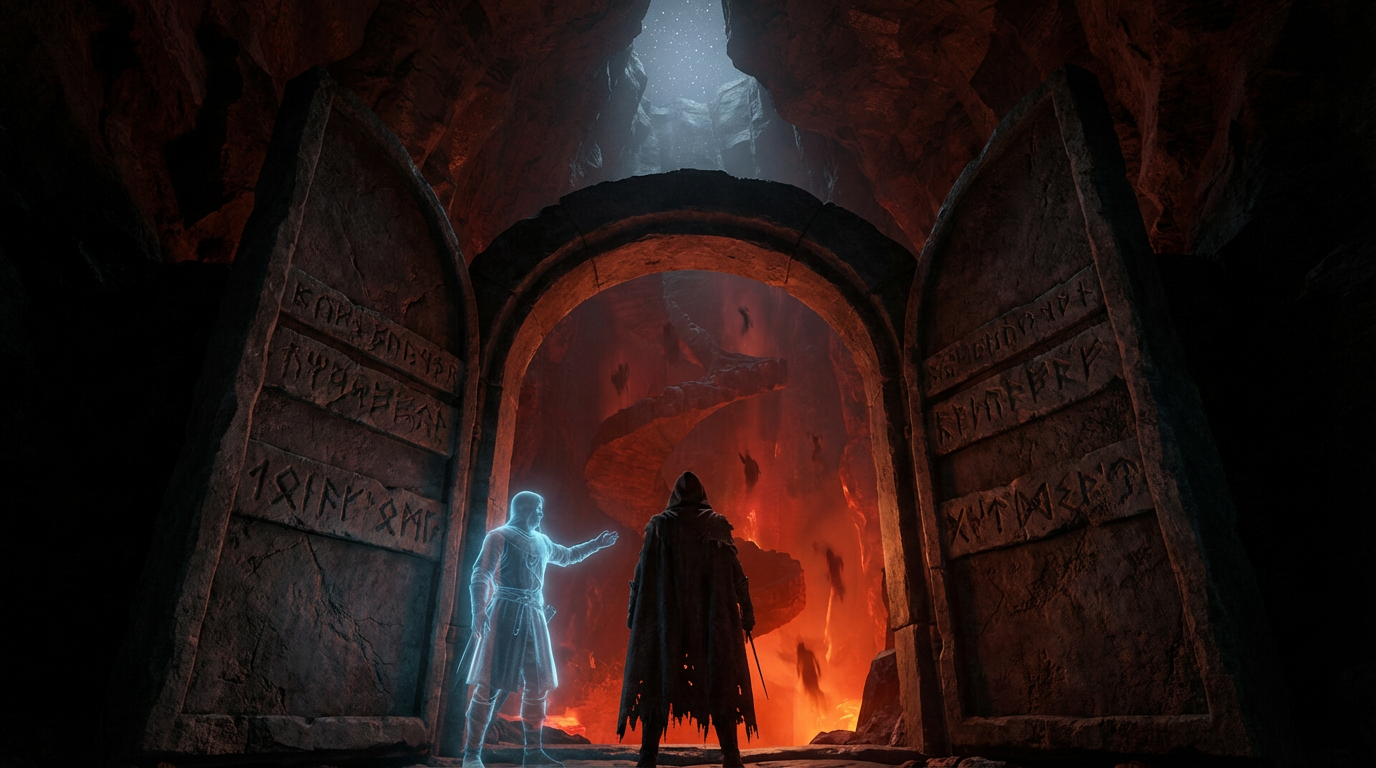
An excerpt from the original text.(complete · 1111 words)
Broke the deep slumber in my brain a crash
Of heavy thunder, that I shook myself,
As one by main force rous’d. Risen upright,
My rested eyes I mov’d around, and search’d
With fixed ken to know what place it was,
Wherein I stood. For certain on the brink
I found me of the lamentable vale,
The dread abyss, that joins a thund’rous sound
Of plaints innumerable. Dark and deep,
And thick with clouds o’erspread, mine eye in vain
Explor’d its bottom, nor could aught discern.

“Now let us to the blind world there beneath
Descend;” the bard began all pale of look:
“I go the first, and thou shalt follow next.”

Then I his alter’d hue perceiving, thus:
“How may I speed, if thou yieldest to dread,
Who still art wont to comfort me in doubt?”

He then: “The anguish of that race below
With pity stains my cheek, which thou for fear
Mistakest. Let us on. Our length of way
Urges to haste.” Onward, this said, he mov’d;
And ent’ring led me with him on the bounds
Of the first circle, that surrounds th’ abyss.
Here, as mine ear could note, no plaint was heard
Except of sighs, that made th’ eternal air
Tremble, not caus’d by tortures, but from grief
Felt by those multitudes, many and vast,
Of men, women, and infants. Then to me
The gentle guide: “Inquir’st thou not what spirits
Are these, which thou beholdest? Ere thou pass
Farther, I would thou know, that these of sin
Were blameless; and if aught they merited,
It profits not, since baptism was not theirs,
The portal to thy faith. If they before
The Gospel liv’d, they serv’d not God aright;
And among such am I. For these defects,
And for no other evil, we are lost;
Only so far afflicted, that we live
Desiring without hope.” So grief assail’d
My heart at hearing this, for well I knew
Suspended in that Limbo many a soul
Of mighty worth. “O tell me, sire rever’d!
Tell me, my master!” I began through wish
Of full assurance in that holy faith,
Which vanquishes all error; “say, did e’er
Any, or through his own or other’s merit,
Come forth from thence, whom afterward was blest?”

Piercing the secret purport of my speech,
He answer’d: “I was new to that estate,
When I beheld a puissant one arrive
Amongst us, with victorious trophy crown’d.
He forth the shade of our first parent drew,
Abel his child, and Noah righteous man,
Of Moses lawgiver for faith approv’d,
Of patriarch Abraham, and David king,
Israel with his sire and with his sons,
Nor without Rachel whom so hard he won,
And others many more, whom he to bliss
Exalted. Before these, be thou assur’d,
No spirit of human kind was ever sav’d.”

We, while he spake, ceas’d not our onward road,
Still passing through the wood; for so I name
Those spirits thick beset. We were not far
On this side from the summit, when I kenn’d
A flame, that o’er the darken’d hemisphere
Prevailing shin’d. Yet we a little space
Were distant, not so far but I in part
Discover’d, that a tribe in honour high
That place possess’d. “O thou, who every art
And science valu’st! who are these, that boast
Such honour, separate from all the rest?”

He answer’d: “The renown of their great names
That echoes through your world above, acquires
Favour in heaven, which holds them thus advanc’d.”
Meantime a voice I heard: “Honour the bard
Sublime! his shade returns that left us late!”
No sooner ceas’d the sound, than I beheld
Four mighty spirits toward us bend their steps,
Of semblance neither sorrowful nor glad.

When thus my master kind began: “Mark him,
Who in his right hand bears that falchion keen,
The other three preceding, as their lord.
This is that Homer, of all bards supreme:
Flaccus the next in satire’s vein excelling;
The third is Naso; Lucan is the last.
Because they all that appellation own,
With which the voice singly accosted me,
Honouring they greet me thus, and well they judge.”

So I beheld united the bright school
Of him the monarch of sublimest song,
That o’er the others like an eagle soars.
When they together short discourse had held,
They turn’d to me, with salutation kind
Beck’ning me; at the which my master smil’d:
Nor was this all; but greater honour still
They gave me, for they made me of their tribe;
And I was sixth amid so learn’d a band.

Far as the luminous beacon on we pass’d
Speaking of matters, then befitting well
To speak, now fitter left untold. At foot
Of a magnificent castle we arriv’d,
Seven times with lofty walls begirt, and round
Defended by a pleasant stream. O’er this
As o’er dry land we pass’d. Next through seven gates
I with those sages enter’d, and we came
Into a mead with lively verdure fresh.

There dwelt a race, who slow their eyes around
Majestically mov’d, and in their port
Bore eminent authority; they spake
Seldom, but all their words were tuneful sweet.

We to one side retir’d, into a place
Open and bright and lofty, whence each one
Stood manifest to view. Incontinent
There on the green enamel of the plain
Were shown me the great spirits, by whose sight
I am exalted in my own esteem.

Electra there I saw accompanied
By many, among whom Hector I knew,
Anchises’ pious son, and with hawk’s eye
Caesar all arm’d, and by Camilla there
Penthesilea. On the other side
Old King Latinus, seated by his child
Lavinia, and that Brutus I beheld,
Who Tarquin chas’d, Lucretia, Cato’s wife
Marcia, with Julia and Cornelia there;
And sole apart retir’d, the Soldan fierce.

Then when a little more I rais’d my brow,
I spied the master of the sapient throng,
Seated amid the philosophic train.
Him all admire, all pay him rev’rence due.
There Socrates and Plato both I mark’d,
Nearest to him in rank; Democritus,
Who sets the world at chance, Diogenes,
With Heraclitus, and Empedocles,
And Anaxagoras, and Thales sage,
Zeno, and Dioscorides well read
In nature’s secret lore. Orpheus I mark’d
And Linus, Tully and moral Seneca,
Euclid and Ptolemy, Hippocrates,
Galenus, Avicen, and him who made
That commentary vast, Averroes.

Of all to speak at full were vain attempt;
For my wide theme so urges, that ofttimes
My words fall short of what bechanc’d. In two
The six associates part. Another way
My sage guide leads me, from that air serene,
Into a climate ever vex’d with storms:
And to a part I come where no light shines.
Master this chapter. Complete your experience
Purchase the complete book to access all chapters and support classic literature
As an Amazon Associate, we earn a small commission from qualifying purchases at no additional cost to you.
Available in paperback, hardcover, and e-book formats
Let's Analyse the Pattern
When we mistake emotional responsiveness to suffering for fear or weakness rather than recognizing it as strength and wisdom.
Why This Matters
Connect literature to life
This chapter teaches how to recognize when emotional responses signal strength rather than vulnerability, and when others mistake empathy for fear.
Practice This Today
This week, notice when you or others get labeled 'too emotional'—ask whether it's actually appropriate compassion being misread as weakness.
Now let's explore the literary elements.
Key Quotes & Analysis
"The anguish of that race below with pity stains my cheek, which thou for fear mistakest."
Context: When Dante sees Virgil looking pale and assumes his guide is afraid
This distinguishes between empathy and fear - crucial for anyone facing difficult situations. Virgil shows that true strength includes feeling others' pain without being paralyzed by it.
In Today's Words:
I'm not scared - I'm heartbroken for what these people are going through.
"Here, as mine ear could note, no plaint was heard except of sighs, that made th' eternal air tremble."
Context: Dante's first impression of Limbo
The absence of screaming makes this more haunting than violent torture. Sometimes quiet suffering is more profound than dramatic pain.
In Today's Words:
The silence was worse than screaming - just the sound of people trying not to fall apart.
"They sinned not; and though they have merit, that suffices not, for they had not baptism."
Context: Explaining why good people are in Hell
Reveals how systems can create injustice regardless of individual worth. Merit isn't always enough when larger forces determine outcomes.
In Today's Words:
They did nothing wrong, but they were born at the wrong time in the wrong place.
Thematic Threads
Leadership
In This Chapter
Virgil demonstrates true leadership by showing appropriate emotional response while maintaining his role as guide
Development
Builds on earlier establishment of Virgil as mentor figure
In Your Life:
Real leaders in your workplace often show empathy rather than just authority
Class
In This Chapter
Limbo reveals how circumstances beyond individual control determine fate—good people suffer due to timing and access
Development
Introduced here as systematic unfairness theme
In Your Life:
Your opportunities often depend more on when and where you were born than on your personal merit
Identity
In This Chapter
Dante questions his own courage when he misreads his guide's emotional state
Development
Continues Dante's self-doubt from earlier chapters
In Your Life:
You might question your own strength when you see others responding emotionally to difficult situations
Social Expectations
In This Chapter
The assumption that wise guides should be fearless reveals cultural expectations about strength and leadership
Development
Builds on themes of how others perceive us
In Your Life:
People expect you to hide your feelings to be taken seriously in professional settings
Human Relationships
In This Chapter
The relationship between Dante and Virgil deepens through this moment of vulnerability and explanation
Development
Develops their mentor-student dynamic established earlier
In Your Life:
Your relationships grow stronger when you understand the difference between someone's fear and their caring
You now have the context. Time to form your own thoughts.
Discussion Questions
- 1
When Dante sees Virgil looking pale and assumes he's afraid, what does this reveal about how we interpret other people's emotions?
analysis • surface - 2
Why does Virgil correct Dante's assumption about fear versus compassion, and what's the difference between these two responses?
analysis • medium - 3
Think about your workplace or family - when have you seen someone's empathy get mistaken for weakness or fear?
application • medium - 4
How would you handle a situation where showing compassion might be seen as being 'too soft' or unprofessional?
application • deep - 5
What does Limbo - where good people suffer through no fault of their own - teach us about fairness and circumstances beyond our control?
reflection • deep
Critical Thinking Exercise
Decode the Emotional Signal
Think of someone in your life who shows strong emotional responses to others' problems - maybe they get upset about unfairness at work, tear up at sad movies, or get angry when people are mistreated. Write down three times you've seen this person react emotionally. For each situation, identify whether their response came from fear (threat to themselves) or compassion (caring about others).
Consider:
- •Notice how your initial interpretation might have been wrong
- •Consider how this person's emotional responses actually guide their actions
- •Think about whether you've dismissed someone's wisdom because of how they expressed it
Journaling Prompt
Write about a time when your own compassion was mistaken for weakness. How did you handle it, and what would you do differently now?
Coming Up Next...
Chapter 5: The Judge and the Lovers
Leaving the noble company of Limbo behind, Dante and Virgil descend to the second circle where they encounter Minos, the infernal judge who determines each soul's eternal punishment. Here, the real torments of Hell begin.