
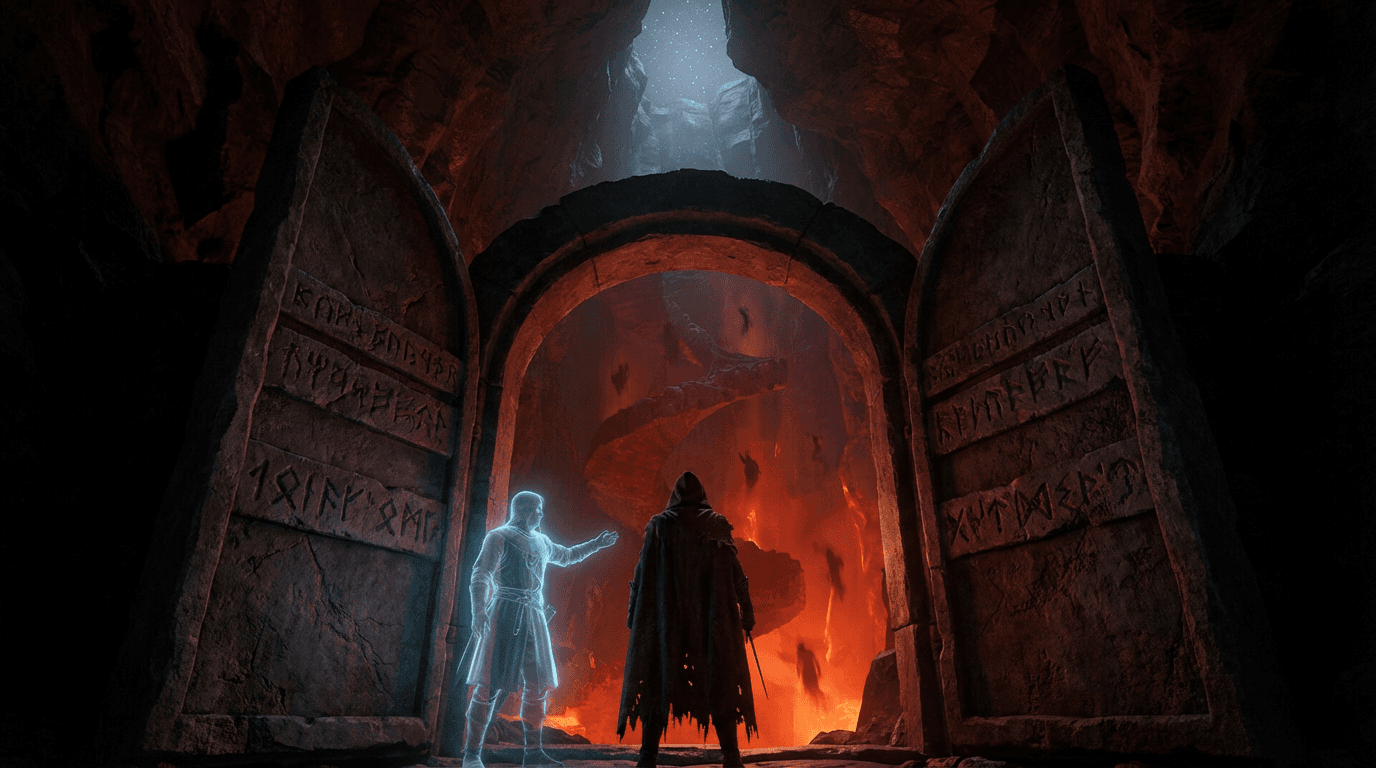
The Structure of Transformation
8 chapters from Purgatorio on how deep change actually works — the stages, the weight you carry, the threshold that always appears at the end, and what completion feels like.
The Pattern: Purgatory as a System
Purgatorio is Dante's most original creation. Hell was inherited from classical and Christian tradition. Paradise draws on mystical theology. But Purgatory as Dante imagines it — a mountain of terraces, each corresponding to a pattern that needs to be reworked, each with its specific practice — is a precise model of how transformation actually works. Not punishment. Not instant grace. A structured process with stages.
Each Terrace Has a Specific Work
Pride, envy, wrath, sloth, avarice, gluttony, lust — each pattern has its own practice that transforms it, not just punishes it.
The Mountain Lightens as You Climb
Each completed terrace removes a P from Dante's forehead. The higher he goes, the lighter he feels. Transformation accumulates.
Completion Is Real
Purgatory ends. The mountain shakes when a soul is done. Unlike Hell, this is not permanent — it is a process with a finish.
Chapter by Chapter
Crossing into Purgatory: Dawn After Hell
After escaping Hell, Dante emerges onto a new shore at dawn. The air is clear, the stars are visible, and Cato — a pagan who chose death over slavery — guards the entrance. He instructs Dante to wash the grime of Hell from his face before proceeding and to tie a reed around his waist, which immediately regrows from the shore. Everything here regenerates.
Crossing into Purgatory: Dawn After Hell
Divine Comedy — Chapter 35
“Here let dead poetry rise once more.”
Key Insight
The transition from Hell to Purgatory is marked by dawn, by clean air, and by a stern guardian who insists on preparation before proceeding. Real transformation begins not with enthusiasm but with orientation: where am I? What needs to be cleaned off before I start? The reed that regrows is the poem's first image of the Purgatorio's central principle — things recover here. That alone is the difference.
The Weight You Carry While Pride Is Removed
On the first terrace of Purgatory, the prideful are purged by carrying enormous, crushing stone slabs on their backs, bent double — forced by their weight to look at the ground, at carvings of pride's ruin. As they walk, they recite the Lord's Prayer together. The physical position — hunched, eyes down — is the opposite of the pride that held their heads high.
The Weight You Carry While Pride Is Removed
Divine Comedy — Chapter 44
Key Insight
Transformation of a genuine character pattern is not primarily intellectual. You cannot think your way out of pride; you have to feel the weight of it. The Purgatorio understands something modern therapy confirms: sustained embodied experience — not insight alone — is what shifts deep patterns. The prideful must physically experience what it is to be leveled. That experience does the work that argument cannot.
Fame Is Shorter Than You Think
Dante encounters Oderisi da Gubbio, a famous manuscript illuminator, who delivers one of the sharpest speeches in the entire Commedia about the brevity of earthly fame. Oderisi was famous; now a younger master has surpassed him. And that younger master will also be surpassed. The soul bearing the stones speaks with total clarity about what he was wrong about in life.
Fame Is Shorter Than You Think
Divine Comedy — Chapter 45
“What empty glory to be renowned for skill / in things that last as long as a brief flower.”
Key Insight
The capacity to see clearly what you were wrong about is a mark of genuine transformation, not its beginning. Oderisi could not say this in life — he was too invested in his reputation. The process of carrying the stone has not only humbled him; it has sharpened his vision. Transformation produces insight as a byproduct. The humility is not the goal; the clarity is.
The Nature of Love and the Possibility of Choice
Dante presses Virgil on the deepest question: if love is the motive of all action, why do souls need to be transformed? Virgil explains the distinction between natural love — which is always good — and elective love, which can be misdirected, excessive, or deficient. The terraces of Purgatory each correspond to a type of misdirected love. Free will is the faculty by which you are responsible for your direction.
The Nature of Love and the Possibility of Choice
Divine Comedy — Chapter 52
Key Insight
Transformation is only possible because choice exists. If love were entirely involuntary — if you had no capacity to redirect it — there would be no point in Purgatory and no possibility of growth. The poem insists on this: you are not just moved, you also move. You are not just conditioned, you also choose. This is both the source of your responsibility for what you've become and the guarantee that it can be different.
The Mountain Shakes: What Completion Feels Like
The mountain of Purgatory suddenly shakes violently, and all the souls shout 'Gloria in excelsis Deo.' Dante is terrified. Then a soul explains: the mountain shakes whenever a soul completes its purgation and rises free. The earthquake is joy. The soul speaking is the Roman poet Statius — who was purged of prodigality for five hundred years — and he is describing his own liberation, which just happened.
The Mountain Shakes: What Completion Feels Like
Divine Comedy — Chapter 55
Key Insight
The mountain shaking at a soul's completion is an image of what genuine transformation does to the structure around you. When someone finishes a deep change, it is noticed — not by announcement but by the quality of their presence and the shift they produce in the world around them. Statius has been quietly working for five hundred years. When he is done, the whole mountain knows.
The Hunger That Heals
On the sixth terrace, the gluttonous are purified in a strange way: they walk past trees loaded with beautiful fruit and streams of clear water they cannot reach. The smell of the food is overwhelming. They are being purged not by deprivation alone but by the proximity of abundance they are learning to be near without grasping.
The Hunger That Heals
Divine Comedy — Chapter 57
Key Insight
The cure for excess is not mere abstinence — it is learning to be in the presence of abundance without compulsive consumption. The gluttonous must practice desiring rightly: to smell, to see, and to not seize. Real transformation of appetite-based patterns requires something harder than avoidance. It requires developing the capacity to be near what you want and choose.
Walking Through the Wall of Fire
At the top of Purgatory, before entering the Earthly Paradise, Dante faces a final wall of purifying fire. He knows it will hurt. He stands frozen. Virgil tells him that Beatrice is on the other side. Eventually — only for that reason — Dante walks in. The fire burns intensely. He walks through it. On the other side, Virgil says this is the last thing he can give Dante: 'your will is now free, upright, and whole.'
Walking Through the Wall of Fire
Divine Comedy — Chapter 61
“Do you believe, Virgil, do you believe / I would remain here in this wall? Could fire / keep me from Beatrice?”
Key Insight
The final stage of transformation always involves a threshold that seems disproportionately terrible compared to everything that came before. You've done the work. And there's still this. The thing that moves us through it is rarely logic — it's the pull of what waits on the other side. What you love more than your fear of the fire.
The Rivers That Complete the Work
Beatrice leads Dante to two rivers at the edge of Eden: Lethe, which erases the memory of sin, and Eunoë, which restores the memory of every good act. He must drink from both. After drinking from Lethe, he can no longer remember his sins clearly. After Eunoë, he is fully restored — and the canto ends with the image of 'new plants renewed with new-sprung leaves.' Purgatory is complete.
The Rivers That Complete the Work
Divine Comedy — Chapter 67
“I came back from those holiest waters, new, / remade, even as new plants renewed with new-sprung leaves.”
Key Insight
The final act of transformation is not carrying your sins forever as a badge of seriousness — it is being genuinely released from them while having your good restored to you. Transformation is complete not when you have suffered enough but when you have been made new. Lethe and Eunoë together say: what you did wrong need not define you, and what you did right is yours again.
Modern Application
Most models of personal change focus on either insight or willpower. Understand why you do it, and you'll stop. Or simply decide to stop, and stop. The Purgatorio suggests something more accurate: genuine transformation of deep character patterns requires sustained, embodied practice specific to the pattern being changed. Insight is not enough. Willpower is not enough. You need the right work for the right pattern, done long enough for it to be genuinely reworked.
The prideful don't just learn about humility — they carry stones. The envious don't just understand envy — their eyes are sewn shut with wire. The practice is tailored to the pattern. This is what the best therapeutic and spiritual traditions also know: the cure must address the specific form of the problem.
The other thing Purgatorio gets right: transformation is not permanent suffering. It ends. You come out the other side renewed. The mountain shakes with joy when it's done. That image — completion as earthquake, as gloria — is something to hold onto in the middle of the difficult work.
The Central Lesson
Transformation is not a moment of insight — it is a structured process with stages, specific work, and a real completion. The mountain does not go on forever. When the work is genuinely done, the mountain shakes, and you are free.
Related Themes in This Book
Recognizing When You Are Lost
The crisis that precedes transformation.
Receiving Guidance and Honoring Teachers
No one transforms alone. Virgil and Beatrice.
Where Your Vices Actually Lead
The alternative to transformation: Hell's endpoint.
Finding Purpose When the World Rejects You
What transformation is ultimately for.