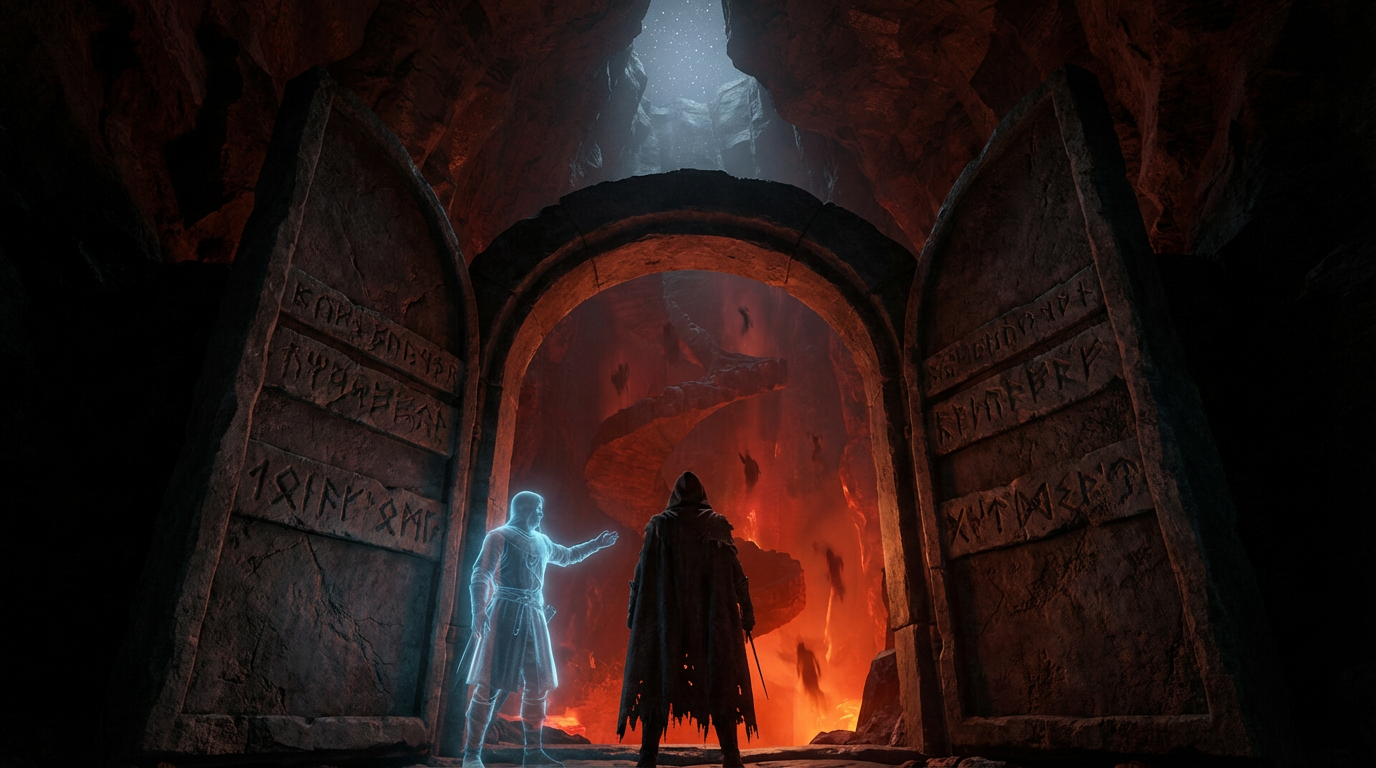
An excerpt from the original text.(complete · 1074 words)
The teacher ended, and his high discourse
Concluding, earnest in my looks inquir’d
If I appear’d content; and I, whom still
Unsated thirst to hear him urg’d, was mute,
Mute outwardly, yet inwardly I said:
“Perchance my too much questioning offends
But he, true father, mark’d the secret wish
By diffidence restrain’d, and speaking, gave
Me boldness thus to speak: “Master, my Sight
Gathers so lively virtue from thy beams,
That all, thy words convey, distinct is seen.
Wherefore I pray thee, father, whom this heart
Holds dearest! thou wouldst deign by proof t’ unfold
That love, from which as from their source thou bring’st
All good deeds and their opposite.” He then:
“To what I now disclose be thy clear ken
Directed, and thou plainly shalt behold
How much those blind have err’d, who make themselves
The guides of men. The soul, created apt
To love, moves versatile which way soe’er
Aught pleasing prompts her, soon as she is wak’d
By pleasure into act. Of substance true
Your apprehension forms its counterfeit,
And in you the ideal shape presenting
Attracts the soul’s regard. If she, thus drawn,
incline toward it, love is that inclining,
And a new nature knit by pleasure in ye.
Then as the fire points up, and mounting seeks
His birth-place and his lasting seat, e’en thus
Enters the captive soul into desire,
Which is a spiritual motion, that ne’er rests
Before enjoyment of the thing it loves.
Enough to show thee, how the truth from those
Is hidden, who aver all love a thing
Praise-worthy in itself: although perhaps
Its substance seem still good. Yet if the wax
Be good, it follows not th’ impression must.”
“What love is,” I return’d, “thy words, O guide!
And my own docile mind, reveal. Yet thence
New doubts have sprung. For from without if love
Be offer’d to us, and the spirit knows
No other footing, tend she right or wrong,
Is no desert of hers.” He answering thus:
“What reason here discovers I have power
To show thee: that which lies beyond, expect
From Beatrice, faith not reason’s task.
Spirit, substantial form, with matter join’d
Not in confusion mix’d, hath in itself
Specific virtue of that union born,
Which is not felt except it work, nor prov’d
But through effect, as vegetable life
By the green leaf. From whence his intellect
Deduced its primal notices of things,
Man therefore knows not, or his appetites
Their first affections; such in you, as zeal
In bees to gather honey; at the first,
Volition, meriting nor blame nor praise.
But o’er each lower faculty supreme,
That as she list are summon’d to her bar,
Ye have that virtue in you, whose just voice
Uttereth counsel, and whose word should keep
The threshold of assent. Here is the source,
Whence cause of merit in you is deriv’d,
E’en as the affections good or ill she takes,
Or severs, winnow’d as the chaff. Those men
Who reas’ning went to depth profoundest, mark’d
That innate freedom, and were thence induc’d
To leave their moral teaching to the world.
Grant then, that from necessity arise
All love that glows within you; to dismiss
Or harbour it, the pow’r is in yourselves.
Remember, Beatrice, in her style,
Denominates free choice by eminence
The noble virtue, if in talk with thee
She touch upon that theme.” The moon, well nigh
To midnight hour belated, made the stars
Appear to wink and fade; and her broad disk
Seem’d like a crag on fire, as up the vault
That course she journey’d, which the sun then warms,
When they of Rome behold him at his set.
Betwixt Sardinia and the Corsic isle.
And now the weight, that hung upon my thought,
Was lighten’d by the aid of that clear spirit,
Who raiseth Andes above Mantua’s name.
I therefore, when my questions had obtain’d
Solution plain and ample, stood as one
Musing in dreary slumber; but not long
Slumber’d; for suddenly a multitude,
The steep already turning, from behind,
Rush’d on. With fury and like random rout,
As echoing on their shores at midnight heard
Ismenus and Asopus, for his Thebes
If Bacchus’ help were needed; so came these
Tumultuous, curving each his rapid step,
By eagerness impell’d of holy love.

Soon they o’ertook us; with such swiftness mov’d
The mighty crowd. Two spirits at their head
Cried weeping; “Blessed Mary sought with haste
The hilly region. Caesar to subdue
Ilerda, darted in Marseilles his sting,
And flew to Spain.”—“Oh tarry not: away;”
The others shouted; “let not time be lost
Through slackness of affection. Hearty zeal
To serve reanimates celestial grace.”

“O ye, in whom intenser fervency
Haply supplies, where lukewarm erst ye fail’d,
Slow or neglectful, to absolve your part
Of good and virtuous, this man, who yet lives,
(Credit my tale, though strange) desires t’ ascend,
So morning rise to light us. Therefore say
Which hand leads nearest to the rifted rock?”

So spake my guide, to whom a shade return’d:
“Come after us, and thou shalt find the cleft.
We may not linger: such resistless will
Speeds our unwearied course. Vouchsafe us then
Thy pardon, if our duty seem to thee
Discourteous rudeness. In Verona I
Was abbot of San Zeno, when the hand
Of Barbarossa grasp’d Imperial sway,
That name, ne’er utter’d without tears in Milan.
And there is he, hath one foot in his grave,
Who for that monastery ere long shall weep,
Ruing his power misus’d: for that his son,
Of body ill compact, and worse in mind,
And born in evil, he hath set in place
Of its true pastor.” Whether more he spake,
Or here was mute, I know not: he had sped
E’en now so far beyond us. Yet thus much
I heard, and in rememb’rance treasur’d it.

He then, who never fail’d me at my need,
Cried, “Hither turn. Lo! two with sharp remorse
Chiding their sin!” In rear of all the troop
These shouted: “First they died, to whom the sea
Open’d, or ever Jordan saw his heirs:
And they, who with Aeneas to the end
Endur’d not suffering, for their portion chose
Life without glory.” Soon as they had fled
Past reach of sight, new thought within me rose
By others follow’d fast, and each unlike
Its fellow: till led on from thought to thought,
And pleasur’d with the fleeting train, mine eye
Was clos’d, and meditation chang’d to dream.
Master this chapter. Complete your experience
Purchase the complete book to access all chapters and support classic literature
As an Amazon Associate, we earn a small commission from qualifying purchases at no additional cost to you.
Available in paperback, hardcover, and e-book formats
Let's Analyse the Pattern
The dangerous comfort zone where understanding something intellectually substitutes for actually doing it, creating false progress while real change remains elusive.
Why This Matters
Connect literature to life
This chapter teaches how to recognize when intellectual understanding becomes a substitute for actual change or progress.
Practice This Today
This week, notice when you feel satisfied after learning something new, then immediately ask yourself what one small action you can take within the next hour to apply that knowledge.
Now let's explore the literary elements.
Key Quotes & Analysis
"The soul, created apt to love, moves versatile which way soe'er aught pleasing prompts her"
Context: Explaining the fundamental nature of human desire and attraction
This reveals that being attracted to things isn't a moral failing - it's how we're designed. The key is what we choose to do with those attractions. Virgil is teaching that desire itself is morally neutral.
In Today's Words:
People are naturally drawn to whatever appeals to them - that's just human nature.
"Master, my sight gathers so lively virtue from thy beams, that all thy words convey, distinct is seen"
Context: Responding to Virgil's encouragement to ask questions freely
Shows Dante's growing confidence and his recognition that good teaching illuminates understanding. He's learning to value his own curiosity and intellectual growth.
In Today's Words:
Your teaching helps me see things so clearly - everything you say just clicks into place.
"Perchance my too much questioning offends"
Context: Hesitating to ask more questions despite his burning curiosity
Captures the universal fear of being seen as annoying or stupid when learning. Dante's vulnerability here makes him relatable - even on a spiritual journey, human insecurities persist.
In Today's Words:
Maybe I'm asking too many questions and getting on your nerves.
Thematic Threads
Personal Growth
In This Chapter
Dante learns about free will and moral choice, while witnessing souls who must now frantically make up for wasted time
Development
Evolution from external guidance to understanding personal responsibility for choices
In Your Life:
You might recognize this when you keep learning about change but never actually changing your situation
Class
In This Chapter
The Abbot represents religious authority corrupted by nepotism and poor appointments
Development
Continued exposure to how institutional power fails ordinary people
In Your Life:
You see this when leadership positions go to connections rather than competence in your workplace
Social Expectations
In This Chapter
The rushing souls demonstrate how society expects constant productivity and action to make up for perceived failures
Development
Building theme of external pressure to perform and prove worth
In Your Life:
You feel this pressure when you're constantly trying to catch up or prove you're working hard enough
Human Relationships
In This Chapter
Brief encounters with souls sharing information before rushing on, showing how urgency can prevent deeper connection
Development
Ongoing exploration of how circumstances affect our ability to truly connect
In Your Life:
You experience this when you're so busy fixing problems that you can't slow down to really listen to people
Identity
In This Chapter
Souls define themselves by their past failures and current frantic efforts to compensate
Development
Continued examination of how past choices shape present identity
In Your Life:
You might struggle with this when you feel defined by mistakes or missed opportunities rather than current potential
You now have the context. Time to form your own thoughts.
Discussion Questions
- 1
What's the difference between the automatic desires Virgil describes and the choices we can make about them?
analysis • surface - 2
Why are the formerly slothful souls running so frantically now, and what does this suggest about their earthly lives?
analysis • medium - 3
Where do you see people today who know exactly what they should do but keep putting it off?
application • medium - 4
How would you break the cycle of understanding something perfectly but never acting on it?
application • deep - 5
What does the contrast between Virgil's calm teaching and the souls' urgent running reveal about the relationship between knowledge and action?
reflection • deep
Critical Thinking Exercise
The Knowledge-Action Audit
Make two columns: 'Things I Know I Should Do' and 'Why I Haven't Done Them Yet.' Fill in at least five items, then circle the one where the gap between knowing and doing is costing you the most. This isn't about judgment—it's about recognizing the pattern so you can work with it instead of against it.
Consider:
- •Notice if your reasons sound like the excuses you'd reject from someone else
- •Look for patterns in what types of actions you delay most often
- •Consider whether 'learning more' has become your way of avoiding action
Journaling Prompt
Write about a time when you finally stopped researching, planning, or thinking about something and just did it. What changed? What made the difference between that situation and the ones where you're still stuck in the knowing phase?
Coming Up Next...
Chapter 53: The Siren's False Promise
As Dante sleeps, a disturbing dream begins to unfold. A stammering woman with twisted features and pale skin appears before him, setting the stage for a powerful lesson about the deceptive nature of sin and temptation.