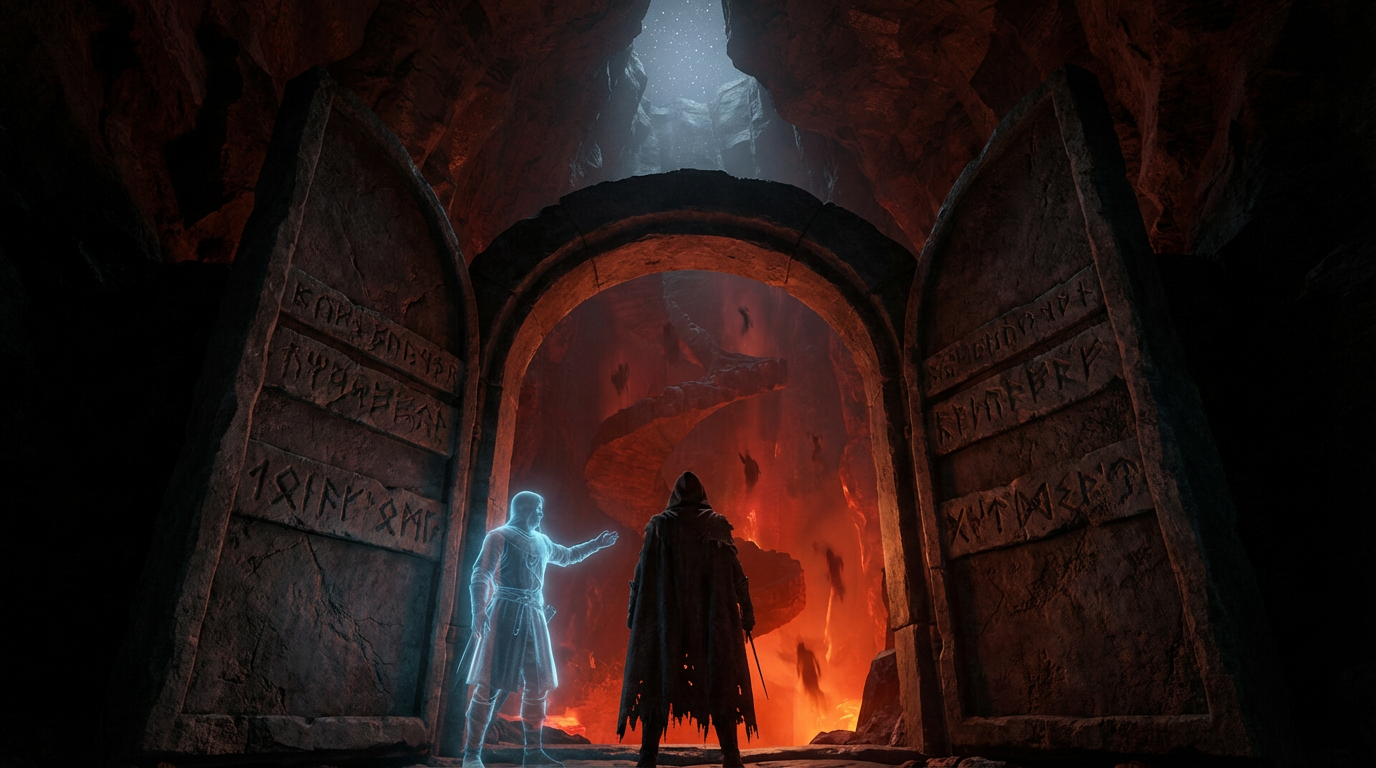
An excerpt from the original text.(complete · 1065 words)
The natural thirst, ne’er quench’d but from the well,
Whereof the woman of Samaria crav’d,
Excited: haste along the cumber’d path,
After my guide, impell’d; and pity mov’d
My bosom for the ’vengeful deed, though just.
When lo! even as Luke relates, that Christ
Appear’d unto the two upon their way,
New-risen from his vaulted grave; to us
A shade appear’d, and after us approach’d,
Contemplating the crowd beneath its feet.
We were not ware of it; so first it spake,
Saying, “God give you peace, my brethren!” then
Sudden we turn’d: and Virgil such salute,
As fitted that kind greeting, gave, and cried:
“Peace in the blessed council be thy lot
Awarded by that righteous court, which me
To everlasting banishment exiles!”

“How!” he exclaim’d, nor from his speed meanwhile
Desisting, “If that ye be spirits, whom God
Vouchsafes not room above, who up the height
Has been thus far your guide?” To whom the bard:
“If thou observe the tokens, which this man
Trac’d by the finger of the angel bears,
’Tis plain that in the kingdom of the just
He needs must share. But sithence she, whose wheel
Spins day and night, for him not yet had drawn
That yarn, which, on the fatal distaff pil’d,
Clotho apportions to each wight that breathes,
His soul, that sister is to mine and thine,
Not of herself could mount, for not like ours
Her ken: whence I, from forth the ample gulf
Of hell was ta’en, to lead him, and will lead
Far as my lore avails. But, if thou know,
Instruct us for what cause, the mount erewhile
Thus shook and trembled: wherefore all at once
Seem’d shouting, even from his wave-wash’d foot.”

That questioning so tallied with my wish,
The thirst did feel abatement of its edge
E’en from expectance. He forthwith replied,
“In its devotion nought irregular
This mount can witness, or by punctual rule
Unsanction’d; here from every change exempt.
Other than that, which heaven in itself
Doth of itself receive, no influence
Can reach us. Tempest none, shower, hail or snow,
Hoar frost or dewy moistness, higher falls
Than that brief scale of threefold steps: thick clouds
Nor scudding rack are ever seen: swift glance
Ne’er lightens, nor Thaumantian Iris gleams,
That yonder often shift on each side heav’n.
Vapour adust doth never mount above
The highest of the trinal stairs, whereon
Peter’s vicegerent stands. Lower perchance,
With various motion rock’d, trembles the soil:
But here, through wind in earth’s deep hollow pent,
I know not how, yet never trembled: then
Trembles, when any spirit feels itself
So purified, that it may rise, or move
For rising, and such loud acclaim ensues.
Purification by the will alone
Is prov’d, that free to change society
Seizes the soul rejoicing in her will.
Desire of bliss is present from the first;
But strong propension hinders, to that wish
By the just ordinance of heav’n oppos’d;
Propension now as eager to fulfil
Th’ allotted torment, as erewhile to sin.
And I who in this punishment had lain
Five hundred years and more, but now have felt
Free wish for happier clime. Therefore thou felt’st
The mountain tremble, and the spirits devout
Heard’st, over all his limits, utter praise
To that liege Lord, whom I entreat their joy
To hasten.” Thus he spake: and since the draught
Is grateful ever as the thirst is keen,
No words may speak my fullness of content.

“Now,” said the instructor sage, “I see the net
That takes ye here, and how the toils are loos’d,
Why rocks the mountain and why ye rejoice.
Vouchsafe, that from thy lips I next may learn,
Who on the earth thou wast, and wherefore here
So many an age wert prostrate.”—“In that time,
When the good Titus, with Heav’n’s King to help,
Aveng’d those piteous gashes, whence the blood
By Judas sold did issue, with the name
Most lasting and most honour’d there was I
Abundantly renown’d,” the shade reply’d,
“Not yet with faith endued. So passing sweet
My vocal Spirit, from Tolosa, Rome
To herself drew me, where I merited
A myrtle garland to inwreathe my brow.
Statius they name me still. Of Thebes I sang,
And next of great Achilles: but i’ th’ way
Fell with the second burthen. Of my flame
Those sparkles were the seeds, which I deriv’d
From the bright fountain of celestial fire
That feeds unnumber’d lamps, the song I mean
Which sounds Aeneas’ wand’rings: that the breast
I hung at, that the nurse, from whom my veins
Drank inspiration: whose authority
Was ever sacred with me. To have liv’d
Coeval with the Mantuan, I would bide
The revolution of another sun
Beyond my stated years in banishment.”

The Mantuan, when he heard him, turn’d to me,
And holding silence: by his countenance
Enjoin’d me silence but the power which wills,
Bears not supreme control: laughter and tears
Follow so closely on the passion prompts them,
They wait not for the motions of the will
In natures most sincere. I did but smile,
As one who winks; and thereupon the shade
Broke off, and peer’d into mine eyes, where best
Our looks interpret. “So to good event
Mayst thou conduct such great emprize,” he cried,
“Say, why across thy visage beam’d, but now,
The lightning of a smile!” On either part
Now am I straiten’d; one conjures me speak,
Th’ other to silence binds me: whence a sigh
I utter, and the sigh is heard. “Speak on; “
The teacher cried; “and do not fear to speak,
But tell him what so earnestly he asks.”
Whereon I thus: “Perchance, O ancient spirit!
Thou marvel’st at my smiling. There is room
For yet more wonder. He who guides my ken
On high, he is that Mantuan, led by whom
Thou didst presume of men arid gods to sing.
If other cause thou deem’dst for which I smil’d,
Leave it as not the true one; and believe
Those words, thou spak’st of him, indeed the cause.”

Now down he bent t’ embrace my teacher’s feet;
But he forbade him: “Brother! do it not:
Thou art a shadow, and behold’st a shade.”
He rising answer’d thus: “Now hast thou prov’d
The force and ardour of the love I bear thee,
When I forget we are but things of air,
And as a substance treat an empty shade.”
Master this chapter. Complete your experience
Purchase the complete book to access all chapters and support classic literature
As an Amazon Associate, we earn a small commission from qualifying purchases at no additional cost to you.
Available in paperback, hardcover, and e-book formats
Let's Analyse the Pattern
Your authentic work creates influence that travels far beyond your awareness, touching lives across time and space in ways you'll never fully see.
Why This Matters
Connect literature to life
This chapter teaches how to identify and trust the unseen influence of your authentic work on others across time and distance.
Practice This Today
This week, notice when someone mentions how your words or actions affected them—and tell someone whose influence shaped you, because they probably don't know either.
Now let's explore the literary elements.
Key Quotes & Analysis
"God give you peace, my brethren!"
Context: His first words when he approaches Dante and Virgil on the mountain path
This greeting shows the transformed nature of souls in Purgatory - they lead with peace and brotherhood instead of suspicion or hostility. It sets up the entire encounter as one of spiritual kinship.
In Today's Words:
Hey there, hope you're doing well!
"The bright fountain that fed my creativity"
Context: Describing how Virgil's Aeneid inspired his own poetry
This beautiful metaphor captures how artistic influence works - one person's creativity becomes the source that nourishes another's. It shows how art creates a chain of inspiration across time.
In Today's Words:
Your work was the spark that lit my creative fire
"We are but shadows"
Context: When Statius tries to embrace his feet in worship
Virgil's humility reminds both Statius and readers that fame and influence are temporary. In death, we're all equal - just souls on the same journey toward understanding.
In Today's Words:
We're all just people here - don't put me on a pedestal
Thematic Threads
Recognition
In This Chapter
Statius finally recognizes his literary hero standing before him, creating an overwhelming moment of connection across centuries
Development
Builds on earlier themes of guidance and mentorship, now showing how influence works even without direct contact
In Your Life:
You might discover that someone you admire has been right there in your world all along, unrecognized.
Humility
In This Chapter
Both poets remain humble—Virgil stops Statius from worshipping him, acknowledging they're both just shadows
Development
Continues the thread of earned wisdom requiring humility, now showing how true masters handle recognition
In Your Life:
When someone credits you with helping them, stay grounded about your role while honoring their growth.
Influence
In This Chapter
Virgil's poetry sustained Statius through 500 years of spiritual work without Virgil knowing his impact
Development
Expands from personal guidance to show how authentic work creates lasting influence across time
In Your Life:
Your best work might be helping people you'll never meet, through the example you set for those who do know you.
Breakthrough
In This Chapter
The mountain shakes when Statius finally feels ready to rise, marking a spiritual earthquake of readiness
Development
Continues the pattern of internal change creating external shifts, now showing how breakthroughs affect entire systems
In Your Life:
Your personal breakthroughs might create ripple effects that help others around you level up too.
Connection
In This Chapter
Dante can barely contain his joy at witnessing this cosmic meeting between poet and inspiration
Development
Develops the theme of witnessing others' growth, showing how connection creates unexpected moments of joy
In Your Life:
Some of your deepest satisfaction might come from watching people you care about meet their heroes or achieve their dreams.
You now have the context. Time to form your own thoughts.
Discussion Questions
- 1
Why does the mountain shake when a soul is ready to move up? What does this tell us about personal breakthroughs?
analysis • surface - 2
Statius spent 500 years drawing inspiration from Virgil's work without ever meeting him. How does influence work when the influencer doesn't even know they're helping someone?
analysis • medium - 3
Think about someone whose work or example has guided you through difficult times. How did their influence reach you, and do they know the impact they had?
application • medium - 4
When Statius meets his hero Virgil, it's awkward because they're both just 'shadows' now. What does this scene teach us about the difference between admiring someone's work and meeting them as a person?
reflection • deep - 5
If your good work influences people you'll never meet, how should this change how you approach your daily responsibilities?
application • deep
Critical Thinking Exercise
Map Your Invisible Influence
Think about your current role—whether it's healthcare, parenting, teaching, or any job where you interact with people. Write down three specific ways your work might be influencing others beyond what you can see. Then identify one person who has influenced you from a distance (through their work, example, or words) and consider whether they know their impact on you.
Consider:
- •Your influence often travels through the people you directly impact to reach others you'll never meet
- •The methods and approaches you use matter as much as the immediate results you see
- •Someone might be watching how you handle difficult situations and learning from your example
Journaling Prompt
Write about a time when you discovered that something you did or said had a bigger impact than you realized. How did it feel to learn about that influence, and how might it change how you approach similar situations in the future?
Coming Up Next...
Chapter 56: The Light Behind That Guides Others
The three poets continue their journey together, but Virgil has something important to tell Dante about the nature of love and virtue. As they climb toward the next terrace, a crucial lesson about human motivation awaits.