
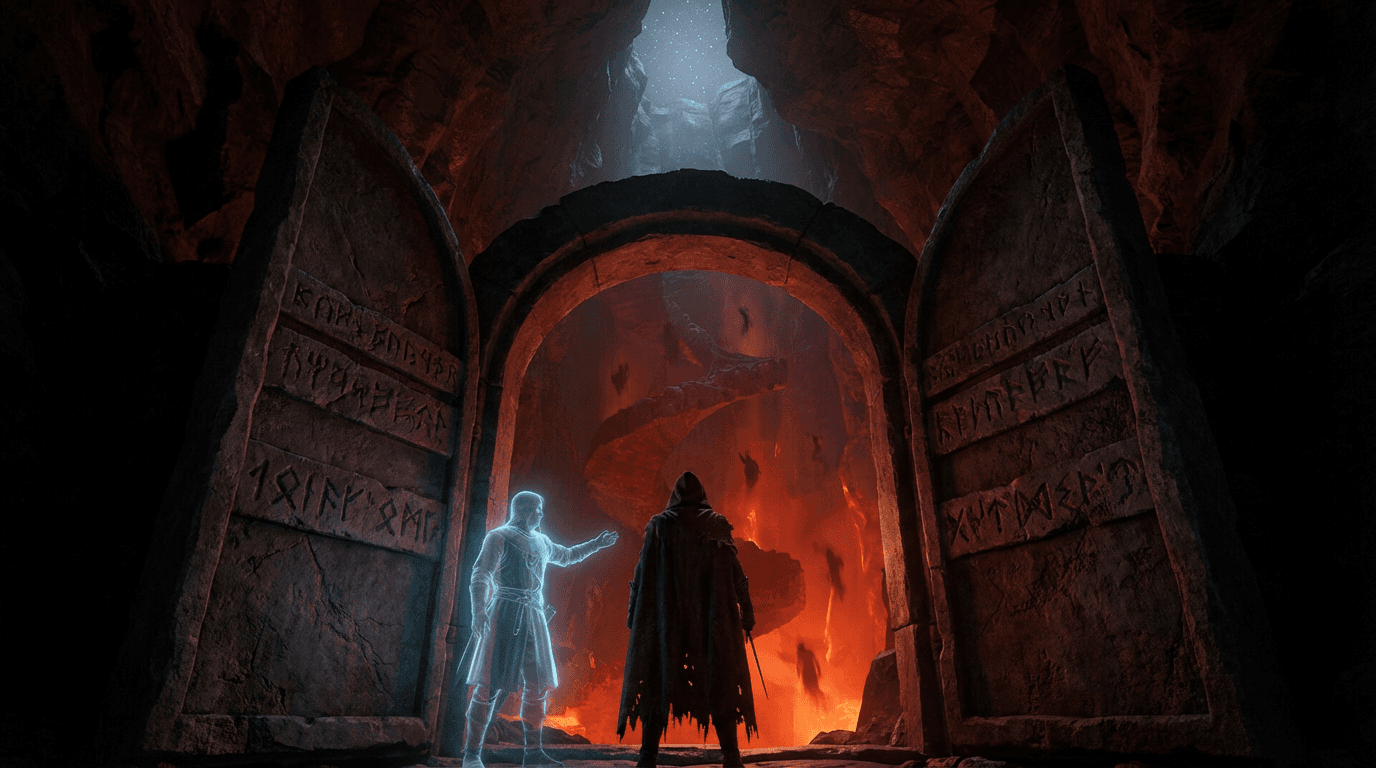
Recognizing When You Are Lost
8 chapters on the experience of being disoriented — how to name it honestly, accept help, face what caused it, and find your way back.
The Pattern: Disorientation as a Starting Point
Dante's poem opens not with a heroic departure but with a confession of being lost. This is unusual and precise. The journey through Hell, Purgatory, and Paradise is made possible only because Dante first admits he doesn't know where he is. Dante's three-part structure tracks the full anatomy of recovery from disorientation.
Name the State
You cannot navigate until you stop pretending you know where you are. The dark wood must be called the dark wood.
Accept a Guide
Virgil can only help because Dante stops insisting he doesn't need help. The right guide arrives when you stop blocking the door.
Do the Work
Getting un-lost requires going through, not around. Dante must descend through Hell before he can ascend. There is no shortcut.
Chapter by Chapter
The Dark Wood at Midlife
Dante finds himself at age 35 — the midpoint of a human life — unable to remember how he strayed from the right road. He is standing in a dense, terrifying forest at dawn. Three beasts block the path to the sunlit hill ahead: a leopard, a lion, a she-wolf. He cannot go forward alone.
The Dark Wood at Midlife
Divine Comedy — Chapter 1
“Midway upon the journey of our life / I found myself within a forest dark, / for the straightforward pathway had been lost.”
Key Insight
Being lost often arrives quietly. You don't notice the wrong turns as they happen; you notice the wrong turns when you look up and don't recognize where you are. Dante's 'dark wood' is not a dramatic fall — it's the slow accumulation of distraction and avoidance that becomes a crisis. The first act of recovery is naming the state: I am lost.
The Paralysis Before Starting
Just as Dante is about to begin his descent into Hell with Virgil as his guide, he freezes. He lists all the reasons he is not worthy — he is not Aeneas, not Saint Paul. Virgil must explain that Beatrice herself has sent him, and that this mission was chosen for Dante, not by him.
The Paralysis Before Starting
Divine Comedy — Chapter 2
“I am not Aeneas, I am not Paul — / Of this I must be worthy of that grace.”
Key Insight
The crisis of confidence at the edge of a necessary journey is almost universal. We delay precisely when we most need to move. Dante's paralysis here is not cowardice — it is the ego's last attempt to preserve itself before transformation. The right response is not to argue with that fear but to hear what sent you, and go.
The Shadow That Proves You Are Still Alive
As Dante climbs the base of Mount Purgatory, the souls gathered there notice something astonishing: Dante casts a shadow. This is the sign that he is a living person passing through the realm of the dead — unique, conspicuous, and still in time rather than eternity.
The Shadow That Proves You Are Still Alive
Divine Comedy — Chapter 37
Key Insight
Being lost while still alive is categorically different from being permanently beyond help. The shadow is Dante's visible proof that he still has choices, still has time. When you are disoriented about where your life has gone, the first orientation point is this: I am still here. I still cast a shadow. There is still a path.
The Angel at the Gate
Dante falls asleep exhausted and dreams of an eagle that lifts him toward fire. He wakes to find himself at the gate of Purgatory proper, where an angel guards the entrance. The angel carves seven P's — peccati, sins — into Dante's forehead and explains that each will be erased as he climbs. The gate will only open after this marking.
The Angel at the Gate
Divine Comedy — Chapter 43
Key Insight
The beginning of real transformation requires an honest accounting. The angel doesn't unlock the gate until Dante is marked with what needs to change. Getting un-lost isn't just about finding a new direction — it requires acknowledging specifically what led you off course. The seven marks are not shame; they are the map of the journey ahead.
The Wall of Fire at the Edge of Paradise
Dante faces his final obstacle before entering the Earthly Paradise: a wall of purifying fire he must walk through. He stops in terror — he has crossed all of Hell and climbed all of Purgatory, and now he will not move. Virgil tells him Beatrice waits on the other side. Only that moves him.
The Wall of Fire at the Edge of Paradise
Divine Comedy — Chapter 61
Key Insight
Every recovery from being lost has a final threshold that feels disproportionately terrifying. You've done the hard work, and then there's one more thing — and it's the one that stops you. Dante's fear here is real and not shameful. The lesson: the thing that moves us through the last fear is usually not logic but love. Connect what's on the other side to someone or something you love.
The Garden at the End of the Climb
Dante emerges from the fire into the Earthly Paradise — Eden restored, perfect and luminous, a place of streams and ancient trees and birdsong. He stepped into the forest lost; here, at last, the forest is one of beauty rather than terror. The same landscape transformed.
The Garden at the End of the Climb
Divine Comedy — Chapter 62
Key Insight
The dark wood and the garden are both forests. The same life that felt like a maze when you were lost can be the same life that feels like arrival when you've found your footing. The goal of getting un-lost is not to escape your life but to inhabit it rightly. The terrain changes when your relationship to it changes.
Beatrice Arrives — and Confronts You
Beatrice descends in the divine procession, and Dante turns instinctively to tell Virgil — his guide, his companion through Hell and Purgatory — but Virgil is gone. Beatrice then rebukes Dante directly, naming all the ways he wasted his gifts and lost the right road after her death. He weeps and confesses.
Beatrice Arrives — and Confronts You
Divine Comedy — Chapter 64
Key Insight
Arrival at a better place doesn't erase the need for honest reckoning. Beatrice's confrontation is not punishment — it is the final act of getting genuinely un-lost. You have to look clearly at where you went wrong and say: yes, that was me. Only then does the guide who brought you this far hand you over to what can take you further.
The River That Washes Memory Clean
Beatrice leads Dante to two rivers: Lethe, which washes away the memory of sin, and Eunoë, which restores the memory of good deeds. She confronts him once more, he confesses once more, and then he drinks from both. He emerges from Eunoë renewed — as Dante puts it, 'remade, even as new plants renewed with new-sprung leaves.'
The River That Washes Memory Clean
Divine Comedy — Chapter 67
“I came back from those holiest waters, new, / remade, even as new plants renewed with new-sprung leaves — / pure and prepared to rise up to the stars.”
Key Insight
The final stage of getting un-lost is not carrying the shame of how you got there. Lethe and Eunoë together are a full picture of recovery: release what you did wrong, restore your memory of who you actually are. Both matter. Holding only the memory of your worst moments is not humility; it is its own form of self-deception.
Modern Application
The “dark wood” moment arrives for most people in their thirties or forties — a professional plateau, a relationship that no longer fits, a sense that the goals they were chasing were not actually their own. The experience rarely announces itself. It accumulates until suddenly you look up and don't recognize where you are.
Dante's poem tells us that this state is not a failure — it is a beginning. The only people who never get lost are people who never move. The task is not to avoid disorientation but to know what to do when it arrives: name it clearly, find the right guide, and be willing to go through what you've been avoiding.
The journey through Hell before Paradise is not poetry's dramatic license. It is an accurate map of how recovery works: you have to see, clearly and without flinching, what went wrong and where it led, before you can build something new.
The Central Lesson
Being lost is not the problem. Refusing to acknowledge it is. The moment you say “I am in a dark wood” — clearly, without softening it — the guide arrives. The journey begins. The stars become visible again at the end.
Related Themes in This Book
Where Your Vices Actually Lead
The Inferno as a map of where unchecked patterns end.
The Structure of Transformation
Purgatory as a model for how people actually change.
Receiving Guidance and Honoring Teachers
Virgil, Beatrice, and the art of being guided well.
Finding Purpose When the World Rejects You
Dante's exile and how loss can become mission.