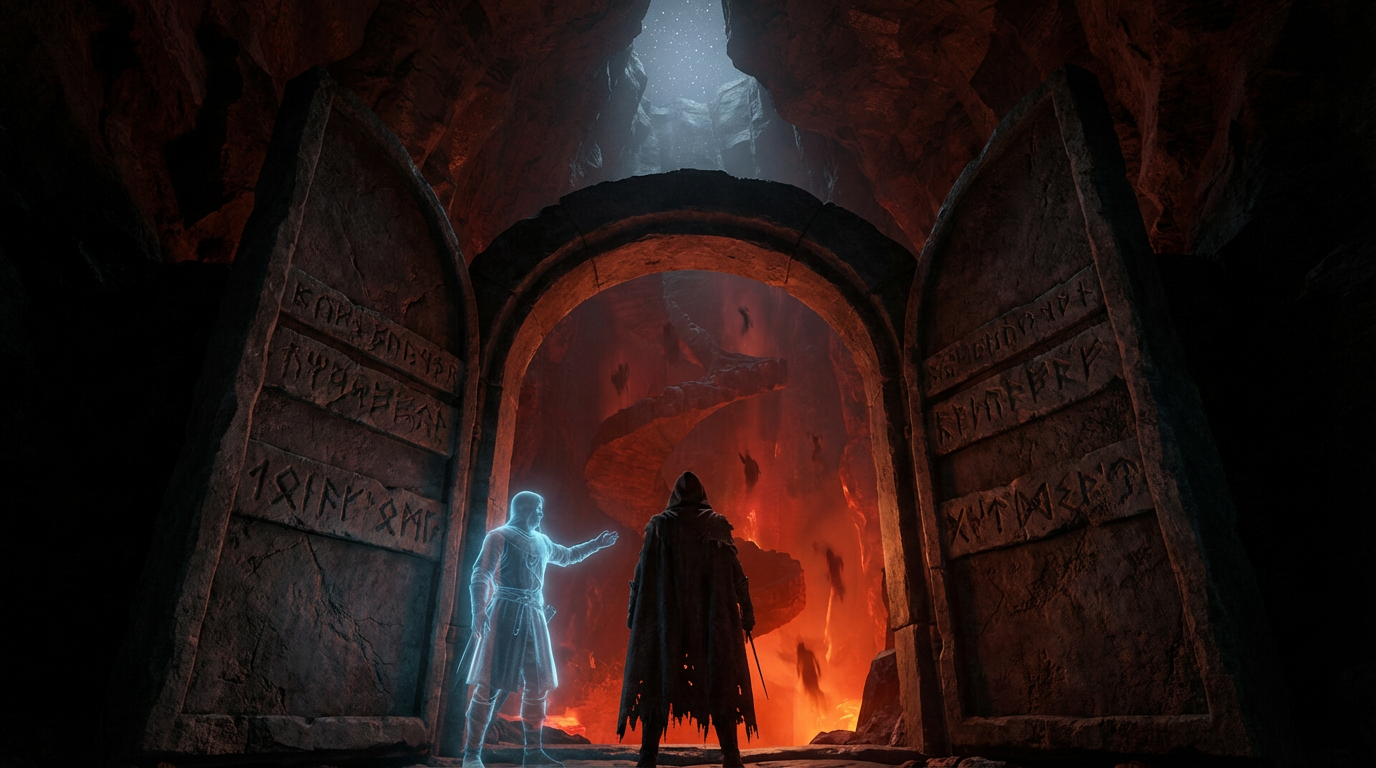
An excerpt from the original text.(complete · 1070 words)
Now the fair consort of Tithonus old,
Arisen from her mate’s beloved arms,
Look’d palely o’er the eastern cliff: her brow,
Lucent with jewels, glitter’d, set in sign
Of that chill animal, who with his train
Smites fearful nations: and where then we were,
Two steps of her ascent the night had past,
And now the third was closing up its wing,
When I, who had so much of Adam with me,
Sank down upon the grass, o’ercome with sleep,
There where all five were seated. In that hour,
When near the dawn the swallow her sad lay,
Rememb’ring haply ancient grief, renews,
And with our minds more wand’rers from the flesh,
And less by thought restrain’d are, as ’twere, full
Of holy divination in their dreams,
Then in a vision did I seem to view
A golden-feather’d eagle in the sky,
With open wings, and hov’ring for descent,
And I was in that place, methought, from whence
Young Ganymede, from his associates ’reft,
Was snatch’d aloft to the high consistory.
“Perhaps,” thought I within me, “here alone
He strikes his quarry, and elsewhere disdains
To pounce upon the prey.” Therewith, it seem’d,
A little wheeling in his airy tour
Terrible as the lightning rush’d he down,
And snatch’d me upward even to the fire.
There both, I thought, the eagle and myself
Did burn; and so intense th’ imagin’d flames,
That needs my sleep was broken off. As erst
Achilles shook himself, and round him roll’d
His waken’d eyeballs wond’ring where he was,
Whenas his mother had from Chiron fled
To Scyros, with him sleeping in her arms;
E’en thus I shook me, soon as from my face
The slumber parted, turning deadly pale,
Like one ice-struck with dread. Solo at my side
My comfort stood: and the bright sun was now
More than two hours aloft: and to the sea
My looks were turn’d. “Fear not,” my master cried,
“Assur’d we are at happy point. Thy strength
Shrink not, but rise dilated. Thou art come
To Purgatory now. Lo! there the cliff
That circling bounds it! Lo! the entrance there,
Where it doth seem disparted! Ere the dawn
Usher’d the daylight, when thy wearied soul
Slept in thee, o’er the flowery vale beneath
A lady came, and thus bespake me: “I
Am Lucia. Suffer me to take this man,
Who slumbers. Easier so his way shall speed.”
Sordello and the other gentle shapes
Tarrying, she bare thee up: and, as day shone,
This summit reach’d: and I pursued her steps.
Here did she place thee. First her lovely eyes
That open entrance show’d me; then at once
She vanish’d with thy sleep.” Like one, whose doubts
Are chas’d by certainty, and terror turn’d
To comfort on discovery of the truth,
Such was the change in me: and as my guide
Beheld me fearless, up along the cliff
He mov’d, and I behind him, towards the height.

Reader! thou markest how my theme doth rise,
Nor wonder therefore, if more artfully
I prop the structure! Nearer now we drew,
Arriv’d’ whence in that part, where first a breach
As of a wall appear’d, I could descry
A portal, and three steps beneath, that led
For inlet there, of different colour each,
And one who watch’d, but spake not yet a word.
As more and more mine eye did stretch its view,
I mark’d him seated on the highest step,
In visage such, as past my power to bear.
Grasp’d in his hand a naked sword, glanc’d back
The rays so toward me, that I oft in vain
My sight directed. “Speak from whence ye stand:”
He cried: “What would ye? Where is your escort?
Take heed your coming upward harm ye not.”

“A heavenly dame, not skilless of these things,”
Replied the’ instructor, “told us, even now,
Pass that way: here the gate is.”—“And may she
Befriending prosper your ascent,” resum’d
The courteous keeper of the gate: “Come then
Before our steps.” We straightway thither came.

The lowest stair was marble white so smooth
And polish’d, that therein my mirror’d form
Distinct I saw. The next of hue more dark
Than sablest grain, a rough and singed block,
Crack’d lengthwise and across. The third, that lay
Massy above, seem’d porphyry, that flam’d
Red as the life-blood spouting from a vein.
On this God’s angel either foot sustain’d,
Upon the threshold seated, which appear’d
A rock of diamond. Up the trinal steps
My leader cheerily drew me. “Ask,” said he,

“With humble heart, that he unbar the bolt.”

Piously at his holy feet devolv’d
I cast me, praying him for pity’s sake
That he would open to me: but first fell
Thrice on my bosom prostrate. Seven times0
The letter, that denotes the inward stain,
He on my forehead with the blunted point
Of his drawn sword inscrib’d. And “Look,” he cried,
“When enter’d, that thou wash these scars away.”

Ashes, or earth ta’en dry out of the ground,
Were of one colour with the robe he wore.
From underneath that vestment forth he drew
Two keys of metal twain: the one was gold,
Its fellow silver. With the pallid first,
And next the burnish’d, he so ply’d the gate,
As to content me well. “Whenever one
Faileth of these, that in the keyhole straight
It turn not, to this alley then expect
Access in vain.” Such were the words he spake.
“One is more precious: but the other needs
Skill and sagacity, large share of each,
Ere its good task to disengage the knot
Be worthily perform’d. From Peter these
I hold, of him instructed, that I err
Rather in opening than in keeping fast;
So but the suppliant at my feet implore.”

Then of that hallow’d gate he thrust the door,
Exclaiming, “Enter, but this warning hear:
He forth again departs who looks behind.”

As in the hinges of that sacred ward
The swivels turn’d, sonorous metal strong,
Harsh was the grating; nor so surlily
Roar’d the Tarpeian, when by force bereft
Of good Metellus, thenceforth from his loss
To leanness doom’d. Attentively I turn’d,
List’ning the thunder, that first issued forth;
And “We praise thee, O God,” methought I heard
In accents blended with sweet melody.
The strains came o’er mine ear, e’en as the sound
Of choral voices, that in solemn chant
With organ mingle, and, now high and clear,
Come swelling, now float indistinct away.
Master this chapter. Complete your experience
Purchase the complete book to access all chapters and support classic literature
As an Amazon Associate, we earn a small commission from qualifying purchases at no additional cost to you.
Available in paperback, hardcover, and e-book formats
Let's Analyse the Pattern
Grace or help gets you past barriers you cannot cross alone, but lasting change still requires your active participation and commitment.
Why This Matters
Connect literature to life
This chapter teaches how to distinguish between the help that gets you started and the work that sustains change.
Practice This Today
This week, notice when someone helps you past an obstacle, then ask yourself: what's the follow-through work that's now my responsibility?
Now let's explore the literary elements.
Key Quotes & Analysis
"Perhaps here alone he strikes his quarry, and elsewhere disdains to pounce upon the prey."
Context: Dante thinks this while observing the eagle in his dream, wondering why it might choose to strike in this particular place.
This reflects the idea that divine intervention comes at specific moments when we're ready for it. The eagle (representing grace) doesn't just randomly grab anyone - there's a right time and place for transformation.
In Today's Words:
Maybe this is the exact moment when help finally shows up, because I'm finally ready for it.
"Whoever looks back after entering will be expelled."
Context: The angel warns Dante before opening the gate to Purgatory proper.
This echoes the biblical story of Lot's wife turning to salt when she looked back at Sodom. It emphasizes that transformation requires complete commitment to moving forward, not dwelling on the past.
In Today's Words:
Don't keep looking back at your old life if you want this new path to work.
"Two steps of her ascent the night had past, and now the third was closing up its wing."
Context: Describing the time of night when Dante falls asleep, using the dawn goddess Aurora's ascent to mark time.
This poetic time-keeping shows Dante's attention to natural cycles and cosmic order. It also suggests that transformation happens in natural rhythms - there are right times for rest and right times for action.
In Today's Words:
It was that deep part of night when you're completely exhausted and dawn still feels far away.
Thematic Threads
Divine Grace
In This Chapter
Saint Lucy carries Dante while he sleeps, moving him past obstacles he couldn't overcome through effort alone
Development
Introduced here as the mechanism that enables transformation when human will reaches its limits
In Your Life:
You might see this when unexpected help arrives just when you're ready to give up on a goal or situation.
Humility
In This Chapter
Dante must prostrate himself three times and accept having his sins visibly marked on his forehead
Development
Builds on earlier themes of recognizing limitations, now requiring active submission to the change process
In Your Life:
You experience this when admitting you need help or acknowledging your mistakes becomes the prerequisite for moving forward.
Commitment
In This Chapter
The angel warns that looking back will result in expulsion from Purgatory
Development
Introduced here as the requirement that transformation demands forward focus without retreat
In Your Life:
You face this choice when deciding whether to fully commit to recovery, education, or relationship changes despite the difficulty.
Visible Accountability
In This Chapter
The seven P's carved on Dante's forehead make his sins and need for purification undeniable
Development
Introduced here as the necessity of making problems visible rather than hidden
In Your Life:
You might experience this when your issues become public or when you must openly acknowledge what you need to change.
Sacred Process
In This Chapter
The elaborate gate ritual with symbolic steps and keys emphasizes that transformation follows established patterns
Development
Builds on earlier journey structure, now formalizing the process with specific requirements and stages
In Your Life:
You see this in any structured change process—rehab, therapy, education—where you must complete specific steps in order.
You now have the context. Time to form your own thoughts.
Discussion Questions
- 1
What happens to Dante while he sleeps, and how does he end up at Purgatory's gate?
analysis • surface - 2
Why do you think Dante had to be carried up the mountain instead of climbing it himself?
analysis • medium - 3
When have you experienced help arriving just when you couldn't handle something alone? What happened next?
application • medium - 4
The angel carves seven P's on Dante's forehead to make his problems visible. How might 'naming your issues' help or hurt in real life?
application • deep - 5
What does this chapter suggest about the relationship between receiving help and doing personal work?
reflection • deep
Critical Thinking Exercise
Map Your Assistance Moments
Think of three times in your life when help arrived just when you needed it most - a job opportunity, someone covering for you, unexpected support during crisis. For each situation, identify what carried you through the difficulty and what work you still had to do afterward. Notice the pattern between receiving assistance and taking responsibility.
Consider:
- •Sometimes help looks different than we expect - it might be practical, emotional, or just good timing
- •The assistance often gets us to a new starting point rather than solving everything
- •There's usually a moment when we have to choose whether to do the follow-up work or waste the opportunity
Journaling Prompt
Write about a time when someone helped you through a difficult situation. What would have happened if you hadn't done the work that came after their help? How did both parts - the assistance and your effort - contribute to the outcome?
Coming Up Next...
Chapter 44: The Weight of Pride
As Dante crosses the threshold into Purgatory proper, the massive gate closes behind him with finality. There's no turning back now - but what awaits inside will test everything he thinks he knows about redemption.