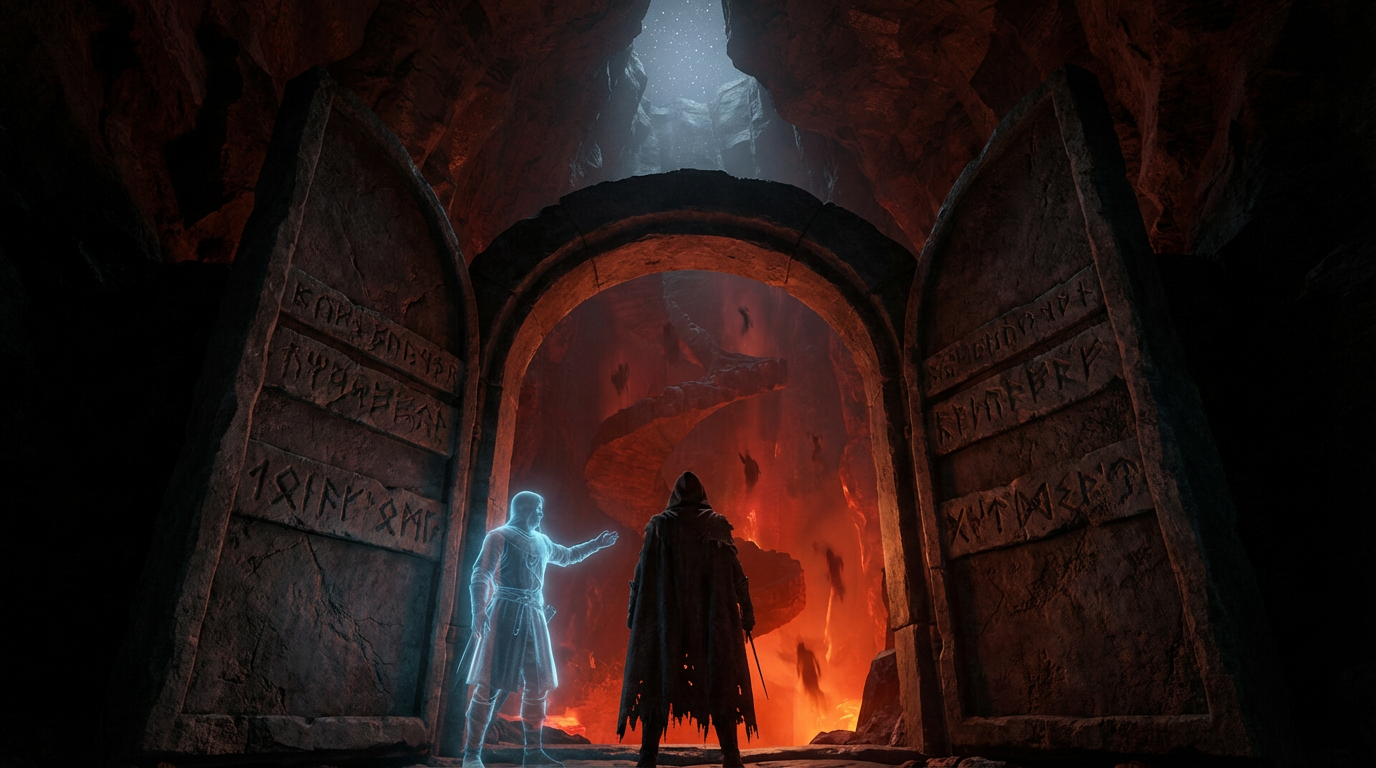
An excerpt from the original text.(complete · 1049 words)
n the midway of this our mortal life,
I found me in a gloomy wood, astray
Gone from the path direct: and e’en to tell
It were no easy task, how savage wild
That forest, how robust and rough its growth,
Which to remember only, my dismay
Renews, in bitterness not far from death.
Yet to discourse of what there good befell,
All else will I relate discover’d there.
How first I enter’d it I scarce can say,
Such sleepy dullness in that instant weigh’d
My senses down, when the true path I left,
But when a mountain’s foot I reach’d, where clos’d
The valley, that had pierc’d my heart with dread,
I look’d aloft, and saw his shoulders broad
Already vested with that planet’s beam,
Who leads all wanderers safe through every way.

Then was a little respite to the fear,
That in my heart’s recesses deep had lain,
All of that night, so pitifully pass’d:
And as a man, with difficult short breath,
Forespent with toiling, ’scap’d from sea to shore,
Turns to the perilous wide waste, and stands
At gaze; e’en so my spirit, that yet fail’d
Struggling with terror, turn’d to view the straits,
That none hath pass’d and liv’d. My weary frame
After short pause recomforted, again
I journey’d on over that lonely steep,
The hinder foot still firmer. Scarce the ascent
Began, when, lo! a panther, nimble, light,
And cover’d with a speckled skin, appear’d,
Nor, when it saw me, vanish’d, rather strove
To check my onward going; that ofttimes
With purpose to retrace my steps I turn’d.

The hour was morning’s prime, and on his way
Aloft the sun ascended with those stars,
That with him rose, when Love divine first mov’d
Those its fair works: so that with joyous hope
All things conspir’d to fill me, the gay skin
Of that swift animal, the matin dawn
And the sweet season. Soon that joy was chas’d,
And by new dread succeeded, when in view
A lion came, ’gainst me, as it appear’d,
With his head held aloft and hunger-mad,
That e’en the air was fear-struck. A she-wolf
Was at his heels, who in her leanness seem’d
Full of all wants, and many a land hath made
Disconsolate ere now. She with such fear
O’erwhelmed me, at the sight of her appall’d,
That of the height all hope I lost. As one,
Who with his gain elated, sees the time
When all unwares is gone, he inwardly
Mourns with heart-griping anguish; such was I,
Haunted by that fell beast, never at peace,
Who coming o’er against me, by degrees
Impell’d me where the sun in silence rests.

While to the lower space with backward step
I fell, my ken discern’d the form one of one,
Whose voice seem’d faint through long disuse of speech.
When him in that great desert I espied,
“Have mercy on me!” cried I out aloud,
“Spirit! or living man! what e’er thou be!”

He answer’d: “Now not man, man once I was,
And born of Lombard parents, Mantuana both
By country, when the power of Julius yet
Was scarcely firm. At Rome my life was past
Beneath the mild Augustus, in the time
Of fabled deities and false. A bard
Was I, and made Anchises’ upright son
The subject of my song, who came from Troy,
When the flames prey’d on Ilium’s haughty towers.
But thou, say wherefore to such perils past
Return’st thou? wherefore not this pleasant mount
Ascendest, cause and source of all delight?”
“And art thou then that Virgil, that well-spring,
From which such copious floods of eloquence
Have issued?” I with front abash’d replied.
“Glory and light of all the tuneful train!
May it avail me that I long with zeal
Have sought thy volume, and with love immense
Have conn’d it o’er. My master thou and guide!
Thou he from whom alone I have deriv’d
That style, which for its beauty into fame
Exalts me. See the beast, from whom I fled.
O save me from her, thou illustrious sage!
For every vein and pulse throughout my frame
She hath made tremble.” He, soon as he saw
That I was weeping, answer’d, “Thou must needs
Another way pursue, if thou wouldst ’scape
From out that savage wilderness. This beast,
At whom thou criest, her way will suffer none
To pass, and no less hindrance makes than death:
So bad and so accursed in her kind,
That never sated is her ravenous will,
Still after food more craving than before.
To many an animal in wedlock vile
She fastens, and shall yet to many more,
Until that greyhound come, who shall destroy
Her with sharp pain. He will not life support
By earth nor its base metals, but by love,
Wisdom, and virtue, and his land shall be
The land ’twixt either Feltro. In his might
Shall safety to Italia’s plains arise,
For whose fair realm, Camilla, virgin pure,
Nisus, Euryalus, and Turnus fell.
He with incessant chase through every town
Shall worry, until he to hell at length
Restore her, thence by envy first let loose.
I for thy profit pond’ring now devise,
That thou mayst follow me, and I thy guide
Will lead thee hence through an eternal space,
Where thou shalt hear despairing shrieks, and see
Spirits of old tormented, who invoke
A second death; and those next view, who dwell
Content in fire, for that they hope to come,
Whene’er the time may be, among the blest,
Into whose regions if thou then desire
T’ ascend, a spirit worthier then I
Must lead thee, in whose charge, when I depart,
Thou shalt be left: for that Almighty King,
Who reigns above, a rebel to his law,
Adjudges me, and therefore hath decreed,
That to his city none through me should come.
He in all parts hath sway; there rules, there holds
His citadel and throne. O happy those,
Whom there he chooses!” I to him in few:
“Bard! by that God, whom thou didst not adore,
I do beseech thee (that this ill and worse
I may escape) to lead me, where thou saidst,
That I Saint Peter’s gate may view, and those
Who as thou tell’st, are in such dismal plight.”

Onward he mov’d, I close his steps pursu’d.
Master this chapter. Complete your experience
Purchase the complete book to access all chapters and support classic literature
As an Amazon Associate, we earn a small commission from qualifying purchases at no additional cost to you.
Available in paperback, hardcover, and e-book formats
Let's Analyse the Pattern
When we're truly lost, the direct path to where we want to go is blocked by problems we must work through, not around.
Why This Matters
Connect literature to life
This chapter teaches how to identify when accumulated compromises have created internal barriers to your goals.
Practice This Today
This week, notice when you want something but feel blocked—ask yourself what behaviors or choices you've made that might be creating those obstacles.
Now let's explore the literary elements.
Key Quotes & Analysis
"In the midway of this our mortal life, I found me in a gloomy wood, astray"
Context: The opening lines of the entire Divine Comedy
This sets up the universal human experience of reaching a point where you realize you're lost. The 'midway' suggests this happens when we're old enough to know better but still have time to change course.
In Today's Words:
When I hit middle age, I realized I had no idea what I was doing with my life.
"How first I entered it I scarce can say, Such sleepy dullness in that instant weighed My senses down"
Context: Dante trying to explain how he got lost in the dark wood
This captures how we often drift into bad situations gradually, not through one dramatic choice but through a kind of spiritual sleepiness where we stop paying attention to our direction.
In Today's Words:
I can't even remember how I got so off track - I guess I just wasn't paying attention.
"The hinder foot still firmer"
Context: Dante describing his climb up the mountain
This detail shows he's still looking back, not fully committed to moving forward. His back foot is more planted than his front foot, suggesting hesitation and the pull of old habits.
In Today's Words:
I was trying to move forward but kept one foot planted in my comfort zone.
"You cannot pass this way"
Context: Explaining why Dante can't go directly up the mountain
Sometimes the most important wisdom is learning that there are no shortcuts through our problems. The direct path that looks easiest often isn't available to us.
In Today's Words:
Sorry, but you can't skip the hard part and go straight to being better.
Thematic Threads
Midlife Recognition
In This Chapter
Dante realizes at 35 he's lost and can't remember how he got there—the slow drift away from his true path
Development
Introduced here
In Your Life:
That moment when you realize your current life doesn't match who you thought you'd become
Self-Sabotage
In This Chapter
The three beasts represent different ways Dante has undermined himself—temptation, pride, and insatiable hunger
Development
Introduced here
In Your Life:
The patterns you repeat that keep you stuck, even when you know better
Guidance
In This Chapter
Virgil appears as the wise guide who's walked difficult paths and can show the way through, not around
Development
Introduced here
In Your Life:
Finding mentors or advisors who've faced similar challenges and can guide you through the hard work
Spiritual Journey
In This Chapter
The recognition that reaching salvation requires going through hell and purgatory first—no shortcuts to redemption
Development
Introduced here
In Your Life:
Understanding that real growth requires facing your worst qualities and doing the uncomfortable work
You now have the context. Time to form your own thoughts.
Discussion Questions
- 1
What are the three beasts that block Dante's path, and what do they represent in terms of personal obstacles we all face?
analysis • surface - 2
Why can't Dante take the direct path up the mountain to reach salvation, and what does this suggest about how real change happens?
analysis • medium - 3
Think about someone in your life who's stuck in a destructive pattern but keeps trying quick fixes. How does Dante's situation help explain why their shortcuts aren't working?
application • medium - 4
Virgil tells Dante he must go through Hell and Purgatory before reaching Paradise. What would be the modern equivalent of 'going through Hell' to solve a serious life problem?
application • deep - 5
What does this chapter reveal about the relationship between our daily choices and our ability to change course when we realize we're lost?
reflection • deep
Critical Thinking Exercise
Map Your Own Blocked Path
Think of an area in your life where you keep trying the same approach but getting blocked. Draw or write out your 'mountain' (your goal), your 'beasts' (what's really stopping you), and identify who could be your 'Virgil' (someone who's successfully navigated a similar challenge). Then sketch the longer path you might need to take instead of the shortcut.
Consider:
- •Your 'beasts' are usually internal patterns, not external circumstances
- •The person who could guide you has likely faced similar struggles, not someone who had it easy
- •The longer path often involves facing uncomfortable truths about yourself
Journaling Prompt
Write about a time when you had to take the long way around a problem instead of the shortcut. What did you learn from that experience that you couldn't have learned from an easy fix?
Coming Up Next...
Chapter 2: Dante's Crisis of Confidence
As darkness falls, Dante must steel himself for the most terrifying journey imaginable. With Virgil as his guide, he approaches the gates of Hell itself, where the real test of his courage and faith begins.