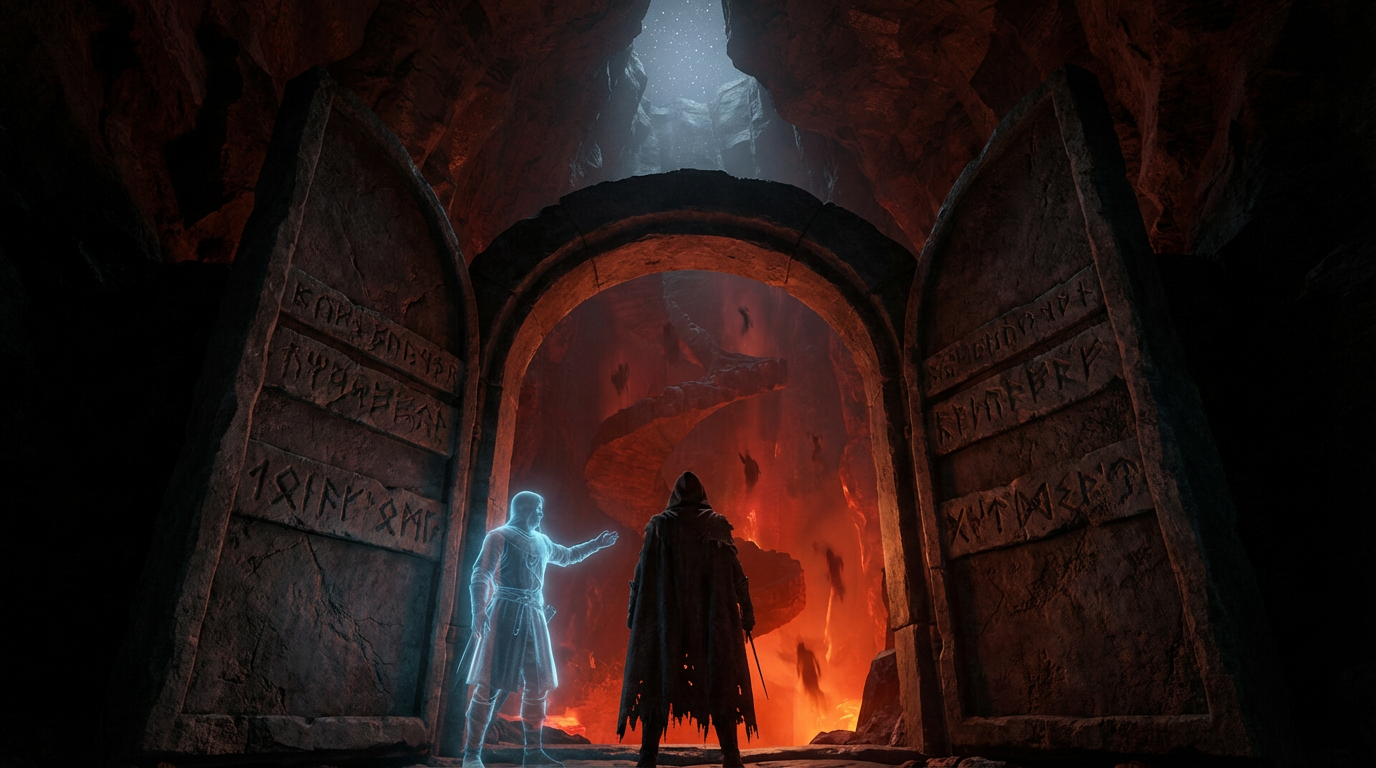
An excerpt from the original text.(complete · 1102 words)
Them sudden flight had scatter’d over the plain,
Turn’d tow’rds the mountain, whither reason’s voice
Drives us; I to my faithful company
Adhering, left it not. For how of him
Depriv’d, might I have sped, or who beside
Would o’er the mountainous tract have led my steps
He with the bitter pang of self-remorse
Seem’d smitten. O clear conscience and upright
How doth a little fling wound thee sore!

Soon as his feet desisted (slack’ning pace),
From haste, that mars all decency of act,
My mind, that in itself before was wrapt,
Its thoughts expanded, as with joy restor’d:
And full against the steep ascent I set
My face, where highest to heav’n its top o’erflows.

The sun, that flar’d behind, with ruddy beam
Before my form was broken; for in me
His rays resistance met. I turn’d aside
With fear of being left, when I beheld
Only before myself the ground obscur’d.
When thus my solace, turning him around,
Bespake me kindly: “Why distrustest thou?
Believ’st not I am with thee, thy sure guide?
It now is evening there, where buried lies
The body, in which I cast a shade, remov’d
To Naples from Brundusium’s wall. Nor thou
Marvel, if before me no shadow fall,
More than that in the sky element
One ray obstructs not other. To endure
Torments of heat and cold extreme, like frames
That virtue hath dispos’d, which how it works
Wills not to us should be reveal’d. Insane
Who hopes, our reason may that space explore,
Which holds three persons in one substance knit.
Seek not the wherefore, race of human kind;
Could ye have seen the whole, no need had been
For Mary to bring forth. Moreover ye
Have seen such men desiring fruitlessly;
To whose desires repose would have been giv’n,
That now but serve them for eternal grief.
I speak of Plato, and the Stagyrite,
And others many more.” And then he bent
Downwards his forehead, and in troubled mood
Broke off his speech. Meanwhile we had arriv’d
Far as the mountain’s foot, and there the rock
Found of so steep ascent, that nimblest steps
To climb it had been vain. The most remote
Most wild untrodden path, in all the tract
’Twixt Lerice and Turbia were to this
A ladder easy’ and open of access.

“Who knows on which hand now the steep declines?”
My master said and paus’d, “so that he may
Ascend, who journeys without aid of wine,?”
And while with looks directed to the ground
The meaning of the pathway he explor’d,
And I gaz’d upward round the stony height,
Of spirits, that toward us mov’d their steps,
Yet moving seem’d not, they so slow approach’d.

I thus my guide address’d: “Upraise thine eyes,
Lo that way some, of whom thou may’st obtain
Counsel, if of thyself thou find’st it not!”

Straightway he look’d, and with free speech replied:
“Let us tend thither: they but softly come.
And thou be firm in hope, my son belov’d.”

Now was that people distant far in space
A thousand paces behind ours, as much
As at a throw the nervous arm could fling,
When all drew backward on the messy crags
Of the steep bank, and firmly stood unmov’d
As one who walks in doubt might stand to look.

“O spirits perfect! O already chosen!”
Virgil to them began, “by that blest peace,
Which, as I deem, is for you all prepar’d,
Instruct us where the mountain low declines,
So that attempt to mount it be not vain.
For who knows most, him loss of time most grieves.”

As sheep, that step from forth their fold, by one,
Or pairs, or three at once; meanwhile the rest
Stand fearfully, bending the eye and nose
To ground, and what the foremost does, that do
The others, gath’ring round her, if she stops,
Simple and quiet, nor the cause discern;
So saw I moving to advance the first,
Who of that fortunate crew were at the head,
Of modest mien and graceful in their gait.
When they before me had beheld the light
From my right side fall broken on the ground,
So that the shadow reach’d the cave, they stopp’d
And somewhat back retir’d: the same did all,
Who follow’d, though unweeting of the cause

“Unask’d of you, yet freely I confess,
This is a human body which ye see.
That the sun’s light is broken on the ground,
Marvel not: but believe, that not without
Virtue deriv’d from Heaven, we to climb
Over this wall aspire.” So them bespake
My master; and that virtuous tribe rejoin’d;
“ Turn, and before you there the entrance lies,”
Making a signal to us with bent hands.

Then of them one began. “Whoe’er thou art,
Who journey’st thus this way, thy visage turn,
Think if me elsewhere thou hast ever seen.”

I tow’rds him turn’d, and with fix’d eye beheld.
Comely, and fair, and gentle of aspect,
He seem’d, but on one brow a gash was mark’d.

When humbly I disclaim’d to have beheld
Him ever: “Now behold!” he said, and show’d
High on his breast a wound: then smiling spake.

“I am Manfredi, grandson to the Queen
Costanza: whence I pray thee, when return’d,
To my fair daughter go, the parent glad
Of Aragonia and Sicilia’s pride;
And of the truth inform her, if of me
Aught else be told. When by two mortal blows
My frame was shatter’d, I betook myself
Weeping to him, who of free will forgives.
My sins were horrible; but so wide arms
Hath goodness infinite, that it receives
All who turn to it. Had this text divine
Been of Cosenza’s shepherd better scann’d,
Who then by Clement on my hunt was set,
Yet at the bridge’s head my bones had lain,
Near Benevento, by the heavy mole
Protected; but the rain now drenches them,
And the wind drives, out of the kingdom’s bounds,
Far as the stream of Verde, where, with lights
Extinguish’d, he remov’d them from their bed.
Yet by their curse we are not so destroy’d,
But that the eternal love may turn, while hope
Retains her verdant blossoms. True it is,
That such one as in contumacy dies
Against the holy church, though he repent,
Must wander thirty-fold for all the time
In his presumption past; if such decree
Be not by prayers of good men shorter made
Look therefore if thou canst advance my bliss;
Revealing to my good Costanza, how
Thou hast beheld me, and beside the terms
Laid on me of that interdict; for here
By means of those below much profit comes.”
Master this chapter. Complete your experience
Purchase the complete book to access all chapters and support classic literature
As an Amazon Associate, we earn a small commission from qualifying purchases at no additional cost to you.
Available in paperback, hardcover, and e-book formats
Let's Analyse the Pattern
Judging reality and worth by what can be seen while missing invisible but crucial truths.
Why This Matters
Connect literature to life
This chapter teaches how to distinguish between visible signs and invisible realities that actually determine outcomes.
Practice This Today
This week, notice when you judge someone's intentions by their immediate response rather than their consistent behavior over time.
Now let's explore the literary elements.
Key Quotes & Analysis
"Why distrustest thou? Believ'st not I am with thee, thy sure guide?"
Context: When Dante panics seeing that Virgil casts no shadow and fears he's been abandoned
Virgil gently challenges Dante's tendency to doubt what he can't see or understand. This shows that true guidance doesn't always come with visible proof, and we must learn to trust based on relationship rather than evidence.
In Today's Words:
Why don't you trust me? Don't you believe I'm here for you?
"O clear conscience and upright, How doth a little fling wound thee sore!"
Context: Describing how even small moral failures deeply trouble those with sensitive consciences
This reveals that people who truly care about doing right are often the hardest on themselves for minor mistakes. It's both a strength and a vulnerability - moral sensitivity can become self-torture.
In Today's Words:
When you really try to do the right thing, even small mistakes feel huge.
"Infinite goodness hath such ample arms, That it receives whatever turns to it"
Context: Explaining how God's mercy embraced him despite his excommunication when he repented at death
This powerful image of divine mercy having 'ample arms' shows that forgiveness is always available to those who genuinely seek it. No one is beyond redemption if they truly turn their heart toward goodness.
In Today's Words:
God's love is big enough for anyone who really wants to change.
Thematic Threads
Identity
In This Chapter
Dante's identity as a living person is revealed by his shadow, while Virgil's spiritual identity is shown by his lack of one
Development
Building on earlier themes of spiritual transformation - now exploring how identity transcends physical markers
In Your Life:
You might question your own worth based on visible achievements while missing your invisible growth and impact on others.
Judgment
In This Chapter
The Church judged Manfred unworthy, but God's mercy operated beyond institutional judgment
Development
Continuing the theme of divine justice versus human judgment from earlier circles
In Your Life:
You might let others' public judgments of you override your private knowledge of your own efforts and intentions.
Mercy
In This Chapter
Manfred finds salvation despite excommunication, showing mercy transcends human institutions
Development
Introduced here as counterpoint to the strict justice seen in earlier parts
In Your Life:
You might withhold forgiveness from yourself or others, forgetting that genuine repentance can transform any situation.
Truth
In This Chapter
Manfred asks Dante to tell his daughter the truth about his salvation, correcting false narratives
Development
Evolved from earlier themes about deception - now showing truth as healing force
In Your Life:
You might stay silent when you could correct harmful misconceptions about someone's character or circumstances.
Appearances
In This Chapter
Shadows, wounds, and physical signs dominate attention while spiritual realities remain hidden
Development
Building on themes of surface versus depth from throughout the journey
In Your Life:
You might focus on how things look to others instead of focusing on what's actually happening in your relationships and growth.
You now have the context. Time to form your own thoughts.
Discussion Questions
- 1
Why does Dante panic when he notices Virgil doesn't cast a shadow, and what does this reveal about how we judge reality?
analysis • surface - 2
How does Manfred's story challenge the idea that visible circumstances determine someone's true worth or spiritual state?
analysis • medium - 3
Where do you see people today judging others by 'shadows' - visible signs that might not tell the whole story?
application • medium - 4
Think of a time when you were judged by external circumstances rather than your true character. How would you handle that situation differently now?
application • deep - 5
What does this chapter suggest about the difference between how institutions judge people versus how mercy or love operates?
reflection • deep
Critical Thinking Exercise
Shadow Inventory
Make two lists: 'Shadows I Cast' (how others might judge you based on visible signs) and 'Shadows I Read' (how you judge others based on what you can see). Then identify one invisible reality you might be missing about someone in your life, and one invisible strength others might miss about you.
Consider:
- •Consider both positive and negative assumptions you make based on appearances
- •Think about times when your first impressions were completely wrong
- •Remember that everyone has struggles and strengths that don't show on the surface
Journaling Prompt
Write about a time when someone saw past your 'shadow' to recognize your true worth, or when you discovered something important about someone that wasn't visible at first glance.
Coming Up Next...
Chapter 38: The Steep Path and Patient Waiting
Dante discovers how the soul's complete attention to one thing can make time disappear entirely. A profound lesson about focus and perception awaits as the journey up the mountain begins in earnest.