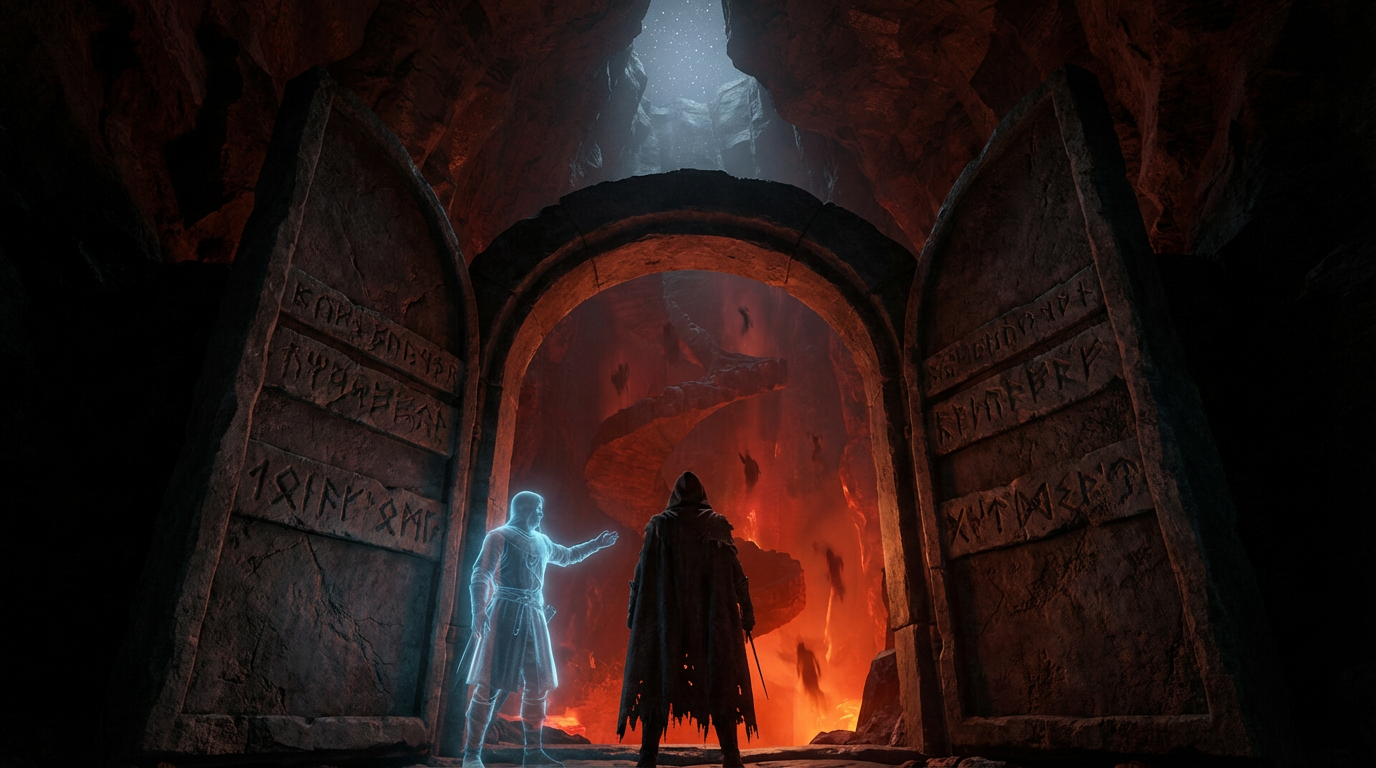
An excerpt from the original text.(complete · 1130 words)
Now was the sun so station’d, as when first
His early radiance quivers on the heights,
Where stream’d his Maker’s blood, while Libra hangs
Above Hesperian Ebro, and new fires
Meridian flash on Ganges’ yellow tide.

So day was sinking, when the’ angel of God
Appear’d before us. Joy was in his mien.
Forth of the flame he stood upon the brink,
And with a voice, whose lively clearness far
Surpass’d our human, “Blessed are the pure
In heart,” he Sang: then near him as we came,
“Go ye not further, holy spirits!” he cried,
“Ere the fire pierce you: enter in; and list
Attentive to the song ye hear from thence.”

I, when I heard his saying, was as one
Laid in the grave. My hands together clasp’d,
And upward stretching, on the fire I look’d,
And busy fancy conjur’d up the forms
Erewhile beheld alive consum’d in flames.

Th’ escorting spirits turn’d with gentle looks
Toward me, and the Mantuan spake: “My son,
Here torment thou mayst feel, but canst not death.
Remember thee, remember thee, if I
Safe e’en on Geryon brought thee: now I come
More near to God, wilt thou not trust me now?
Of this be sure: though in its womb that flame
A thousand years contain’d thee, from thy head
No hair should perish. If thou doubt my truth,
Approach, and with thy hands thy vesture’s hem
Stretch forth, and for thyself confirm belief.
Lay now all fear, O lay all fear aside.
Turn hither, and come onward undismay’d.”
I still, though conscience urg’d’ no step advanc’d.

When still he saw me fix’d and obstinate,
Somewhat disturb’d he cried: “Mark now, my son,
From Beatrice thou art by this wall
Divided.” As at Thisbe’s name the eye
Of Pyramus was open’d (when life ebb’d
Fast from his veins), and took one parting glance,
While vermeil dyed the mulberry; thus I turn’d
To my sage guide, relenting, when I heard
The name, that springs forever in my breast.

He shook his forehead; and, “How long,” he said,
“Linger we now?” then smil’d, as one would smile
Upon a child, that eyes the fruit and yields.
Into the fire before me then he walk’d;
And Statius, who erewhile no little space
Had parted us, he pray’d to come behind.

I would have cast me into molten glass
To cool me, when I enter’d; so intense
Rag’d the conflagrant mass. The sire belov’d,
To comfort me, as he proceeded, still
Of Beatrice talk’d. “Her eyes,” saith he,
“E’en now I seem to view.” From the other side
A voice, that sang, did guide us, and the voice
Following, with heedful ear, we issued forth,
There where the path led upward. “Come,” we heard,
“Come, blessed of my Father.” Such the sounds,
That hail’d us from within a light, which shone
So radiant, I could not endure the view.
“The sun,” it added, “hastes: and evening comes.
Delay not: ere the western sky is hung
With blackness, strive ye for the pass.” Our way
Upright within the rock arose, and fac’d
Such part of heav’n, that from before my steps
The beams were shrouded of the sinking sun.

Nor many stairs were overpass, when now
By fading of the shadow we perceiv’d
The sun behind us couch’d: and ere one face
Of darkness o’er its measureless expanse
Involv’d th’ horizon, and the night her lot
Held individual, each of us had made
A stair his pallet: not that will, but power,
Had fail’d us, by the nature of that mount
Forbidden further travel. As the goats,
That late have skipp’d and wanton’d rapidly
Upon the craggy cliffs, ere they had ta’en
Their supper on the herb, now silent lie
And ruminate beneath the umbrage brown,
While noonday rages; and the goatherd leans
Upon his staff, and leaning watches them:
And as the swain, that lodges out all night
In quiet by his flock, lest beast of prey
Disperse them; even so all three abode,
I as a goat and as the shepherds they,
Close pent on either side by shelving rock.

A little glimpse of sky was seen above;
Yet by that little I beheld the stars
In magnitude and rustle shining forth
With more than wonted glory. As I lay,
Gazing on them, and in that fit of musing,
Sleep overcame me, sleep, that bringeth oft
Tidings of future hap. About the hour,
As I believe, when Venus from the east
First lighten’d on the mountain, she whose orb
Seems always glowing with the fire of love,
A lady young and beautiful, I dream’d,
Was passing o’er a lea; and, as she came,
Methought I saw her ever and anon
Bending to cull the flowers; and thus she sang:
“Know ye, whoever of my name would ask,
That I am Leah: for my brow to weave
A garland, these fair hands unwearied ply.
To please me at the crystal mirror, here
I deck me. But my sister Rachel, she
Before her glass abides the livelong day,
Her radiant eyes beholding, charm’d no less,
Than I with this delightful task. Her joy
In contemplation, as in labour mine.”

And now as glimm’ring dawn appear’d, that breaks
More welcome to the pilgrim still, as he
Sojourns less distant on his homeward way,
Darkness from all sides fled, and with it fled
My slumber; whence I rose and saw my guide
Already risen. “That delicious fruit,
Which through so many a branch the zealous care
Of mortals roams in quest of, shall this day
Appease thy hunger.” Such the words I heard
From Virgil’s lip; and never greeting heard
So pleasant as the sounds. Within me straight
Desire so grew upon desire to mount,
Thenceforward at each step I felt the wings
Increasing for my flight. When we had run
O’er all the ladder to its topmost round,
As there we stood, on me the Mantuan fix’d
His eyes, and thus he spake: “Both fires, my son,
The temporal and eternal, thou hast seen,
And art arriv’d, where of itself my ken
No further reaches. I with skill and art
Thus far have drawn thee. Now thy pleasure take
For guide. Thou hast o’ercome the steeper way,
O’ercome the straighter. Lo! the sun, that darts
His beam upon thy forehead! lo! the herb,
The arboreta and flowers, which of itself
This land pours forth profuse! Till those bright eyes
With gladness come, which, weeping, made me haste
To succour thee, thou mayst or seat thee down,
Or wander where thou wilt. Expect no more
Sanction of warning voice or sign from me,
Free of thy own arbitrement to choose,
Discreet, judicious. To distrust thy sense
Were henceforth error. I invest thee then
With crown and mitre, sovereign o’er thyself.”
Master this chapter. Complete your experience
Purchase the complete book to access all chapters and support classic literature
As an Amazon Associate, we earn a small commission from qualifying purchases at no additional cost to you.
Available in paperback, hardcover, and e-book formats
Let's Analyse the Pattern
When necessary action is blocked by paralyzing fear, love or purpose must provide the emotional fuel that logic cannot.
Why This Matters
Connect literature to life
This chapter teaches how to break through terror that freezes us before necessary action by finding emotional fuel stronger than fear.
Practice This Today
This week, notice when fear freezes you before important action—then ask 'Who am I protecting by moving forward?' instead of 'What might go wrong?'
Now let's explore the literary elements.
Key Quotes & Analysis
"Blessed are the pure in heart"
Context: The angel sings this as he blocks their path to paradise
This biblical beatitude sets the standard for entry - only those with pure hearts can pass. It emphasizes that external purification isn't enough; internal transformation is required.
In Today's Words:
Only people with clean hearts get to move forward
"Here torment thou mayst feel, but canst not death"
Context: Virgil tries to reassure the terrified Dante about entering the fire
Virgil appeals to logic and past experience, reminding Dante that he's survived other impossible things. But fear isn't always logical, and sometimes we need more than facts to move forward.
In Today's Words:
This will hurt, but it won't kill you
"I crown and miter thee over thyself"
Context: Virgil's farewell speech as he declares Dante ready to guide himself
This marks Dante's graduation from student to master of his own destiny. The crown and miter represent both royal and religious authority - Dante now rules himself with wisdom.
In Today's Words:
You're the boss of your own life now
Thematic Threads
Personal Growth
In This Chapter
Dante must overcome his deepest terror to graduate from student to self-directed seeker
Development
Culmination of his entire journey—from lost in dark woods to sovereign over himself
In Your Life:
Growth often requires walking through what terrifies you most, not around it
Class
In This Chapter
Virgil's farewell marks Dante's elevation from guided follower to independent navigator
Development
Evolved from early class anxiety to earned authority through experience
In Your Life:
Real advancement comes when you no longer need someone else's permission to act
Human Relationships
In This Chapter
Love for Beatrice provides the only force strong enough to overcome paralyzing fear
Development
Love transforms from distant ideal to practical motivating force
In Your Life:
The people you love most can give you courage to do what logic alone cannot
Identity
In This Chapter
Dante is crowned sovereign over himself, free to choose his own path
Development
Journey from confused exile to self-directed individual
In Your Life:
True identity emerges when you stop waiting for external validation to act
Social Expectations
In This Chapter
The angel's declaration that none can pass without entering the flames—no exceptions for status
Development
Reinforces that spiritual growth requires personal courage regardless of position
In Your Life:
Some challenges cannot be delegated or avoided through privilege—you must face them yourself
You now have the context. Time to form your own thoughts.
Discussion Questions
- 1
What stops Dante from walking through the wall of fire, even when he's told it won't kill him?
analysis • surface - 2
Why does mentioning Beatrice's name suddenly give Dante the courage to move forward when logical reassurance failed?
analysis • medium - 3
Think about a time when you knew you should do something but felt frozen by fear. What finally got you moving - logic or emotion?
application • medium - 4
When someone you care about is paralyzed by fear of taking necessary action, what approach would work better - explaining why they're safe or helping them focus on what they're fighting for?
application • deep - 5
What does Dante's experience reveal about the relationship between fear, love, and courage in human decision-making?
reflection • deep
Critical Thinking Exercise
Map Your Wall of Fire
Think of something important you know you should do but keep avoiding because it scares you. Write down what specifically terrifies you about taking action, then identify what or who you're fighting for on the other side. Finally, describe what staying frozen is already costing you.
Consider:
- •Your rational mind might know the risk is manageable, but your emotional brain may still be sounding alarms
- •The person or outcome you're protecting might be more powerful motivation than the thing you're avoiding
- •Sometimes the cost of inaction becomes clearer than the fear of action
Journaling Prompt
Write about a time when love or commitment to someone else gave you courage to do something that terrified you. What did that teach you about where real strength comes from?
Coming Up Next...
Chapter 62: The Garden of Eden Revealed
Dante enters the earthly paradise alone, wandering through a celestial forest where every breath brings new wonder. But this garden holds mysteries and encounters that will change everything he thought he knew about love and redemption.