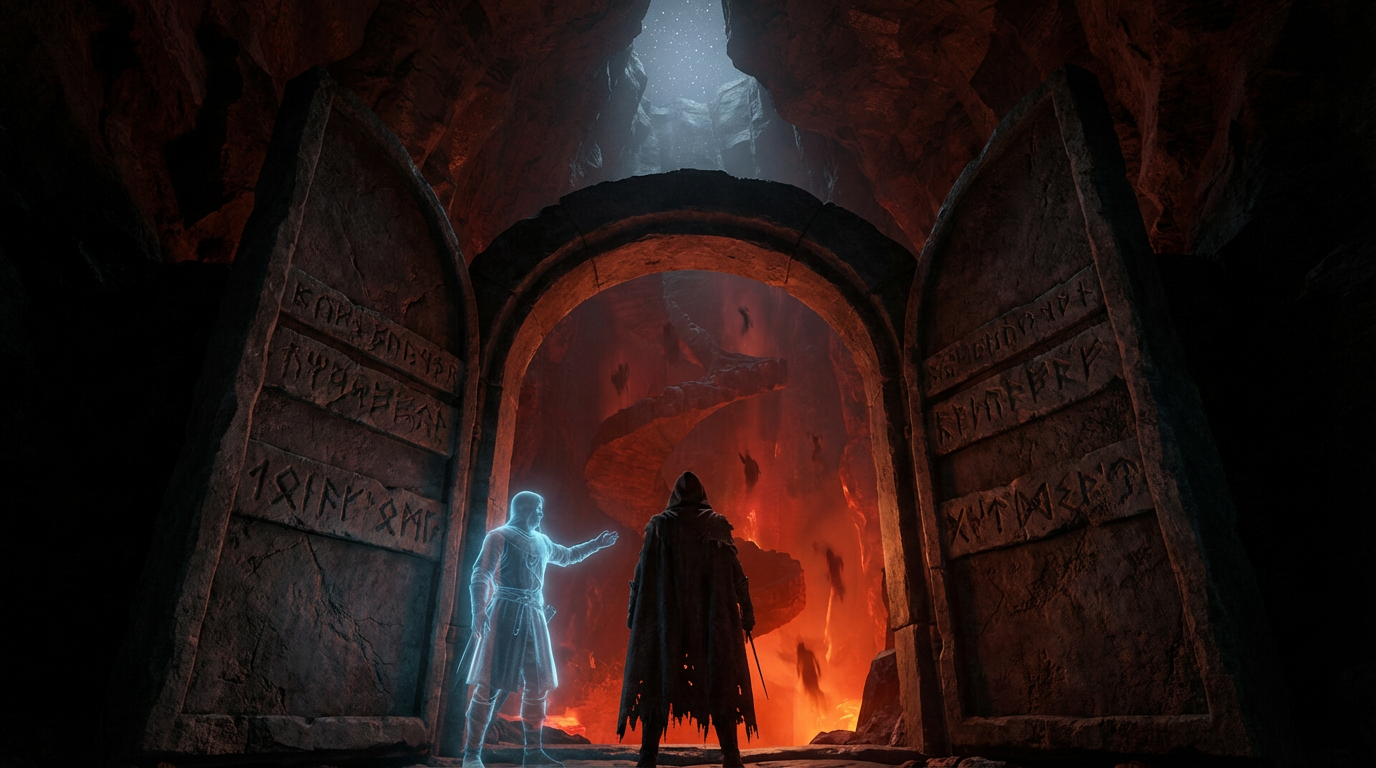
An excerpt from the original text.(complete · 1118 words)
While singly thus along the rim we walk’d,
Oft the good master warn’d me: “Look thou well.
Avail it that I caution thee.” The sun
Now all the western clime irradiate chang’d
From azure tinct to white; and, as I pass’d,
My passing shadow made the umber’d flame
Burn ruddier. At so strange a sight I mark’d
That many a spirit marvel’d on his way.

This bred occasion first to speak of me,
“He seems,” said they, “no insubstantial frame:”
Then to obtain what certainty they might,
Stretch’d towards me, careful not to overpass
The burning pale. “O thou, who followest
The others, haply not more slow than they,
But mov’d by rev’rence, answer me, who burn
In thirst and fire: nor I alone, but these
All for thine answer do more thirst, than doth
Indian or Aethiop for the cooling stream.
Tell us, how is it that thou mak’st thyself
A wall against the sun, as thou not yet
Into th’ inextricable toils of death
Hadst enter’d?” Thus spake one, and I had straight
Declar’d me, if attention had not turn’d
To new appearance. Meeting these, there came,
Midway the burning path, a crowd, on whom
Earnestly gazing, from each part I view
The shadows all press forward, sev’rally
Each snatch a hasty kiss, and then away.
E’en so the emmets, ’mid their dusky troops,
Peer closely one at other, to spy out
Their mutual road perchance, and how they thrive.

That friendly greeting parted, ere dispatch
Of the first onward step, from either tribe
Loud clamour rises: those, who newly come,
Shout Sodom and Gomorrah!” these, “The cow
Pasiphae enter’d, that the beast she woo’d
Might rush unto her luxury.” Then as cranes,
That part towards the Riphaean mountains fly,
Part towards the Lybic sands, these to avoid
The ice, and those the sun; so hasteth off
One crowd, advances th’ other; and resume
Their first song weeping, and their several shout.

Again drew near my side the very same,
Who had erewhile besought me, and their looks
Mark’d eagerness to listen. I, who twice
Their will had noted, spake: “O spirits secure,
Whene’er the time may be, of peaceful end!
My limbs, nor crude, nor in mature old age,
Have I left yonder: here they bear me, fed
With blood, and sinew-strung. That I no more
May live in blindness, hence I tend aloft.
There is a dame on high, who wind for us
This grace, by which my mortal through your realm
I bear. But may your utmost wish soon meet
Such full fruition, that the orb of heaven,
Fullest of love, and of most ample space,
Receive you, as ye tell (upon my page
Henceforth to stand recorded) who ye are,
And what this multitude, that at your backs
Have past behind us.” As one, mountain-bred,
Rugged and clownish, if some city’s walls
He chance to enter, round him stares agape,
Confounded and struck dumb; e’en such appear’d
Each spirit. But when rid of that amaze,
(Not long the inmate of a noble heart)
He, who before had question’d, thus resum’d:
“O blessed, who, for death preparing, tak’st
Experience of our limits, in thy bark!
Their crime, who not with us proceed, was that,
For which, as he did triumph, Caesar heard
The snout of ‘queen,’ to taunt him. Hence their cry
Of ‘Sodom,’ as they parted, to rebuke
Themselves, and aid the burning by their shame.
Our sinning was Hermaphrodite: but we,
Because the law of human kind we broke,
Following like beasts our vile concupiscence,
Hence parting from them, to our own disgrace
Record the name of her, by whom the beast
In bestial tire was acted. Now our deeds
Thou know’st, and how we sinn’d. If thou by name
Wouldst haply know us, time permits not now
To tell so much, nor can I. Of myself
Learn what thou wishest. Guinicelli I,
Who having truly sorrow’d ere my last,
Already cleanse me.” With such pious joy,
As the two sons upon their mother gaz’d
From sad Lycurgus rescu’d, such my joy
(Save that I more represt it) when I heard
From his own lips the name of him pronounc’d,
Who was a father to me, and to those
My betters, who have ever us’d the sweet
And pleasant rhymes of love. So nought I heard
Nor spake, but long time thoughtfully I went,
Gazing on him; and, only for the fire,
Approach’d not nearer. When my eyes were fed
By looking on him, with such solemn pledge,
As forces credence, I devoted me
Unto his service wholly. In reply
He thus bespake me: “What from thee I hear
Is grav’d so deeply on my mind, the waves
Of Lethe shall not wash it off, nor make
A whit less lively. But as now thy oath
Has seal’d the truth, declare what cause impels
That love, which both thy looks and speech bewray.”

“Those dulcet lays,” I answer’d, “which, as long
As of our tongue the beauty does not fade,
Shall make us love the very ink that trac’d them.”

“Brother!” he cried, and pointed at a shade
Before him, “there is one, whose mother speech
Doth owe to him a fairer ornament.
He in love ditties and the tales of prose
Without a rival stands, and lets the fools
Talk on, who think the songster of Limoges
O’ertops him. Rumour and the popular voice
They look to more than truth, and so confirm
Opinion, ere by art or reason taught.
Thus many of the elder time cried up
Guittone, giving him the prize, till truth
By strength of numbers vanquish’d. If thou own
So ample privilege, as to have gain’d
Free entrance to the cloister, whereof Christ
Is Abbot of the college, say to him
One paternoster for me, far as needs
For dwellers in this world, where power to sin
No longer tempts us.” Haply to make way
For one, that follow’d next, when that was said,
He vanish’d through the fire, as through the wave
A fish, that glances diving to the deep.

I, to the spirit he had shown me, drew
A little onward, and besought his name,
For which my heart, I said, kept gracious room.
He frankly thus began: “Thy courtesy
So wins on me, I have nor power nor will
To hide me. I am Arnault; and with songs,
Sorely lamenting for my folly past,
Thorough this ford of fire I wade, and see
The day, I hope for, smiling in my view.
I pray ye by the worth that guides ye up
Unto the summit of the scale, in time
Remember ye my suff’rings.” With such words
He disappear’d in the refining flame.
Master this chapter. Complete your experience
Purchase the complete book to access all chapters and support classic literature
As an Amazon Associate, we earn a small commission from qualifying purchases at no additional cost to you.
Available in paperback, hardcover, and e-book formats
Let's Analyse the Pattern
Everyone who shaped us was shaped by others and is still growing themselves, creating invisible networks of mutual influence and support.
Why This Matters
Connect literature to life
This chapter teaches how to identify the invisible networks of influence that shape every person's development and approach.
Practice This Today
This week, notice when someone you admire credits their own teachers or influences - trace those connections and see how wisdom actually travels through communities.
Now let's explore the literary elements.
Key Quotes & Analysis
"He seems no insubstantial frame"
Context: The spirits notice Dante casts a shadow, proving he's alive
This moment highlights how rare and precious life is from the perspective of the dead. The spirits are amazed because Dante has something they've lost - a living body that interacts with the physical world.
In Today's Words:
Wait, this guy's actually alive!
"O thou who art my master and my author, thou from whom alone I took the style that has brought me honor"
Context: Dante addresses Guinicelli as his literary father
This shows the profound gratitude we owe to those who shaped our abilities. Dante acknowledges that his success comes from building on Guinicelli's foundation, demonstrating intellectual humility.
In Today's Words:
You're the reason I became good at what I do - everything I achieved started with learning from you
"Brother, he whom I point out to you was a better craftsman of the mother tongue"
Context: Guinicelli points Dante toward Arnaut Daniel
True mentorship means knowing when to step aside and point your student toward someone even better. Guinicelli's humility shows that greatness includes recognizing others' superiority.
In Today's Words:
See that guy over there? He's way better at this than I am - you should learn from him instead
"Now I pray you, by that power which guides you to the summit of the stairway, be mindful in due time of my pain"
Context: Guinicelli asks Dante to remember him in prayer when he reaches Paradise
Even our heroes need our support and prayers. This reminds us that the people we look up to are still struggling with their own challenges and can benefit from our help.
In Today's Words:
When you make it to the top, don't forget to put in a good word for me
Thematic Threads
Mentorship
In This Chapter
Dante meets his literary father Guinicelli, who humbly points him toward an even greater influence
Development
Expanded from earlier guidance figures to show how influence chains connect across generations
In Your Life:
The people whose advice shaped you were once asking for advice themselves
Humility
In This Chapter
Guinicelli, despite being Dante's hero, immediately redirects praise to another poet he considers superior
Development
Continues the theme of true greatness requiring self-awareness and recognition of others
In Your Life:
The most respected people in your workplace often credit others for their success
Personal Growth
In This Chapter
Even accomplished souls must walk through purifying fire to complete their development
Development
Reinforces that growth is ongoing regardless of achievement level
In Your Life:
Your heroes and role models are still working on themselves, just like you are
Human Relationships
In This Chapter
Guinicelli asks Dante for prayers, showing that even influences need support from those they've shaped
Development
Deepens the understanding that relationships involve mutual support rather than one-way admiration
In Your Life:
The people who helped you still need encouragement and support in their own struggles
Identity
In This Chapter
Dante's identity as a poet is revealed through his connection to literary predecessors
Development
Shows how personal identity emerges through recognizing our place in larger networks of influence
In Your Life:
Who you are professionally and personally connects to invisible chains of people who shaped your path
You now have the context. Time to form your own thoughts.
Discussion Questions
- 1
Why is Dante so overwhelmed when he meets Guinicelli, and what does Guinicelli's humble response tell us about how he sees himself?
analysis • surface - 2
What does it mean that Guinicelli immediately points Dante toward someone he considers even greater? Why doesn't he just accept the praise?
analysis • medium - 3
Think about someone whose work, advice, or example changed your life's direction. How do you think they learned what they taught you?
application • medium - 4
Guinicelli asks Dante to pray for him, showing even our heroes need support. How could you support someone who influenced you, even if they don't know you exist?
application • deep - 5
The spirits walk through purifying fire while helping each other. What does this suggest about how personal growth and supporting others work together?
reflection • deep
Critical Thinking Exercise
Trace Your Chain of Influence
Draw a simple chain showing how influence flowed to you and through you. Start with someone who shaped your thinking or approach to life. Then trace backward: who influenced them? Next, trace forward: who have you influenced, even in small ways? Include at least three links going back and two going forward.
Consider:
- •Your influences might be people you've never met - authors, speakers, even characters
- •Consider both obvious mentors and unexpected influences who changed how you see things
- •Remember that you influence others even when you don't realize it - coworkers, family, friends
Journaling Prompt
Write about one person in your chain who you could reach out to with gratitude, and one person you've influenced who might benefit from your continued support or encouragement.
Coming Up Next...
Chapter 61: Crossing the Wall of Fire
As dawn approaches and the sun begins to rise, Dante prepares for the final challenge before reaching the summit of Mount Purgatory. The journey is about to reach a crucial turning point that will change everything.