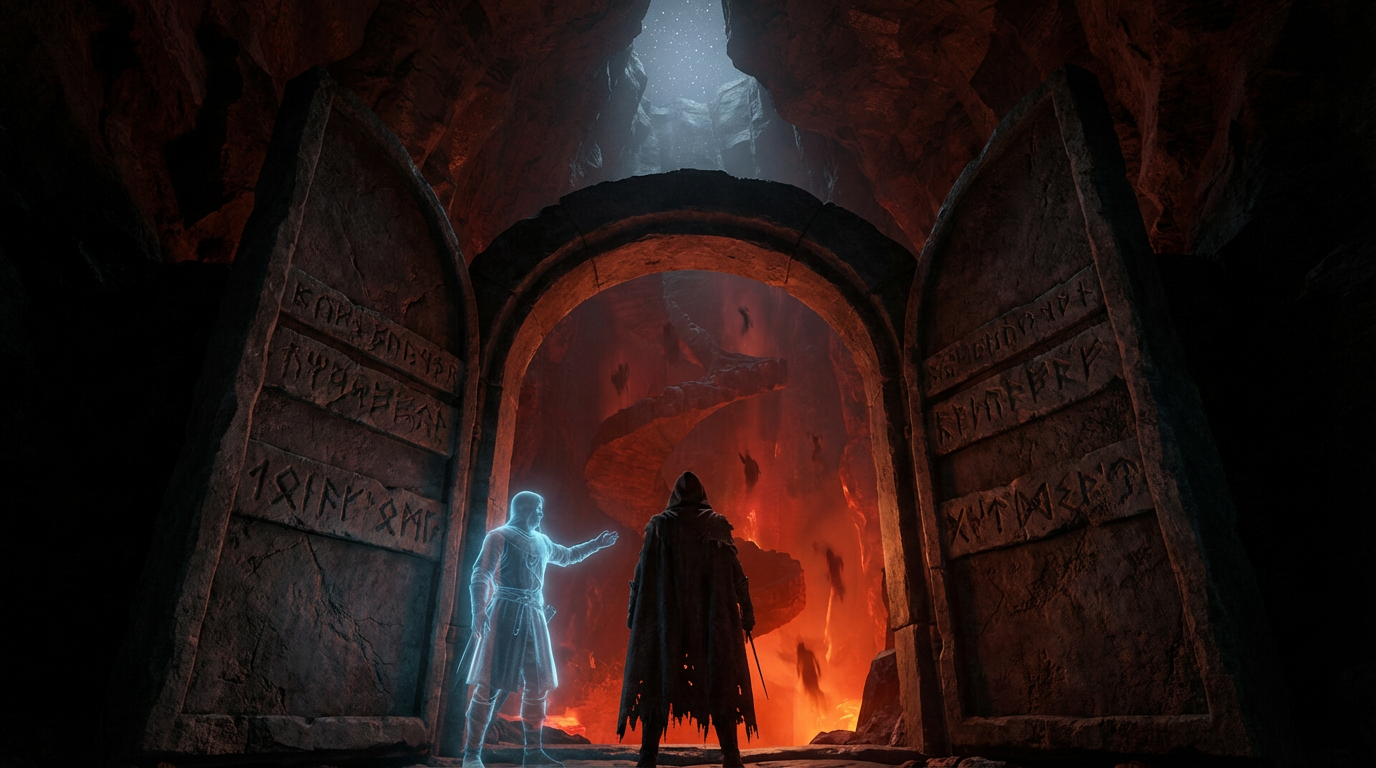
An excerpt from the original text.(complete · 1025 words)
t was an hour, when he who climbs, had need
To walk uncrippled: for the sun had now
To Taurus the meridian circle left,
And to the Scorpion left the night. As one
That makes no pause, but presses on his road,
Whate’er betide him, if some urgent need
Impel: so enter’d we upon our way,
One before other; for, but singly, none
That steep and narrow scale admits to climb.

E’en as the young stork lifteth up his wing
Through wish to fly, yet ventures not to quit
The nest, and drops it; so in me desire
Of questioning my guide arose, and fell,
Arriving even to the act, that marks
A man prepar’d for speech. Him all our haste
Restrain’d not, but thus spake the sire belov’d:
Fear not to speed the shaft, that on thy lip
Stands trembling for its flight.” Encourag’d thus
I straight began: “How there can leanness come,
Where is no want of nourishment to feed?”

“If thou,” he answer’d, “hadst remember’d thee,
How Meleager with the wasting brand
Wasted alike, by equal fires consm’d,
This would not trouble thee: and hadst thou thought,
How in the mirror your reflected form
With mimic motion vibrates, what now seems
Hard, had appear’d no harder than the pulp
Of summer fruit mature. But that thy will
In certainty may find its full repose,
Lo Statius here! on him I call, and pray
That he would now be healer of thy wound.”

“If in thy presence I unfold to him
The secrets of heaven’s vengeance, let me plead
Thine own injunction, to exculpate me.”
So Statius answer’d, and forthwith began:
“Attend my words, O son, and in thy mind
Receive them: so shall they be light to clear
The doubt thou offer’st. Blood, concocted well,
Which by the thirsty veins is ne’er imbib’d,
And rests as food superfluous, to be ta’en
From the replenish’d table, in the heart
Derives effectual virtue, that informs
The several human limbs, as being that,
Which passes through the veins itself to make them.
Yet more concocted it descends, where shame
Forbids to mention: and from thence distils
In natural vessel on another’s blood.
Then each unite together, one dispos’d
T’ endure, to act the other, through meet frame
Of its recipient mould: that being reach’d,
It ’gins to work, coagulating first;
Then vivifies what its own substance caus’d
To bear. With animation now indued,
The active virtue (differing from a plant
No further, than that this is on the way
And at its limit that) continues yet
To operate, that now it moves, and feels,
As sea sponge clinging to the rock: and there
Assumes th’ organic powers its seed convey’d.
‘This is the period, son! at which the virtue,
That from the generating heart proceeds,
Is pliant and expansive; for each limb
Is in the heart by forgeful nature plann’d.
How babe of animal becomes, remains
For thy consid’ring. At this point, more wise,
Than thou hast err’d, making the soul disjoin’d
From passive intellect, because he saw
No organ for the latter’s use assign’d.

“Open thy bosom to the truth that comes.
Know soon as in the embryo, to the brain,
Articulation is complete, then turns
The primal Mover with a smile of joy
On such great work of nature, and imbreathes
New spirit replete with virtue, that what here
Active it finds, to its own substance draws,
And forms an individual soul, that lives,
And feels, and bends reflective on itself.
And that thou less mayst marvel at the word,
Mark the sun’s heat, how that to wine doth change,
Mix’d with the moisture filter’d through the vine.

“When Lachesis hath spun the thread, the soul
Takes with her both the human and divine,
Memory, intelligence, and will, in act
Far keener than before, the other powers
Inactive all and mute. No pause allow’d,
In wond’rous sort self-moving, to one strand
Of those, where the departed roam, she falls,
Here learns her destin’d path. Soon as the place
Receives her, round the plastic virtue beams,
Distinct as in the living limbs before:
And as the air, when saturate with showers,
The casual beam refracting, decks itself
With many a hue; so here the ambient air
Weareth that form, which influence of the soul
Imprints on it; and like the flame, that where
The fire moves, thither follows, so henceforth
The new form on the spirit follows still:
Hence hath it semblance, and is shadow call’d,
With each sense even to the sight endued:
Hence speech is ours, hence laughter, tears, and sighs
Which thou mayst oft have witness’d on the mount
Th’ obedient shadow fails not to present
Whatever varying passion moves within us.
And this the cause of what thou marvel’st at.”

Now the last flexure of our way we reach’d,
And to the right hand turning, other care
Awaits us. Here the rocky precipice
Hurls forth redundant flames, and from the rim
A blast upblown, with forcible rebuff
Driveth them back, sequester’d from its bound.

Behoov’d us, one by one, along the side,
That border’d on the void, to pass; and I
Fear’d on one hand the fire, on th’ other fear’d
Headlong to fall: when thus th’ instructor warn’d:
“Strict rein must in this place direct the eyes.
A little swerving and the way is lost.”

Then from the bosom of the burning mass,
“O God of mercy!” heard I sung; and felt
No less desire to turn. And when I saw
Spirits along the flame proceeding, I
Between their footsteps and mine own was fain
To share by turns my view. At the hymn’s close
They shouted loud, “I do not know a man;”
Then in low voice again took up the strain,
Which once more ended, “To the wood,” they cried,
“Ran Dian, and drave forth Callisto, stung
With Cytherea’s poison:” then return’d
Unto their song; then marry a pair extoll’d,
Who liv’d in virtue chastely, and the bands
Of wedded love. Nor from that task, I ween,
Surcease they; whilesoe’er the scorching fire
Enclasps them. Of such skill appliance needs
To medicine the wound, that healeth last.
Master this chapter. Complete your experience
Purchase the complete book to access all chapters and support classic literature
As an Amazon Associate, we earn a small commission from qualifying purchases at no additional cost to you.
Available in paperback, hardcover, and e-book formats
Let's Analyse the Pattern
Meaningful understanding requires overcoming the social fear of appearing ignorant by directly voicing confusion.
Why This Matters
Connect literature to life
This chapter teaches how to transform confusion into understanding by overcoming the social anxiety that keeps us silent about what we don't know.
Practice This Today
This week, notice when you're nodding along without really understanding—then practice saying 'Could you help me understand that better?' or 'What should I be looking for here?'
Now let's explore the literary elements.
Key Quotes & Analysis
"Fear not to speed the shaft, that on thy lip stands trembling for its flight"
Context: Encouraging Dante to ask the question he's been hesitating to voice
This shows how good mentors create safe spaces for honest questions. Virgil recognizes Dante's internal struggle and gives him permission to speak up without fear of judgment.
In Today's Words:
Go ahead and ask what's on your mind - don't be afraid to speak up
"How there can leanness come, where is no want of nourishment to feed?"
Context: His question about how souls can appear to waste away without physical bodies
This represents the courage to ask questions that seem obvious or stupid. Dante admits his confusion about spiritual mysteries, showing that seeking understanding requires humility.
In Today's Words:
How can something get thin when it doesn't actually need food?
"If in thy presence I unfold the secrets of what manner thing we are when freed from flesh"
Context: Beginning his explanation about the nature of souls after death
Shows respect for both the questioner and the complexity of the answer. He acknowledges this is deep material that deserves careful explanation, not dismissive responses.
In Today's Words:
Let me explain to you exactly what happens to us after we die
Thematic Threads
Intellectual Courage
In This Chapter
Dante overcomes hesitation to ask about the nature of souls and shadow-bodies
Development
Builds on earlier themes of needing guides and teachers for growth
In Your Life:
You might recognize this when you sit silent in meetings rather than ask for clarification
Mentorship
In This Chapter
Virgil calls on Statius to provide expert knowledge beyond his own capabilities
Development
Evolves the guide relationship to show how good mentors connect you with other experts
In Your Life:
You see this when a supervisor refers you to a specialist rather than guessing at answers
Spiritual Formation
In This Chapter
Souls in the fire represent the final purification before entering Paradise
Development
Continues the journey's progression through increasingly refined spiritual states
In Your Life:
You experience this in any process where the final steps require confronting your deepest challenges
Sacred Boundaries
In This Chapter
The spirits celebrate chastity and marital fidelity as they walk through purifying flames
Development
Builds on themes of proper relationships and self-control throughout Purgatory
In Your Life:
You encounter this when maintaining professional boundaries or honoring commitments becomes difficult
Community Witness
In This Chapter
Souls sing together and celebrate examples of virtue from others' lives
Development
Continues the pattern of souls helping each other through shared stories and encouragement
In Your Life:
You see this in support groups or teams that share success stories to motivate each other
You now have the context. Time to form your own thoughts.
Discussion Questions
- 1
What prevents Dante from asking his question about souls having shadows, and what finally makes him speak up?
analysis • surface - 2
Why does Dante's confusion about souls casting shadows represent a deeper pattern about how we handle not understanding something?
analysis • medium - 3
Where do you see people staying silent about their confusion in healthcare, work, or relationships instead of asking for clarification?
application • medium - 4
How would you create an environment where people feel safe admitting they don't understand something?
application • deep - 5
What does this chapter reveal about the relationship between intellectual courage and personal growth?
reflection • deep
Critical Thinking Exercise
Map Your Confusion Zones
Think about your current life situation - work, health, relationships, finances. Identify three areas where you have questions or confusion but haven't asked for clarification. For each area, write down what's stopping you from asking and what you think might happen if you did ask.
Consider:
- •Consider whether your fear of looking foolish is actually protecting you or holding you back
- •Think about people in your life who might actually welcome your questions
- •Notice whether staying confused is costing you more than asking would
Journaling Prompt
Write about a time when you finally asked a question you'd been afraid to ask. What happened? How did the reality compare to your fears?
Coming Up Next...
Chapter 60: Meeting Your Heroes and Mentors
As Dante walks along the fiery rim, his physical shadow creates an unusual effect in the flames, causing the spirits to marvel at this living man among them. The sun begins to set, marking another transition in their otherworldly journey.