
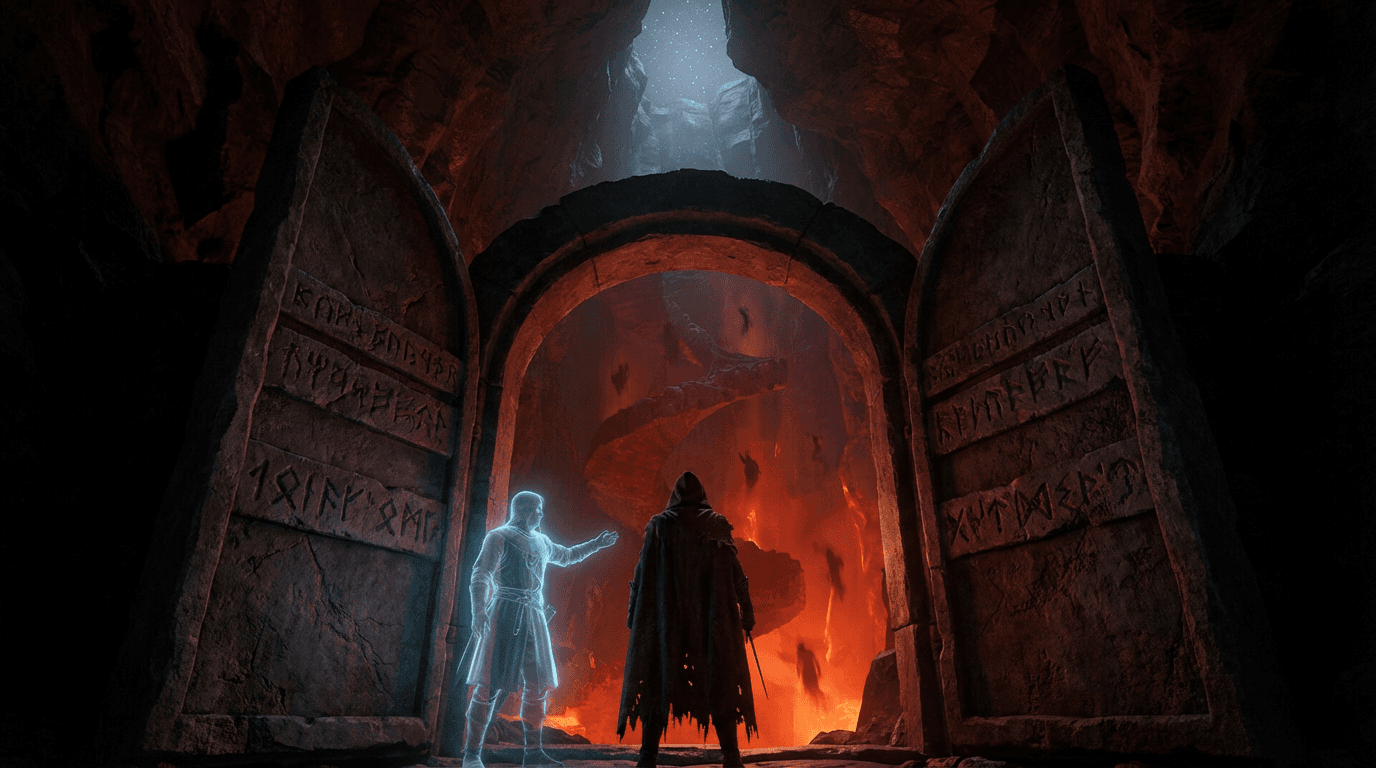
Finding Purpose When the World Rejects You
8chapters tracing Dante's own exile through the poem — how the loss of everything he worked for became the condition that made the Commedia possible.
The Pattern: Exile as Origin Story
Dante was exiled from Florence in 1302 under penalty of death. He spent the remaining twenty years of his life wandering, dependent on the hospitality of various patrons, never returning to his city. The Divine Comedy was written entirely in exile. This is not incidental — it is the condition that made the poem possible. The person who wrote the Commedia could not have been a successful Florentine politician. The displacement produced the vantage point.
The Vantage of Exile
Those expelled from the inside can see it clearly. Dante's exile gave him a clarity about Florence — and about human nature — that belonging would have obscured.
Loss as Fuel, Not Paralysis
The poem is not about recovering what was lost. It is about what emerges from the loss when faced directly rather than avoided.
The Authorized Mission
Cacciaguida's charge to Dante — speak what you have seen, spare no one — is the mission that the exile made possible and necessary.
Chapter by Chapter
The Midlife Crisis as Mission-Starting Point
Dante is 35 years old, lost in a dark wood, with no memory of how he got there. He is a man in disgrace — he has been exiled from Florence, his political career is over, his city has expelled him. The poem begins not with triumph but with complete disorientation. This is the condition from which the journey to God begins.
The Midlife Crisis as Mission-Starting Point
Divine Comedy — Chapter 1
“Midway upon the journey of our life / I found myself within a forest dark.”
Key Insight
The Divine Comedy was written in exile. Dante was banished from Florence in 1302 and never returned. The poem we have — one of the greatest works in world literature — emerges from that expulsion. The midlife disorientation in the dark wood is not just narrative; it is autobiographical. The loss of everything he had worked for became the condition that made the poem possible. Rejection can be the starting point of something nothing else could have produced.
Ulysses: The Warning About Purpose Gone Wrong
Ulysses stands in Hell as a counterexample — a man who pursued purpose and knowledge without wisdom or restraint. He left his family again after returning to Ithaca, sailed past all human limits, and convinced his crew to follow him with a speech about the nobility of experience and knowledge. His ship sank within sight of a mountain he was forbidden to approach.
Ulysses: The Warning About Purpose Gone Wrong
Divine Comedy — Chapter 26
“Consider well the seed that gave you birth: / you were not made to live your lives as brutes.”
Key Insight
Purpose is not automatically noble. Ulysses had a genuine drive — to know, to experience, to push past the limits of the possible. But it had no wisdom, no restraint, no accountability to those his choices affected. The Comedy acknowledges this by placing him in Hell: the will to exceed limits, without reference to anything beyond yourself, is its own kind of self-destruction. Purpose that serves only yourself is not purpose — it is appetite with a better story.
Emerging Into Light After the Descent
After escaping Hell, Dante emerges onto a new shore at dawn. He looks up and sees stars he has not seen in a very long time — the stars that were hidden while he was in the dark. The first thing he does is look up. Cato greets them. The air is clean. The journey through Hell — through everything that had to be seen and faced — has made this arrival possible.
Emerging Into Light After the Descent
Divine Comedy — Chapter 35
“And then we came forth to see once more the stars.”
Key Insight
There is no shortcut from the dark wood to the stars. The path goes through Hell, not around it. The exile, the loss, the descent through everything difficult — Dante is saying that the path to genuine clarity and capacity goes through, not around, the worst of what needs to be faced. The stars that appear at the end of Purgatorio and Paradiso are visible precisely because of what was traveled to get there.
The Living Among the Dead
As Dante continues through Purgatory, the souls notice he casts a shadow — proof that he is still alive in a realm of the departed. He is unique here: a living person passing through. Some souls are astounded; others ask him to carry word to the living. His very presence is an anomaly. He belongs neither entirely to the living nor to the dead — he is between.
The Living Among the Dead
Divine Comedy — Chapter 39
Key Insight
The exile's condition is to belong nowhere entirely. Dante in Purgatory — living among the dead — mirrors his situation in the world: expelled from Florence, never fully received elsewhere, not quite at home in any political faction. This in-between position, which felt like dispossession, turned out to be the vantage point from which the entire poem was written. The place of not-belonging is also the place of seeing everything.
Beatrice's Confrontation: What You Did With Your Gifts
Beatrice confronts Dante directly, naming the specific ways he wasted his gifts after her death — how he followed false images of good, how he was led astray by things that could not deliver what she offered. She is not consoling him; she is naming what he did wrong with what he was given. He weeps and confesses.
Beatrice's Confrontation: What You Did With Your Gifts
Divine Comedy — Chapter 65
“For a time I sustained him with my face. / Showing the eyes of youth to him, I led him / with me turned toward the right direction.”
Key Insight
Exile and loss do not automatically produce wisdom or mission. The raw material of loss must be faced honestly — including an honest account of what you contributed to the situation. Beatrice's confrontation is not punishment; it is the clearing of accounts that makes a new direction possible. You cannot find new purpose on a foundation of self-deception about what went wrong.
Finding Peace in the Place You've Been Given
In the lowest sphere of Paradise, Dante meets souls who were forced to break their vows by powerful men — nuns taken from their convents and forced into secular life. They dwell in the lowest sphere, not the highest. Dante asks if they wish they were higher. Piccarda Donati answers with one of the most startling lines in the Commedia: 'In His will is our peace.' She is not consoled — she is genuinely at rest.
Finding Peace in the Place You've Been Given
Divine Comedy — Chapter 70
“In His will is our peace.”
Key Insight
The person who has found purpose accepts their particular place in the order with something that looks like peace but is more precise than contentment: it is the recognition that this is where they are, this is what they have been given, and the task is to be fully here rather than wishing to be elsewhere. The exile who has found mission is not someone who no longer feels the loss — it is someone for whom the loss has been metabolized into fuel.
The Florence That Was Lost
Cacciaguida, Dante's great-great-grandfather, speaks at length about the Florence of his era — sober, modest, faithful, unlike the corrupt Florence of Dante's time that expelled him. The description is suffused with grief and love for what was. But it is not paralyzed by that grief; it is precise about what has been lost and why. The nostalgia itself is a form of clarity.
The Florence That Was Lost
Divine Comedy — Chapter 83
Key Insight
Grief for what you have lost can be a form of knowledge rather than a form of stagnation. Cacciaguida's detailed memory of what Florence was illuminates exactly what Florence became and why it expelled Dante. The exile's clear-eyed memory of the home that rejected him is one source of the poem's moral authority. You can love what you've lost without being unable to move.
The Prophecy: Your Exile Is Your Mission
Cacciaguida tells Dante the full scope of what is coming: the exile, the bitterness, the dependence on others' charity, the difficulty. And then he gives the charge: write what you have seen. Do not soften it for the people it will offend. Let it be bitter bread that nourishes those who are hungry for truth. The poem that Dante is, in a sense, already writing — because he is writing it in exile — is itself the mission that the exile made possible.
The Prophecy: Your Exile Is Your Mission
Divine Comedy — Chapter 84
“Let your cry be as the wind, which strikes most hard / the highest peaks; and this shall be no small / argument of honor to you.”
Key Insight
The purpose that emerges from rejection is usually larger than the purpose that was lost. Dante the successful Florentine politician might never have written the Commedia. Dante the exile — with nothing to lose, everything to say, and seventy cantos already behind him — writes a poem that has shaped the Western imagination for seven hundred years. The mission was not in spite of the exile. It was the exile, transfigured.
Modern Application
Most people who lose their position, their community, their identity — through job loss, divorce, illness, political expulsion, social rejection — experience it as the end of the story they were living. The question the Commedia raises is: what if that's the beginning of a different, larger story? Not because loss is secretly good, but because the removal of a particular structure can reveal — or force — capacities that would not have developed otherwise.
The key variables are: what you do with the loss, whether you face it honestly or construct self-protecting stories about it, whether you use the new vantage point to see something true, and whether you find or accept a mission larger than restoring what you lost.
Cacciaguida's charge — “let your cry be as the wind” — is not a consolation prize. It is an authorization. The exile can speak truths that those inside cannot afford to say. That is not nothing. That is, in many cases, the most important thing.
The Central Lesson
The purpose that emerges from rejection is usually larger than the purpose that was lost. The exile who faces what was lost honestly, without self-deception, and who accepts a mission rather than a restoration — that person has access to a vantage point that belonging never grants.
Related Themes in This Book
Recognizing When You Are Lost
The dark wood that preceded the mission.
Receiving Guidance and Honoring Teachers
Cacciaguida's charge: what the guide gives you for the mission.
The Structure of Transformation
The process that exile and loss set in motion.
Where Your Vices Actually Lead
The alternative to finding mission: Hell's endpoint.