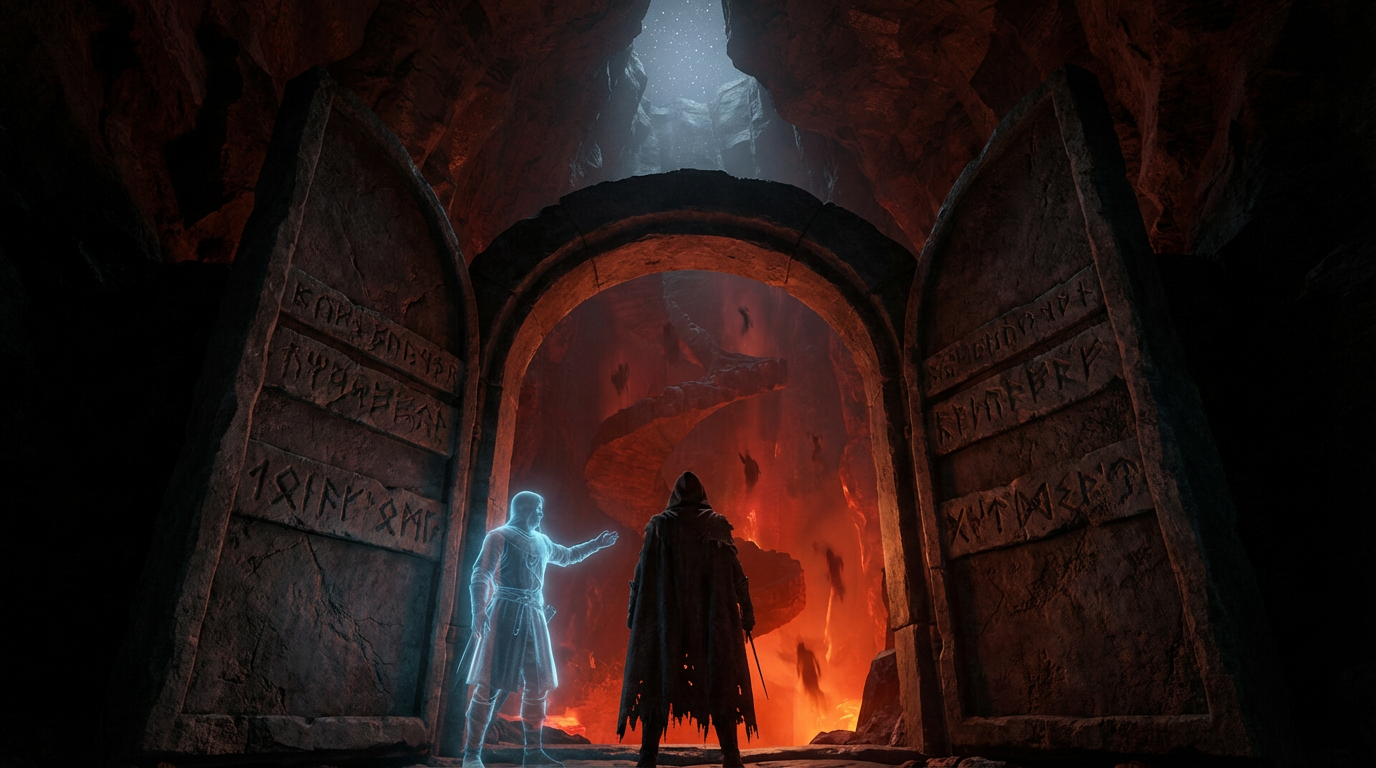
An excerpt from the original text.(complete · 1039 words)
Such as the youth, who came to Clymene
To certify himself of that reproach,
Which had been fasten’d on him, (he whose end
Still makes the fathers chary to their sons,
E’en such was I; nor unobserv’d was such
Of Beatrice, and that saintly lamp,
Who had erewhile for me his station mov’d;
When thus by lady: “Give thy wish free vent,
That it may issue, bearing true report
Of the mind’s impress; not that aught thy words
May to our knowledge add, but to the end,
That thou mayst use thyself to own thy thirst
And men may mingle for thee when they hear.”

“O plant! from whence I spring! rever’d and lov’d!
Who soar’st so high a pitch, thou seest as clear,
As earthly thought determines two obtuse
In one triangle not contain’d, so clear
Dost see contingencies, ere in themselves
Existent, looking at the point whereto
All times are present, I, the whilst I scal’d
With Virgil the soul purifying mount,
And visited the nether world of woe,
Touching my future destiny have heard
Words grievous, though I feel me on all sides
Well squar’d to fortune’s blows. Therefore my will
Were satisfied to know the lot awaits me,
The arrow, seen beforehand, slacks its flight.”

So said I to the brightness, which erewhile
To me had spoken, and my will declar’d,
As Beatrice will’d, explicitly.
Nor with oracular response obscure,
Such, as or ere the Lamb of God was slain,
Beguil’d the credulous nations; but, in terms
Precise and unambiguous lore, replied
The spirit of paternal love, enshrin’d,
Yet in his smile apparent; and thus spake:
“Contingency, unfolded not to view
Upon the tablet of your mortal mold,
Is all depictur’d in the’ eternal sight;
But hence deriveth not necessity,
More then the tall ship, hurried down the flood,
Doth from the vision, that reflects the scene.
From thence, as to the ear sweet harmony
From organ comes, so comes before mine eye
The time prepar’d for thee. Such as driv’n out
From Athens, by his cruel stepdame’s wiles,
Hippolytus departed, such must thou
Depart from Florence. This they wish, and this
Contrive, and will ere long effectuate, there,
Where gainful merchandize is made of Christ,
Throughout the livelong day. The common cry,
Will, as ’tis ever wont, affix the blame
Unto the party injur’d: but the truth
Shall, in the vengeance it dispenseth, find
A faithful witness. Thou shall leave each thing
Belov’d most dearly: this is the first shaft
Shot from the bow of exile. Thou shalt prove
How salt the savour is of other’s bread,
How hard the passage to descend and climb
By other’s stairs, But that shall gall thee most
Will he the worthless and vile company,
With whom thou must be thrown into these straits.
For all ungrateful, impious all and mad,
Shall turn ’gainst thee: but in a little while
Theirs and not thine shall be the crimson’d brow
Their course shall so evince their brutishness
T’ have ta’en thy stand apart shall well become thee.

“First refuge thou must find, first place of rest,
In the great Lombard’s courtesy, who bears
Upon the ladder perch’d the sacred bird.
He shall behold thee with such kind regard,
That ’twixt ye two, the contrary to that
Which falls ’twixt other men, the granting shall
Forerun the asking. With him shalt thou see
That mortal, who was at his birth impress
So strongly from this star, that of his deeds
The nations shall take note. His unripe age
Yet holds him from observance; for these wheels
Only nine years have compass him about.
But, ere the Gascon practice on great Harry,
Sparkles of virtue shall shoot forth in him,
In equal scorn of labours and of gold.
His bounty shall be spread abroad so widely,
As not to let the tongues e’en of his foes
Be idle in its praise. Look thou to him
And his beneficence: for he shall cause
Reversal of their lot to many people,
Rich men and beggars interchanging fortunes.
And thou shalt bear this written in thy soul
Of him, but tell it not; “and things he told
Incredible to those who witness them;
Then added: “So interpret thou, my son,
What hath been told thee.—Lo! the ambushment
That a few circling seasons hide for thee!
Yet envy not thy neighbours: time extends
Thy span beyond their treason’s chastisement.”

Soon, as the saintly spirit, by his silence,
Had shown the web, which I had streteh’d for him
Upon the warp, was woven, I began,
As one, who in perplexity desires
Counsel of other, wise, benign and friendly:
“My father! well I mark how time spurs on
Toward me, ready to inflict the blow,
Which falls most heavily on him, who most
Abandoned himself. Therefore ’tis good
I should forecast, that driven from the place
Most dear to me, I may not lose myself
All others by my song. Down through the world
Of infinite mourning, and along the mount
From whose fair height my lady’s eyes did lift me,
And after through this heav’n from light to light,
Have I learnt that, which if I tell again,
It may with many woefully disrelish;
And, if I am a timid friend to truth,
I fear my life may perish among those,
To whom these days shall be of ancient date.”

The brightness, where enclos’d the treasure smil’d,
Which I had found there, first shone glisteningly,
Like to a golden mirror in the sun;
Next answer’d: “Conscience, dimm’d or by its own
Or other’s shame, will feel thy saying sharp.
Thou, notwithstanding, all deceit remov’d,
See the whole vision be made manifest.
And let them wince who have their withers wrung.
What though, when tasted first, thy voice shall prove
Unwelcome, on digestion it will turn
To vital nourishment. The cry thou raisest,
Shall, as the wind doth, smite the proudest summits;
Which is of honour no light argument,
For this there only have been shown to thee,
Throughout these orbs, the mountain, and the deep,
Spirits, whom fame hath note of. For the mind
Of him, who hears, is loth to acquiesce
And fix its faith, unless the instance brought
Be palpable, and proof apparent urge.”
Master this chapter. Complete your experience
Purchase the complete book to access all chapters and support classic literature
As an Amazon Associate, we earn a small commission from qualifying purchases at no additional cost to you.
Available in paperback, hardcover, and e-book formats
Let's Analyse the Pattern
Speaking necessary truths often costs the messenger more than staying silent, but some messages are too important for personal comfort to matter.
Why This Matters
Connect literature to life
This chapter teaches how to speak difficult truths while preparing for the inevitable backlash from those who benefit from the status quo.
Practice This Today
Next time you witness workplace misconduct or institutional corruption, document everything first, then ask yourself: is this truth bigger than my comfort?
Now let's explore the literary elements.
Key Quotes & Analysis
"The arrow, seen beforehand, slacks its flight."
Context: Dante explains why he wants to know his future - that forewarning reduces the impact of misfortune.
This reveals a fundamental truth about anxiety and preparation. When we know what's coming, we can brace ourselves and the blow feels less devastating. Dante shows wisdom in seeking clarity rather than living in fearful uncertainty.
In Today's Words:
If you see the punch coming, it doesn't hit as hard.
"Thou shalt leave everything beloved most dearly; and this is the arrow that the bow of exile shoots first."
Context: Beginning his prophecy of Dante's exile from Florence.
This captures the deepest pain of any major life disruption - losing what we love most. The metaphor of exile's 'first arrow' shows that separation from loved ones hurts more than material losses.
In Today's Words:
You're going to lose everything you care about most, and that's going to be the hardest part.
"Thou shalt prove how salt doth taste another's bread, and how hard a path it is to climb and descend another's stairs."
Context: Describing the humiliation of depending on others' charity during exile.
This perfectly captures the bitter taste of dependence after independence. The specific details - bread, stairs - make abstract suffering concrete and relatable. It's about dignity lost, not just comfort.
In Today's Words:
You'll find out how awful it feels to depend on other people's charity and live by their rules.
"Let thy voice be like the wind, which strikes hardest the highest peaks."
Context: Encouraging Dante to speak truth boldly, especially to those in power.
This metaphor suggests that truth should hit hardest where it's needed most - among the powerful and proud. It's a call to courage, to speak up regardless of who might be offended by the message.
In Today's Words:
Speak your truth loudly, especially when it makes important people uncomfortable.
Thematic Threads
Exile
In This Chapter
Dante learns his physical exile from Florence is actually preparation for his greater mission
Development
Evolved from punishment to purpose—exile becomes the source of his authority to speak truth
In Your Life:
Sometimes being pushed out of comfortable situations positions you to see and speak truths others can't.
Class
In This Chapter
Dante will taste 'bitter bread' of dependence and climb 'other people's stairs'—the humiliation of losing status
Development
Deepened understanding of how class mobility works both directions and shapes perspective
In Your Life:
Losing economic security teaches you things about society that comfort never could.
Truth
In This Chapter
Cacciaguida commands Dante to reveal everything he's seen, regardless of who feels uncomfortable
Development
Truth transforms from personal insight to moral obligation—the duty to speak difficult realities
In Your Life:
Sometimes staying quiet to keep peace enables the very problems that need addressing.
Purpose
In This Chapter
Dante's personal suffering serves a larger mission—his words will 'nourish souls' and challenge the corrupt
Development
Individual pain becomes meaningful when connected to helping others navigate similar challenges
In Your Life:
Your hardest experiences often become your greatest qualifications to help others facing the same struggles.
Courage
In This Chapter
Dante worries about being 'too harsh a friend to truth' but is told to speak anyway
Development
Courage evolves from personal bravery to accepting the responsibility that comes with seeing clearly
In Your Life:
Real courage isn't feeling fearless—it's speaking necessary truths despite knowing the cost.
You now have the context. Time to form your own thoughts.
Discussion Questions
- 1
What harsh truths does Cacciaguida tell Dante about his future, and how does he frame these hardships?
analysis • surface - 2
Why does Cacciaguida insist that Dante must tell everything he's seen, even if it makes people uncomfortable?
analysis • medium - 3
Where do you see this pattern today - people being punished for speaking necessary truths while the real problems continue?
application • medium - 4
How would you prepare yourself to speak a difficult truth that might cost you relationships or your position?
application • deep - 5
What does this chapter reveal about the difference between being popular and being necessary?
reflection • deep
Critical Thinking Exercise
Map Your Truth-Telling Dilemma
Think of a situation where you know something important that others don't want to hear - maybe workplace safety issues, family dysfunction, or community problems. Write down the truth, who benefits from keeping it hidden, what speaking up would cost you, and what staying silent costs others. Then create a strategic plan for how you might address it.
Consider:
- •Consider who has the power to retaliate and how they might use it
- •Think about who would benefit from hearing this truth, even if it's uncomfortable
- •Evaluate whether this truth is big enough to justify the personal cost of speaking it
Journaling Prompt
Write about a time when you stayed silent about something important to avoid conflict. What was the long-term cost of that silence, and how might you handle a similar situation differently now?
Coming Up Next...
Chapter 85: The Eagle of Divine Justice
With his destiny revealed and his mission clarified, Dante must now process this overwhelming prophecy. As Cacciaguida falls silent, having woven the tapestry of Dante's future, both ancestor and descendant contemplate the weight of truth and the price of purpose.