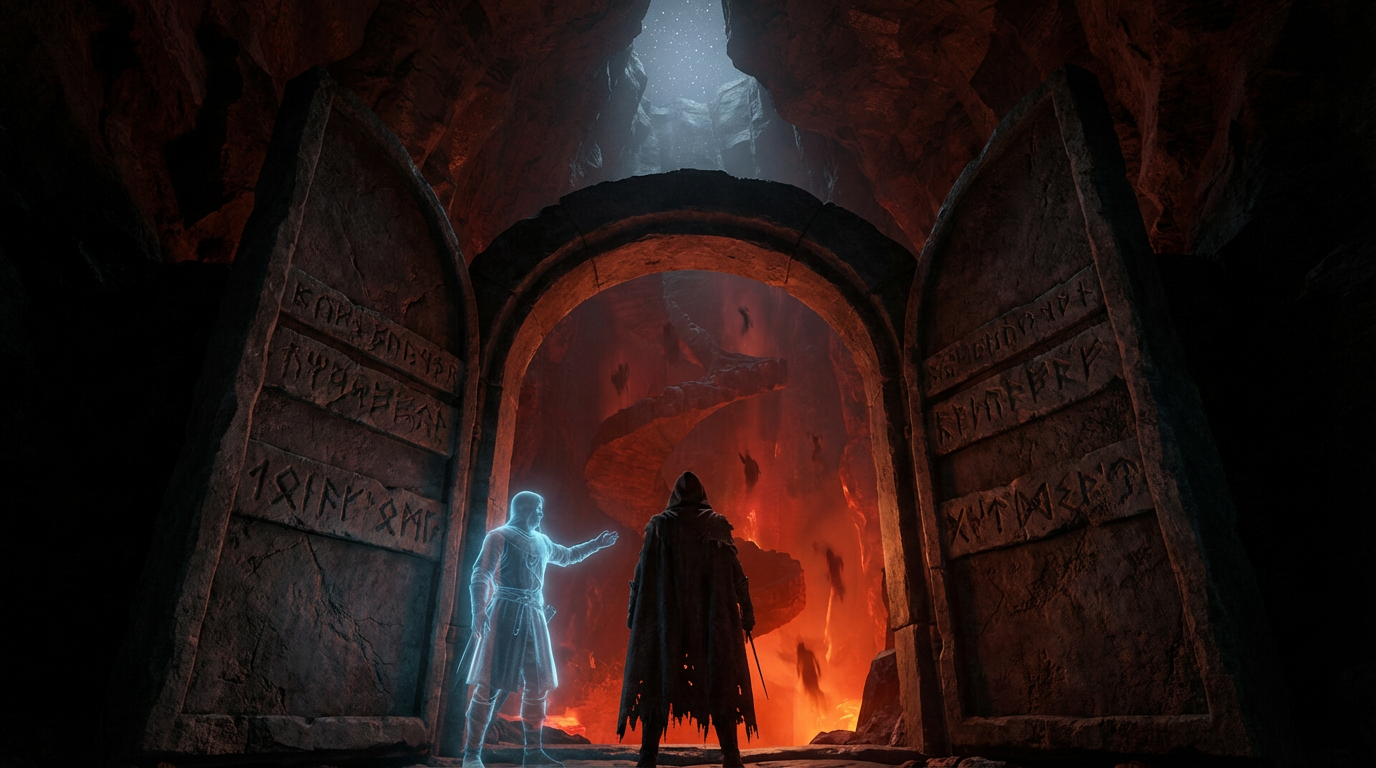
An excerpt from the original text.(complete · 1146 words)
O slight respect of man’s nobility!
I never shall account it marvelous,
That our infirm affection here below
Thou mov’st to boasting, when I could not choose,
E’en in that region of unwarp’d desire,
In heav’n itself, but make my vaunt in thee!
Yet cloak thou art soon shorten’d, for that time,
Unless thou be eked out from day to day,
Goes round thee with his shears. Resuming then
With greeting such, as Rome, was first to bear,
But since hath disaccustom’d I began;
And Beatrice, that a little space
Was sever’d, smil’d reminding me of her,
Whose cough embolden’d (as the story holds)
To first offence the doubting Guenever.

“You are my sire,” said I, “you give me heart
Freely to speak my thought: above myself
You raise me. Through so many streams with joy
My soul is fill’d, that gladness wells from it;
So that it bears the mighty tide, and bursts not
Say then, my honour’d stem! what ancestors
Where those you sprang from, and what years were mark’d
In your first childhood? Tell me of the fold,
That hath Saint John for guardian, what was then
Its state, and who in it were highest seated?”

As embers, at the breathing of the wind,
Their flame enliven, so that light I saw
Shine at my blandishments; and, as it grew
More fair to look on, so with voice more sweet,
Yet not in this our modern phrase, forthwith
It answer’d: “From the day, when it was said
‘Hail Virgin!’ to the throes, by which my mother,
Who now is sainted, lighten’d her of me
Whom she was heavy with, this fire had come,
Five hundred fifty times and thrice, its beams
To reilumine underneath the foot
Of its own lion. They, of whom I sprang,
And I, had there our birth-place, where the last
Partition of our city first is reach’d
By him, that runs her annual game. Thus much
Suffice of my forefathers: who they were,
And whence they hither came, more honourable
It is to pass in silence than to tell.
All those, who in that time were there from Mars
Until the Baptist, fit to carry arms,
Were but the fifth of them this day alive.
But then the citizen’s blood, that now is mix’d
From Campi and Certaldo and Fighine,
Ran purely through the last mechanic’s veins.
O how much better were it, that these people
Were neighbours to you, and that at Galluzzo
And at Trespiano, ye should have your bound’ry,
Than to have them within, and bear the stench
Of Aguglione’s hind, and Signa’s, him,
That hath his eye already keen for bart’ring!
Had not the people, which of all the world
Degenerates most, been stepdame unto Caesar,
But, as a mother, gracious to her son;
Such one, as hath become a Florentine,
And trades and traffics, had been turn’d adrift
To Simifonte, where his grandsire ply’d
The beggar’s craft. The Conti were possess’d
Of Montemurlo still: the Cerchi still
Were in Acone’s parish; nor had haply
From Valdigrieve past the Buondelmonte.
The city’s malady hath ever source
In the confusion of its persons, as
The body’s, in variety of food:
And the blind bull falls with a steeper plunge,
Than the blind lamb; and oftentimes one sword
Doth more and better execution,
Than five. Mark Luni, Urbisaglia mark,
How they are gone, and after them how go
Chiusi and Sinigaglia; and ’twill seem
No longer new or strange to thee to hear,
That families fail, when cities have their end.
All things, that appertain t’ ye, like yourselves,
Are mortal: but mortality in some
Ye mark not, they endure so long, and you
Pass by so suddenly. And as the moon
Doth, by the rolling of her heav’nly sphere,
Hide and reveal the strand unceasingly;
So fortune deals with Florence. Hence admire not
At what of them I tell thee, whose renown
Time covers, the first Florentines. I saw
The Ughi, Catilini and Filippi,
The Alberichi, Greci and Ormanni,
Now in their wane, illustrious citizens:
And great as ancient, of Sannella him,
With him of Arca saw, and Soldanieri
And Ardinghi, and Bostichi. At the poop,
That now is laden with new felony,
So cumb’rous it may speedily sink the bark,
The Ravignani sat, of whom is sprung
The County Guido, and whoso hath since
His title from the fam’d Bellincione ta’en.
Fair governance was yet an art well priz’d
By him of Pressa: Galigaio show’d
The gilded hilt and pommel, in his house.
The column, cloth’d with verrey, still was seen
Unshaken: the Sacchetti still were great,
Giouchi, Sifanti, Galli and Barucci,
With them who blush to hear the bushel nam’d.
Of the Calfucci still the branchy trunk
Was in its strength: and to the curule chairs
Sizii and Arigucci yet were drawn.
How mighty them I saw, whom since their pride
Hath undone! and in all her goodly deeds
Florence was by the bullets of bright gold
O’erflourish’d. Such the sires of those, who now,
As surely as your church is vacant, flock
Into her consistory, and at leisure
There stall them and grow fat. The o’erweening brood,
That plays the dragon after him that flees,
But unto such, as turn and show the tooth,
Ay or the purse, is gentle as a lamb,
Was on its rise, but yet so slight esteem’d,
That Ubertino of Donati grudg’d
His father-in-law should yoke him to its tribe.
Already Caponsacco had descended
Into the mart from Fesole: and Giuda
And Infangato were good citizens.
A thing incredible I tell, tho’ true:
The gateway, named from those of Pera, led
Into the narrow circuit of your walls.
Each one, who bears the sightly quarterings
Of the great Baron (he whose name and worth
The festival of Thomas still revives)
His knighthood and his privilege retain’d;
Albeit one, who borders them With gold,
This day is mingled with the common herd.
In Borgo yet the Gualterotti dwelt,
And Importuni: well for its repose
Had it still lack’d of newer neighbourhood.
The house, from whence your tears have had their spring,
Through the just anger that hath murder’d ye
And put a period to your gladsome days,
Was honour’d, it, and those consorted with it.
O Buondelmonte! what ill counseling
Prevail’d on thee to break the plighted bond
Many, who now are weeping, would rejoice,
Had God to Ema giv’n thee, the first time
Thou near our city cam’st. But so was doom’d:
On that maim’d stone set up to guard the bridge,
At thy last peace, the victim, Florence! fell.
With these and others like to them, I saw
Florence in such assur’d tranquility,
She had no cause at which to grieve: with these
Saw her so glorious and so just, that ne’er
The lily from the lance had hung reverse,
Or through division been with vermeil dyed.”
Master this chapter. Complete your experience
Purchase the complete book to access all chapters and support classic literature
As an Amazon Associate, we earn a small commission from qualifying purchases at no additional cost to you.
Available in paperback, hardcover, and e-book formats
Let's Analyse the Pattern
The Golden Age Trap
Using idealized memories of the past to avoid addressing present problems by blaming change and outsiders rather than examining root causes.
Why This Matters
Connect literature to life
This chapter teaches how to recognize when people use idealized memories to avoid dealing with current problems.
Practice This Today
This week, notice when conversations shift from solving present problems to lamenting how things used to be better—then gently redirect toward actionable solutions.
Now let's explore the literary elements.
Key Quotes & Analysis
"O slight respect of man's nobility! I never shall account it marvelous, That our infirm affection here below Thou mov'st to boasting"
Context: Dante addresses the concept of nobility itself, admitting he's about to boast about his family lineage
Dante acknowledges that pride in family heritage is a human weakness, yet he can't help himself. This self-awareness makes his ancestor worship more complex—he knows it's vanity but does it anyway.
In Today's Words:
I shouldn't be surprised that I'm about to brag about my family—everyone does it, even when they know better.
"You are my sire, you give me heart Freely to speak my thought: above myself You raise me"
Context: Dante addresses Cacciaguida with deep reverence, asking him to share family history
This shows how ancestral connection can provide confidence and identity. Dante feels elevated by his lineage, suggesting that knowing where we come from helps us face current challenges.
In Today's Words:
You're my ancestor, and that gives me confidence to speak up—knowing I come from you makes me feel stronger.
"From the day, when it was said 'Ave' to Mary, down to the birth when my mother gave me birth"
Context: Cacciaguida begins his story of old Florence by dating it from the Annunciation to his own birth
He frames his personal history within sacred time, suggesting that his era was blessed and divinely ordained. This rhetorical move makes his nostalgia seem spiritually justified rather than just personal preference.
In Today's Words:
Back in my day—and I'm talking about a time that was truly blessed—things were different.
Thematic Threads
Class
In This Chapter
Cacciaguida blames Florence's problems on mixing of noble blood with merchant families, revealing class anxiety about social mobility
Development
Continues from earlier Paradise themes about social hierarchy and proper order
In Your Life:
You might feel this when established groups at work resist new employees or procedures
Identity
In This Chapter
Family stories shape how Dante understands his place in Florence's decline and his own mission
Development
Builds on earlier themes about personal destiny and belonging
In Your Life:
Your family's version of 'how things used to be' influences how you see current challenges
Social Expectations
In This Chapter
The ancestor expects traditional values to remain unchanged while society transforms around them
Development
Continues Paradise exploration of proper social roles and duties
In Your Life:
You experience this tension when old rules no longer fit new situations at work or home
Human Relationships
In This Chapter
The broken marriage engagement that sparked factional violence shows how personal conflicts become public disasters
Development
Echoes earlier themes about individual choices affecting entire communities
In Your Life:
You see this when family feuds or workplace conflicts escalate beyond their original cause
You now have the context. Time to form your own thoughts.
Discussion Questions
- 1
What specific changes does Cacciaguida blame for Florence's decline, and how does he describe the 'good old days'?
analysis • surface - 2
Why might Cacciaguida's memories of the past be unreliable or selective?
analysis • medium - 3
Where do you hear similar 'things were better before' complaints in your workplace, community, or family?
application • medium - 4
How can you tell the difference between genuine problems that need solving and nostalgic complaints that avoid real solutions?
application • deep - 5
What does this chapter reveal about how people use the past to avoid dealing with present challenges?
reflection • deep
Critical Thinking Exercise
Decode the Golden Age Story
Think of a time when someone older complained that 'things aren't like they used to be' - at work, in your family, or community. Write down their specific complaints, then research or think critically about what that time period was actually like. What problems did they have then that we've solved now? What are they romanticizing or forgetting?
Consider:
- •What specific evidence contradicts their rosy memories?
- •What current problems might they be avoiding by focusing on the past?
- •How might their age, social position, or circumstances affect their perspective?
Journaling Prompt
Write about a time when you caught yourself thinking 'things were better when...' What were you really feeling anxious about in the present moment?
Coming Up Next...
Chapter 84: Prophecy of Exile and Purpose
Dante, emboldened by his ancestor's words, prepares to ask the burning question that has haunted his journey through the afterlife. What he learns will challenge everything he thought he knew about his own destiny.