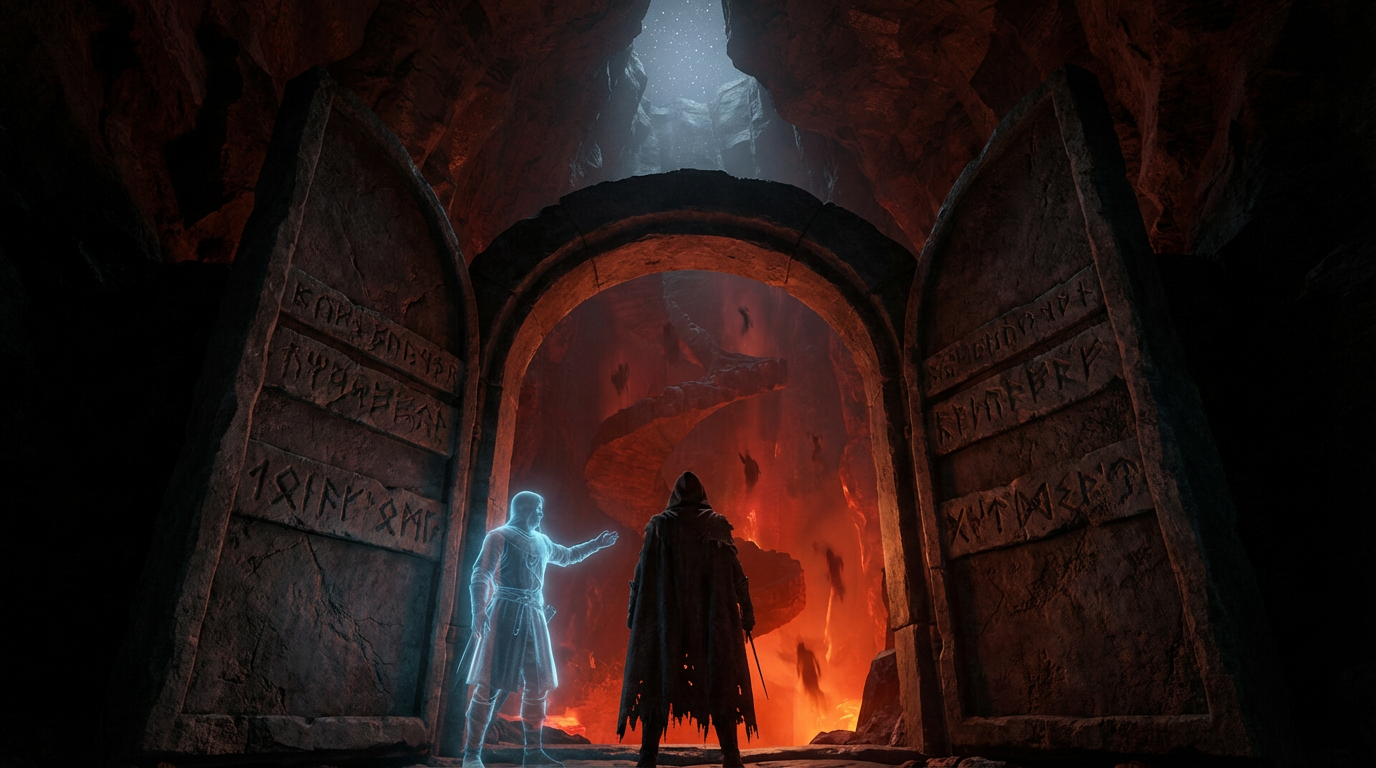
An excerpt from the original text.(complete · 1017 words)
Now in his word, sole, ruminating, joy’d
That blessed spirit; and I fed on mine,
Tempting the sweet with bitter: she meanwhile,
Who led me unto God, admonish’d: “Muse
On other thoughts: bethink thee, that near Him
I dwell, who recompenseth every wrong.”

At the sweet sounds of comfort straight I turn’d;
And, in the saintly eyes what love was seen,
I leave in silence here: nor through distrust
Of my words only, but that to such bliss
The mind remounts not without aid. Thus much
Yet may I speak; that, as I gaz’d on her,
Affection found no room for other wish.
While the everlasting pleasure, that did full
On Beatrice shine, with second view
From her fair countenance my gladden’d soul
Contented; vanquishing me with a beam
Of her soft smile, she spake: “Turn thee, and list.
These eyes are not thy only Paradise.”

As here we sometimes in the looks may see
Th’ affection mark’d, when that its sway hath ta’en
The spirit wholly; thus the hallow’d light,
To whom I turn’d, flashing, bewray’d its will
To talk yet further with me, and began:
“On this fifth lodgment of the tree, whose life
Is from its top, whose fruit is ever fair
And leaf unwith’ring, blessed spirits abide,
That were below, ere they arriv’d in heav’n,
So mighty in renown, as every muse
Might grace her triumph with them. On the horns
Look therefore of the cross: he, whom I name,
Shall there enact, as doth 1n summer cloud
Its nimble fire.” Along the cross I saw,
At the repeated name of Joshua,
A splendour gliding; nor, the word was said,
Ere it was done: then, at the naming saw
Of the great Maccabee, another move
With whirling speed; and gladness was the scourge
Unto that top. The next for Charlemagne
And for the peer Orlando, two my gaze
Pursued, intently, as the eye pursues
A falcon flying. Last, along the cross,
William, and Renard, and Duke Godfrey drew
My ken, and Robert Guiscard. And the soul,
Who spake with me among the other lights
Did move away, and mix; and with the choir
Of heav’nly songsters prov’d his tuneful skill.

To Beatrice on my right l bent,
Looking for intimation or by word
Or act, what next behoov’d; and did descry
Such mere effulgence in her eyes, such joy,
It past all former wont. And, as by sense
Of new delight, the man, who perseveres
In good deeds doth perceive from day to day
His virtue growing; I e’en thus perceiv’d
Of my ascent, together with the heav’n
The circuit widen’d, noting the increase
Of beauty in that wonder. Like the change
In a brief moment on some maiden’s cheek,
Which from its fairness doth discharge the weight
Of pudency, that stain’d it; such in her,
And to mine eyes so sudden was the change,
Through silvery whiteness of that temperate star,
Whose sixth orb now enfolded us. I saw,
Within that Jovial cresset, the clear sparks
Of love, that reign’d there, fashion to my view
Our language. And as birds, from river banks
Arisen, now in round, now lengthen’d troop,
Array them in their flight, greeting, as seems,
Their new-found pastures; so, within the lights,
The saintly creatures flying, sang, and made
Now D. now I. now L. figur’d I’ th’ air.
First, singing, to their notes they mov’d, then one
Becoming of these signs, a little while
Did rest them, and were mute. O nymph divine
Of Pegasean race! whose souls, which thou
Inspir’st, mak’st glorious and long-liv’d, as they
Cities and realms by thee! thou with thyself
Inform me; that I may set forth the shapes,
As fancy doth present them. Be thy power
Display’d in this brief song. The characters,
Vocal and consonant, were five-fold seven.
In order each, as they appear’d, I mark’d.
Diligite Justitiam, the first,
Both verb and noun all blazon’d; and the extreme
Qui judicatis terram. In the M.
Of the fifth word they held their station,
Making the star seem silver streak’d with gold.
And on the summit of the M. I saw
Descending other lights, that rested there,
Singing, methinks, their bliss and primal good.
Then, as at shaking of a lighted brand,
Sparkles innumerable on all sides
Rise scatter’d, source of augury to th’ unwise;
Thus more than thousand twinkling lustres hence
Seem’d reascending, and a higher pitch
Some mounting, and some less; e’en as the sun,
Which kindleth them, decreed. And when each one
Had settled in his place, the head and neck
Then saw I of an eagle, lively
Grav’d in that streaky fire. Who painteth there,
Hath none to guide him; of himself he guides;
And every line and texture of the nest
Doth own from him the virtue, fashions it.
The other bright beatitude, that seem’d
Erewhile, with lilied crowning, well content
To over-canopy the M. mov’d forth,
Following gently the impress of the bird.

 Sweet star! what glorious and thick-studded gems
Declar’d to me our justice on the earth
To be the effluence of that heav’n, which thou,
Thyself a costly jewel, dost inlay!
Therefore I pray the Sovran Mind, from whom
Thy motion and thy virtue are begun,
That he would look from whence the fog doth rise,
To vitiate thy beam: so that once more
He may put forth his hand ’gainst such, as drive
Their traffic in that sanctuary, whose walls
With miracles and martyrdoms were built.

Ye host of heaven! whose glory I survey l
O beg ye grace for those, that are on earth
All after ill example gone astray.
War once had for its instrument the sword:
But now ’tis made, taking the bread away
Which the good Father locks from none.—And thou,
That writes but to cancel, think, that they,
Who for the vineyard, which thou wastest, died,
Peter and Paul live yet, and mark thy doings.
Thou hast good cause to cry, “My heart so cleaves
To him, that liv’d in solitude remote,
And from the wilds was dragg’d to martyrdom,
I wist not of the fisherman nor Paul.”
Master this chapter. Complete your experience
Purchase the complete book to access all chapters and support classic literature
As an Amazon Associate, we earn a small commission from qualifying purchases at no additional cost to you.
Available in paperback, hardcover, and e-book formats
Let's Analyse the Pattern
Leaders who use collective trust and sacred positions for personal gain rather than serving the greater purpose they were meant to protect.
Why This Matters
Connect literature to life
This chapter teaches how to spot when leaders use collective trust for personal gain by watching for gaps between their public message and private actions.
Practice This Today
This week, notice when authority figures invoke 'the greater good' while making decisions that primarily benefit themselves—watch their language, their lifestyle, and who they spend time with.
Now let's explore the literary elements.
Key Quotes & Analysis
"Love justice, you who judge the earth"
Context: The spirits form themselves into letters spelling this biblical message
This quote establishes the central theme of the sphere - that all earthly authority must be grounded in love and justice, not self-interest. It's both a command and a warning to those in power.
In Today's Words:
If you're in charge of people, you better do right by them
"Turn thee, and list. These eyes are not thy only Paradise"
Context: She tells Dante to look away from her and pay attention to the eagle
Beatrice reminds Dante that divine wisdom comes from many sources, not just one guide. She's teaching him to be open to learning from different aspects of divine truth.
In Today's Words:
Don't just listen to me - there's wisdom everywhere if you pay attention
"He makes war with bread who deprives of it"
Context: Condemning church leaders who use excommunication for profit
This powerful metaphor shows how spiritual weapons become tools of oppression when used for money. The eagle condemns turning sacred authority into a business model.
In Today's Words:
You're fighting dirty when you use people's basic needs against them
Thematic Threads
Justice
In This Chapter
Divine justice shown as collective wisdom (the eagle) versus corrupt earthly justice serving self-interest
Development
Evolved from individual punishment in Hell to collective harmony in Paradise
In Your Life:
You see this when workplace policies benefit managers while hurting frontline workers
Authority
In This Chapter
Righteous rulers merge into one voice while corrupt leaders use sacred power for personal gain
Development
Builds on earlier themes of legitimate versus illegitimate power
In Your Life:
You experience this with supervisors who either lift the team up or use their position to make life easier for themselves
Collective vs Individual
In This Chapter
Souls willingly lose individual identity to form the eagle of justice
Development
Contrasts with Hell's isolation and continues Paradise's theme of unity
In Your Life:
You face this choice when deciding whether to speak up for coworkers or protect only yourself
Sacred Corruption
In This Chapter
Church leaders using excommunication for profit rather than spiritual guidance
Development
Continues Dante's critique of institutional corruption throughout the Comedy
In Your Life:
You see this when trusted institutions (healthcare, education, religion) prioritize profit over their stated mission
Recognition and Judgment
In This Chapter
Saints Peter and Paul still watching and judging corruption from heaven
Development
Reinforces that ultimate accountability exists even when earthly justice fails
In Your Life:
You find comfort knowing that workplace bullies and corrupt leaders don't escape consequences forever
You now have the context. Time to form your own thoughts.
Discussion Questions
- 1
How do the souls in Jupiter demonstrate their unity, and what message do they spell out with their lights?
analysis • surface - 2
Why does Dante show the souls speaking as one eagle voice instead of individual voices, and what does this teach about legitimate authority?
analysis • medium - 3
Where do you see leaders today 'making war with bread'—using their position to serve themselves instead of their mission?
application • medium - 4
When you're in any leadership role (parent, team member, volunteer), how can you tell if you're serving the purpose or if the purpose is serving you?
application • deep - 5
What does the contrast between the unified eagle and corrupt earthly rulers reveal about why some authority lasts while other authority crumbles?
reflection • deep
Critical Thinking Exercise
Authority Audit: Self-Serving vs. Mission-Serving
Think of someone in authority over you (boss, politician, coach, pastor). List three recent decisions they made. For each decision, ask: 'Who really benefited from this choice?' Then flip it: think of a time when you had authority over others (as a parent, trainer, team lead). Apply the same test to your own decisions.
Consider:
- •Look for patterns—do their decisions consistently benefit the mission or consistently benefit them personally?
- •Consider both obvious benefits (money, status) and subtle ones (avoiding difficult conversations, maintaining popularity)
- •Notice the difference between leaders who sacrifice for the mission versus those who sacrifice the mission for themselves
Journaling Prompt
Write about a time when you had to choose between what was easy for you personally and what was right for the people counting on you. How did you decide, and what would you do differently now?
Coming Up Next...
Chapter 86: Divine Justice and Human Judgment
The magnificent eagle of justice prepares to speak with one voice formed from countless righteous souls. Its words will reveal the deepest mysteries of divine judgment and challenge everything Dante thought he knew about earthly power.