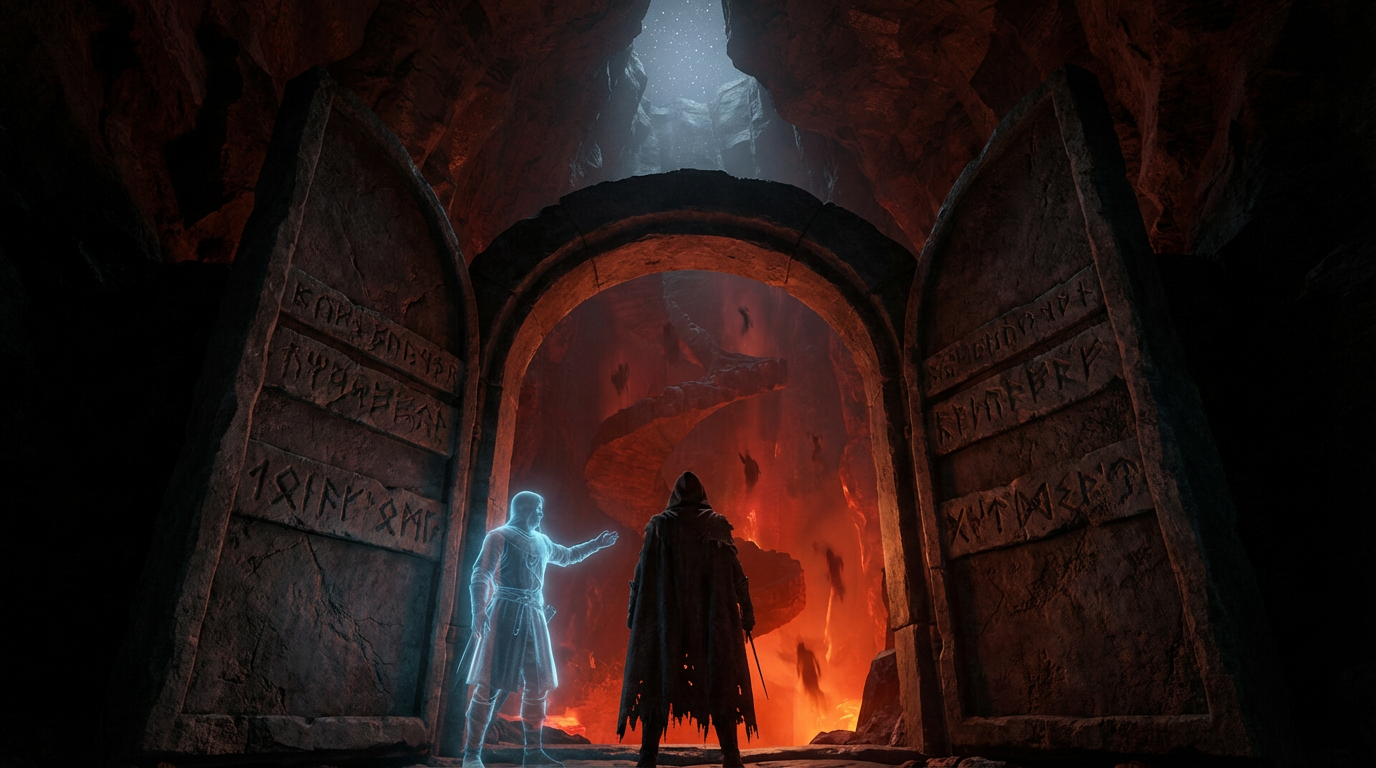
An excerpt from the original text.(complete · 1092 words)
Before my sight appear’d, with open wings,
The beauteous image, in fruition sweet
Gladdening the thronged spirits. Each did seem
A little ruby, whereon so intense
The sun-beam glow’d that to mine eyes it came
In clear refraction. And that, which next
Befalls me to portray, voice hath not utter’d,
Nor hath ink written, nor in fantasy
Was e’er conceiv’d. For I beheld and heard
The beak discourse; and, what intention form’d
Of many, singly as of one express,
Beginning: “For that I was just and piteous,
l am exalted to this height of glory,
The which no wish exceeds: and there on earth
Have I my memory left, e’en by the bad
Commended, while they leave its course untrod.”

Thus is one heat from many embers felt,
As in that image many were the loves,
And one the voice, that issued from them all.
Whence I address them: “O perennial flowers
Of gladness everlasting! that exhale
In single breath your odours manifold!
Breathe now; and let the hunger be appeas’d,
That with great craving long hath held my soul,
Finding no food on earth. This well I know,
That if there be in heav’n a realm, that shows
In faithful mirror the celestial Justice,
Yours without veil reflects it. Ye discern
The heed, wherewith I do prepare myself
To hearken; ye the doubt that urges me
With such inveterate craving.” Straight I saw,
Like to a falcon issuing from the hood,
That rears his head, and claps him with his wings,
His beauty and his eagerness bewraying.
So saw I move that stately sign, with praise
Of grace divine inwoven and high song
Of inexpressive joy. “He,” it began,
“Who turn’d his compass on the world’s extreme,
And in that space so variously hath wrought,
Both openly, and in secret, in such wise
Could not through all the universe display
Impression of his glory, that the Word
Of his omniscience should not still remain
In infinite excess. In proof whereof,
He first through pride supplanted, who was sum
Of each created being, waited not
For light celestial, and abortive fell.
Whence needs each lesser nature is but scant
Receptacle unto that Good, which knows
No limit, measur’d by itself alone.
Therefore your sight, of th’ omnipresent Mind
A single beam, its origin must own
Surpassing far its utmost potency.
The ken, your world is gifted with, descends
In th’ everlasting Justice as low down,
As eye doth in the sea; which though it mark
The bottom from the shore, in the wide main
Discerns it not; and ne’ertheless it is,
But hidden through its deepness. Light is none,
Save that which cometh from the pure serene
Of ne’er disturbed ether: for the rest,
’Tis darkness all, or shadow of the flesh,
Or else its poison. Here confess reveal’d
That covert, which hath hidden from thy search
The living justice, of the which thou mad’st
Such frequent question; for thou saidst—‘A man
Is born on Indus’ banks, and none is there
Who speaks of Christ, nor who doth read nor write,
And all his inclinations and his acts,
As far as human reason sees, are good,
And he offendeth not in word or deed.
But unbaptiz’d he dies, and void of faith.
Where is the justice that condemns him? where
His blame, if he believeth not?’—What then,
And who art thou, that on the stool wouldst sit
To judge at distance of a thousand miles
With the short-sighted vision of a span?
To him, who subtilizes thus with me,
There would assuredly be room for doubt
Even to wonder, did not the safe word
Of scripture hold supreme authority.

“O animals of clay! O spirits gross I
The primal will, that in itself is good,
Hath from itself, the chief Good, ne’er been mov’d.
Justice consists in consonance with it,
Derivable by no created good,
Whose very cause depends upon its beam.”

As on her nest the stork, that turns about
Unto her young, whom lately she hath fed,
While they with upward eyes do look on her;
So lifted I my gaze; and bending so
The ever-blessed image wav’d its wings,
Lab’ring with such deep counsel. Wheeling round
It warbled, and did say: “As are my notes
To thee, who understand’st them not, such is
Th’ eternal judgment unto mortal ken.”

Then still abiding in that ensign rang’d,
Wherewith the Romans over-awed the world,
Those burning splendours of the Holy Spirit
Took up the strain; and thus it spake again:
“None ever hath ascended to this realm,
Who hath not a believer been in Christ,
Either before or after the blest limbs
Were nail’d upon the wood. But lo! of those
Who call ‘Christ, Christ,’ there shall be many found,
 In judgment, further off from him by far,
Than such, to whom his name was never known.
Christians like these the Ethiop shall condemn:
When that the two assemblages shall part;
One rich eternally, the other poor.

“What may the Persians say unto your kings,
When they shall see that volume, in the which
All their dispraise is written, spread to view?
There amidst Albert’s works shall that be read,
Which will give speedy motion to the pen,
When Prague shall mourn her desolated realm.
There shall be read the woe, that he doth work
With his adulterate money on the Seine,
Who by the tusk will perish: there be read
The thirsting pride, that maketh fool alike
The English and Scot, impatient of their bound.
There shall be seen the Spaniard’s luxury,
The delicate living there of the Bohemian,
Who still to worth has been a willing stranger.
The halter of Jerusalem shall see
A unit for his virtue, for his vices
No less a mark than million. He, who guards
The isle of fire by old Anchises honour’d
Shall find his avarice there and cowardice;
And better to denote his littleness,
The writing must be letters maim’d, that speak
Much in a narrow space. All there shall know
His uncle and his brother’s filthy doings,
Who so renown’d a nation and two crowns
Have bastardized. And they, of Portugal
And Norway, there shall be expos’d with him
Of Ratza, who hath counterfeited ill
The coin of Venice. O blest Hungary!
If thou no longer patiently abid’st
Thy ill-entreating! and, O blest Navarre!
If with thy mountainous girdle thou wouldst arm thee
In earnest of that day, e’en now are heard
Wailings and groans in Famagosta’s streets
And Nicosia’s, grudging at their beast,
Who keepeth even footing with the rest.”
Master this chapter. Complete your experience
Purchase the complete book to access all chapters and support classic literature
As an Amazon Associate, we earn a small commission from qualifying purchases at no additional cost to you.
Available in paperback, hardcover, and e-book formats
Let's Analyse the Pattern
Using group membership or credentials to avoid personal accountability while judging others harshly.
Why This Matters
Connect literature to life
This chapter teaches how to spot the gap between proclaimed values and actual behavior, especially when people use credentials or group membership to avoid accountability.
Practice This Today
This week, notice when someone emphasizes their good intentions or group identity while their actions tell a different story - then look for the quiet people who just do what needs doing.
Now let's explore the literary elements.
Key Quotes & Analysis
"For that I was just and piteous, I am exalted to this height of glory"
Context: The Eagle explains why these souls achieved Paradise
This reveals that salvation comes from actually being just and merciful, not from titles or religious labels. Character and actions matter more than position or proclamations.
In Today's Words:
I'm here because I actually did right by people and showed compassion - that's what counts.
"Many cry Christ, Christ, but at the judgment shall be far less near to him than such as know not Christ"
Context: Warning about religious hypocrisy versus genuine goodness
This shocking statement suggests that people who loudly proclaim faith while acting badly are worse off than good people who never heard of Christ. It's about integrity, not labels.
In Today's Words:
Plenty of people talk a good Christian game, but they'll be judged harder than decent folks who never set foot in church.
"O predestination, how remote thy root from such as see not the First Cause entire!"
Context: Explaining why humans cannot understand divine justice
This humbles human arrogance about understanding God's ways. We see only fragments while divine justice sees the whole picture, including all circumstances and motivations.
In Today's Words:
You can't possibly understand how this all works when you're only seeing a tiny piece of the puzzle.
Thematic Threads
Identity
In This Chapter
The eagle challenges the assumption that religious identity guarantees salvation
Development
Evolved from Dante's earlier class assumptions - now questioning fundamental group loyalties
In Your Life:
You might catch yourself assuming someone's character based on their job title or beliefs rather than their actions
Class
In This Chapter
Divine justice ignores earthly hierarchies - rulers are judged more harshly than commoners
Development
Continues the theme that social position doesn't determine moral worth
In Your Life:
You might notice how people with authority often expect different rules to apply to them
Social Expectations
In This Chapter
The expectation that being Christian automatically makes one righteous is shattered
Development
Building on earlier themes about false appearances and social pretense
In Your Life:
You might recognize when you're performing virtue rather than actually practicing it
Human Relationships
In This Chapter
The eagle's unified voice shows how individual souls can work together for higher purpose
Development
Contrasts with earlier examples of souls trapped in isolation by their earthly failures
In Your Life:
You might see how genuine collaboration requires letting go of individual ego and status
You now have the context. Time to form your own thoughts.
Discussion Questions
- 1
The eagle tells Dante that humans can't judge divine justice, comparing it to trying to see the ocean floor from the shore. What does this metaphor reveal about the limits of human understanding?
analysis • surface - 2
Why does the eagle suggest that some Christian rulers will be judged more harshly than people who never heard of Christ? What's the difference between having knowledge and acting on it?
analysis • medium - 3
Think about people in positions of authority today - politicians, bosses, religious leaders, even parents. Where do you see the pattern of people using their titles or roles to excuse poor behavior?
application • medium - 4
When you're evaluating someone's character, how do you separate what they claim to represent from what they actually do? What red flags tell you someone is hiding behind their credentials?
application • deep - 5
The eagle's message suggests that actions matter more than labels or group membership. How does this challenge the way we typically judge people - and ourselves?
reflection • deep
Critical Thinking Exercise
Audit Your Own Labels
List 3-5 roles or identities you hold (parent, employee, community member, etc.). For each one, write down one way you might be using that label to justify behavior you wouldn't accept from others. Then identify one specific action you could take to align your behavior with your stated values in that role.
Consider:
- •Be honest about the gap between your ideals and your actions
- •Consider how others might see your behavior versus how you see it
- •Focus on patterns, not isolated incidents
Journaling Prompt
Write about a time when you realized someone you respected was using their position or credentials to avoid accountability. How did it change your view of authority and what you look for in leaders?
Coming Up Next...
Chapter 87: The Eagle Speaks of Divine Justice
As the great eagle falls silent, the individual souls within it begin to shine even brighter, preparing to burst into songs of such beauty that they challenge the limits of human memory and expression.