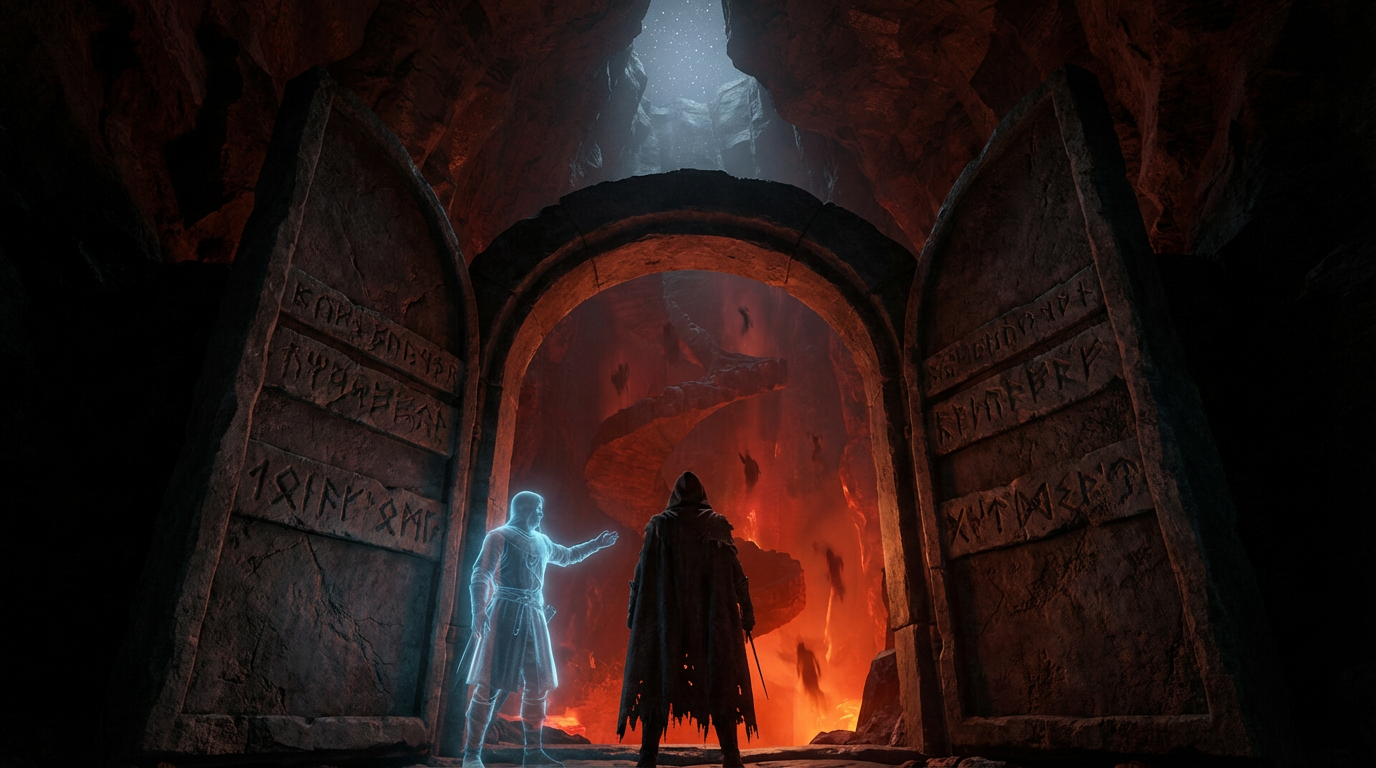
An excerpt from the original text.(complete · 1073 words)
When, disappearing, from our hemisphere,
The world’s enlightener vanishes, and day
On all sides wasteth, suddenly the sky,
Erewhile irradiate only with his beam,
Is yet again unfolded, putting forth
Innumerable lights wherein one shines.
Of such vicissitude in heaven I thought,
As the great sign, that marshaleth the world
And the world’s leaders, in the blessed beak
Was silent; for that all those living lights,
Waxing in splendour, burst forth into songs,
Such as from memory glide and fall away.

Sweet love! that dost apparel thee in smiles,
How lustrous was thy semblance in those sparkles,
Which merely are from holy thoughts inspir’d!

After the precious and bright beaming stones,
That did ingem the sixth light, ceas’d the chiming
Of their angelic bells; methought I heard
The murmuring of a river, that doth fall
From rock to rock transpicuous, making known
The richness of his spring-head: and as sound
Of cistern, at the fret-board, or of pipe,
Is, at the wind-hole, modulate and tun’d;
Thus up the neck, as it were hollow, rose
That murmuring of the eagle, and forthwith
Voice there assum’d, and thence along the beak
Issued in form of words, such as my heart
Did look for, on whose tables I inscrib’d them.

“The part in me, that sees, and bears the sun,,
In mortal eagles,” it began, “must now
Be noted steadfastly: for of the fires,
That figure me, those, glittering in mine eye,
Are chief of all the greatest. This, that shines
Midmost for pupil, was the same, who sang
The Holy Spirit’s song, and bare about
The ark from town to town; now doth he know
The merit of his soul-impassion’d strains
By their well-fitted guerdon. Of the five,
That make the circle of the vision, he
Who to the beak is nearest, comforted
The widow for her son: now doth he know
How dear he costeth not to follow Christ,
Both from experience of this pleasant life,
And of its opposite. He next, who follows
In the circumference, for the over arch,
By true repenting slack’d the pace of death:
Now knoweth he, that the degrees of heav’n
Alter not, when through pious prayer below
Today’s is made tomorrow’s destiny.
The other following, with the laws and me,
To yield the shepherd room, pass’d o’er to Greece,
From good intent producing evil fruit:
Now knoweth he, how all the ill, deriv’d
From his well doing, doth not helm him aught,
Though it have brought destruction on the world.
That, which thou seest in the under bow,
Was William, whom that land bewails, which weeps
For Charles and Frederick living: now he knows
How well is lov’d in heav’n the righteous king,
Which he betokens by his radiant seeming.
Who in the erring world beneath would deem,
That Trojan Ripheus in this round was set
Fifth of the saintly splendours? now he knows
Enough of that, which the world cannot see,
The grace divine, albeit e’en his sight
Reach not its utmost depth.” Like to the lark,
That warbling in the air expatiates long,
Then, trilling out his last sweet melody,
Drops satiate with the sweetness; such appear’d
That image stampt by the’ everlasting pleasure,
Which fashions like itself all lovely things.

I, though my doubting were as manifest,
As is through glass the hue that mantles it,
In silence waited not: for to my lips
“What things are these?” involuntary rush’d,
And forc’d a passage out: whereat I mark’d
A sudden lightening and new revelry.
The eye was kindled: and the blessed sign
No more to keep me wond’ring and suspense,
Replied: “I see that thou believ’st these things,
Because I tell them, but discern’st not how;
So that thy knowledge waits not on thy faith:
As one who knows the name of thing by rote,
But is a stranger to its properties,
Till other’s tongue reveal them. Fervent love
And lively hope with violence assail
The kingdom of the heavens, and overcome
The will of the Most high; not in such sort
As man prevails o’er man; but conquers it,
Because ’tis willing to be conquer’d, still,
Though conquer’d, by its mercy conquering.

“Those, in the eye who live the first and fifth,
Cause thee to marvel, in that thou behold’st
The region of the angels deck’d with them.
They quitted not their bodies, as thou deem’st,
Gentiles but Christians, in firm rooted faith,
This of the feet in future to be pierc’d,
That of feet nail’d already to the cross.
One from the barrier of the dark abyss,
Where never any with good will returns,
Came back unto his bones. Of lively hope
Such was the meed; of lively hope, that wing’d
The prayers sent up to God for his release,
And put power into them to bend his will.
The glorious Spirit, of whom I speak to thee,
A little while returning to the flesh,
Believ’d in him, who had the means to help,
And, in believing, nourish’d such a flame
Of holy love, that at the second death
He was made sharer in our gamesome mirth.
The other, through the riches of that grace,
Which from so deep a fountain doth distil,
As never eye created saw its rising,
Plac’d all his love below on just and right:
Wherefore of grace God op’d in him the eye
To the redemption of mankind to come;
Wherein believing, he endur’d no more
The filth of paganism, and for their ways
Rebuk’d the stubborn nations. The three nymphs,
Whom at the right wheel thou beheldst advancing,
Were sponsors for him more than thousand years
Before baptizing. O how far remov’d,
Predestination! is thy root from such
As see not the First cause entire: and ye,
O mortal men! be wary how ye judge:
For we, who see our Maker, know not yet
The number of the chosen: and esteem
Such scantiness of knowledge our delight:
For all our good is in that primal good
Concentrate, and God’s will and ours are one.”

So, by that form divine, was giv’n to me
Sweet medicine to clear and strengthen sight,
And, as one handling skillfully the harp,
Attendant on some skilful songster’s voice
Bids the chords vibrate, and therein the song
Acquires more pleasure; so, the whilst it spake,
It doth remember me, that I beheld
The pair of blessed luminaries move.
Like the accordant twinkling of two eyes,
Their beamy circlets, dancing to the sounds.
Master this chapter. Complete your experience
Purchase the complete book to access all chapters and support classic literature
As an Amazon Associate, we earn a small commission from qualifying purchases at no additional cost to you.
Available in paperback, hardcover, and e-book formats
Let's Analyse the Pattern
The tendency to categorize people as deserving or undeserving based on limited information, missing opportunities for connection and growth.
Why This Matters
Connect literature to life
This chapter teaches how to spot worth in people others have dismissed by recognizing the gap between appearance and reality.
Practice This Today
This week, notice when you make snap judgments about coworkers or neighbors, then actively look for evidence that contradicts your first impression.
Now let's explore the literary elements.
Key Quotes & Analysis
"The part in me, that sees, and bears the sun, In mortal eagles, must now Be noted steadfastly: for of the fires, That figure me, those, glittering in mine eye, Are chief of all the greatest."
Context: The eagle begins to reveal the identities of the souls that form its eye
The eagle emphasizes that its eye - the part that sees truth most clearly - contains the greatest souls. This establishes a hierarchy of spiritual insight and prepares Dante for the surprising revelations to come.
In Today's Words:
Pay attention to who's really in charge here - the ones with the clearest vision are the most important.
"Now knoweth he how dearly it doth cost Not to follow Christ, by the experience Of this sweet life and of its opposite."
Context: Explaining how Emperor Trajan learned the value of following Christ after being rescued from hell
This reveals how divine education works - even after death, souls can learn and grow. Trajan's experience of both damnation and salvation taught him what he couldn't understand in life.
In Today's Words:
He learned the hard way what he was missing out on by not believing.
"Love conquered, and of love I speak. And hope, that hope which cannot come to shame, Because the love of God is shed abroad In our hearts by the Holy Ghost."
Context: Explaining how divine love and hope can 'conquer' God's will
This paradox shows that God chooses to be moved by genuine devotion. It's not that love overpowers God, but that God's nature is to respond to authentic spiritual longing with mercy.
In Today's Words:
Real love and hope can change everything - even what seems set in stone.
Thematic Threads
Divine Justice
In This Chapter
God's mercy operates beyond human understanding, saving unexpected souls like Ripheus
Development
Evolved from earlier punishment-focused justice to mercy that transcends human categories
In Your Life:
You might discover that fairness isn't always about equal treatment, but about meeting each person's unique needs
Human Limitations
In This Chapter
Even blessed souls don't know the complete number of the saved, finding joy in this ignorance
Development
Continued theme of accepting what we cannot know or control
In Your Life:
You might find peace in admitting you don't have all the answers about who deserves what
Unexpected Grace
In This Chapter
Ripheus the pagan receives salvation through divine enlightenment before Christ
Development
New revelation that grace can reach anyone, regardless of circumstances
In Your Life:
You might be surprised by kindness from people you least expect it from
Love Conquering
In This Chapter
Love and hope can 'conquer' God's will because God chooses to be moved by devotion
Development
Builds on earlier themes of love as the ultimate force in the universe
In Your Life:
You might find that genuine care and persistence can change minds that seemed unchangeable
Paradox Resolution
In This Chapter
Divine mercy appears to contradict justice but actually fulfills it in hidden ways
Development
Continuing exploration of how apparent contradictions reveal deeper truths
In Your Life:
You might discover that what seems unfair in the moment serves a larger purpose you can't yet see
You now have the context. Time to form your own thoughts.
Discussion Questions
- 1
Why was Dante shocked to find Ripheus the Trojan among the saved souls, and what does this reveal about his expectations?
analysis • surface - 2
How does the eagle explain that love and hope can 'conquer' God's will, and what does this suggest about the nature of divine mercy?
analysis • medium - 3
Think about someone you've written off or categorized as 'undeserving.' What assumptions led to that judgment, and what might you be missing?
application • medium - 4
When have you been surprised by grace or mercy from someone who had every right to judge you harshly? How did it change your perspective?
reflection • deep - 5
What does this chapter suggest about the danger of keeping mental scorecards of who deserves what, and how might this apply to workplace dynamics or family relationships?
application • deep
Critical Thinking Exercise
Practice Scorecard Suspension
Think of three people you interact with regularly - at work, in your family, or in your community. For each person, write down your first impression or mental category for them. Then challenge yourself to list three things you don't know about their background, struggles, or hidden strengths. Finally, identify one assumption you might be making that could be limiting your relationship with them.
Consider:
- •Notice how quickly you formed these impressions and what evidence they're based on
- •Consider how your own background and experiences might be shaping these judgments
- •Think about times when someone surprised you by breaking out of the box you'd put them in
Journaling Prompt
Write about a time when someone showed you unexpected grace or gave you a second chance when you didn't deserve it. How did their willingness to suspend judgment about you change your life, and how can you extend that same openness to others?
Coming Up Next...
Chapter 88: The Ladder of Contemplation
Dante's eyes return to Beatrice, but she warns him not to expect her usual smile - her beauty is growing so intense that it would destroy him like lightning. As they ascend to the seventh sphere, her radiance becomes almost unbearable.