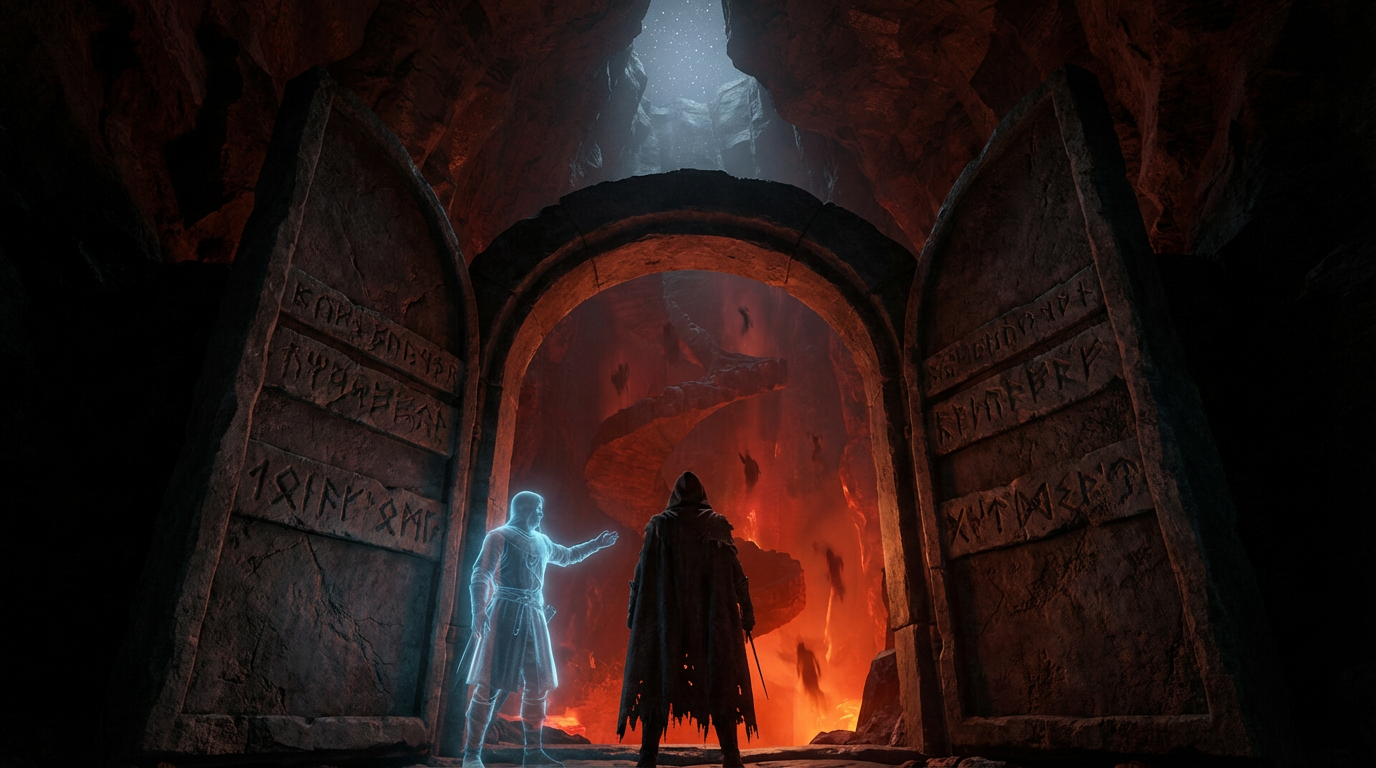
An excerpt from the original text.(complete · 1031 words)
Again mine eyes were fix’d on Beatrice,
And with mine eyes my soul, that in her looks
Found all contentment. Yet no smile she wore
And, “Did I smile,” quoth she, “thou wouldst be straight
Like Semele when into ashes turn’d:
For, mounting these eternal palace-stairs,
My beauty, which the loftier it climbs,
As thou hast noted, still doth kindle more,
So shines, that, were no temp’ring interpos’d,
Thy mortal puissance would from its rays
Shrink, as the leaf doth from the thunderbolt.
Into the seventh splendour are we wafted,
That underneath the burning lion’s breast
Beams, in this hour, commingled with his might,
Thy mind be with thine eyes: and in them mirror’d
The shape, which in this mirror shall be shown.”
Whoso can deem, how fondly I had fed
My sight upon her blissful countenance,
May know, when to new thoughts I chang’d, what joy
To do the bidding of my heav’nly guide:
In equal balance poising either weight.

Within the crystal, which records the name,
(As its remoter circle girds the world)
Of that lov’d monarch, in whose happy reign
No ill had power to harm, I saw rear’d up,
In colour like to sun-illumin’d gold.
A ladder, which my ken pursued in vain,
So lofty was the summit; down whose steps
I saw the splendours in such multitude
Descending, ev’ry light in heav’n, methought,
Was shed thence. As the rooks, at dawn of day
Bestirring them to dry their feathers chill,
Some speed their way a-field, and homeward some,
Returning, cross their flight, while some abide
And wheel around their airy lodge; so seem’d
That glitterance, wafted on alternate wing,
As upon certain stair it met, and clash’d
Its shining. And one ling’ring near us, wax’d
So bright, that in my thought: said: “The love,
Which this betokens me, admits no doubt.”

Unwillingly from question I refrain,
To her, by whom my silence and my speech
Are order’d, looking for a sign: whence she,
Who in the sight of Him, that seeth all,
Saw wherefore I was silent, prompted me
T’ indulge the fervent wish; and I began:
“I am not worthy, of my own desert,
That thou shouldst answer me; but for her sake,
Who hath vouchsaf’d my asking, spirit blest!
That in thy joy art shrouded! say the cause,
Which bringeth thee so near: and wherefore, say,
Doth the sweet symphony of Paradise
Keep silence here, pervading with such sounds
Of rapt devotion ev’ry lower sphere?”
“Mortal art thou in hearing as in sight;”
Was the reply: “and what forbade the smile
Of Beatrice interrupts our song.
Only to yield thee gladness of my voice,
And of the light that vests me, I thus far
Descend these hallow’d steps: not that more love
Invites me; for lo! there aloft, as much
Or more of love is witness’d in those flames:
But such my lot by charity assign’d,
That makes us ready servants, as thou seest,
To execute the counsel of the Highest.
“That in this court,” said I, “O sacred lamp!
Love no compulsion needs, but follows free
Th’ eternal Providence, I well discern:
This harder find to deem, why of thy peers
Thou only to this office wert foredoom’d.”
I had not ended, when, like rapid mill,
Upon its centre whirl’d the light; and then
The love, that did inhabit there, replied:
“Splendour eternal, piercing through these folds,
Its virtue to my vision knits, and thus
Supported, lifts me so above myself,
That on the sov’ran essence, which it wells from,
I have the power to gaze: and hence the joy,
Wherewith I sparkle, equaling with my blaze
The keenness of my sight. But not the soul,
That is in heav’n most lustrous, nor the seraph
That hath his eyes most fix’d on God, shall solve
What thou hast ask’d: for in th’ abyss it lies
Of th’ everlasting statute sunk so low,
That no created ken may fathom it.
And, to the mortal world when thou return’st,
Be this reported; that none henceforth dare
Direct his footsteps to so dread a bourn.
The mind, that here is radiant, on the earth
Is wrapt in mist. Look then if she may do,
Below, what passeth her ability,
When she is ta’en to heav’n.” By words like these
Admonish’d, I the question urg’d no more;
And of the spirit humbly sued alone
T’ instruct me of its state. “’Twixt either shore
Of Italy, nor distant from thy land,
A stony ridge ariseth, in such sort,
The thunder doth not lift his voice so high,
They call it Catria: at whose foot a cell
Is sacred to the lonely Eremite,
For worship set apart and holy rites.”
A third time thus it spake; then added: “There
So firmly to God’s service I adher’d,
That with no costlier viands than the juice
Of olives, easily I pass’d the heats
Of summer and the winter frosts, content
In heav’n-ward musings. Rich were the returns
And fertile, which that cloister once was us’d
To render to these heavens: now ’tis fall’n
Into a waste so empty, that ere long
Detection must lay bare its vanity
Pietro Damiano there was I y-clept:
Pietro the sinner, when before I dwelt
Beside the Adriatic, in the house
Of our blest Lady. Near upon my close
Of mortal life, through much importuning
I was constrain’d to wear the hat that still
From bad to worse it shifted.—Cephas came;
He came, who was the Holy Spirit’s vessel,
Barefoot and lean, eating their bread, as chanc’d,
At the first table. Modern Shepherd’s need
Those who on either hand may prop and lead them,
So burly are they grown: and from behind
Others to hoist them. Down the palfrey’s sides
Spread their broad mantles, so as both the beasts
Are cover’d with one skin. O patience! thou
That lookst on this and doth endure so long.”
I at those accents saw the splendours down
From step to step alight, and wheel, and wax,
Each circuiting, more beautiful. Round this
They came, and stay’d them; uttered them a shout
So loud, it hath no likeness here: nor I
Wist what it spake, so deaf’ning was the thunder.
Master this chapter. Complete your experience
Purchase the complete book to access all chapters and support classic literature
As an Amazon Associate, we earn a small commission from qualifying purchases at no additional cost to you.
Available in paperback, hardcover, and e-book formats
Let's Analyse the Pattern
Institutions corrupt even well-intentioned people by providing comfort and status that distances them from their original purpose.
Why This Matters
Connect literature to life
This chapter teaches how to recognize when organizations corrupt good people by gradually separating them from the people they're meant to serve.
Practice This Today
This week, notice when someone in authority seems disconnected from the reality of the people they manage—ask yourself what privileges or pressures might be influencing their decisions.
Now let's explore the literary elements.
Key Quotes & Analysis
"Did I smile, thou wouldst be straight like Semele when into ashes turned"
Context: Explaining why she cannot smile at Dante in this sphere
This shows how divine beauty becomes so intense it could destroy mortal beings. It's about the overwhelming nature of truth and perfection when we're not ready for it.
In Today's Words:
If I showed you my full self right now, it would blow your mind in a bad way
"No ill had power to harm"
Context: Describing the reign of a beloved monarch reflected in the crystal sphere
This represents an ideal time when leadership was pure and corruption couldn't take hold. It contrasts sharply with the church corruption Pietro will describe.
In Today's Words:
Back when the good guys were actually in charge and nothing could mess that up
"Such divine decisions are beyond human comprehension, buried in God's eternal decrees"
Context: Explaining why he was chosen to speak to Dante
This teaches acceptance of mystery and the limits of human understanding. Some things happen for reasons we'll never grasp, and that's okay.
In Today's Words:
Some things are way above my pay grade, and yours too - we just have to roll with it
Thematic Threads
Class
In This Chapter
The stark contrast between simple hermit life and elaborate cardinal lifestyle shows how institutional elevation creates class division
Development
Continues from earlier themes about social hierarchy, now focusing on how institutions create and maintain class barriers
In Your Life:
You might see this when promoted coworkers suddenly seem out of touch with daily workplace struggles
Identity
In This Chapter
Pietro struggles between his hermit identity and his cardinal role, showing how institutions can force identity conflicts
Development
Builds on previous identity themes by showing how external roles can conflict with authentic self
In Your Life:
You might feel this tension when job requirements conflict with your personal values or background
Social Expectations
In This Chapter
Cardinals are expected to live lavishly while early church leaders lived simply, showing how institutional expectations shift over time
Development
Expands from individual expectations to institutional ones, showing how organizations develop their own pressures
In Your Life:
You might face this when workplace culture expects behaviors that feel wrong to you personally
Personal Growth
In This Chapter
Pietro's spiritual development happened in solitude, but institutional demands pulled him away from that growth
Development
Introduces tension between personal spiritual development and external obligations
In Your Life:
You might recognize this when career advancement opportunities conflict with what actually helps you grow as a person
You now have the context. Time to form your own thoughts.
Discussion Questions
- 1
Why doesn't Beatrice smile when they reach Saturn, and what does Pietro Damiano's simple life on the mountain tell us about spiritual devotion?
analysis • surface - 2
How does Pietro contrast early church leaders like Saint Peter with modern cardinals, and what specific changes does he point out?
analysis • medium - 3
Where do you see this same pattern today—people who started with good intentions but got corrupted by the institutions they joined?
application • medium - 4
If you were promoted to a position of authority in your workplace, what specific steps would you take to avoid becoming disconnected from the people you're supposed to serve?
application • deep - 5
What does Pietro's story teach us about the difference between personal virtue and institutional power, and why even good people can become part of corrupt systems?
reflection • deep
Critical Thinking Exercise
Track Your Institution's Drift
Think of an organization you belong to—your workplace, church, union, or community group. Compare how it operates now versus its original mission or founding principles. List three specific ways the institution has drifted from serving people to serving itself. Then identify one person in leadership who still remembers the original mission.
Consider:
- •Look for gaps between stated values and actual practices
- •Notice who benefits most from current policies and procedures
- •Consider how physical spaces and meeting locations have changed over time
Journaling Prompt
Write about a time when you had to choose between going along with institutional pressure and staying true to your original values. What did you do, and what would you do differently now?
Coming Up Next...
Chapter 89: Looking Down from Heaven's Height
Dante is overwhelmed by the thunderous cry of the contemplative souls, turning to Beatrice for comfort like a frightened child seeking his mother. She reassures him that he's in heaven, where everything is holy and done with perfect intention, preparing to explain the meaning behind the souls' powerful response.