An excerpt from the original text.(complete · 883 words)
Upon the utmost verge of a high bank,
By craggy rocks environ’d round, we came,
Where woes beneath more cruel yet were stow’d:
And here to shun the horrible excess
Of fetid exhalation, upward cast
From the profound abyss, behind the lid
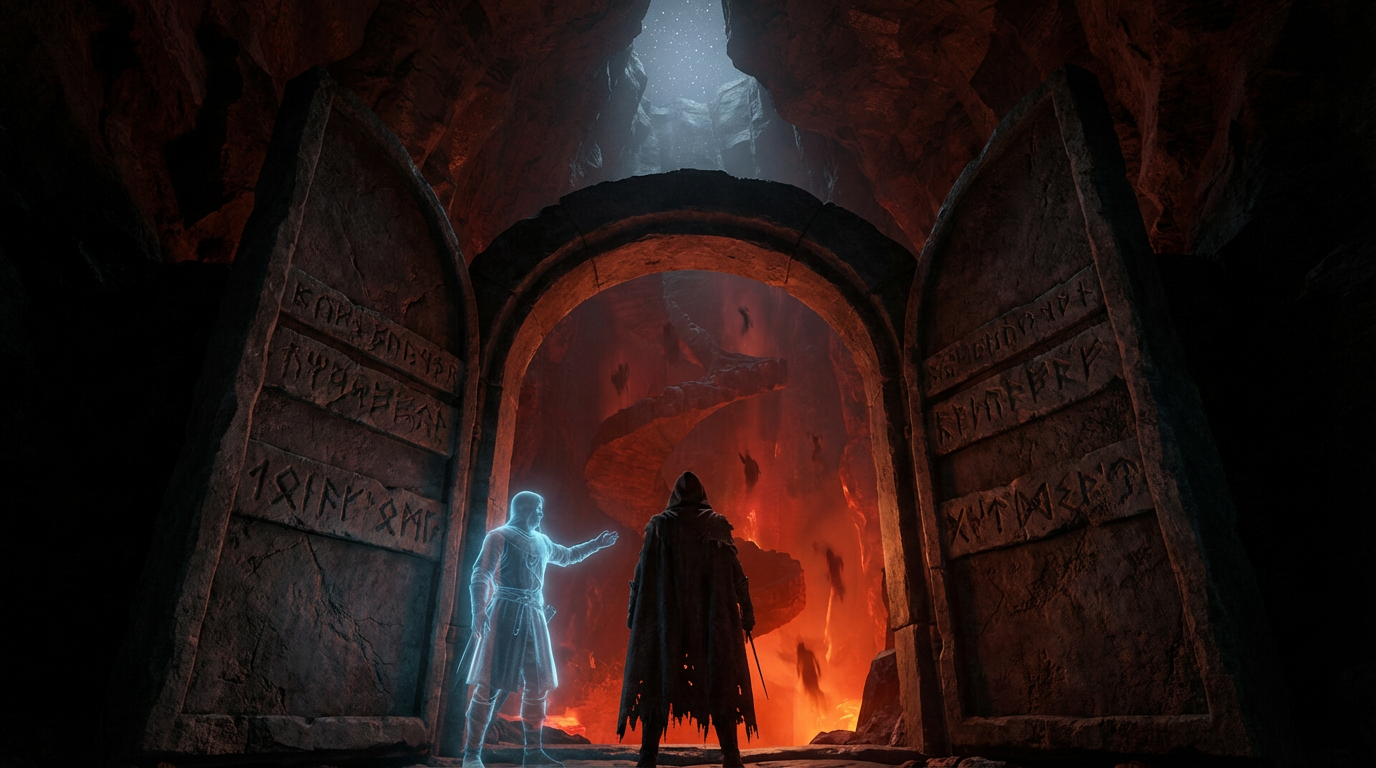
Of a great monument we stood retir’d,
Whereon this scroll I mark’d: “I have in charge
Pope Anastasius, whom Photinus drew
From the right path.—Ere our descent behooves
We make delay, that somewhat first the sense,
To the dire breath accustom’d, afterward
Regard it not.” My master thus; to whom
Answering I spake: “Some compensation find
That the time past not wholly lost.” He then:
“Lo! how my thoughts e’en to thy wishes tend!
My son! within these rocks,” he thus began,
“Are three close circles in gradation plac’d,
As these which now thou leav’st. Each one is full
Of spirits accurs’d; but that the sight alone
Hereafter may suffice thee, listen how
And for what cause in durance they abide.

“Of all malicious act abhorr’d in heaven,
The end is injury; and all such end
Either by force or fraud works other’s woe
But fraud, because of man peculiar evil,
To God is more displeasing; and beneath
The fraudulent are therefore doom’d to’ endure
Severer pang. The violent occupy
All the first circle; and because to force
Three persons are obnoxious, in three rounds
Hach within other sep’rate is it fram’d.
To God, his neighbour, and himself, by man
Force may be offer’d; to himself I say
And his possessions, as thou soon shalt hear
At full. Death, violent death, and painful wounds
Upon his neighbour he inflicts; and wastes
By devastation, pillage, and the flames,
His substance. Slayers, and each one that smites
In malice, plund’rers, and all robbers, hence
The torment undergo of the first round
In different herds. Man can do violence
To himself and his own blessings: and for this
He in the second round must aye deplore
With unavailing penitence his crime,
Whoe’er deprives himself of life and light,
In reckless lavishment his talent wastes,
And sorrows there where he should dwell in joy.
To God may force be offer’d, in the heart
Denying and blaspheming his high power,
And nature with her kindly law contemning.
And thence the inmost round marks with its seal
Sodom and Cahors, and all such as speak
Contemptuously’ of the Godhead in their hearts.

“Fraud, that in every conscience leaves a sting,
May be by man employ’d on one, whose trust
He wins, or on another who withholds
Strict confidence. Seems as the latter way
Broke but the bond of love which Nature makes.
Whence in the second circle have their nest
Dissimulation, witchcraft, flatteries,
Theft, falsehood, simony, all who seduce
To lust, or set their honesty at pawn,
With such vile scum as these. The other way
Forgets both Nature’s general love, and that
Which thereto added afterwards gives birth
To special faith. Whence in the lesser circle,
Point of the universe, dread seat of Dis,
The traitor is eternally consum’d.”

I thus: “Instructor, clearly thy discourse
Proceeds, distinguishing the hideous chasm
And its inhabitants with skill exact.
But tell me this: they of the dull, fat pool,
Whom the rain beats, or whom the tempest drives,
Or who with tongues so fierce conflicting meet,
Wherefore within the city fire-illum’d
Are not these punish’d, if God’s wrath be on them?
And if it be not, wherefore in such guise
Are they condemned?” He answer thus return’d:
“Wherefore in dotage wanders thus thy mind,
Not so accustom’d? or what other thoughts
Possess it? Dwell not in thy memory
The words, wherein thy ethic page describes
Three dispositions adverse to Heav’n’s will,
Incont’nence, malice, and mad brutishness,
And how incontinence the least offends
God, and least guilt incurs? If well thou note
This judgment, and remember who they are,
Without these walls to vain repentance doom’d,
Thou shalt discern why they apart are plac’d
From these fell spirits, and less wreakful pours
Justice divine on them its vengeance down.”

“O Sun! who healest all imperfect sight,
Thou so content’st me, when thou solv’st my doubt,
That ignorance not less than knowledge charms.
Yet somewhat turn thee back,” I in these words
Continu’d, “where thou saidst, that usury
Offends celestial Goodness; and this knot
Perplex’d unravel.” He thus made reply:
“Philosophy, to an attentive ear,
Clearly points out, not in one part alone,
How imitative nature takes her course
From the celestial mind and from its art:
And where her laws the Stagyrite unfolds,
Not many leaves scann’d o’er, observing well
Thou shalt discover, that your art on her
Obsequious follows, as the learner treads
In his instructor’s step, so that your art
Deserves the name of second in descent
From God. These two, if thou recall to mind
Creation’s holy book, from the beginning
Were the right source of life and excellence
To human kind. But in another path
The usurer walks; and Nature in herself
And in her follower thus he sets at nought,
Placing elsewhere his hope. But follow now
My steps on forward journey bent; for now
The Pisces play with undulating glance
Along the’ horizon, and the Wain lies all
O’er the north-west; and onward there a space
Is our steep passage down the rocky height.”
Master this chapter. Complete your experience
Purchase the complete book to access all chapters and support classic literature
As an Amazon Associate, we earn a small commission from qualifying purchases at no additional cost to you.
Available in paperback, hardcover, and e-book formats
Let's Analyse the Pattern
Evil operates in levels based on how much trust and premeditation is involved, with calculated betrayal of special relationships being the worst form.
Why This Matters
Connect literature to life
This chapter teaches how to distinguish between someone acting badly in the moment versus someone systematically exploiting trust.
Practice This Today
This week, notice when someone's story doesn't match their actions, or when they seem to know too much about situations they shouldn't be involved in.
Now let's explore the literary elements.
Key Quotes & Analysis
"But fraud, because of man peculiar evil, To God is more displeasing; and beneath The fraudulent are therefore doom'd to endure Severer pang."
Context: Explaining why fraud is punished worse than violence in Hell's hierarchy
This reveals Dante's belief that what makes us uniquely human - our intelligence and ability to form trust - makes our betrayals more serious than simple animal aggression.
In Today's Words:
Lying and betrayal are worse than violence because only humans can break trust, and that makes it a special kind of evil.
"Of all malicious act abhorr'd in heaven, The end is injury; and all such end Either by force or fraud works other's woe"
Context: Beginning his systematic explanation of how evil works
This shows Dante's logical approach to understanding sin - all deliberate evil ultimately aims to harm others, and there are only two ways to do it.
In Today's Words:
Every truly evil act is designed to hurt someone, and you can only do that through violence or trickery.
"Some compensation find That the time past not wholly lost."
Context: Responding to Virgil's suggestion they wait for their senses to adjust to the stench
Shows Dante's eagerness to learn and make productive use of every moment, even delays. He sees education as the best use of time.
In Today's Words:
Let's make this wait time worth something - teach me something while we're stuck here.
Thematic Threads
Class
In This Chapter
Virgil uses classical education to teach moral categories, showing how knowledge systems help navigate complex situations
Development
Evolved from earlier class tensions to show education as practical survival tool
In Your Life:
Understanding frameworks helps you make better decisions about who to trust and how to respond to betrayal
Identity
In This Chapter
Dante learns to think systematically about evil rather than just reacting emotionally to each sinner
Development
Continued growth from impulsive judge to thoughtful observer
In Your Life:
Your identity strengthens when you can categorize problems instead of being overwhelmed by them
Social Expectations
In This Chapter
Different relationships create different obligations—betraying family, country, or guests carries special weight
Development
Builds on earlier themes about proper social roles and duties
In Your Life:
You can expect more loyalty from family and close friends, and should give it in return
Personal Growth
In This Chapter
Dante develops sophisticated moral reasoning, learning to distinguish between types of wrongdoing
Development
Major advancement from simple moral outrage to nuanced understanding
In Your Life:
Growth means learning to see patterns and systems instead of just reacting to individual events
Human Relationships
In This Chapter
Trust and betrayal are uniquely human capacities that create both our greatest bonds and deepest wounds
Development
Introduced here as central to understanding human evil
In Your Life:
The people closest to you have the most power to help or harm you
You now have the context. Time to form your own thoughts.
Discussion Questions
- 1
According to Virgil, what are the three main categories of evil, and why does fraud get punished more harshly than violence?
analysis • surface - 2
Why does Dante's system put betrayal of special relationships (family, country, benefactors) at the bottom of Hell? What makes these betrayals worse than random violence?
analysis • medium - 3
Think about conflicts in your workplace, family, or community. Can you identify examples of weakness, violence, and fraud? How do people respond differently to each type?
application • medium - 4
When someone wrongs you, how do you decide whether they deserve another chance or need to be cut from your life? How might Dante's hierarchy help you make that decision?
application • deep - 5
Virgil argues that only humans can commit fraud because only we can build complex trust relationships. What does this suggest about the price we pay for being social creatures?
reflection • deep
Critical Thinking Exercise
Map Your Trust Circles
Draw three concentric circles representing different levels of trust in your life. Inner circle: people whose betrayal would devastate you (family, closest friends, partners). Middle circle: important relationships where betrayal would hurt but not destroy you (good friends, trusted colleagues). Outer circle: casual relationships where betrayal would be annoying but manageable. Now think about what each circle has access to in your life and what boundaries protect each level.
Consider:
- •What information, resources, or vulnerabilities does each circle have access to?
- •Have you ever been betrayed by someone from the wrong circle - someone you trusted too much or too little?
- •How do you decide when someone moves between circles, either gaining or losing trust?
Journaling Prompt
Write about a time when someone betrayed your trust. Using Dante's categories, was it weakness, violence, or fraud? How did recognizing the type of betrayal affect how you handled it and whether you gave them another chance?
Coming Up Next...
Chapter 12: The River of Blood
The philosophical lesson ends as Dante and Virgil begin their treacherous descent down the cliff face into the seventh circle. What awaits them is violence in its rawest form—and Dante is about to discover that even in Hell, some encounters require unexpected strategies.