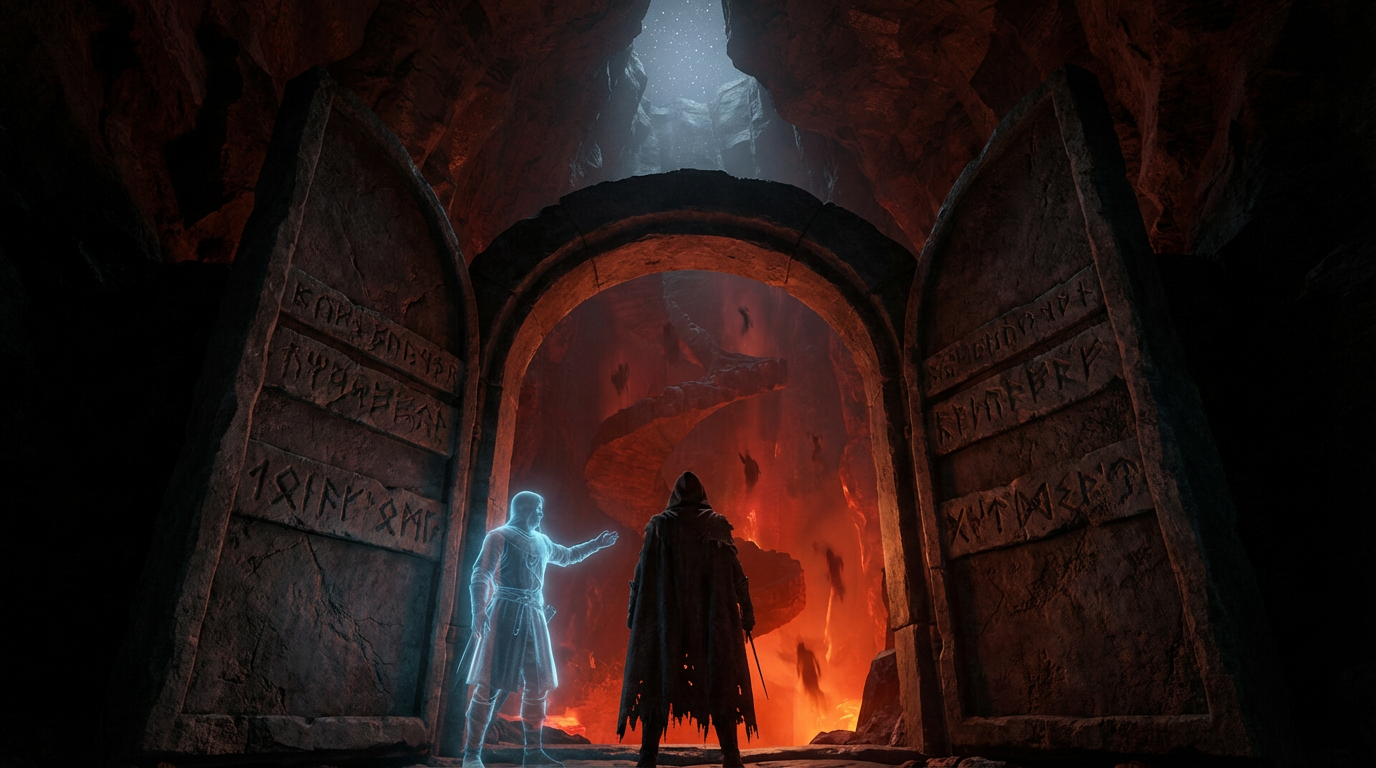
An excerpt from the original text.(complete · 1071 words)
Now by a secret pathway we proceed,
Between the walls, that hem the region round,
And the tormented souls: my master first,
I close behind his steps. “Virtue supreme!”
I thus began; “who through these ample orbs
In circuit lead’st me, even as thou will’st,
Speak thou, and satisfy my wish. May those,
Who lie within these sepulchres, be seen?
Already all the lids are rais’d, and none
O’er them keeps watch.” He thus in answer spake
“They shall be closed all, what-time they here
From Josaphat return’d shall come, and bring
Their bodies, which above they now have left.
The cemetery on this part obtain
With Epicurus all his followers,
Who with the body make the spirit die.
Here therefore satisfaction shall be soon
Both to the question ask’d, and to the wish,
Which thou conceal’st in silence.” I replied:
“I keep not, guide belov’d! from thee my heart
Secreted, but to shun vain length of words,
A lesson erewhile taught me by thyself.”

“O Tuscan! thou who through the city of fire
Alive art passing, so discreet of speech!
Here please thee stay awhile. Thy utterance
Declares the place of thy nativity
To be that noble land, with which perchance
I too severely dealt.” Sudden that sound
Forth issu’d from a vault, whereat in fear
I somewhat closer to my leader’s side
Approaching, he thus spake: “What dost thou? Turn.
Lo, Farinata, there! who hath himself
Uplifted: from his girdle upwards all
Expos’d behold him.” On his face was mine
Already fix’d; his breast and forehead there
Erecting, seem’d as in high scorn he held
E’en hell. Between the sepulchres to him
My guide thrust me with fearless hands and prompt,
This warning added: “See thy words be clear!”

He, soon as there I stood at the tomb’s foot,
Ey’d me a space, then in disdainful mood
Address’d me: “Say, what ancestors were thine?”

I, willing to obey him, straight reveal’d
The whole, nor kept back aught: whence he, his brow
Somewhat uplifting, cried: “Fiercely were they
Adverse to me, my party, and the blood
From whence I sprang: twice therefore I abroad
Scatter’d them.” “Though driv’n out, yet they each time
From all parts,” answer’d I, “return’d; an art
Which yours have shown, they are not skill’d to learn.”

Then, peering forth from the unclosed jaw,
Rose from his side a shade, high as the chin,
Leaning, methought, upon its knees uprais’d.
It look’d around, as eager to explore
If there were other with me; but perceiving
That fond imagination quench’d, with tears
Thus spake: “If thou through this blind prison go’st.
Led by thy lofty genius and profound,
Where is my son? and wherefore not with thee?”

I straight replied: “Not of myself I come,
By him, who there expects me, through this clime
Conducted, whom perchance Guido thy son
Had in contempt.” Already had his words
And mode of punishment read me his name,
Whence I so fully answer’d. He at once
Exclaim’d, up starting, “How! said’st thou he HAD?
No longer lives he? Strikes not on his eye
The blessed daylight?” Then of some delay
I made ere my reply aware, down fell
Supine, not after forth appear’d he more.

Meanwhile the other, great of soul, near whom
I yet was station’d, chang’d not count’nance stern,
Nor mov’d the neck, nor bent his ribbed side.
“And if,” continuing the first discourse,
“They in this art,” he cried, “small skill have shown,
That doth torment me more e’en than this bed.
But not yet fifty times shall be relum’d
Her aspect, who reigns here Queen of this realm,
Ere thou shalt know the full weight of that art.
So to the pleasant world mayst thou return,
As thou shalt tell me, why in all their laws,
Against my kin this people is so fell?”

“The slaughter and great havoc,” I replied,
“That colour’d Arbia’s flood with crimson stain—
To these impute, that in our hallow’d dome
Such orisons ascend.” Sighing he shook
The head, then thus resum’d: “In that affray
I stood not singly, nor without just cause
Assuredly should with the rest have stirr’d;
But singly there I stood, when by consent
Of all, Florence had to the ground been raz’d,
The one who openly forbad the deed.”

“So may thy lineage find at last repose,”
I thus adjur’d him, “as thou solve this knot,
Which now involves my mind. If right I hear,
Ye seem to view beforehand, that which time
Leads with him, of the present uninform’d.”

“We view, as one who hath an evil sight,”
He answer’d, “plainly, objects far remote:
So much of his large spendour yet imparts
The’ Almighty Ruler; but when they approach
Or actually exist, our intellect
Then wholly fails, nor of your human state
Except what others bring us know we aught.
Hence therefore mayst thou understand, that all
Our knowledge in that instant shall expire,
When on futurity the portals close.”

Then conscious of my fault, and by remorse
Smitten, I added thus: “Now shalt thou say
To him there fallen, that his offspring still
Is to the living join’d; and bid him know,
That if from answer silent I abstain’d,
’Twas that my thought was occupied intent
Upon that error, which thy help hath solv’d.”

But now my master summoning me back
I heard, and with more eager haste besought
The spirit to inform me, who with him
Partook his lot. He answer thus return’d:

“More than a thousand with me here are laid
Within is Frederick, second of that name,
And the Lord Cardinal, and of the rest
I speak not.” He, this said, from sight withdrew.
But I my steps towards the ancient bard
Reverting, ruminated on the words
Betokening me such ill. Onward he mov’d,
And thus in going question’d: “Whence the’ amaze
That holds thy senses wrapt?” I satisfied
The’ inquiry, and the sage enjoin’d me straight:
“Let thy safe memory store what thou hast heard
To thee importing harm; and note thou this,”
With his rais’d finger bidding me take heed,

“When thou shalt stand before her gracious beam,
Whose bright eye all surveys, she of thy life
The future tenour will to thee unfold.”

Forthwith he to the left hand turn’d his feet:
We left the wall, and tow’rds the middle space
Went by a path, that to a valley strikes;
Which e’en thus high exhal’d its noisome steam.
Master this chapter. Complete your experience
Purchase the complete book to access all chapters and support classic literature
As an Amazon Associate, we earn a small commission from qualifying purchases at no additional cost to you.
Available in paperback, hardcover, and e-book formats
Let's Analyse the Pattern
When group loyalty becomes so strong it prevents us from seeing present reality or making moral choices based on individual judgment.
Why This Matters
Connect literature to life
This chapter teaches how to recognize when group loyalty prevents us from seeing present reality clearly.
Practice This Today
This week, notice when you dismiss good ideas because they come from the 'wrong' person or department, then ask yourself what you're really defending.
Now let's explore the literary elements.
Key Quotes & Analysis
"O Tuscan! thou who through the city of fire / Alive art passing, so discreet of speech!"
Context: Farinata recognizes Dante's Florentine accent and calls out to him from his burning tomb
Even in Hell, Farinata shows pride in his origins and respects eloquent speech. This reveals how our deepest identities - regional, cultural, intellectual - persist even in the worst circumstances.
In Today's Words:
Hey, you're from my hometown! I can tell by how you talk, and I respect that you're well-spoken.
"Thy utterance / Declares the place of thy nativity / To be that noble land, with which perchance / I too severely dealt."
Context: Farinata admits he may have been too harsh in his political actions against Florence
This shows remarkable self-awareness from someone who could easily blame others. Even the proud and damned can acknowledge when they went too far, suggesting that moral clarity sometimes comes only in hindsight.
In Today's Words:
I can tell you're from that great city that I probably treated too harshly back in the day.
"But we, like those who have imperfect sight, / Things distant see, when they shine clear to us"
Context: Explaining why the damned can see the future but not the present
This creates a perfect metaphor for how obsession with long-term consequences can blind us to immediate reality. The damned's punishment fits their crime - they rejected present spiritual truth, so now they can't see present truth at all.
In Today's Words:
We're like people who need reading glasses - we can see far away just fine, but everything up close is blurry.
Thematic Threads
Pride
In This Chapter
Farinata stands tall in his burning tomb, showing no shame about his damnation, still defending his political choices
Development
Evolved from earlier chapters where pride led to punishment; here pride prevents learning from consequences
In Your Life:
You might refuse to admit mistakes at work because it would damage your reputation, even when admitting error would help the team
Class
In This Chapter
Farinata immediately recognizes Dante as Florentine nobility through his speech, and their conflict centers on which family controlled the city
Development
Developed from earlier focus on social hierarchies; here class creates permanent divisions that survive even death
In Your Life:
You might find yourself automatically distrusting or deferring to people based on their accent, education, or job title rather than their actual character
Knowledge
In This Chapter
The damned can see the future but know nothing of the present—Cavalcante doesn't know if his son is alive or dead
Development
Introduced here as a new limitation; knowledge becomes incomplete and distorted when disconnected from present reality
In Your Life:
You might be so focused on long-term career plans that you miss obvious signs your current job is in jeopardy
Identity
In This Chapter
Both men's identities are so tied to their political factions that they can't move beyond old conflicts even in Hell
Development
Evolved from personal identity struggles to show how group identity can become a prison
In Your Life:
You might define yourself so strongly by your profession, political views, or family role that you can't adapt when circumstances change
Human Relationships
In This Chapter
Cavalcante's love for his son Guido creates both connection and anguish when he misunderstands Dante's words about his son's fate
Development
Developed to show how love persists even in damnation but becomes a source of torment when communication fails
In Your Life:
You might avoid difficult conversations with loved ones to protect them, but your silence creates more worry and misunderstanding than honesty would
You now have the context. Time to form your own thoughts.
Discussion Questions
- 1
Why do Dante and Farinata immediately start arguing about old political fights, even though they're both in Hell?
analysis • surface - 2
What does it mean that the damned can see the future but not the present? How does this connect to their earthly behavior?
analysis • medium - 3
Where do you see people today getting so caught up in defending their 'side' that they miss what's actually happening around them?
application • medium - 4
Farinata once stood against his own allies to save Florence. When might you need to break with your group to do what's right?
application • deep - 5
What's the difference between healthy loyalty and tribal blindness? How can you tell when you've crossed the line?
reflection • deep
Critical Thinking Exercise
Map Your Tribal Blindspots
Think of a current disagreement in your workplace, family, or community where people have taken strong sides. Write down what each side believes and why. Then identify what important information or concerns each side might be missing because they're focused on defending their position rather than solving the problem.
Consider:
- •Notice when you feel defensive about your group's position - that's often where blindspots hide
- •Look for valid points from the 'other side' that your group dismisses without really considering
- •Identify what everyone actually wants underneath the surface arguments
Journaling Prompt
Write about a time when you realized you were wrong about something important because you were too invested in being on the 'right' team. What helped you see past your tribal loyalty?
Coming Up Next...
Chapter 11: The Architecture of Evil
As they leave the burning tombs behind, Dante and Virgil approach the edge of a great cliff where even more terrible punishments await. The stench rising from the depths below is so overwhelming they must take shelter behind a monument to prepare for their descent into deeper horrors.