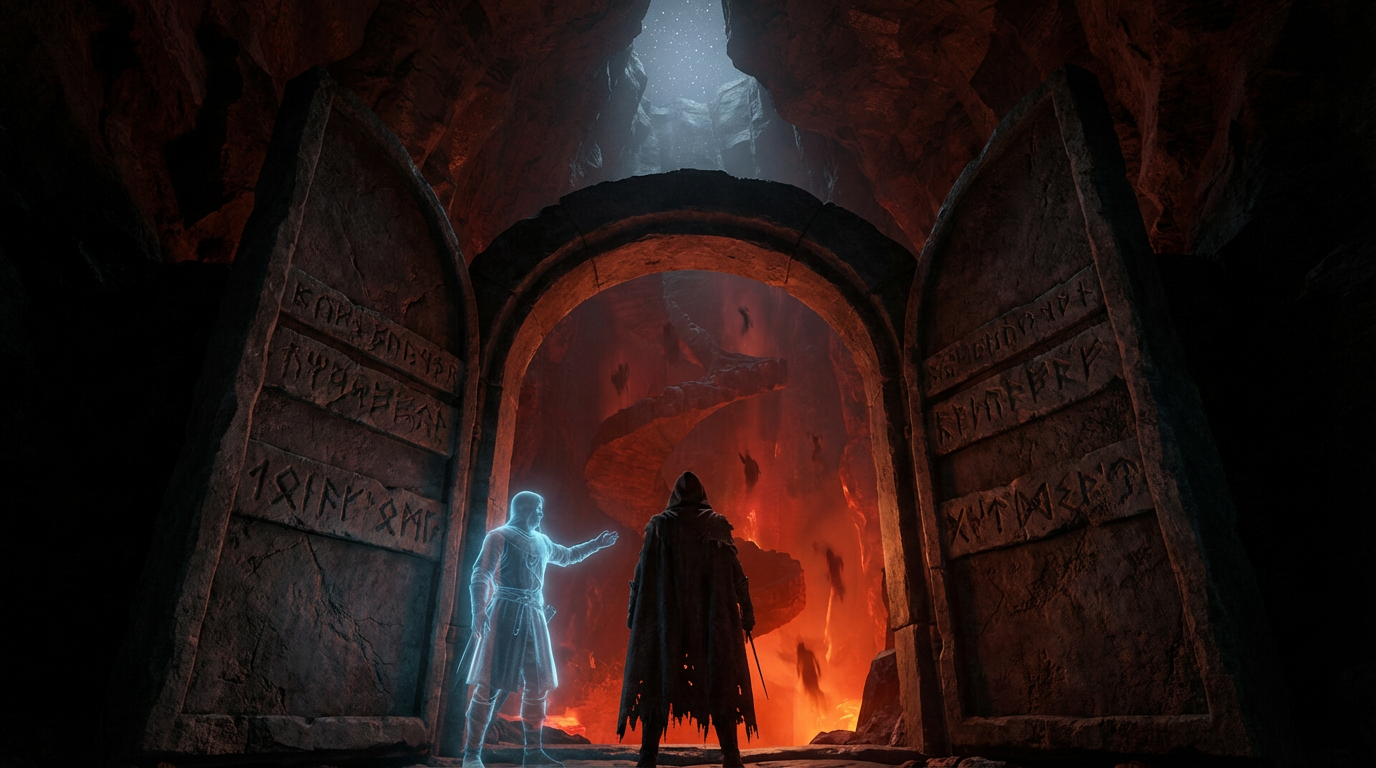
An excerpt from the original text.(complete · 1007 words)
The hue, which coward dread on my pale cheeks
Imprinted, when I saw my guide turn back,
Chas’d that from his which newly they had worn,
And inwardly restrain’d it. He, as one
Who listens, stood attentive: for his eye
Not far could lead him through the sable air,
And the thick-gath’ring cloud. “It yet behooves
We win this fight”—thus he began—” if not—
Such aid to us is offer’d.—Oh, how long
Me seems it, ere the promis’d help arrive!”

I noted, how the sequel of his words
Clok’d their beginning; for the last he spake
Agreed not with the first. But not the less
My fear was at his saying; sith I drew
To import worse perchance, than that he held,
His mutilated speech. “Doth ever any
Into this rueful concave’s extreme depth
Descend, out of the first degree, whose pain
Is deprivation merely of sweet hope?”

Thus I inquiring. “Rarely,” he replied,
“It chances, that among us any makes
This journey, which I wend. Erewhile ’tis true
Once came I here beneath, conjur’d by fell
Erictho, sorceress, who compell’d the shades
Back to their bodies. No long space my flesh
Was naked of me, when within these walls
She made me enter, to draw forth a spirit
From out of Judas’ circle. Lowest place
Is that of all, obscurest, and remov’d
Farthest from heav’n’s all-circling orb. The road
Full well I know: thou therefore rest secure.
That lake, the noisome stench exhaling, round
The city’ of grief encompasses, which now
We may not enter without rage.” Yet more
He added: but I hold it not in mind,
For that mine eye toward the lofty tower
Had drawn me wholly, to its burning top.
Where in an instant I beheld uprisen
At once three hellish furies stain’d with blood:
In limb and motion feminine they seem’d;
Around them greenest hydras twisting roll’d
Their volumes; adders and cerastes crept
Instead of hair, and their fierce temples bound.

He knowing well the miserable hags
Who tend the queen of endless woe, thus spake:
“Mark thou each dire Erinnys. To the left
This is Megaera; on the right hand she,
Who wails, Alecto; and Tisiphone
I’ th’ midst.” This said, in silence he remain’d
Their breast they each one clawing tore; themselves
Smote with their palms, and such shrill clamour rais’d,
That to the bard I clung, suspicion-bound.
“Hasten Medusa: so to adamant
Him shall we change;” all looking down exclaim’d.
“E’en when by Theseus’ might assail’d, we took
No ill revenge.” “Turn thyself round, and keep
Thy count’nance hid; for if the Gorgon dire
Be shown, and thou shouldst view it, thy return
Upwards would be for ever lost.” This said,
Himself my gentle master turn’d me round,
Nor trusted he my hands, but with his own
He also hid me. Ye of intellect
Sound and entire, mark well the lore conceal’d
Under close texture of the mystic strain!

And now there came o’er the perturbed waves
Loud-crashing, terrible, a sound that made
Either shore tremble, as if of a wind
Impetuous, from conflicting vapours sprung,
That ’gainst some forest driving all its might,
Plucks off the branches, beats them down and hurls
Afar; then onward passing proudly sweeps
Its whirlwind rage, while beasts and shepherds fly.

Mine eyes he loos’d, and spake: “And now direct
Thy visual nerve along that ancient foam,
There, thickest where the smoke ascends.” As frogs
Before their foe the serpent, through the wave
Ply swiftly all, till at the ground each one
Lies on a heap; more than a thousand spirits
Destroy’d, so saw I fleeing before one
Who pass’d with unwet feet the Stygian sound.
He, from his face removing the gross air,
Oft his left hand forth stretch’d, and seem’d alone
By that annoyance wearied. I perceiv’d
That he was sent from heav’n, and to my guide
Turn’d me, who signal made that I should stand
Quiet, and bend to him. Ah me! how full
Of noble anger seem’d he! To the gate
He came, and with his wand touch’d it, whereat
Open without impediment it flew.

“Outcasts of heav’n! O abject race and scorn’d!”
Began he on the horrid grunsel standing,
“Whence doth this wild excess of insolence
Lodge in you? wherefore kick you ’gainst that will
Ne’er frustrate of its end, and which so oft
Hath laid on you enforcement of your pangs?
What profits at the fays to but the horn?
Your Cerberus, if ye remember, hence
Bears still, peel’d of their hair, his throat and maw.”

This said, he turn’d back o’er the filthy way,
And syllable to us spake none, but wore
The semblance of a man by other care
Beset, and keenly press’d, than thought of him
Who in his presence stands. Then we our steps
Toward that territory mov’d, secure
After the hallow’d words. We unoppos’d
There enter’d; and my mind eager to learn
What state a fortress like to that might hold,
I soon as enter’d throw mine eye around,
And see on every part wide-stretching space
Replete with bitter pain and torment ill.

As where Rhone stagnates on the plains of Arles,
Or as at Pola, near Quarnaro’s gulf,
That closes Italy and laves her bounds,
The place is all thick spread with sepulchres;
So was it here, save what in horror here
Excell’d: for ’midst the graves were scattered flames,
Wherewith intensely all throughout they burn’d,
That iron for no craft there hotter needs.

Their lids all hung suspended, and beneath
From them forth issu’d lamentable moans,
Such as the sad and tortur’d well might raise.

I thus: “Master! say who are these, interr’d
Within these vaults, of whom distinct we hear
The dolorous sighs?” He answer thus return’d:

“The arch-heretics are here, accompanied
By every sect their followers; and much more,
Than thou believest, tombs are freighted: like
With like is buried; and the monuments
Are different in degrees of heat. “This said,
He to the right hand turning, on we pass’d
Betwixt the afflicted and the ramparts high.
Master this chapter. Complete your experience
Purchase the complete book to access all chapters and support classic literature
As an Amazon Associate, we earn a small commission from qualifying purchases at no additional cost to you.
Available in paperback, hardcover, and e-book formats
Let's Analyse the Pattern
The moment when personal strength and skill prove insufficient, requiring external help or intervention to continue forward.
Why This Matters
Connect literature to life
This chapter teaches how to distinguish between challenges you can overcome through effort and barriers that require different strategies or outside help.
Practice This Today
This week, notice when you're spinning your wheels on a problem—ask yourself if this is something more effort will solve, or if you need different resources, connections, or approaches.
Now let's explore the literary elements.
Key Quotes & Analysis
"It yet behooves we win this fight—if not— Such aid to us is offer'd."
Context: Virgil's incomplete sentence when facing the blocked gates, showing his uncertainty
This broken speech terrifies Dante more than any monster because it reveals that even his trusted guide doesn't know what to do. The incomplete thought shows Virgil's internal struggle between confidence and doubt.
In Today's Words:
We have to figure this out somehow— unless— well, maybe we'll get help.
"Rarely it chances, that among us any makes this journey, which I wend."
Context: Explaining that few from Limbo have traveled to lower Hell
Virgil admits he's not as experienced as he seemed, which both reassures and worries Dante. It shows that even guides are learning and growing through their experiences.
In Today's Words:
I don't usually come down this far either.
"Oh, how long me seems it, ere the promis'd help arrive!"
Context: Waiting anxiously for divine intervention at the gates
Shows Virgil's very human impatience and worry while waiting for help beyond his control. Even wise mentors struggle with uncertainty and the need to depend on others.
In Today's Words:
This wait for help is killing me!
Thematic Threads
Pride
In This Chapter
Virgil's uncertainty shatters the illusion that wisdom and reason can solve everything
Development
Evolved from earlier confidence to revealing the limits of human knowledge
In Your Life:
You might feel this when your expertise isn't enough to solve a family crisis
Authority
In This Chapter
Divine messenger effortlessly opens gates that demons cannot keep closed, demonstrating true versus false power
Development
Introduced here as contrast between demonic rebellion and divine authority
In Your Life:
You see this when company policies crumble before legal intervention or union action
Intellectual Limits
In This Chapter
Burning tombs of heretics who denied spiritual truth through intellectual pride
Development
New theme showing consequences of rejecting wisdom beyond reason
In Your Life:
You might recognize this when book knowledge fails to help with real-world problems
Protection
In This Chapter
Virgil covers Dante's eyes to protect him from Medusa's deadly gaze
Development
Evolved from guidance to active protection against spiritual dangers
In Your Life:
You see this when experienced coworkers shield you from toxic workplace situations
Divine Intervention
In This Chapter
Heavenly messenger arrives precisely when human effort fails completely
Development
Introduced here as solution to insurmountable obstacles
In Your Life:
You might experience this when unexpected help arrives during your darkest moments
You now have the context. Time to form your own thoughts.
Discussion Questions
- 1
What happens when Virgil shows uncertainty for the first time, and why does this terrify Dante more than any monster they've encountered?
analysis • surface - 2
Why do you think Virgil immediately covers Dante's eyes when the Furies threaten to summon Medusa, rather than letting him face the danger?
analysis • medium - 3
Think about a time when someone you trusted showed doubt or uncertainty. How did that affect your own confidence in the situation?
application • medium - 4
The heavenly messenger opens gates that demons couldn't keep closed. What does this suggest about different types of power and authority in our own lives?
application • deep - 5
What does this chapter teach us about the difference between admitting limitations and giving up entirely?
reflection • deep
Critical Thinking Exercise
Map Your Support Network
Think of a current challenge you're facing where your usual approaches aren't working. Draw a simple map showing: 1) What you've already tried, 2) What resources or people you haven't asked for help yet, and 3) What 'gates' in your life might need external help to open. Sometimes the path forward requires admitting we can't do it alone.
Consider:
- •Consider both formal help (professionals, institutions) and informal support (friends, family, community)
- •Think about what pride or fear might be keeping you from seeking certain types of help
- •Remember that asking for help is a skill, not a weakness
Journaling Prompt
Write about a time when you had to accept help to move forward. What did that teach you about the difference between independence and isolation?
Coming Up Next...
Chapter 10: Conversations with the Dead
Among the burning tombs, Dante will encounter heretics who challenged fundamental beliefs about the afterlife. These conversations will test his own faith and reveal how intellectual arrogance can become its own form of hell.