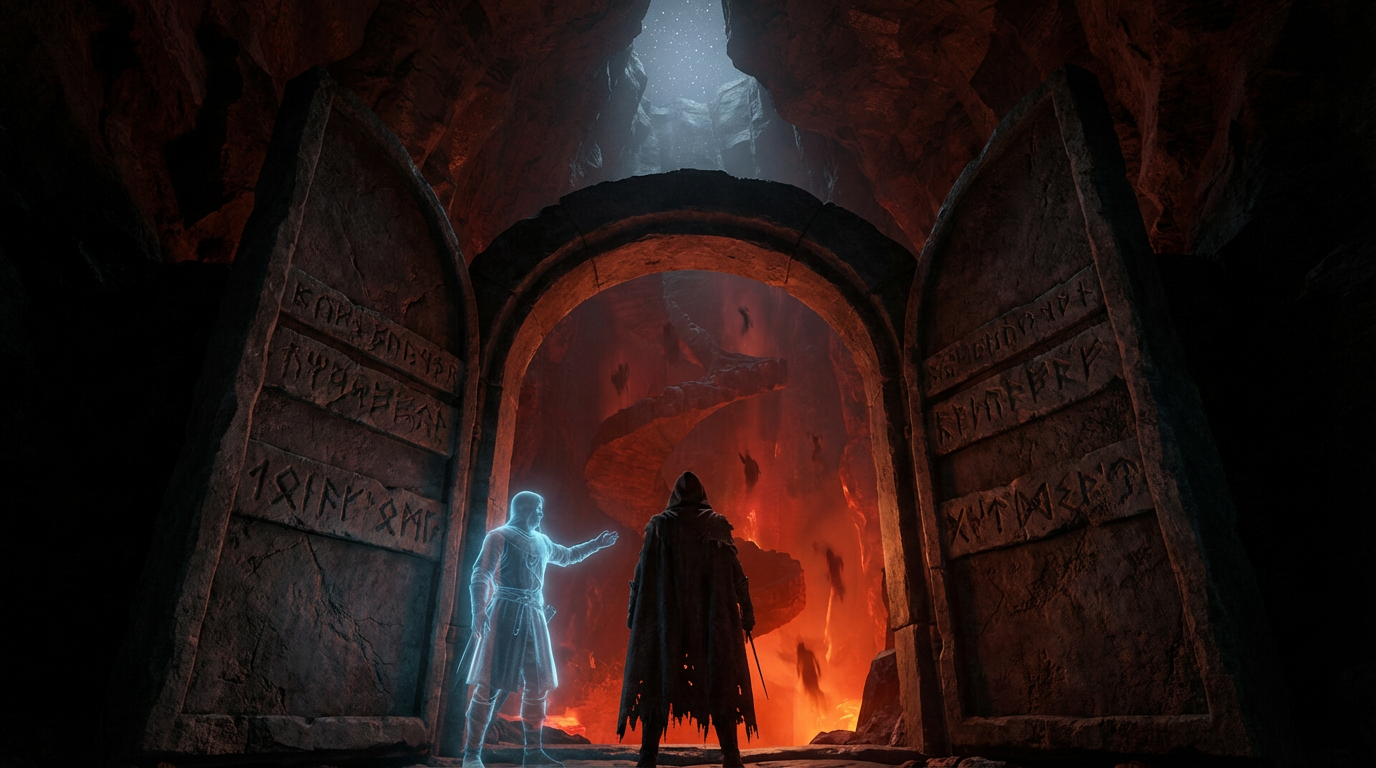
An excerpt from the original text.(complete · 1005 words)
My theme pursuing, I relate that ere
We reach’d the lofty turret’s base, our eyes
Its height ascended, where two cressets hung
We mark’d, and from afar another light
Return the signal, so remote, that scarce
The eye could catch its beam. I turning round
To the deep source of knowledge, thus inquir’d:
“Say what this means? and what that other light
In answer set? what agency doth this?”

“There on the filthy waters,” he replied,
“E’en now what next awaits us mayst thou see,
If the marsh-gender’d fog conceal it not.”

Never was arrow from the cord dismiss’d,
That ran its way so nimbly through the air,
As a small bark, that through the waves I spied
Toward us coming, under the sole sway
Of one that ferried it, who cried aloud:
“Art thou arriv’d, fell spirit?”—“Phlegyas, Phlegyas,
This time thou criest in vain,” my lord replied;
“No longer shalt thou have us, but while o’er
The slimy pool we pass.” As one who hears
Of some great wrong he hath sustain’d, whereat
Inly he pines; so Phlegyas inly pin’d
In his fierce ire. My guide descending stepp’d
Into the skiff, and bade me enter next
Close at his side; nor till my entrance seem’d
The vessel freighted. Soon as both embark’d,
Cutting the waves, goes on the ancient prow,
More deeply than with others it is wont.

While we our course o’er the dead channel held.
One drench’d in mire before me came, and said;
“Who art thou, that thou comest ere thine hour?”

I answer’d: “Though I come, I tarry not;
But who art thou, that art become so foul?”

“One, as thou seest, who mourn: “ he straight replied.

To which I thus: “ In mourning and in woe,
Curs’d spirit! tarry thou. I know thee well,
E’en thus in filth disguis’d.” Then stretch’d he forth
Hands to the bark; whereof my teacher sage
Aware, thrusting him back: “Away! down there
To the’ other dogs!” then, with his arms my neck
Encircling, kiss’d my cheek, and spake: “O soul
Justly disdainful! blest was she in whom
Thou was conceiv’d! He in the world was one
For arrogance noted; to his memory
No virtue lends its lustre; even so
Here is his shadow furious. There above
How many now hold themselves mighty kings
Who here like swine shall wallow in the mire,
Leaving behind them horrible dispraise!”

I then: “Master! him fain would I behold
Whelm’d in these dregs, before we quit the lake.”

He thus: “Or ever to thy view the shore
Be offer’d, satisfied shall be that wish,
Which well deserves completion.” Scarce his words
Were ended, when I saw the miry tribes
Set on him with such violence, that yet
For that render I thanks to God and praise
“To Filippo Argenti:” cried they all:
And on himself the moody Florentine
Turn’d his avenging fangs. Him here we left,
Nor speak I of him more. But on mine ear
Sudden a sound of lamentation smote,
Whereat mine eye unbarr’d I sent abroad.

And thus the good instructor: “Now, my son!
Draws near the city, that of Dis is nam’d,
With its grave denizens, a mighty throng.”

I thus: “The minarets already, Sir!
There certes in the valley I descry,
Gleaming vermilion, as if they from fire
Had issu’d.” He replied: “Eternal fire,
That inward burns, shows them with ruddy flame
Illum’d; as in this nether hell thou seest.”

We came within the fosses deep, that moat
This region comfortless. The walls appear’d
As they were fram’d of iron. We had made
Wide circuit, ere a place we reach’d, where loud
The mariner cried vehement: “Go forth!
The’ entrance is here!” Upon the gates I spied
More than a thousand, who of old from heaven
Were hurl’d. With ireful gestures, “Who is this,”
They cried, “that without death first felt, goes through
The regions of the dead?” My sapient guide
Made sign that he for secret parley wish’d;
Whereat their angry scorn abating, thus
They spake: “Come thou alone; and let him go
Who hath so hardily enter’d this realm.
Alone return he by his witless way;
If well he know it, let him prove. For thee,
Here shalt thou tarry, who through clime so dark
Hast been his escort.” Now bethink thee, reader!
What cheer was mine at sound of those curs’d words.
I did believe I never should return.

“O my lov’d guide! who more than seven times
Security hast render’d me, and drawn
From peril deep, whereto I stood expos’d,
Desert me not,” I cried, “in this extreme.
And if our onward going be denied,
Together trace we back our steps with speed.”

My liege, who thither had conducted me,
Replied: “Fear not: for of our passage none
Hath power to disappoint us, by such high
Authority permitted. But do thou
Expect me here; meanwhile thy wearied spirit
Comfort, and feed with kindly hope, assur’d
I will not leave thee in this lower world.”

This said, departs the sire benevolent,
And quits me. Hesitating I remain
At war ’twixt will and will not in my thoughts.

I could not hear what terms he offer’d them,
But they conferr’d not long, for all at once
To trial fled within. Clos’d were the gates
By those our adversaries on the breast
Of my liege lord: excluded he return’d
To me with tardy steps. Upon the ground
His eyes were bent, and from his brow eras’d
All confidence, while thus with sighs he spake:
“Who hath denied me these abodes of woe?”
Then thus to me: “That I am anger’d, think
No ground of terror: in this trial I
Shall vanquish, use what arts they may within
For hindrance. This their insolence, not new,
Erewhile at gate less secret they display’d,
Which still is without bolt; upon its arch
Thou saw’st the deadly scroll: and even now
On this side of its entrance, down the steep,
Passing the circles, unescorted, comes
One whose strong might can open us this land.”
Master this chapter. Complete your experience
Purchase the complete book to access all chapters and support classic literature
As an Amazon Associate, we earn a small commission from qualifying purchases at no additional cost to you.
Available in paperback, hardcover, and e-book formats
Let's Analyse the Pattern
How justified anger against wrong behavior gradually transforms us into the very kind of person we originally opposed.
Why This Matters
Connect literature to life
This chapter teaches us to recognize the moment when defending ourselves transforms into attacking others.
Practice This Today
This week, notice when you feel angry at someone's behavior—ask yourself if you're trying to solve the problem or punish the person.
Now let's explore the literary elements.
Key Quotes & Analysis
"Phlegyas, Phlegyas, this time thou criest in vain"
Context: When the angry ferryman demands to know if Dante is a damned spirit
Virgil calmly asserts his authority over the raging boatman, showing that reason and divine purpose can control even violent anger. This demonstrates Virgil's wisdom in handling aggressive personalities.
In Today's Words:
Save your drama - we're just passing through
"Who art thou, that comest here before thy time?"
Context: When the muddy soul confronts Dante in the river
Argenti's arrogant challenge reveals his continued pride even in punishment. He still thinks he has the right to question others, showing how some people never learn humility even when facing consequences.
In Today's Words:
Who do you think you are, cutting in line?
"Blessed be she that bare thee, for in thee is kindled righteous anger"
Context: After Dante harshly condemns Argenti
Virgil praises Dante's moral development, recognizing that anger at evil is virtuous, not sinful. This marks Dante's growth from passive observer to active moral judge.
In Today's Words:
Good for you - sometimes people deserve to be called out
"Master, already in the valley there I discern the vermillion mosques"
Context: As they approach the glowing city of Dis
Dante sees the red-glowing towers of the infernal city, marking their arrival at organized, deliberate evil. The imagery suggests both beauty and menace - evil can appear impressive while remaining fundamentally wrong.
In Today's Words:
I can see those red buildings glowing up ahead
Thematic Threads
Pride
In This Chapter
Argenti's arrogance in life now traps him in mud, while Dante's pride in his own righteousness makes him cruel
Development
Evolved from earlier focus on personal pride to showing how pride corrupts even our moral responses
In Your Life:
Notice when feeling morally superior makes you treat others worse than you'd want to be treated
Class
In This Chapter
Dante recognizes Argenti as a fellow Florentine but shows no mercy based on shared background
Development
Continues theme of how shared identity doesn't guarantee compassion or understanding
In Your Life:
Being from the same place, job, or background doesn't automatically make someone an ally
Authority
In This Chapter
Virgil's wisdom fails at the gates of Dis, showing even the best guides have limitations
Development
First time Virgil appears uncertain, introducing theme of authority's limits
In Your Life:
Even your most trusted mentors and advisors will eventually reach situations beyond their expertise
Fear
In This Chapter
Dante panics when Virgil can't get them through the gates and might have to continue alone
Development
Introduced here as Dante faces the possibility of losing his guide
In Your Life:
The fear of losing support often reveals how much we've been depending on others to navigate challenges
Social Expectations
In This Chapter
The fallen angels expect Dante to turn back because he doesn't belong in their realm yet
Development
Continues theme of being challenged for not fitting expected categories
In Your Life:
People will often try to exclude you from spaces they think you don't belong in
You now have the context. Time to form your own thoughts.
Discussion Questions
- 1
What happens when Dante encounters Filippo Argenti in the marsh, and how does Dante's reaction surprise us?
analysis • surface - 2
Why does Virgil praise Dante for his harsh treatment of Argenti, and what does this reveal about how anger can feel justified?
analysis • medium - 3
Where do you see people today becoming cruel while believing they're being righteous - in families, workplaces, or online spaces?
application • medium - 4
How can you tell the difference between setting healthy boundaries and becoming the aggressor when someone's behavior genuinely bothers you?
application • deep - 5
What does this chapter teach us about how fighting monsters can turn us into monsters ourselves?
reflection • deep
Critical Thinking Exercise
Track Your Righteous Anger
Think of someone whose behavior genuinely frustrates you - a coworker, family member, or public figure. Write down what they do that bothers you, then honestly examine your own response. Are you addressing the behavior or attacking the person? Are you trying to solve a problem or punish them? What would a neutral observer think of your reactions?
Consider:
- •Notice when your anger feels completely justified - that's often when it's most dangerous
- •Pay attention to whether you're starting to enjoy the other person's struggles or failures
- •Ask yourself if your methods match your values, regardless of how wrong the other person is
Journaling Prompt
Write about a time when your justified anger led you to become harsher than you intended. What warning signs could you watch for next time to stay on the right side of the line between justice and vengeance?
Coming Up Next...
Chapter 9: The Heavenly Messenger Opens the Gate
As Virgil struggles to maintain his composure after being rejected at the gates of Dis, both he and Dante must wait for the mysterious powerful figure who can break through where even the great Roman poet cannot. The tension builds as they face their greatest obstacle yet.