
What to expect ahead
What follows is a compact summary of each chapter in the book, designed to help you quickly grasp the core ideas while inviting you to continue into the full original text. Even when chapter text is presented here, these summaries are meant as a gateway to understanding, so your eventual reading of the complete book feels richer, deeper, and more fully appreciated.
Little Women
A Brief Description
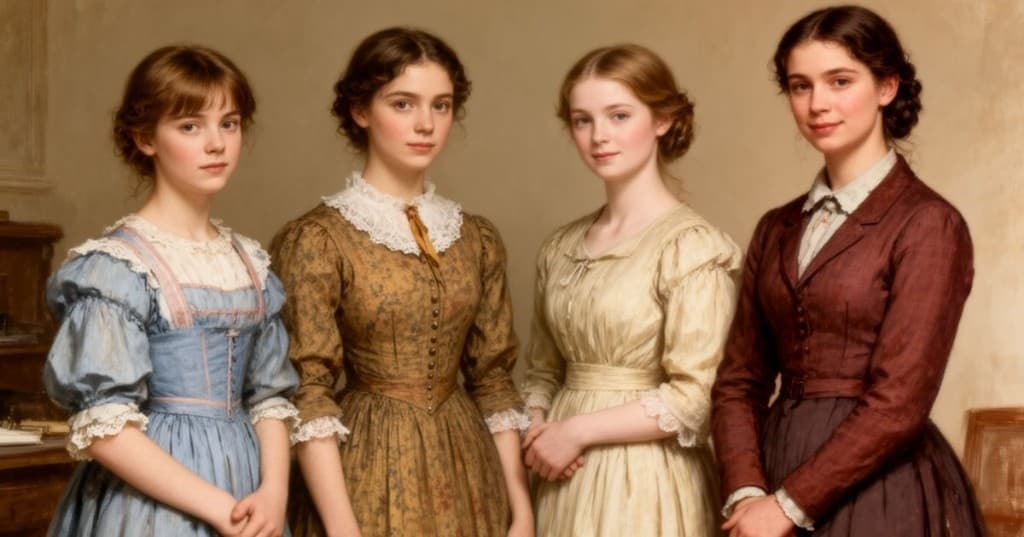
Little Women follows the four March sisters—Meg, Jo, Beth, and Amy—as they grow from girls into women in a New England household during and after the Civil War. Their father is away with the army; their mother, Marmee, holds the family together on very little money. The novel opens on a Christmas without presents, and the sisters learn early that their choices are constrained by gender and class. Yet within those constraints, each sister pursues a different path: Meg longs for a secure, loving marriage; Jo burns to write and to be independent; Beth lives quietly at the piano and at home, giving comfort; Amy aims for refinement, art, and a place in the world.
Louisa May Alcott’s 1868 book is often remembered as a cozy domestic tale, but it is also a sharp portrait of female ambition and the compromises it demands. Jo March—restless, talented, and unwilling to be “ladylike” on anyone else’s terms—has inspired generations of writers and readers. Her struggle to publish, to refuse marriage when it would mean giving up her work, and to accept love only when it doesn’t ask her to shrink, feels startlingly modern. The novel doesn’t spare its characters: Beth’s illness and death reshape the family; Meg’s marriage brings both joy and the dull weight of poverty; Amy grows from a vain child into someone capable of real sacrifice. Sisterhood is the constant—the fights, the loyalty, the shared room and shared dreams.
What's really going on: you’ll recognize the same tensions that run through life now—between doing what you love and doing what pays, between family duty and personal ambition, between the person you’re expected to be and the one you’re becoming. Little Women doesn’t resolve those tensions; it lets the March sisters live inside them, and in doing so it gives you a map for navigating your own.
Essential Life Skills Deep Dive
Explore chapter-by-chapter breakdowns of the essential life skills taught in this classic novel.
How Anger Destroys What You Love
8 chapters tracing anger's arc — from the moment Jo almost loses Amy to the slow burn that compromises her writing, and what genuine change actually requires.
The Gap Between Dreams and the Work They Demand
8 chapters on ambition — from the hilltop where the sisters name their castles in the air to the harvest where they count what actually grew.
How Social Pressure Turns You Into a Stranger
8 chapters on the slow drift away from yourself — from Amy's borrowed limes to Meg's borrowed dress to Jo's borrowed moral code.
The Person Nobody Sees Until They're Gone
8 chapters on Beth March — the invisible labor, the quiet influence, and what we only understand about those who sustain us when they stop.
How to Let Go of What You Expected
8 chapters on release — from Jo not wanting Meg to change, through Beth's acceptance of dying, to Jo's 25th birthday when the life she planned became something better.
What Love Actually Requires
8 chapters on love's real demands — from Jo crossing the social divide to reach Laurie, to the muddy-street declaration that ends the book.
Essential Skills
Life skills and patterns this book helps you develop—drawn from its themes and characters.
Critical Thinking Through Literature
Develop analytical skills by examining the complex themes and character motivations in Little Women, learning to question assumptions and see multiple perspectives.
Historical Context Understanding
Learn to place events and ideas within their historical context, understanding how Little Women reflects and responds to the issues of its time.
Empathy and Perspective-Taking
Build empathy by experiencing life through the eyes of characters from different times, backgrounds, and circumstances in Little Women.
Recognizing Timeless Human Nature
Understand that human nature remains constant across centuries, as Little Women reveals patterns of behavior and motivation that persist today.
Articulating Complex Ideas
Improve your ability to express nuanced thoughts and feelings by engaging with the sophisticated language and themes in Little Women.
Moral Reasoning and Ethics
Develop your ethical reasoning by grappling with the moral dilemmas and philosophical questions raised throughout Little Women.
Table of Contents
Four Sisters Face Hard Times Together
A Merry Christmas
Finding Your People at the Dance
When Life Gets Heavy Again
Breaking Down Barriers Through Kindness
Beth Overcomes Her Fear
Amy's Valley of Humiliation
When Anger Burns Everything Down
Meg Goes to Vanity Fair
The Pickwick Club and Post Office
The Vacation Experiment
Camp Laurence
Dreams and Duty Collide
Jo's Secret Writing Success
Crisis Brings Out True Character
About Louisa May Alcott
Published 1868
Louisa May Alcott (1832-1888) was an American novelist who grew up in a transcendentalist household, friends with Emerson, Thoreau, and Hawthorne. She served as a Civil War nurse and wrote sensational thrillers under pseudonyms before Little Women made her famous. She never married, supporting her family through her writing.
Why This Author Matters Today
Louisa May Alcott's insights into human nature, social constraints, and the search for authenticity remain powerfully relevant. Their work helps us understand the timeless tensions between individual desire and social expectation, making them an essential guide for navigating modern life's complexities.
Amplified Classics is different.
not a sparknotes, nor a cliffnotes
This is a retelling. The story is still told—completely. You walk with the characters, feel what they feel, discover what they discover. The meaning arrives because you experienced it, not because someone explained a summary.
Read this, then read the original. The prose will illuminate—you'll notice what makes the author that author, because you're no longer fighting to follow the story.
Read the original first, then read this. Something will click. You'll want to go back.
Either way, the door opens inward.
Get the Full Book
Purchase the complete book to access all chapters and support classic literature
As an Amazon Associate, we earn a small commission from qualifying purchases at no additional cost to you.
Available in paperback, hardcover, and e-book formats
You Might Also Like




Free to read • No account required