
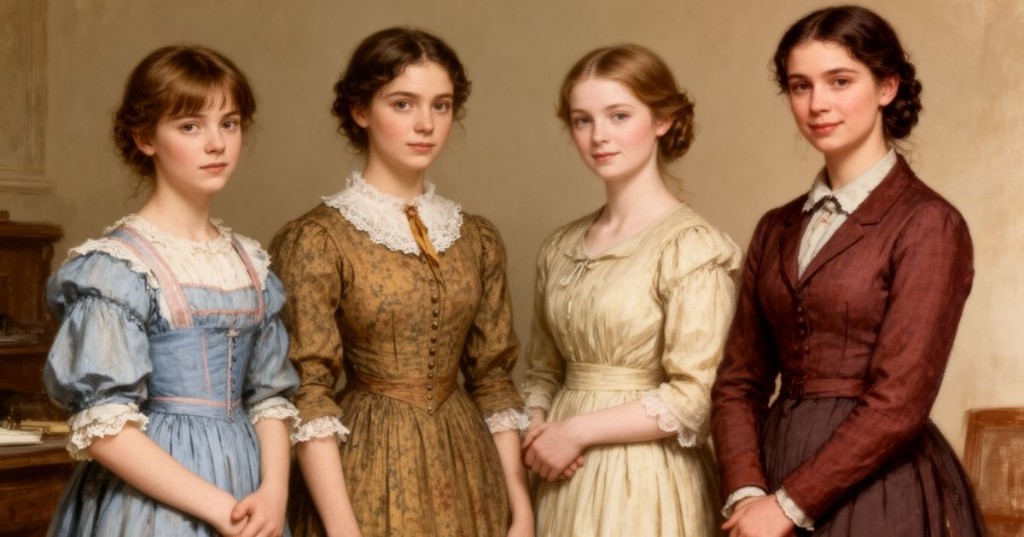
An excerpt from the original text.(complete · 7285 words)
CHAPTER TWELVE CAMP LAURENCE
Beth was postmistress, for, being most at home, she could attend to it
regularly, and dearly liked the daily task of unlocking the little door
and distributing the mail. One July day she came in with her hands
full, and went about the house leaving letters and parcels like the
penny post.
“Here’s your posy, Mother! Laurie never forgets that,” she said,
putting the fresh nosegay in the vase that stood in ‘Marmee’s corner’,
and was kept supplied by the affectionate boy.
“Miss Meg March, one letter and a glove,” continued Beth, delivering
the articles to her sister, who sat near her mother, stitching
wristbands.
“Why, I left a pair over there, and here is only one,” said Meg,
looking at the gray cotton glove. “Didn’t you drop the other in the
garden?”
“No, I’m sure I didn’t, for there was only one in the office.”
“I hate to have odd gloves! Never mind, the other may be found. My
letter is only a translation of the German song I wanted. I think Mr.
Brooke did it, for this isn’t Laurie’s writing.”
Mrs. March glanced at Meg, who was looking very pretty in her gingham
morning gown, with the little curls blowing about her forehead, and
very womanly, as she sat sewing at her little worktable, full of tidy
white rolls, so unconscious of the thought in her mother’s mind as she
sewed and sang, while her fingers flew and her thoughts were busied
with girlish fancies as innocent and fresh as the pansies in her belt,
that Mrs. March smiled and was satisfied.
“Two letters for Doctor Jo, a book, and a funny old hat, which covered
the whole post office and stuck outside,” said Beth, laughing as she
went into the study where Jo sat writing.
“What a sly fellow Laurie is! I said I wished bigger hats were the
fashion, because I burn my face every hot day. He said, ‘Why mind the
fashion? Wear a big hat, and be comfortable!’ I said I would if I had
one, and he has sent me this, to try me. I’ll wear it for fun, and show
him I don’t care for the fashion.” And hanging the antique broad-brim
on a bust of Plato, Jo read her letters.
One from her mother made her cheeks glow and her eyes fill, for it said
to her...
My Dear:
I write a little word to tell you with how much satisfaction I watch
your efforts to control your temper. You say nothing about your trials,
failures, or successes, and think, perhaps, that no one sees them but
the Friend whose help you daily ask, if I may trust the well-worn cover
of your guidebook. I, too, have seen them all, and heartily believe in
the sincerity of your resolution, since it begins to bear fruit. Go on,
dear, patiently and bravely, and always believe that no one sympathizes
more tenderly with you than your loving...
Mother
“That does me good! That’s worth millions of money and pecks of praise.
Oh, Marmee, I do try! I will keep on trying, and not get tired, since I
have you to help me.”
Laying her head on her arms, Jo wet her little romance with a few happy
tears, for she had thought that no one saw and appreciated her efforts
to be good, and this assurance was doubly precious, doubly encouraging,
because unexpected and from the person whose commendation she most
valued. Feeling stronger than ever to meet and subdue her Apollyon, she
pinned the note inside her frock, as a shield and a reminder, lest she
be taken unaware, and proceeded to open her other letter, quite ready
for either good or bad news. In a big, dashing hand, Laurie wrote...
Dear Jo, What ho!
Some English girls and boys are coming to see me tomorrow and I want to
have a jolly time. If it’s fine, I’m going to pitch my tent in
Longmeadow, and row up the whole crew to lunch and croquet—have a fire,
make messes, gypsy fashion, and all sorts of larks. They are nice
people, and like such things. Brooke will go to keep us boys steady,
and Kate Vaughn will play propriety for the girls. I want you all to
come, can’t let Beth off at any price, and nobody shall worry her.
Don’t bother about rations, I’ll see to that and everything else, only
do come, there’s a good fellow!
In a tearing hurry, Yours ever, Laurie.
“Here’s richness!” cried Jo, flying in to tell the news to Meg.
“Of course we can go, Mother? It will be such a help to Laurie, for I
can row, and Meg see to the lunch, and the children be useful in some
way.”
“I hope the Vaughns are not fine grown-up people. Do you know anything
about them, Jo?” asked Meg.
“Only that there are four of them. Kate is older than you, Fred and
Frank (twins) about my age, and a little girl (Grace), who is nine or
ten. Laurie knew them abroad, and liked the boys. I fancied, from the
way he primmed up his mouth in speaking of her, that he didn’t admire
Kate much.”
“I’m so glad my French print is clean, it’s just the thing and so
becoming!” observed Meg complacently. “Have you anything decent, Jo?”
“Scarlet and gray boating suit, good enough for me. I shall row and
tramp about, so I don’t want any starch to think of. You’ll come,
Betty?”
“If you won’t let any boys talk to me.”
“Not a boy!”
“I like to please Laurie, and I’m not afraid of Mr. Brooke, he is so
kind. But I don’t want to play, or sing, or say anything. I’ll work
hard and not trouble anyone, and you’ll take care of me, Jo, so I’ll
go.”
“That’s my good girl. You do try to fight off your shyness, and I love
you for it. Fighting faults isn’t easy, as I know, and a cheery word
kind of gives a lift. Thank you, Mother,” And Jo gave the thin cheek a
grateful kiss, more precious to Mrs. March than if it had given back
the rosy roundness of her youth.
“I had a box of chocolate drops, and the picture I wanted to copy,”
said Amy, showing her mail.
“And I got a note from Mr. Laurence, asking me to come over and play to
him tonight, before the lamps are lighted, and I shall go,” added Beth,
whose friendship with the old gentleman prospered finely.
“Now let’s fly round, and do double duty today, so that we can play
tomorrow with free minds,” said Jo, preparing to replace her pen with a
broom.
When the sun peeped into the girls’ room early next morning to promise
them a fine day, he saw a comical sight. Each had made such preparation
for the fete as seemed necessary and proper. Meg had an extra row of
little curlpapers across her forehead, Jo had copiously anointed her
afflicted face with cold cream, Beth had taken Joanna to bed with her
to atone for the approaching separation, and Amy had capped the climax
by putting a clothespin on her nose to uplift the offending feature. It
was one of the kind artists use to hold the paper on their drawing
boards, therefore quite appropriate and effective for the purpose it
was now being put. This funny spectacle appeared to amuse the sun, for
he burst out with such radiance that Jo woke up and roused her sisters
by a hearty laugh at Amy’s ornament.
Sunshine and laughter were good omens for a pleasure party, and soon a
lively bustle began in both houses. Beth, who was ready first, kept
reporting what went on next door, and enlivened her sisters’ toilets by
frequent telegrams from the window.
“There goes the man with the tent! I see Mrs. Barker doing up the lunch
in a hamper and a great basket. Now Mr. Laurence is looking up at the
sky and the weathercock. I wish he would go too. There’s Laurie,
looking like a sailor, nice boy! Oh, mercy me! Here’s a carriage full
of people, a tall lady, a little girl, and two dreadful boys. One is
lame, poor thing, he’s got a crutch. Laurie didn’t tell us that. Be
quick, girls! It’s getting late. Why, there is Ned Moffat, I do
declare. Meg, isn’t that the man who bowed to you one day when we were
shopping?”
“So it is. How queer that he should come. I thought he was at the
mountains. There is Sallie. I’m glad she got back in time. Am I all
right, Jo?” cried Meg in a flutter.
“A regular daisy. Hold up your dress and put your hat on straight, it
looks sentimental tipped that way and will fly off at the first puff.
Now then, come on!”
“Oh, Jo, you are not going to wear that awful hat? It’s too absurd! You
shall not make a guy of yourself,” remonstrated Meg, as Jo tied down
with a red ribbon the broad-brimmed, old-fashioned leghorn Laurie had
sent for a joke.
“I just will, though, for it’s capital, so shady, light, and big. It
will make fun, and I don’t mind being a guy if I’m comfortable.” With
that Jo marched straight away and the rest followed, a bright little
band of sisters, all looking their best in summer suits, with happy
faces under the jaunty hatbrims.
Laurie ran to meet and present them to his friends in the most cordial
manner. The lawn was the reception room, and for several minutes a
lively scene was enacted there. Meg was grateful to see that Miss Kate,
though twenty, was dressed with a simplicity which American girls would
do well to imitate, and who was much flattered by Mr. Ned’s assurances
that he came especially to see her. Jo understood why Laurie ‘primmed
up his mouth’ when speaking of Kate, for that young lady had a
standoff-don’t-touch-me air, which contrasted strongly with the free
and easy demeanor of the other girls. Beth took an observation of the
new boys and decided that the lame one was not ‘dreadful’, but gentle
and feeble, and she would be kind to him on that account. Amy found
Grace a well-mannered, merry, little person, and after staring dumbly
at one another for a few minutes, they suddenly became very good
friends.
Tents, lunch, and croquet utensils having been sent on beforehand, the
party was soon embarked, and the two boats pushed off together, leaving
Mr. Laurence waving his hat on the shore. Laurie and Jo rowed one boat,
Mr. Brooke and Ned the other, while Fred Vaughn, the riotous twin, did
his best to upset both by paddling about in a wherry like a disturbed
water bug. Jo’s funny hat deserved a vote of thanks, for it was of
general utility. It broke the ice in the beginning by producing a
laugh, it created quite a refreshing breeze, flapping to and fro as she
rowed, and would make an excellent umbrella for the whole party, if a
shower came up, she said. Miss Kate decided that she was ‘odd’, but
rather clever, and smiled upon her from afar.
Meg, in the other boat, was delightfully situated, face to face with
the rowers, who both admired the prospect and feathered their oars with
uncommon ‘skill and dexterity’. Mr. Brooke was a grave, silent young
man, with handsome brown eyes and a pleasant voice. Meg liked his quiet
manners and considered him a walking encyclopedia of useful knowledge.
He never talked to her much, but he looked at her a good deal, and she
felt sure that he did not regard her with aversion. Ned, being in
college, of course put on all the airs which freshmen think it their
bounden duty to assume. He was not very wise, but very good-natured,
and altogether an excellent person to carry on a picnic. Sallie
Gardiner was absorbed in keeping her white pique dress clean and
chattering with the ubiquitous Fred, who kept Beth in constant terror
by his pranks.
It was not far to Longmeadow, but the tent was pitched and the wickets
down by the time they arrived. A pleasant green field, with three
wide-spreading oaks in the middle and a smooth strip of turf for
croquet.
“Welcome to Camp Laurence!” said the young host, as they landed with
exclamations of delight.
“Brooke is commander in chief, I am commissary general, the other
fellows are staff officers, and you, ladies, are company. The tent is
for your especial benefit and that oak is your drawing room, this is
the messroom and the third is the camp kitchen. Now, let’s have a game
before it gets hot, and then we’ll see about dinner.”
Frank, Beth, Amy, and Grace sat down to watch the game played by the
other eight. Mr. Brooke chose Meg, Kate, and Fred. Laurie took Sallie,
Jo, and Ned. The English played well, but the Americans played better,
and contested every inch of the ground as strongly as if the spirit of
’76 inspired them. Jo and Fred had several skirmishes and once narrowly
escaped high words. Jo was through the last wicket and had missed the
stroke, which failure ruffled her a good deal. Fred was close behind
her and his turn came before hers. He gave a stroke, his ball hit the
wicket, and stopped an inch on the wrong side. No one was very near,
and running up to examine, he gave it a sly nudge with his toe, which
put it just an inch on the right side.
“I’m through! Now, Miss Jo, I’ll settle you, and get in first,” cried
the young gentleman, swinging his mallet for another blow.
“You pushed it. I saw you. It’s my turn now,” said Jo sharply.
“Upon my word, I didn’t move it. It rolled a bit, perhaps, but that is
allowed. So, stand off please, and let me have a go at the stake.”
“We don’t cheat in America, but you can, if you choose,” said Jo
angrily.
“Yankees are a deal the most tricky, everybody knows. There you go!”
returned Fred, croqueting her ball far away.
Jo opened her lips to say something rude, but checked herself in time,
colored up to her forehead and stood a minute, hammering down a wicket
with all her might, while Fred hit the stake and declared himself out
with much exultation. She went off to get her ball, and was a long time
finding it among the bushes, but she came back, looking cool and quiet,
and waited her turn patiently. It took several strokes to regain the
place she had lost, and when she got there, the other side had nearly
won, for Kate’s ball was the last but one and lay near the stake.
“By George, it’s all up with us! Goodbye, Kate. Miss Jo owes me one, so
you are finished,” cried Fred excitedly, as they all drew near to see
the finish.
“Yankees have a trick of being generous to their enemies,” said Jo,
with a look that made the lad redden, “especially when they beat them,”
she added, as, leaving Kate’s ball untouched, she won the game by a
clever stroke.
Laurie threw up his hat, then remembered that it wouldn’t do to exult
over the defeat of his guests, and stopped in the middle of the cheer
to whisper to his friend, “Good for you, Jo! He did cheat, I saw him.
We can’t tell him so, but he won’t do it again, take my word for it.”
Meg drew her aside, under pretense of pinning up a loose braid, and
said approvingly, “It was dreadfully provoking, but you kept your
temper, and I’m so glad, Jo.”
“Don’t praise me, Meg, for I could box his ears this minute. I should
certainly have boiled over if I hadn’t stayed among the nettles till I
got my rage under control enough to hold my tongue. It’s simmering now,
so I hope he’ll keep out of my way,” returned Jo, biting her lips as
she glowered at Fred from under her big hat.
“Time for lunch,” said Mr. Brooke, looking at his watch. “Commissary
general, will you make the fire and get water, while Miss March, Miss
Sallie, and I spread the table? Who can make good coffee?”
“Jo can,” said Meg, glad to recommend her sister. So Jo, feeling that
her late lessons in cookery were to do her honor, went to preside over
the coffeepot, while the children collected dry sticks, and the boys
made a fire and got water from a spring near by. Miss Kate sketched and
Frank talked to Beth, who was making little mats of braided rushes to
serve as plates.
The commander in chief and his aides soon spread the tablecloth with an
inviting array of eatables and drinkables, prettily decorated with
green leaves. Jo announced that the coffee was ready, and everyone
settled themselves to a hearty meal, for youth is seldom dyspeptic, and
exercise develops wholesome appetites. A very merry lunch it was, for
everything seemed fresh and funny, and frequent peals of laughter
startled a venerable horse who fed near by. There was a pleasing
inequality in the table, which produced many mishaps to cups and
plates, acorns dropped in the milk, little black ants partook of the
refreshments without being invited, and fuzzy caterpillars swung down
from the tree to see what was going on. Three white-headed children
peeped over the fence, and an objectionable dog barked at them from the
other side of the river with all his might and main.
“There’s salt here,” said Laurie, as he handed Jo a saucer of berries.
“Thank you, I prefer spiders,” she replied, fishing up two unwary
little ones who had gone to a creamy death. “How dare you remind me of
that horrid dinner party, when yours is so nice in every way?” added
Jo, as they both laughed and ate out of one plate, the china having run
short.
“I had an uncommonly good time that day, and haven’t got over it yet.
This is no credit to me, you know, I don’t do anything. It’s you and
Meg and Brooke who make it all go, and I’m no end obliged to you. What
shall we do when we can’t eat anymore?” asked Laurie, feeling that his
trump card had been played when lunch was over.
“Have games till it’s cooler. I brought Authors, and I dare say Miss
Kate knows something new and nice. Go and ask her. She’s company, and
you ought to stay with her more.”
“Aren’t you company too? I thought she’d suit Brooke, but he keeps
talking to Meg, and Kate just stares at them through that ridiculous
glass of hers. I’m going, so you needn’t try to preach propriety, for
you can’t do it, Jo.”
Miss Kate did know several new games, and as the girls would not, and
the boys could not, eat any more, they all adjourned to the drawing
room to play Rig-marole.
“One person begins a story, any nonsense you like, and tells as long as
he pleases, only taking care to stop short at some exciting point, when
the next takes it up and does the same. It’s very funny when well done,
and makes a perfect jumble of tragical comical stuff to laugh over.
Please start it, Mr. Brooke,” said Kate, with a commanding air, which
surprised Meg, who treated the tutor with as much respect as any other
gentleman.
Lying on the grass at the feet of the two young ladies, Mr. Brooke
obediently began the story, with the handsome brown eyes steadily fixed
upon the sunshiny river.
“Once on a time, a knight went out into the world to seek his fortune,
for he had nothing but his sword and his shield. He traveled a long
while, nearly eight-and-twenty years, and had a hard time of it, till
he came to the palace of a good old king, who had offered a reward to
anyone who could tame and train a fine but unbroken colt, of which he
was very fond. The knight agreed to try, and got on slowly but surely,
for the colt was a gallant fellow, and soon learned to love his new
master, though he was freakish and wild. Every day, when he gave his
lessons to this pet of the king’s, the knight rode him through the
city, and as he rode, he looked everywhere for a certain beautiful
face, which he had seen many times in his dreams, but never found. One
day, as he went prancing down a quiet street, he saw at the window of a
ruinous castle the lovely face. He was delighted, inquired who lived in
this old castle, and was told that several captive princesses were kept
there by a spell, and spun all day to lay up money to buy their
liberty. The knight wished intensely that he could free them, but he
was poor and could only go by each day, watching for the sweet face and
longing to see it out in the sunshine. At last he resolved to get into
the castle and ask how he could help them. He went and knocked. The
great door flew open, and he beheld...”
“A ravishingly lovely lady, who exclaimed, with a cry of rapture, ‘At
last! At last!’” continued Kate, who had read French novels, and
admired the style. “’Tis she!’ cried Count Gustave, and fell at her
feet in an ecstasy of joy. ‘Oh, rise!’ she said, extending a hand of
marble fairness. ‘Never! Till you tell me how I may rescue you,’ swore
the knight, still kneeling. ‘Alas, my cruel fate condemns me to remain
here till my tyrant is destroyed.’ ‘Where is the villain?’ ‘In the
mauve salon. Go, brave heart, and save me from despair.’ ‘I obey, and
return victorious or dead!’ With these thrilling words he rushed away,
and flinging open the door of the mauve salon, was about to enter, when
he received...”
“A stunning blow from the big Greek lexicon, which an old fellow in a
black gown fired at him,” said Ned. “Instantly, Sir What’s-his-name
recovered himself, pitched the tyrant out of the window, and turned to
join the lady, victorious, but with a bump on his brow, found the door
locked, tore up the curtains, made a rope ladder, got halfway down when
the ladder broke, and he went headfirst into the moat, sixty feet
below. Could swim like a duck, paddled round the castle till he came to
a little door guarded by two stout fellows, knocked their heads
together till they cracked like a couple of nuts, then, by a trifling
exertion of his prodigious strength, he smashed in the door, went up a
pair of stone steps covered with dust a foot thick, toads as big as
your fist, and spiders that would frighten you into hysterics, Miss
March. At the top of these steps he came plump upon a sight that took
his breath away and chilled his blood...”
“A tall figure, all in white with a veil over its face and a lamp in
its wasted hand,” went on Meg. “It beckoned, gliding noiselessly before
him down a corridor as dark and cold as any tomb. Shadowy effigies in
armor stood on either side, a dead silence reigned, the lamp burned
blue, and the ghostly figure ever and anon turned its face toward him,
showing the glitter of awful eyes through its white veil. They reached
a curtained door, behind which sounded lovely music. He sprang forward
to enter, but the specter plucked him back, and waved threateningly
before him a...”
“Snuffbox,” said Jo, in a sepulchral tone, which convulsed the
audience. “‘Thankee,’ said the knight politely, as he took a pinch and
sneezed seven times so violently that his head fell off. ‘Ha! Ha!’
laughed the ghost, and having peeped through the keyhole at the
princesses spinning away for dear life, the evil spirit picked up her
victim and put him in a large tin box, where there were eleven other
knights packed together without their heads, like sardines, who all
rose and began to...”
“Dance a hornpipe,” cut in Fred, as Jo paused for breath, “and, as they
danced, the rubbishy old castle turned to a man-of-war in full sail.
‘Up with the jib, reef the tops’l halliards, helm hard alee, and man
the guns!’ roared the captain, as a Portuguese pirate hove in sight,
with a flag black as ink flying from her foremast. ‘Go in and win, my
hearties!’ says the captain, and a tremendous fight began. Of course
the British beat—they always do.”
“No, they don’t!” cried Jo, aside.
“Having taken the pirate captain prisoner, sailed slap over the
schooner, whose decks were piled high with dead and whose lee scuppers
ran blood, for the order had been ‘Cutlasses, and die hard!’ ‘Bosun’s
mate, take a bight of the flying-jib sheet, and start this villain if
he doesn’t confess his sins double quick,’ said the British captain.
The Portuguese held his tongue like a brick, and walked the plank,
while the jolly tars cheered like mad. But the sly dog dived, came up
under the man-of-war, scuttled her, and down she went, with all sail
set, ‘To the bottom of the sea, sea, sea’ where...”
“Oh, gracious! What shall I say?” cried Sallie, as Fred ended his
rigmarole, in which he had jumbled together pell-mell nautical phrases
and facts out of one of his favorite books. “Well, they went to the
bottom, and a nice mermaid welcomed them, but was much grieved on
finding the box of headless knights, and kindly pickled them in brine,
hoping to discover the mystery about them, for being a woman, she was
curious. By-and-by a diver came down, and the mermaid said, ‘I’ll give
you a box of pearls if you can take it up,’ for she wanted to restore
the poor things to life, and couldn’t raise the heavy load herself. So
the diver hoisted it up, and was much disappointed on opening it to
find no pearls. He left it in a great lonely field, where it was found
by a...”
“Little goose girl, who kept a hundred fat geese in the field,” said
Amy, when Sallie’s invention gave out. “The little girl was sorry for
them, and asked an old woman what she should do to help them. ‘Your
geese will tell you, they know everything.’ said the old woman. So she
asked what she should use for new heads, since the old ones were lost,
and all the geese opened their hundred mouths and screamed...”
“‘Cabbages!’” continued Laurie promptly. “‘Just the thing,’ said the
girl, and ran to get twelve fine ones from her garden. She put them on,
the knights revived at once, thanked her, and went on their way
rejoicing, never knowing the difference, for there were so many other
heads like them in the world that no one thought anything of it. The
knight in whom I’m interested went back to find the pretty face, and
learned that the princesses had spun themselves free and all gone and
married, but one. He was in a great state of mind at that, and mounting
the colt, who stood by him through thick and thin, rushed to the castle
to see which was left. Peeping over the hedge, he saw the queen of his
affections picking flowers in her garden. ‘Will you give me a rose?’
said he. ‘You must come and get it. I can’t come to you, it isn’t
proper,’ said she, as sweet as honey. He tried to climb over the hedge,
but it seemed to grow higher and higher. Then he tried to push through,
but it grew thicker and thicker, and he was in despair. So he patiently
broke twig after twig till he had made a little hole through which he
peeped, saying imploringly, ‘Let me in! Let me in!’ But the pretty
princess did not seem to understand, for she picked her roses quietly,
and left him to fight his way in. Whether he did or not, Frank will
tell you.”
“I can’t. I’m not playing, I never do,” said Frank, dismayed at the
sentimental predicament out of which he was to rescue the absurd
couple. Beth had disappeared behind Jo, and Grace was asleep.
“So the poor knight is to be left sticking in the hedge, is he?” asked
Mr. Brooke, still watching the river, and playing with the wild rose in
his buttonhole.
“I guess the princess gave him a posy, and opened the gate after a
while,” said Laurie, smiling to himself, as he threw acorns at his
tutor.
“What a piece of nonsense we have made! With practice we might do
something quite clever. Do you know Truth?”
“I hope so,” said Meg soberly.
“The game, I mean?”
“What is it?” said Fred.
“Why, you pile up your hands, choose a number, and draw out in turn,
and the person who draws at the number has to answer truly any question
put by the rest. It’s great fun.”
“Let’s try it,” said Jo, who liked new experiments.
Miss Kate and Mr. Brooke, Meg, and Ned declined, but Fred, Sallie, Jo,
and Laurie piled and drew, and the lot fell to Laurie.
“Who are your heroes?” asked Jo.
“Grandfather and Napoleon.”
“Which lady here do you think prettiest?” said Sallie.
“Margaret.”
“Which do you like best?” from Fred.
“Jo, of course.”
“What silly questions you ask!” And Jo gave a disdainful shrug as the
rest laughed at Laurie’s matter-of-fact tone.
“Try again. Truth isn’t a bad game,” said Fred.
“It’s a very good one for you,” retorted Jo in a low voice. Her turn
came next.
“What is your greatest fault?” asked Fred, by way of testing in her the
virtue he lacked himself.
“A quick temper.”
“What do you most wish for?” said Laurie.
“A pair of boot lacings,” returned Jo, guessing and defeating his
purpose.
“Not a true answer. You must say what you really do want most.”
“Genius. Don’t you wish you could give it to me, Laurie?” And she slyly
smiled in his disappointed face.
“What virtues do you most admire in a man?” asked Sallie.
“Courage and honesty.”
“Now my turn,” said Fred, as his hand came last.
“Let’s give it to him,” whispered Laurie to Jo, who nodded and asked at
once...
“Didn’t you cheat at croquet?”
“Well, yes, a little bit.”
“Good! Didn’t you take your story out of The Sea Lion?” said Laurie.
“Rather.”
“Don’t you think the English nation perfect in every respect?” asked
Sallie.
“I should be ashamed of myself if I didn’t.”
“He’s a true John Bull. Now, Miss Sallie, you shall have a chance
without waiting to draw. I’ll harrrow up your feelings first by asking
if you don’t think you are something of a flirt,” said Laurie, as Jo
nodded to Fred as a sign that peace was declared.
“You impertinent boy! Of course I’m not,” exclaimed Sallie, with an air
that proved the contrary.
“What do you hate most?” asked Fred.
“Spiders and rice pudding.”
“What do you like best?” asked Jo.
“Dancing and French gloves.”
“Well, I think Truth is a very silly play. Let’s have a sensible game
of Authors to refresh our minds,” proposed Jo.
Ned, Frank, and the little girls joined in this, and while it went on,
the three elders sat apart, talking. Miss Kate took out her sketch
again, and Margaret watched her, while Mr. Brooke lay on the grass with
a book, which he did not read.
“How beautifully you do it! I wish I could draw,” said Meg, with
mingled admiration and regret in her voice.
“Why don’t you learn? I should think you had taste and talent for it,”
replied Miss Kate graciously.
“I haven’t time.”
“Your mamma prefers other accomplishments, I fancy. So did mine, but I
proved to her that I had talent by taking a few lessons privately, and
then she was quite willing I should go on. Can’t you do the same with
your governess?”
“I have none.”
“I forgot young ladies in America go to school more than with us. Very
fine schools they are, too, Papa says. You go to a private one, I
suppose?”
“I don’t go at all. I am a governess myself.”
“Oh, indeed!” said Miss Kate, but she might as well have said, “Dear
me, how dreadful!” for her tone implied it, and something in her face
made Meg color, and wish she had not been so frank.
Mr. Brooke looked up and said quickly, “Young ladies in America love
independence as much as their ancestors did, and are admired and
respected for supporting themselves.”
“Oh, yes, of course it’s very nice and proper in them to do so. We have
many most respectable and worthy young women who do the same and are
employed by the nobility, because, being the daughters of gentlemen,
they are both well bred and accomplished, you know,” said Miss Kate in
a patronizing tone that hurt Meg’s pride, and made her work seem not
only more distasteful, but degrading.
“Did the German song suit, Miss March?” inquired Mr. Brooke, breaking
an awkward pause.
“Oh, yes! It was very sweet, and I’m much obliged to whoever translated
it for me.” And Meg’s downcast face brightened as she spoke.
“Don’t you read German?” asked Miss Kate with a look of surprise.
“Not very well. My father, who taught me, is away, and I don’t get on
very fast alone, for I’ve no one to correct my pronunciation.”
“Try a little now. Here is Schiller’s Mary Stuart and a tutor who loves
to teach.” And Mr. Brooke laid his book on her lap with an inviting
smile.
“It’s so hard I’m afraid to try,” said Meg, grateful, but bashful in
the presence of the accomplished young lady beside her.
“I’ll read a bit to encourage you.” And Miss Kate read one of the most
beautiful passages in a perfectly correct but perfectly expressionless
manner.
Mr. Brooke made no comment as she returned the book to Meg, who said
innocently, “I thought it was poetry.”
“Some of it is. Try this passage.”
There was a queer smile about Mr. Brooke’s mouth as he opened at poor
Mary’s lament.
Meg obediently following the long grass-blade which her new tutor used
to point with, read slowly and timidly, unconsciously making poetry of
the hard words by the soft intonation of her musical voice. Down the
page went the green guide, and presently, forgetting her listener in
the beauty of the sad scene, Meg read as if alone, giving a little
touch of tragedy to the words of the unhappy queen. If she had seen the
brown eyes then, she would have stopped short, but she never looked up,
and the lesson was not spoiled for her.
“Very well indeed!” said Mr. Brooke, as she paused, quite ignoring her
many mistakes, and looking as if he did indeed love to teach.
Miss Kate put up her glass, and, having taken a survey of the little
tableau before her, shut her sketch book, saying with condescension,
“You’ve a nice accent and in time will be a clever reader. I advise you
to learn, for German is a valuable accomplishment to teachers. I must
look after Grace, she is romping.” And Miss Kate strolled away, adding
to herself with a shrug, “I didn’t come to chaperone a governess,
though she is young and pretty. What odd people these Yankees are. I’m
afraid Laurie will be quite spoiled among them.”
“I forgot that English people rather turn up their noses at governesses
and don’t treat them as we do,” said Meg, looking after the retreating
figure with an annoyed expression.
“Tutors also have rather a hard time of it there, as I know to my
sorrow. There’s no place like America for us workers, Miss Margaret.”
And Mr. Brooke looked so contented and cheerful that Meg was ashamed to
lament her hard lot.
“I’m glad I live in it then. I don’t like my work, but I get a good
deal of satisfaction out of it after all, so I won’t complain. I only
wished I liked teaching as you do.”
“I think you would if you had Laurie for a pupil. I shall be very sorry
to lose him next year,” said Mr. Brooke, busily punching holes in the
turf.
“Going to college, I suppose?” Meg’s lips asked the question, but her
eyes added, “And what becomes of you?”
“Yes, it’s high time he went, for he is ready, and as soon as he is
off, I shall turn soldier. I am needed.”
“I am glad of that!” exclaimed Meg. “I should think every young man
would want to go, though it is hard for the mothers and sisters who
stay at home,” she added sorrowfully.
“I have neither, and very few friends to care whether I live or die,”
said Mr. Brooke rather bitterly as he absently put the dead rose in the
hole he had made and covered it up, like a little grave.
“Laurie and his grandfather would care a great deal, and we should all
be very sorry to have any harm happen to you,” said Meg heartily.
“Thank you, that sounds pleasant,” began Mr. Brooke, looking cheerful
again, but before he could finish his speech, Ned, mounted on the old
horse, came lumbering up to display his equestrian skill before the
young ladies, and there was no more quiet that day.
“Don’t you love to ride?” asked Grace of Amy, as they stood resting
after a race round the field with the others, led by Ned.
“I dote upon it. My sister, Meg, used to ride when Papa was rich, but
we don’t keep any horses now, except Ellen Tree,” added Amy, laughing.
“Tell me about Ellen Tree. Is it a donkey?” asked Grace curiously.
“Why, you see, Jo is crazy about horses and so am I, but we’ve only got
an old sidesaddle and no horse. Out in our garden is an apple tree that
has a nice low branch, so Jo put the saddle on it, fixed some reins on
the part that turns up, and we bounce away on Ellen Tree whenever we
like.”
“How funny!” laughed Grace. “I have a pony at home, and ride nearly
every day in the park with Fred and Kate. It’s very nice, for my
friends go too, and the Row is full of ladies and gentlemen.”
“Dear, how charming! I hope I shall go abroad some day, but I’d rather
go to Rome than the Row,” said Amy, who had not the remotest idea what
the Row was and wouldn’t have asked for the world.
Frank, sitting just behind the little girls, heard what they were
saying, and pushed his crutch away from him with an impatient gesture
as he watched the active lads going through all sorts of comical
gymnastics. Beth, who was collecting the scattered Author cards, looked
up and said, in her shy yet friendly way, “I’m afraid you are tired.
Can I do anything for you?”
“Talk to me, please. It’s dull, sitting by myself,” answered Frank, who
had evidently been used to being made much of at home.
If he asked her to deliver a Latin oration, it would not have seemed a
more impossible task to bashful Beth, but there was no place to run to,
no Jo to hide behind now, and the poor boy looked so wistfully at her
that she bravely resolved to try.
“What do you like to talk about?” she asked, fumbling over the cards
and dropping half as she tried to tie them up.
“Well, I like to hear about cricket and boating and hunting,” said
Frank, who had not yet learned to suit his amusements to his strength.
My heart! What shall I do? I don’t know anything about them, thought
Beth, and forgetting the boy’s misfortune in her flurry, she said,
hoping to make him talk, “I never saw any hunting, but I suppose you
know all about it.”
“I did once, but I can never hunt again, for I got hurt leaping a
confounded five-barred gate, so there are no more horses and hounds for
me,” said Frank with a sigh that made Beth hate herself for her
innocent blunder.
“Your deer are much prettier than our ugly buffaloes,” she said,
turning to the prairies for help and feeling glad that she had read one
of the boys’ books in which Jo delighted.
Buffaloes proved soothing and satisfactory, and in her eagerness to
amuse another, Beth forgot herself, and was quite unconscious of her
sisters’ surprise and delight at the unusual spectacle of Beth talking
away to one of the dreadful boys, against whom she had begged
protection.
“Bless her heart! She pities him, so she is good to him,” said Jo,
beaming at her from the croquet ground.
“I always said she was a little saint,” added Meg, as if there could be
no further doubt of it.
“I haven’t heard Frank laugh so much for ever so long,” said Grace to
Amy, as they sat discussing dolls and making tea sets out of the acorn
cups.
“My sister Beth is a very fastidious girl, when she likes to be,” said
Amy, well pleased at Beth’s success. She meant ‘facinating’, but as
Grace didn’t know the exact meaning of either word, fastidious sounded
well and made a good impression.
An impromptu circus, fox and geese, and an amicable game of croquet
finished the afternoon. At sunset the tent was struck, hampers packed,
wickets pulled up, boats loaded, and the whole party floated down the
river, singing at the tops of their voices. Ned, getting sentimental,
warbled a serenade with the pensive refrain...
Alone, alone, ah! Woe, alone,
and at the lines...
We each are young, we each have a heart,
Oh, why should we stand thus coldly apart?
he looked at Meg with such a lackadaisical expression that she laughed
outright and spoiled his song.
“How can you be so cruel to me?” he whispered, under cover of a lively
chorus. “You’ve kept close to that starched-up Englishwoman all day,
and now you snub me.”
“I didn’t mean to, but you looked so funny I really couldn’t help it,”
replied Meg, passing over the first part of his reproach, for it was
quite true that she had shunned him, remembering the Moffat party and
the talk after it.
Ned was offended and turned to Sallie for consolation, saying to her
rather pettishly, “There isn’t a bit of flirt in that girl, is there?”
“Not a particle, but she’s a dear,” returned Sallie, defending her
friend even while confessing her shortcomings.
“She’s not a stricken deer anyway,” said Ned, trying to be witty, and
succeeding as well as very young gentlemen usually do.
On the lawn where it had gathered, the little party separated with
cordial good nights and good-byes, for the Vaughns were going to
Canada. As the four sisters went home through the garden, Miss Kate
looked after them, saying, without the patronizing tone in her voice,
“In spite of their demonstrative manners, American girls are very nice
when one knows them.”
“I quite agree with you,” said Mr. Brooke.
Master this chapter. Complete your experience
Purchase the complete book to access all chapters and support classic literature
As an Amazon Associate, we earn a small commission from qualifying purchases at no additional cost to you.
Available in paperback, hardcover, and e-book formats
Let's Analyse the Pattern
True power comes from choosing your response rather than reacting emotionally to provocation.
Why This Matters
Connect literature to life
This chapter teaches how to recognize when someone is trying to provoke you to make you look bad.
Practice This Today
Next time someone baits you with insults or unfairness, pause and ask what they gain if you lose control—then choose a response that serves you instead.
Now let's explore the literary elements.
Key Quotes & Analysis
"It's no use, Jo, we never shall be anything but Americans."
Context: After being made to feel inferior by the English guests
This shows Meg accepting that they'll always be seen as 'less than' by certain social circles, but there's pride in it too. She's learning that trying to impress snobs is pointless.
In Today's Words:
We'll never be fancy enough for some people, and that's okay.
"I'm not ashamed of my little weaknesses, and I don't intend to let them conquer me."
Context: When she successfully controls her temper despite provocation
Jo acknowledges her flaws but refuses to be defeated by them. This represents real maturity—not denying your problems but working to overcome them.
In Today's Words:
I know I have issues, but I'm not going to let them control my life.
"Young ladies in America love independence as much as their ancestors did."
Context: Defending American women against English criticism
Brooke shows he values strong, independent women rather than submissive ones. This makes him an ideal match for the independent March sisters.
In Today's Words:
American women don't need to be rescued—they can take care of themselves.
Thematic Threads
Self-Control
In This Chapter
Jo resists her famous temper when provoked by Fred's cheating and insults, winning through skill instead
Development
Major evolution - Jo's temper has been her defining flaw, this shows real growth
In Your Life:
You might face this when someone tries to bait you into an argument at work or family gatherings.
Class Consciousness
In This Chapter
Kate looks down on Meg for being a governess, while Americans see honest work as respectable
Development
Builds on earlier themes about poverty vs. pride, now adding international class differences
In Your Life:
You might experience this when people judge your job or background as 'lesser than' theirs.
Hidden Strength
In This Chapter
Beth overcomes her shyness to comfort disabled Frank, showing compassion conquers fear
Development
Beth's growth continues - she's finding her voice through helping others
In Your Life:
You might discover your own courage when focusing on helping someone else rather than your own anxiety.
Social Testing
In This Chapter
The picnic becomes a proving ground where each sister's character is tested in different ways
Development
Introduced here - the idea that social gatherings reveal true character under pressure
In Your Life:
You might find your values tested when you're in unfamiliar social situations or meeting new people.
Romantic Awareness
In This Chapter
Meg begins seeing Mr. Brooke differently while he defends American values and shows interest in her
Development
New development - romance enters the story through respectful admiration rather than passion
In Your Life:
You might find attraction growing from respect and shared values rather than instant chemistry.
You now have the context. Time to form your own thoughts.
Discussion Questions
- 1
What specific strategies did Jo use to handle Fred's cheating and insults instead of losing her temper?
analysis • surface - 2
Why was Jo's controlled response more powerful than an angry outburst would have been?
analysis • medium - 3
Where do you see people today trying to provoke others into losing control, and what do they gain from it?
application • medium - 4
Think of a time someone pushed your buttons - how might the situation have changed if you'd responded like Jo instead of reacting emotionally?
application • deep - 5
What does this chapter reveal about the difference between power that comes from control versus power that comes from reaction?
reflection • deep
Critical Thinking Exercise
Map Your Trigger Points
Think about the last time someone really got under your skin - at work, at home, or online. Write down what they did, how you reacted, and what they might have gained from provoking you. Then rewrite the scenario using Jo's approach: pause, breathe, choose a strategic response that serves your goals instead of their manipulation.
Consider:
- •What specific words or actions tend to trigger your strongest reactions?
- •How might people benefit when you lose control or get emotional?
- •What would a calm, strategic response look like in your most challenging relationships?
Journaling Prompt
Write about a relationship where someone regularly pushes your buttons. What would change if you stopped giving them the reaction they're looking for?
Coming Up Next...
Chapter 13: Dreams and Duty Collide
As autumn approaches, the March sisters share their deepest dreams and ambitions with each other, revealing what they truly hope to achieve in life. But will their castles in the air prove to be realistic goals or impossible fantasies?



