
An excerpt from the original text.(complete · 4103 words)
CHAPTER ONE PLAYING PILGRIMS
“Christmas won’t be Christmas without any presents,” grumbled Jo, lying
on the rug.
“It’s so dreadful to be poor!” sighed Meg, looking down at her old
dress.
“I don’t think it’s fair for some girls to have plenty of pretty
things, and other girls nothing at all,” added little Amy, with an
injured sniff.
“We’ve got Father and Mother, and each other,” said Beth contentedly
from her corner.
The four young faces on which the firelight shone brightened at the
cheerful words, but darkened again as Jo said sadly, “We haven’t got
Father, and shall not have him for a long time.” She didn’t say
“perhaps never,” but each silently added it, thinking of Father far
away, where the fighting was.
Nobody spoke for a minute; then Meg said in an altered tone, “You know
the reason Mother proposed not having any presents this Christmas was
because it is going to be a hard winter for everyone; and she thinks we
ought not to spend money for pleasure, when our men are suffering so in
the army. We can’t do much, but we can make our little sacrifices, and
ought to do it gladly. But I am afraid I don’t,” and Meg shook her
head, as she thought regretfully of all the pretty things she wanted.
“But I don’t think the little we should spend would do any good. We’ve
each got a dollar, and the army wouldn’t be much helped by our giving
that. I agree not to expect anything from Mother or you, but I do want
to buy Undine and Sintran for myself. I’ve wanted it so long,” said
Jo, who was a bookworm.
“I planned to spend mine in new music,” said Beth, with a little sigh,
which no one heard but the hearth brush and kettle-holder.
“I shall get a nice box of Faber’s drawing pencils; I really need
them,” said Amy decidedly.
“Mother didn’t say anything about our money, and she won’t wish us to
give up everything. Let’s each buy what we want, and have a little fun;
I’m sure we work hard enough to earn it,” cried Jo, examining the heels
of her shoes in a gentlemanly manner.
“I know I do—teaching those tiresome children nearly all day, when I’m
longing to enjoy myself at home,” began Meg, in the complaining tone
again.
“You don’t have half such a hard time as I do,” said Jo. “How would you
like to be shut up for hours with a nervous, fussy old lady, who keeps
you trotting, is never satisfied, and worries you till you’re ready to
fly out the window or cry?”
“It’s naughty to fret, but I do think washing dishes and keeping things
tidy is the worst work in the world. It makes me cross, and my hands
get so stiff, I can’t practice well at all.” And Beth looked at her
rough hands with a sigh that any one could hear that time.
“I don’t believe any of you suffer as I do,” cried Amy, “for you don’t
have to go to school with impertinent girls, who plague you if you
don’t know your lessons, and laugh at your dresses, and label your
father if he isn’t rich, and insult you when your nose isn’t nice.”
“If you mean libel, I’d say so, and not talk about labels, as if Papa
was a pickle bottle,” advised Jo, laughing.
“I know what I mean, and you needn’t be statirical about it. It’s
proper to use good words, and improve your vocabilary,” returned Amy,
with dignity.
“Don’t peck at one another, children. Don’t you wish we had the money
Papa lost when we were little, Jo? Dear me! How happy and good we’d be,
if we had no worries!” said Meg, who could remember better times.
“You said the other day you thought we were a deal happier than the
King children, for they were fighting and fretting all the time, in
spite of their money.”
“So I did, Beth. Well, I think we are. For though we do have to work,
we make fun of ourselves, and are a pretty jolly set, as Jo would say.”
“Jo does use such slang words!” observed Amy, with a reproving look at
the long figure stretched on the rug.
Jo immediately sat up, put her hands in her pockets, and began to
whistle.
“Don’t, Jo. It’s so boyish!”
“That’s why I do it.”
“I detest rude, unladylike girls!”
“I hate affected, niminy-piminy chits!”
“Birds in their little nests agree,” sang Beth, the peacemaker, with
such a funny face that both sharp voices softened to a laugh, and the
“pecking” ended for that time.
“Really, girls, you are both to be blamed,” said Meg, beginning to
lecture in her elder-sisterly fashion. “You are old enough to leave off
boyish tricks, and to behave better, Josephine. It didn’t matter so
much when you were a little girl, but now you are so tall, and turn up
your hair, you should remember that you are a young lady.”
“I’m not! And if turning up my hair makes me one, I’ll wear it in two
tails till I’m twenty,” cried Jo, pulling off her net, and shaking down
a chestnut mane. “I hate to think I’ve got to grow up, and be Miss
March, and wear long gowns, and look as prim as a China Aster! It’s bad
enough to be a girl, anyway, when I like boy’s games and work and
manners! I can’t get over my disappointment in not being a boy. And
it’s worse than ever now, for I’m dying to go and fight with Papa. And
I can only stay home and knit, like a poky old woman!”
And Jo shook the blue army sock till the needles rattled like
castanets, and her ball bounded across the room.
“Poor Jo! It’s too bad, but it can’t be helped. So you must try to be
contented with making your name boyish, and playing brother to us
girls,” said Beth, stroking the rough head with a hand that all the
dish washing and dusting in the world could not make ungentle in its
touch.
“As for you, Amy,” continued Meg, “you are altogether too particular
and prim. Your airs are funny now, but you’ll grow up an affected
little goose, if you don’t take care. I like your nice manners and
refined ways of speaking, when you don’t try to be elegant. But your
absurd words are as bad as Jo’s slang.”
“If Jo is a tomboy and Amy a goose, what am I, please?” asked Beth,
ready to share the lecture.
“You’re a dear, and nothing else,” answered Meg warmly, and no one
contradicted her, for the ‘Mouse’ was the pet of the family.
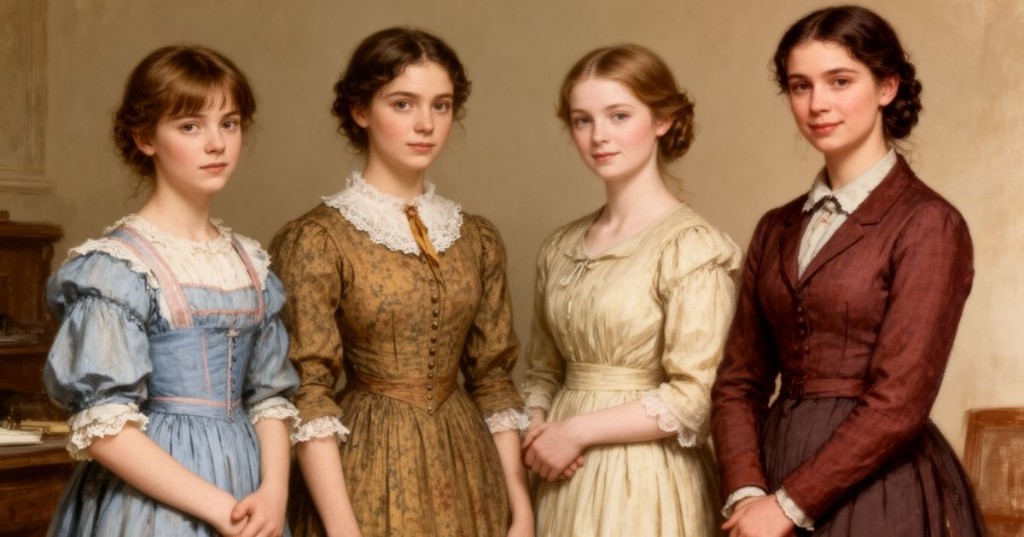
As young readers like to know ‘how people look’, we will take this
moment to give them a little sketch of the four sisters, who sat
knitting away in the twilight, while the December snow fell quietly
without, and the fire crackled cheerfully within. It was a comfortable
room, though the carpet was faded and the furniture very plain, for a
good picture or two hung on the walls, books filled the recesses,
chrysanthemums and Christmas roses bloomed in the windows, and a
pleasant atmosphere of home peace pervaded it.
Margaret, the eldest of the four, was sixteen, and very pretty, being
plump and fair, with large eyes, plenty of soft brown hair, a sweet
mouth, and white hands, of which she was rather vain. Fifteen-year-old
Jo was very tall, thin, and brown, and reminded one of a colt, for she
never seemed to know what to do with her long limbs, which were very
much in her way. She had a decided mouth, a comical nose, and sharp,
gray eyes, which appeared to see everything, and were by turns fierce,
funny, or thoughtful. Her long, thick hair was her one beauty, but it
was usually bundled into a net, to be out of her way. Round shoulders
had Jo, big hands and feet, a flyaway look to her clothes, and the
uncomfortable appearance of a girl who was rapidly shooting up into a
woman and didn’t like it. Elizabeth, or Beth, as everyone called her,
was a rosy, smooth-haired, bright-eyed girl of thirteen, with a shy
manner, a timid voice, and a peaceful expression which was seldom
disturbed. Her father called her ‘Little Miss Tranquility’, and the
name suited her excellently, for she seemed to live in a happy world of
her own, only venturing out to meet the few whom she trusted and loved.
Amy, though the youngest, was a most important person, in her own
opinion at least. A regular snow maiden, with blue eyes, and yellow
hair curling on her shoulders, pale and slender, and always carrying
herself like a young lady mindful of her manners. What the characters
of the four sisters were we will leave to be found out.
The clock struck six and, having swept up the hearth, Beth put a pair
of slippers down to warm. Somehow the sight of the old shoes had a good
effect upon the girls, for Mother was coming, and everyone brightened
to welcome her. Meg stopped lecturing, and lighted the lamp, Amy got
out of the easy chair without being asked, and Jo forgot how tired she
was as she sat up to hold the slippers nearer to the blaze.
“They are quite worn out. Marmee must have a new pair.”
“I thought I’d get her some with my dollar,” said Beth.
“No, I shall!” cried Amy.
“I’m the oldest,” began Meg, but Jo cut in with a decided, “I’m the man
of the family now Papa is away, and I shall provide the slippers, for
he told me to take special care of Mother while he was gone.”
“I’ll tell you what we’ll do,” said Beth, “let’s each get her something
for Christmas, and not get anything for ourselves.”
“That’s like you, dear! What will we get?” exclaimed Jo.
Everyone thought soberly for a minute, then Meg announced, as if the
idea was suggested by the sight of her own pretty hands, “I shall give
her a nice pair of gloves.”
“Army shoes, best to be had,” cried Jo.
“Some handkerchiefs, all hemmed,” said Beth.
“I’ll get a little bottle of cologne. She likes it, and it won’t cost
much, so I’ll have some left to buy my pencils,” added Amy.
“How will we give the things?” asked Meg.
“Put them on the table, and bring her in and see her open the bundles.
Don’t you remember how we used to do on our birthdays?” answered Jo.
“I used to be so frightened when it was my turn to sit in the chair
with the crown on, and see you all come marching round to give the
presents, with a kiss. I liked the things and the kisses, but it was
dreadful to have you sit looking at me while I opened the bundles,”
said Beth, who was toasting her face and the bread for tea at the same
time.
“Let Marmee think we are getting things for ourselves, and then
surprise her. We must go shopping tomorrow afternoon, Meg. There is so
much to do about the play for Christmas night,” said Jo, marching up
and down, with her hands behind her back, and her nose in the air.
“I don’t mean to act any more after this time. I’m getting too old for
such things,” observed Meg, who was as much a child as ever about
‘dressing-up’ frolics.
“You won’t stop, I know, as long as you can trail round in a white gown
with your hair down, and wear gold-paper jewelry. You are the best
actress we’ve got, and there’ll be an end of everything if you quit the
boards,” said Jo. “We ought to rehearse tonight. Come here, Amy, and do
the fainting scene, for you are as stiff as a poker in that.”
“I can’t help it. I never saw anyone faint, and I don’t choose to make
myself all black and blue, tumbling flat as you do. If I can go down
easily, I’ll drop. If I can’t, I shall fall into a chair and be
graceful. I don’t care if Hugo does come at me with a pistol,” returned
Amy, who was not gifted with dramatic power, but was chosen because she
was small enough to be borne out shrieking by the villain of the piece.
“Do it this way. Clasp your hands so, and stagger across the room,
crying frantically, ‘Roderigo! Save me! Save me!’” and away went Jo,
with a melodramatic scream which was truly thrilling.
Amy followed, but she poked her hands out stiffly before her, and
jerked herself along as if she went by machinery, and her “Ow!” was
more suggestive of pins being run into her than of fear and anguish. Jo
gave a despairing groan, and Meg laughed outright, while Beth let her
bread burn as she watched the fun with interest. “It’s no use! Do the
best you can when the time comes, and if the audience laughs, don’t
blame me. Come on, Meg.”
Then things went smoothly, for Don Pedro defied the world in a speech
of two pages without a single break. Hagar, the witch, chanted an awful
incantation over her kettleful of simmering toads, with weird effect.
Roderigo rent his chains asunder manfully, and Hugo died in agonies of
remorse and arsenic, with a wild, “Ha! Ha!”
“It’s the best we’ve had yet,” said Meg, as the dead villain sat up and
rubbed his elbows.
“I don’t see how you can write and act such splendid things, Jo. You’re
a regular Shakespeare!” exclaimed Beth, who firmly believed that her
sisters were gifted with wonderful genius in all things.
“Not quite,” replied Jo modestly. “I do think The Witches Curse, an
Operatic Tragedy is rather a nice thing, but I’d like to try
Macbeth, if we only had a trapdoor for Banquo. I always wanted to do
the killing part. ‘Is that a dagger that I see before me?” muttered Jo,
rolling her eyes and clutching at the air, as she had seen a famous
tragedian do.
“No, it’s the toasting fork, with Mother’s shoe on it instead of the
bread. Beth’s stage-struck!” cried Meg, and the rehearsal ended in a
general burst of laughter.
“Glad to find you so merry, my girls,” said a cheery voice at the door,
and actors and audience turned to welcome a tall, motherly lady with a
‘can I help you’ look about her which was truly delightful. She was not
elegantly dressed, but a noble-looking woman, and the girls thought the
gray cloak and unfashionable bonnet covered the most splendid mother in
the world.
“Well, dearies, how have you got on today? There was so much to do,
getting the boxes ready to go tomorrow, that I didn’t come home to
dinner. Has anyone called, Beth? How is your cold, Meg? Jo, you look
tired to death. Come and kiss me, baby.”
While making these maternal inquiries Mrs. March got her wet things
off, her warm slippers on, and sitting down in the easy chair, drew Amy
to her lap, preparing to enjoy the happiest hour of her busy day. The
girls flew about, trying to make things comfortable, each in her own
way. Meg arranged the tea table, Jo brought wood and set chairs,
dropping, over-turning, and clattering everything she touched. Beth
trotted to and fro between parlor kitchen, quiet and busy, while Amy
gave directions to everyone, as she sat with her hands folded.
As they gathered about the table, Mrs. March said, with a particularly
happy face, “I’ve got a treat for you after supper.”
A quick, bright smile went round like a streak of sunshine. Beth
clapped her hands, regardless of the biscuit she held, and Jo tossed up
her napkin, crying, “A letter! A letter! Three cheers for Father!”
“Yes, a nice long letter. He is well, and thinks he shall get through
the cold season better than we feared. He sends all sorts of loving
wishes for Christmas, and an especial message to you girls,” said Mrs.
March, patting her pocket as if she had got a treasure there.
“Hurry and get done! Don’t stop to quirk your little finger and simper
over your plate, Amy,” cried Jo, choking on her tea and dropping her
bread, butter side down, on the carpet in her haste to get at the
treat.
Beth ate no more, but crept away to sit in her shadowy corner and brood
over the delight to come, till the others were ready.
“I think it was so splendid in Father to go as chaplain when he was too
old to be drafted, and not strong enough for a soldier,” said Meg
warmly.
“Don’t I wish I could go as a drummer, a vivan—what’s its name? Or a
nurse, so I could be near him and help him,” exclaimed Jo, with a
groan.
“It must be very disagreeable to sleep in a tent, and eat all sorts of
bad-tasting things, and drink out of a tin mug,” sighed Amy.
“When will he come home, Marmee?” asked Beth, with a little quiver in
her voice.
“Not for many months, dear, unless he is sick. He will stay and do his
work faithfully as long as he can, and we won’t ask for him back a
minute sooner than he can be spared. Now come and hear the letter.”
They all drew to the fire, Mother in the big chair with Beth at her
feet, Meg and Amy perched on either arm of the chair, and Jo leaning on
the back, where no one would see any sign of emotion if the letter
should happen to be touching. Very few letters were written in those
hard times that were not touching, especially those which fathers sent
home. In this one little was said of the hardships endured, the dangers
faced, or the homesickness conquered. It was a cheerful, hopeful
letter, full of lively descriptions of camp life, marches, and military
news, and only at the end did the writer’s heart over-flow with
fatherly love and longing for the little girls at home.
“Give them all of my dear love and a kiss. Tell them I think of them by
day, pray for them by night, and find my best comfort in their
affection at all times. A year seems very long to wait before I see
them, but remind them that while we wait we may all work, so that these
hard days need not be wasted. I know they will remember all I said to
them, that they will be loving children to you, will do their duty
faithfully, fight their bosom enemies bravely, and conquer themselves
so beautifully that when I come back to them I may be fonder and
prouder than ever of my little women.” Everybody sniffed when they came
to that part. Jo wasn’t ashamed of the great tear that dropped off the
end of her nose, and Amy never minded the rumpling of her curls as she
hid her face on her mother’s shoulder and sobbed out, “I am a selfish
girl! But I’ll truly try to be better, so he mayn’t be disappointed in
me by-and-by.”
“We all will,” cried Meg. “I think too much of my looks and hate to
work, but won’t any more, if I can help it.”
“I’ll try and be what he loves to call me, ‘a little woman’ and not be
rough and wild, but do my duty here instead of wanting to be somewhere
else,” said Jo, thinking that keeping her temper at home was a much
harder task than facing a rebel or two down South.
Beth said nothing, but wiped away her tears with the blue army sock and
began to knit with all her might, losing no time in doing the duty that
lay nearest her, while she resolved in her quiet little soul to be all
that Father hoped to find her when the year brought round the happy
coming home.
Mrs. March broke the silence that followed Jo’s words, by saying in her
cheery voice, “Do you remember how you used to play Pilgrims Progress
when you were little things? Nothing delighted you more than to have me
tie my piece bags on your backs for burdens, give you hats and sticks
and rolls of paper, and let you travel through the house from the
cellar, which was the City of Destruction, up, up, to the housetop,
where you had all the lovely things you could collect to make a
Celestial City.”
“What fun it was, especially going by the lions, fighting Apollyon, and
passing through the valley where the hob-goblins were,” said Jo.
“I liked the place where the bundles fell off and tumbled downstairs,”
said Meg.
“I don’t remember much about it, except that I was afraid of the cellar
and the dark entry, and always liked the cake and milk we had up at the
top. If I wasn’t too old for such things, I’d rather like to play it
over again,” said Amy, who began to talk of renouncing childish things
at the mature age of twelve.
“We never are too old for this, my dear, because it is a play we are
playing all the time in one way or another. Our burdens are here, our
road is before us, and the longing for goodness and happiness is the
guide that leads us through many troubles and mistakes to the peace
which is a true Celestial City. Now, my little pilgrims, suppose you
begin again, not in play, but in earnest, and see how far on you can
get before Father comes home.”
“Really, Mother? Where are our bundles?” asked Amy, who was a very
literal young lady.
“Each of you told what your burden was just now, except Beth. I rather
think she hasn’t got any,” said her mother.
“Yes, I have. Mine is dishes and dusters, and envying girls with nice
pianos, and being afraid of people.”
Beth’s bundle was such a funny one that everybody wanted to laugh, but
nobody did, for it would have hurt her feelings very much.
“Let us do it,” said Meg thoughtfully. “It is only another name for
trying to be good, and the story may help us, for though we do want to
be good, it’s hard work and we forget, and don’t do our best.”
“We were in the Slough of Despond tonight, and Mother came and pulled
us out as Help did in the book. We ought to have our roll of
directions, like Christian. What shall we do about that?” asked Jo,
delighted with the fancy which lent a little romance to the very dull
task of doing her duty.
“Look under your pillows Christmas morning, and you will find your
guidebook,” replied Mrs. March.
They talked over the new plan while old Hannah cleared the table, then
out came the four little work baskets, and the needles flew as the
girls made sheets for Aunt March. It was uninteresting sewing, but
tonight no one grumbled. They adopted Jo’s plan of dividing the long
seams into four parts, and calling the quarters Europe, Asia, Africa,
and America, and in that way got on capitally, especially when they
talked about the different countries as they stitched their way through
them.
At nine they stopped work, and sang, as usual, before they went to bed.
No one but Beth could get much music out of the old piano, but she had
a way of softly touching the yellow keys and making a pleasant
accompaniment to the simple songs they sang. Meg had a voice like a
flute, and she and her mother led the little choir. Amy chirped like a
cricket, and Jo wandered through the airs at her own sweet will, always
coming out at the wrong place with a croak or a quaver that spoiled the
most pensive tune. They had always done this from the time they could
lisp...
Crinkle, crinkle, ’ittle ’tar,
and it had become a household custom, for the mother was a born singer.
The first sound in the morning was her voice as she went about the
house singing like a lark, and the last sound at night was the same
cheery sound, for the girls never grew too old for that familiar
lullaby.
Master this chapter. Complete your experience
Purchase the complete book to access all chapters and support classic literature
As an Amazon Associate, we earn a small commission from qualifying purchases at no additional cost to you.
Available in paperback, hardcover, and e-book formats
Let's Analyse the Pattern
Shared hardship creates deeper, more authentic connections than shared comfort by stripping away pretense and creating mutual vulnerability.
Why This Matters
Connect literature to life
This chapter teaches how to identify when shared hardship is creating genuine connection versus when it's breeding resentment and competition.
Practice This Today
This week, notice when people facing similar challenges either bond together or turn against each other—the difference usually lies in whether they're honest about their struggles or trying to hide them.
Now let's explore the literary elements.
Key Quotes & Analysis
"Christmas won't be Christmas without any presents"
Context: Opening line as the sisters gather around the fire
This immediately establishes the family's financial struggles and sets up the central tension between wanting material things and finding meaning in what they have. It's a very human, relatable complaint that draws readers in.
In Today's Words:
This is going to be the worst Christmas ever if we don't get anything
"We've got Father and Mother, and each other"
Context: Beth responds to her sisters' complaints about being poor
Beth's gentle reminder shows her role as the family's moral center. She consistently redirects attention from what's missing to what's present, demonstrating the book's theme that relationships matter more than possessions.
In Today's Words:
At least we have our family
"We haven't got Father, and shall not have him for a long time"
Context: Jo's somber response that dampens the mood
This reveals the deeper anxiety beneath their material complaints. The Civil War has separated their family, creating both financial hardship and emotional pain. Jo's honesty about their real fears shows her direct nature.
In Today's Words:
Dad's been gone forever and who knows when he's coming back
"We can make our little sacrifices, and ought to do it gladly"
Context: Explaining why their mother suggested no Christmas presents
Meg tries to embrace the moral lesson but admits her struggle with it. This shows the realistic difficulty of choosing duty over desire, and how the family tries to find meaning in their hardships.
In Today's Words:
We should be happy to give things up for a good cause, but honestly, it's hard
Thematic Threads
Class
In This Chapter
The March family's genteel poverty—educated but poor, maintaining dignity while doing manual work
Development
Introduced here
In Your Life:
You might recognize this if you've ever felt caught between your background and your current financial reality.
Identity
In This Chapter
Each sister's distinct personality emerges through her response to family circumstances and individual dreams
Development
Introduced here
In Your Life:
You see this when crisis reveals who family members really are beneath their usual roles.
Social Expectations
In This Chapter
The tension between what young women 'should' want (marriage, refinement) and individual desires (adventure, independence)
Development
Introduced here
In Your Life:
You experience this when others' expectations for your life don't match your own dreams or circumstances.
Personal Growth
In This Chapter
Father's letter encouraging them to be 'little women' and overcome their character flaws during his absence
Development
Introduced here
In Your Life:
You face this when someone you respect challenges you to grow up and take responsibility.
Human Relationships
In This Chapter
The family's evening rituals of work, music, and storytelling that create warmth despite material poverty
Development
Introduced here
In Your Life:
You create this when you build meaningful traditions with people you care about, regardless of money.
You now have the context. Time to form your own thoughts.
Discussion Questions
- 1
What specific hardships are the March family facing, and how does each sister react differently to their situation?
analysis • surface - 2
Why does Mrs. March suggest they think of their struggles as a 'Pilgrim's Progress' journey rather than just complaining about being poor?
analysis • medium - 3
Where do you see families or groups today becoming closer through shared challenges rather than shared success?
application • medium - 4
If you were building a support system during tough times, what would you learn from how the March family handles their evening routine and honest conversations?
application • deep - 5
What does this chapter reveal about the difference between performing happiness and finding genuine connection through vulnerability?
reflection • deep
Critical Thinking Exercise
Map Your Own March Family
Think about a difficult period in your life when you felt closest to certain people. Draw a simple map showing who was in your 'inner circle' during that time versus who was in your life during easier periods. Notice the differences and what that reveals about relationship-building through shared struggle.
Consider:
- •Consider why some people step closer during hard times while others step away
- •Think about whether you tend to hide struggles or share them authentically
- •Notice if your strongest relationships were forged through challenges or comfort
Journaling Prompt
Write about a time when sharing a real struggle with someone brought you closer together. What made that vulnerability feel safe, and how did it change your relationship?
Coming Up Next...
Chapter 2: A Merry Christmas
Christmas morning arrives with surprises that test the sisters' newfound resolve to put others before themselves. Their first real challenge in becoming 'little women' comes sooner than expected.



