
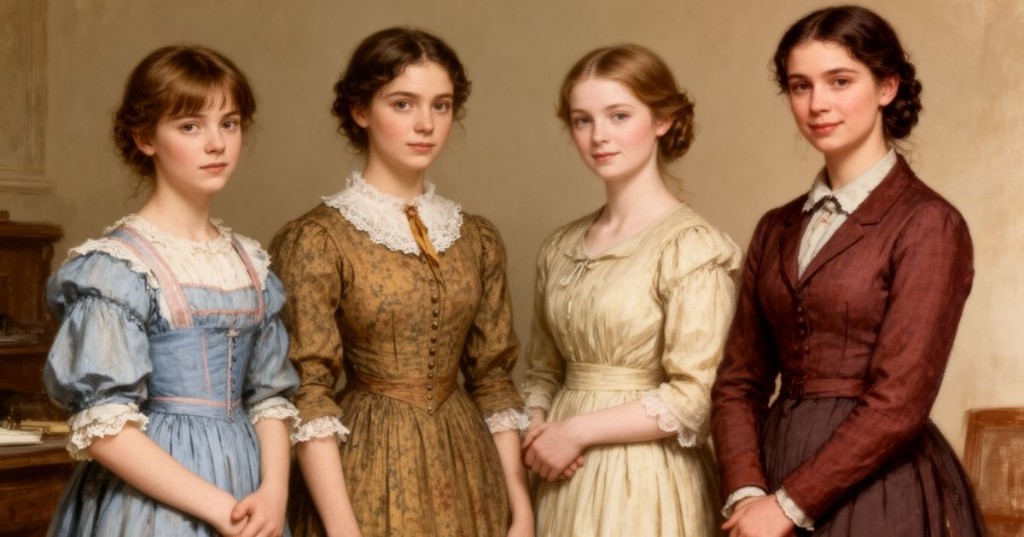
An excerpt from the original text.(complete · 4058 words)
CHAPTER TWO A MERRY CHRISTMAS
Jo was the first to wake in the gray dawn of Christmas morning. No
stockings hung at the fireplace, and for a moment she felt as much
disappointed as she did long ago, when her little sock fell down
because it was crammed so full of goodies. Then she remembered her
mother’s promise and, slipping her hand under her pillow, drew out a
little crimson-covered book. She knew it very well, for it was that
beautiful old story of the best life ever lived, and Jo felt that it
was a true guidebook for any pilgrim going on a long journey. She woke
Meg with a “Merry Christmas,” and bade her see what was under her
pillow. A green-covered book appeared, with the same picture inside,
and a few words written by their mother, which made their one present
very precious in their eyes. Presently Beth and Amy woke to rummage and
find their little books also, one dove-colored, the other blue, and all
sat looking at and talking about them, while the east grew rosy with
the coming day.
In spite of her small vanities, Margaret had a sweet and pious nature,
which unconsciously influenced her sisters, especially Jo, who loved
her very tenderly, and obeyed her because her advice was so gently
given.
“Girls,” said Meg seriously, looking from the tumbled head beside her
to the two little night-capped ones in the room beyond, “Mother wants
us to read and love and mind these books, and we must begin at once. We
used to be faithful about it, but since Father went away and all this
war trouble unsettled us, we have neglected many things. You can do as
you please, but I shall keep my book on the table here and read a
little every morning as soon as I wake, for I know it will do me good
and help me through the day.”
Then she opened her new book and began to read. Jo put her arm round
her and, leaning cheek to cheek, read also, with the quiet expression
so seldom seen on her restless face.
“How good Meg is! Come, Amy, let’s do as they do. I’ll help you with
the hard words, and they’ll explain things if we don’t understand,”
whispered Beth, very much impressed by the pretty books and her
sisters’ example.
“I’m glad mine is blue,” said Amy. and then the rooms were very still
while the pages were softly turned, and the winter sunshine crept in to
touch the bright heads and serious faces with a Christmas greeting.
“Where is Mother?” asked Meg, as she and Jo ran down to thank her for
their gifts, half an hour later.
“Goodness only knows. Some poor creeter came a-beggin’, and your ma
went straight off to see what was needed. There never was such a woman
for givin’ away vittles and drink, clothes and firin’,” replied Hannah,
who had lived with the family since Meg was born, and was considered by
them all more as a friend than a servant.
“She will be back soon, I think, so fry your cakes, and have everything
ready,” said Meg, looking over the presents which were collected in a
basket and kept under the sofa, ready to be produced at the proper
time. “Why, where is Amy’s bottle of cologne?” she added, as the little
flask did not appear.
“She took it out a minute ago, and went off with it to put a ribbon on
it, or some such notion,” replied Jo, dancing about the room to take
the first stiffness off the new army slippers.
“How nice my handkerchiefs look, don’t they? Hannah washed and ironed
them for me, and I marked them all myself,” said Beth, looking proudly
at the somewhat uneven letters which had cost her such labor.
“Bless the child! She’s gone and put ‘Mother’ on them instead of ‘M.
March’. How funny!” cried Jo, taking one up.
“Isn’t that right? I thought it was better to do it so, because Meg’s
initials are M.M., and I don’t want anyone to use these but Marmee,”
said Beth, looking troubled.
“It’s all right, dear, and a very pretty idea, quite sensible too, for
no one can ever mistake now. It will please her very much, I know,”
said Meg, with a frown for Jo and a smile for Beth.
“There’s Mother. Hide the basket, quick!” cried Jo, as a door slammed
and steps sounded in the hall.
Amy came in hastily, and looked rather abashed when she saw her sisters
all waiting for her.
“Where have you been, and what are you hiding behind you?” asked Meg,
surprised to see, by her hood and cloak, that lazy Amy had been out so
early.
“Don’t laugh at me, Jo! I didn’t mean anyone should know till the time
came. I only meant to change the little bottle for a big one, and I
gave all my money to get it, and I’m truly trying not to be selfish any
more.”
As she spoke, Amy showed the handsome flask which replaced the cheap
one, and looked so earnest and humble in her little effort to forget
herself that Meg hugged her on the spot, and Jo pronounced her ‘a
trump’, while Beth ran to the window, and picked her finest rose to
ornament the stately bottle.
“You see I felt ashamed of my present, after reading and talking about
being good this morning, so I ran round the corner and changed it the
minute I was up, and I’m so glad, for mine is the handsomest now.”
Another bang of the street door sent the basket under the sofa, and the
girls to the table, eager for breakfast.
“Merry Christmas, Marmee! Many of them! Thank you for our books. We
read some, and mean to every day,” they all cried in chorus.
“Merry Christmas, little daughters! I’m glad you began at once, and
hope you will keep on. But I want to say one word before we sit down.
Not far away from here lies a poor woman with a little newborn baby.
Six children are huddled into one bed to keep from freezing, for they
have no fire. There is nothing to eat over there, and the oldest boy
came to tell me they were suffering hunger and cold. My girls, will you
give them your breakfast as a Christmas present?”
They were all unusually hungry, having waited nearly an hour, and for a
minute no one spoke, only a minute, for Jo exclaimed impetuously, “I’m
so glad you came before we began!”
“May I go and help carry the things to the poor little children?” asked
Beth eagerly.
“I shall take the cream and the muffings,” added Amy, heroically giving
up the article she most liked.
Meg was already covering the buckwheats, and piling the bread into one
big plate.
“I thought you’d do it,” said Mrs. March, smiling as if satisfied. “You
shall all go and help me, and when we come back we will have bread and
milk for breakfast, and make it up at dinnertime.”
They were soon ready, and the procession set out. Fortunately it was
early, and they went through back streets, so few people saw them, and
no one laughed at the queer party.
A poor, bare, miserable room it was, with broken windows, no fire,
ragged bedclothes, a sick mother, wailing baby, and a group of pale,
hungry children cuddled under one old quilt, trying to keep warm.
How the big eyes stared and the blue lips smiled as the girls went in.
“Ach, mein Gott! It is good angels come to us!” said the poor woman,
crying for joy.
“Funny angels in hoods and mittens,” said Jo, and set them to laughing.
In a few minutes it really did seem as if kind spirits had been at work
there. Hannah, who had carried wood, made a fire, and stopped up the
broken panes with old hats and her own cloak. Mrs. March gave the
mother tea and gruel, and comforted her with promises of help, while
she dressed the little baby as tenderly as if it had been her own. The
girls meantime spread the table, set the children round the fire, and
fed them like so many hungry birds, laughing, talking, and trying to
understand the funny broken English.
“Das ist gut!” “Die Engel-kinder!” cried the poor things as they ate
and warmed their purple hands at the comfortable blaze. The girls had
never been called angel children before, and thought it very agreeable,
especially Jo, who had been considered a ‘Sancho’ ever since she was
born. That was a very happy breakfast, though they didn’t get any of
it. And when they went away, leaving comfort behind, I think there were
not in all the city four merrier people than the hungry little girls
who gave away their breakfasts and contented themselves with bread and
milk on Christmas morning.
“That’s loving our neighbor better than ourselves, and I like it,” said
Meg, as they set out their presents while their mother was upstairs
collecting clothes for the poor Hummels.
Not a very splendid show, but there was a great deal of love done up in
the few little bundles, and the tall vase of red roses, white
chrysanthemums, and trailing vines, which stood in the middle, gave
quite an elegant air to the table.
“She’s coming! Strike up, Beth! Open the door, Amy! Three cheers for
Marmee!” cried Jo, prancing about while Meg went to conduct Mother to
the seat of honor.
Beth played her gayest march, Amy threw open the door, and Meg enacted
escort with great dignity. Mrs. March was both surprised and touched,
and smiled with her eyes full as she examined her presents and read the
little notes which accompanied them. The slippers went on at once, a
new handkerchief was slipped into her pocket, well scented with Amy’s
cologne, the rose was fastened in her bosom, and the nice gloves were
pronounced a perfect fit.
There was a good deal of laughing and kissing and explaining, in the
simple, loving fashion which makes these home festivals so pleasant at
the time, so sweet to remember long afterward, and then all fell to
work.
The morning charities and ceremonies took so much time that the rest of
the day was devoted to preparations for the evening festivities. Being
still too young to go often to the theater, and not rich enough to
afford any great outlay for private performances, the girls put their
wits to work, and necessity being the mother of invention, made
whatever they needed. Very clever were some of their productions,
pasteboard guitars, antique lamps made of old-fashioned butter boats
covered with silver paper, gorgeous robes of old cotton, glittering
with tin spangles from a pickle factory, and armor covered with the
same useful diamond shaped bits left in sheets when the lids of
preserve pots were cut out. The big chamber was the scene of many
innocent revels.
No gentleman were admitted, so Jo played male parts to her heart’s
content and took immense satisfaction in a pair of russet leather boots
given her by a friend, who knew a lady who knew an actor. These boots,
an old foil, and a slashed doublet once used by an artist for some
picture, were Jo’s chief treasures and appeared on all occasions. The
smallness of the company made it necessary for the two principal actors
to take several parts apiece, and they certainly deserved some credit
for the hard work they did in learning three or four different parts,
whisking in and out of various costumes, and managing the stage
besides. It was excellent drill for their memories, a harmless
amusement, and employed many hours which otherwise would have been
idle, lonely, or spent in less profitable society.
On Christmas night, a dozen girls piled onto the bed which was the
dress circle, and sat before the blue and yellow chintz curtains in a
most flattering state of expectancy. There was a good deal of rustling
and whispering behind the curtain, a trifle of lamp smoke, and an
occasional giggle from Amy, who was apt to get hysterical in the
excitement of the moment. Presently a bell sounded, the curtains flew
apart, and the operatic tragedy began.
“A gloomy wood,” according to the one playbill, was represented by a
few shrubs in pots, green baize on the floor, and a cave in the
distance. This cave was made with a clothes horse for a roof, bureaus
for walls, and in it was a small furnace in full blast, with a black
pot on it and an old witch bending over it. The stage was dark and the
glow of the furnace had a fine effect, especially as real steam issued
from the kettle when the witch took off the cover. A moment was allowed
for the first thrill to subside, then Hugo, the villain, stalked in
with a clanking sword at his side, a slouching hat, black beard,
mysterious cloak, and the boots. After pacing to and fro in much
agitation, he struck his forehead, and burst out in a wild strain,
singing of his hatred for Roderigo, his love for Zara, and his pleasing
resolution to kill the one and win the other. The gruff tones of Hugo’s
voice, with an occasional shout when his feelings overcame him, were
very impressive, and the audience applauded the moment he paused for
breath. Bowing with the air of one accustomed to public praise, he
stole to the cavern and ordered Hagar to come forth with a commanding,
“What ho, minion! I need thee!”
Out came Meg, with gray horsehair hanging about her face, a red and
black robe, a staff, and cabalistic signs upon her cloak. Hugo demanded
a potion to make Zara adore him, and one to destroy Roderigo. Hagar, in
a fine dramatic melody, promised both, and proceeded to call up the
spirit who would bring the love philter.
Hither, hither, from thy home,
Airy sprite, I bid thee come!
Born of roses, fed on dew,
Charms and potions canst thou brew?
Bring me here, with elfin speed,
The fragrant philter which I need.
Make it sweet and swift and strong,
Spirit, answer now my song!
A soft strain of music sounded, and then at the back of the cave
appeared a little figure in cloudy white, with glittering wings, golden
hair, and a garland of roses on its head. Waving a wand, it sang...
Hither I come,
From my airy home,
Afar in the silver moon.
Take the magic spell,
And use it well,
Or its power will vanish soon!
And dropping a small, gilded bottle at the witch’s feet, the spirit
vanished. Another chant from Hagar produced another apparition, not a
lovely one, for with a bang an ugly black imp appeared and, having
croaked a reply, tossed a dark bottle at Hugo and disappeared with a
mocking laugh. Having warbled his thanks and put the potions in his
boots, Hugo departed, and Hagar informed the audience that as he had
killed a few of her friends in times past, she had cursed him, and
intends to thwart his plans, and be revenged on him. Then the curtain
fell, and the audience reposed and ate candy while discussing the
merits of the play.
A good deal of hammering went on before the curtain rose again, but
when it became evident what a masterpiece of stage carpentery had been
got up, no one murmured at the delay. It was truly superb. A tower rose
to the ceiling, halfway up appeared a window with a lamp burning in it,
and behind the white curtain appeared Zara in a lovely blue and silver
dress, waiting for Roderigo. He came in gorgeous array, with plumed
cap, red cloak, chestnut lovelocks, a guitar, and the boots, of course.
Kneeling at the foot of the tower, he sang a serenade in melting tones.
Zara replied and, after a musical dialogue, consented to fly. Then came
the grand effect of the play. Roderigo produced a rope ladder, with
five steps to it, threw up one end, and invited Zara to descend.
Timidly she crept from her lattice, put her hand on Roderigo’s
shoulder, and was about to leap gracefully down when “Alas! Alas for
Zara!” she forgot her train. It caught in the window, the tower
tottered, leaned forward, fell with a crash, and buried the unhappy
lovers in the ruins.
A universal shriek arose as the russet boots waved wildly from the
wreck and a golden head emerged, exclaiming, “I told you so! I told you
so!” With wonderful presence of mind, Don Pedro, the cruel sire, rushed
in, dragged out his daughter, with a hasty aside...
“Don’t laugh! Act as if it was all right!” and, ordering Roderigo up,
banished him from the kingdom with wrath and scorn. Though decidedly
shaken by the fall from the tower upon him, Roderigo defied the old
gentleman and refused to stir. This dauntless example fired Zara. She
also defied her sire, and he ordered them both to the deepest dungeons
of the castle. A stout little retainer came in with chains and led them
away, looking very much frightened and evidently forgetting the speech
he ought to have made.
Act third was the castle hall, and here Hagar appeared, having come to
free the lovers and finish Hugo. She hears him coming and hides, sees
him put the potions into two cups of wine and bid the timid little
servant, “Bear them to the captives in their cells, and tell them I
shall come anon.” The servant takes Hugo aside to tell him something,
and Hagar changes the cups for two others which are harmless.
Ferdinando, the ‘minion’, carries them away, and Hagar puts back the
cup which holds the poison meant for Roderigo. Hugo, getting thirsty
after a long warble, drinks it, loses his wits, and after a good deal
of clutching and stamping, falls flat and dies, while Hagar informs him
what she has done in a song of exquisite power and melody.
This was a truly thrilling scene, though some persons might have
thought that the sudden tumbling down of a quantity of long red hair
rather marred the effect of the villain’s death. He was called before
the curtain, and with great propriety appeared, leading Hagar, whose
singing was considered more wonderful than all the rest of the
performance put together.
Act fourth displayed the despairing Roderigo on the point of stabbing
himself because he has been told that Zara has deserted him. Just as
the dagger is at his heart, a lovely song is sung under his window,
informing him that Zara is true but in danger, and he can save her if
he will. A key is thrown in, which unlocks the door, and in a spasm of
rapture he tears off his chains and rushes away to find and rescue his
lady love.
Act fifth opened with a stormy scene between Zara and Don Pedro. He
wishes her to go into a convent, but she won’t hear of it, and after a
touching appeal, is about to faint when Roderigo dashes in and demands
her hand. Don Pedro refuses, because he is not rich. They shout and
gesticulate tremendously but cannot agree, and Rodrigo is about to bear
away the exhausted Zara, when the timid servant enters with a letter
and a bag from Hagar, who has mysteriously disappeared. The latter
informs the party that she bequeaths untold wealth to the young pair
and an awful doom to Don Pedro, if he doesn’t make them happy. The bag
is opened, and several quarts of tin money shower down upon the stage
till it is quite glorified with the glitter. This entirely softens the
stern sire. He consents without a murmur, all join in a joyful chorus,
and the curtain falls upon the lovers kneeling to receive Don Pedro’s
blessing in attitudes of the most romantic grace.
Tumultuous applause followed but received an unexpected check, for the
cot bed, on which the dress circle was built, suddenly shut up and
extinguished the enthusiastic audience. Roderigo and Don Pedro flew to
the rescue, and all were taken out unhurt, though many were speechless
with laughter. The excitement had hardly subsided when Hannah appeared,
with “Mrs. March’s compliments, and would the ladies walk down to
supper.”
This was a surprise even to the actors, and when they saw the table,
they looked at one another in rapturous amazement. It was like Marmee
to get up a little treat for them, but anything so fine as this was
unheard of since the departed days of plenty. There was ice cream,
actually two dishes of it, pink and white, and cake and fruit and
distracting French bonbons and, in the middle of the table, four great
bouquets of hot house flowers.
It quite took their breath away, and they stared first at the table and
then at their mother, who looked as if she enjoyed it immensely.
“Is it fairies?” asked Amy.
“Santa Claus,” said Beth.
“Mother did it.” And Meg smiled her sweetest, in spite of her gray
beard and white eyebrows.
“Aunt March had a good fit and sent the supper,” cried Jo, with a
sudden inspiration.
“All wrong. Old Mr. Laurence sent it,” replied Mrs. March.
“The Laurence boy’s grandfather! What in the world put such a thing
into his head? We don’t know him!” exclaimed Meg.
“Hannah told one of his servants about your breakfast party. He is an
odd old gentleman, but that pleased him. He knew my father years ago,
and he sent me a polite note this afternoon, saying he hoped I would
allow him to express his friendly feeling toward my children by sending
them a few trifles in honor of the day. I could not refuse, and so you
have a little feast at night to make up for the bread-and-milk
breakfast.”
“That boy put it into his head, I know he did! He’s a capital fellow,
and I wish we could get acquainted. He looks as if he’d like to know us
but he’s bashful, and Meg is so prim she won’t let me speak to him when
we pass,” said Jo, as the plates went round, and the ice began to melt
out of sight, with ohs and ahs of satisfaction.
“You mean the people who live in the big house next door, don’t you?”
asked one of the girls. “My mother knows old Mr. Laurence, but says
he’s very proud and doesn’t like to mix with his neighbors. He keeps
his grandson shut up, when he isn’t riding or walking with his tutor,
and makes him study very hard. We invited him to our party, but he
didn’t come. Mother says he’s very nice, though he never speaks to us
girls.”
“Our cat ran away once, and he brought her back, and we talked over the
fence, and were getting on capitally, all about cricket, and so on,
when he saw Meg coming, and walked off. I mean to know him some day,
for he needs fun, I’m sure he does,” said Jo decidedly.
“I like his manners, and he looks like a little gentleman, so I’ve no
objection to your knowing him, if a proper opportunity comes. He
brought the flowers himself, and I should have asked him in, if I had
been sure what was going on upstairs. He looked so wistful as he went
away, hearing the frolic and evidently having none of his own.”
“It’s a mercy you didn’t, Mother!” laughed Jo, looking at her boots.
“But we’ll have another play sometime that he can see. Perhaps he’ll
help act. Wouldn’t that be jolly?”
“I never had such a fine bouquet before! How pretty it is!” And Meg
examined her flowers with great interest.
“They are lovely. But Beth’s roses are sweeter to me,” said Mrs. March,
smelling the half-dead posy in her belt.
Beth nestled up to her, and whispered softly, “I wish I could send my
bunch to Father. I’m afraid he isn’t having such a merry Christmas as
we are.”
Master this chapter. Complete your experience
Purchase the complete book to access all chapters and support classic literature
As an Amazon Associate, we earn a small commission from qualifying purchases at no additional cost to you.
Available in paperback, hardcover, and e-book formats
Let's Analyse the Pattern
The Generosity Multiplier - How Giving Creates Abundance
Authentic giving when you have little creates social capital that returns as unexpected support and opportunities through network effects.
Why This Matters
Connect literature to life
This chapter teaches how to recognize when small acts of generosity build long-term relationship wealth that provides security beyond money.
Practice This Today
This week, notice when someone gives authentically despite having little—watch how others respond and what opportunities emerge from those moments of witnessed sacrifice.
Now let's explore the literary elements.
Key Quotes & Analysis
"She knew it very well, for it was that beautiful old story of the best life ever lived, and Jo felt that it was a true guidebook for any pilgrim going on a long journey."
Context: Jo discovers her Christmas gift book under her pillow
This establishes that the March family sees life as a spiritual journey requiring guidance and moral direction. The book represents practical wisdom for navigating life's challenges, not just religious doctrine.
In Today's Words:
She recognized it as one of those books that actually teaches you how to live better, like a roadmap for getting through tough times.
"I'm so full of happiness, that if Father was only here, I couldn't hold one drop more."
Context: After their day of giving and receiving unexpected kindness
Shows how acts of generosity and community connection create deeper satisfaction than material possessions ever could. Amy recognizes that joy comes from relationships and meaningful experiences.
In Today's Words:
I'm happier than I've ever been - if Dad were here too, I'd probably burst from all this good feeling.
"That's loving our neighbor better than ourselves, and I like it."
Context: After delivering their breakfast to the hungry Hummel family
Meg recognizes that true satisfaction comes from putting others' needs first, especially when you have little yourself. This moment shows her growth in understanding what real generosity means.
In Today's Words:
Putting other people first when we don't have much ourselves - that felt really good.
Thematic Threads
Class
In This Chapter
The March family's poverty doesn't prevent them from helping others—they give their breakfast to an even poorer immigrant family, showing that generosity transcends economic status
Development
Builds on Chapter 1's theme of genteel poverty by showing how the family maintains dignity and creates value through service rather than consumption
In Your Life:
You might find that your willingness to help others despite your own struggles creates stronger bonds than any material gift could.
Identity
In This Chapter
The girls discover their identity as 'angel children' through their actions, not their possessions—they become who they are by what they do for others
Development
Develops from Chapter 1's focus on individual character development to show how identity forms through service and sacrifice
In Your Life:
You might realize that who you are is defined more by how you treat others in difficult moments than by what you own or achieve.
Social Expectations
In This Chapter
The chapter subverts expectations about Christmas—the best gifts aren't material but experiential, and the greatest joy comes from giving rather than receiving
Development
Continues challenging conventional values from Chapter 1, now showing alternative definitions of celebration and success
In Your Life:
You might find that the holidays or celebrations that bring you the most satisfaction involve giving your time and attention rather than expensive gifts.
Human Relationships
In This Chapter
Mr. Laurence's surprise feast shows how acts of kindness create unexpected connections—the girls' charity toward strangers opens the door to friendship with their mysterious neighbor
Development
Introduced here as a new theme showing how authentic generosity builds bridges across social and economic divides
In Your Life:
You might discover that helping others often leads to meaningful relationships with people you never expected to connect with.
Personal Growth
In This Chapter
Each sister grows by choosing sacrifice over self-interest—they learn that true satisfaction comes from serving others rather than indulging themselves
Development
Builds on Chapter 1's individual character challenges by showing growth through collective action and shared values
In Your Life:
You might find that the moments when you choose to help others despite personal cost are the times you feel most proud of who you're becoming.
You now have the context. Time to form your own thoughts.
Discussion Questions
- 1
What did the March sisters give up on Christmas morning, and what did they receive in return from Mr. Laurence?
analysis • surface - 2
Why do you think Mr. Laurence sent the surprise supper after observing the girls' charity to the German family?
analysis • medium - 3
Where have you seen this pattern in your own life or community - someone's small act of kindness leading to unexpected help or friendship?
application • medium - 4
If you were facing financial hardship but wanted to build stronger community connections, what non-monetary things could you offer to help others?
application • deep - 5
What does this Christmas story reveal about the difference between being poor in money versus being poor in relationships and community?
reflection • deep
Critical Thinking Exercise
Track Your Generosity Network
Draw a simple map of your current relationships, marking times you've helped others and times others have helped you. Look for patterns: Do the same people appear in both categories? Are there relationships where you only give or only receive? Identify one small way you could help someone this week who isn't currently in your support network.
Consider:
- •Small acts count just as much as big ones - listening, sharing information, or offering encouragement all build social capital
- •Notice whether your giving feels authentic or transactional - people can usually sense the difference
- •Consider whether you're comfortable both giving and receiving help, or if you lean heavily toward one side
Journaling Prompt
Write about a time when someone's unexpected kindness came exactly when you needed it most. What had you done, if anything, that might have contributed to that person wanting to help you?
Coming Up Next...
Chapter 3: Finding Your People at the Dance
The mysterious Laurence boy who sent the Christmas feast becomes a source of fascination for Jo, who's determined to befriend the lonely neighbor despite his grandfather's reputation for being proud and standoffish.



