
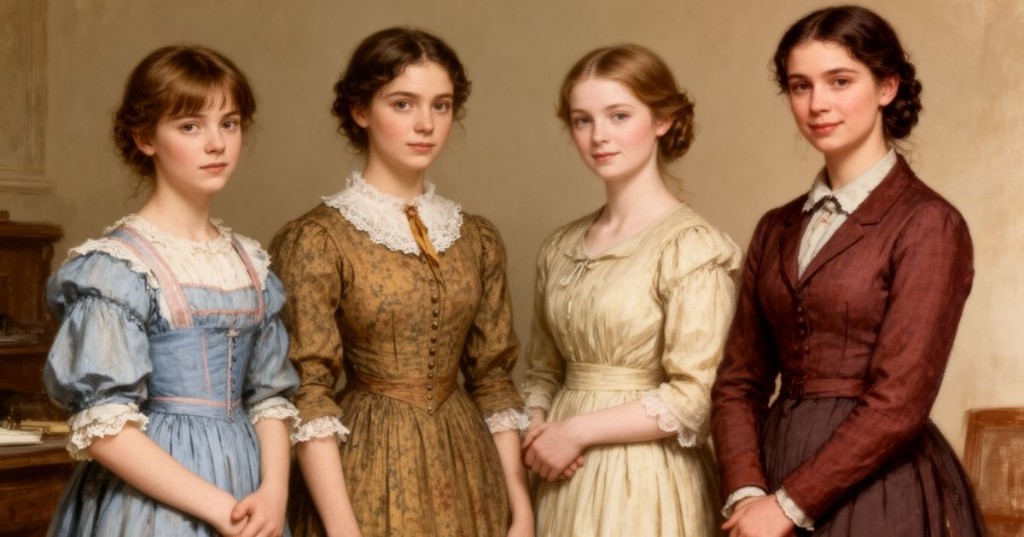
An excerpt from the original text.(complete · 3895 words)
CHAPTER THREE THE LAURENCE BOY
“Jo! Jo! Where are you?” cried Meg at the foot of the garret stairs.
“Here!” answered a husky voice from above, and, running up, Meg found
her sister eating apples and crying over the Heir of Redclyffe, wrapped
up in a comforter on an old three-legged sofa by the sunny window. This
was Jo’s favorite refuge, and here she loved to retire with half a
dozen russets and a nice book, to enjoy the quiet and the society of a
pet rat who lived near by and didn’t mind her a particle. As Meg
appeared, Scrabble whisked into his hole. Jo shook the tears off her
cheeks and waited to hear the news.
“Such fun! Only see! A regular note of invitation from Mrs. Gardiner
for tomorrow night!” cried Meg, waving the precious paper and then
proceeding to read it with girlish delight.
“‘Mrs. Gardiner would be happy to see Miss March and Miss Josephine at
a little dance on New Year’s Eve.’ Marmee is willing we should go, now
what shall we wear?”
“What’s the use of asking that, when you know we shall wear our
poplins, because we haven’t got anything else?” answered Jo with her
mouth full.
“If I only had a silk!” sighed Meg. “Mother says I may when I’m
eighteen perhaps, but two years is an everlasting time to wait.”
“I’m sure our pops look like silk, and they are nice enough for us.
Yours is as good as new, but I forgot the burn and the tear in mine.
Whatever shall I do? The burn shows badly, and I can’t take any out.”
“You must sit still all you can and keep your back out of sight. The
front is all right. I shall have a new ribbon for my hair, and Marmee
will lend me her little pearl pin, and my new slippers are lovely, and
my gloves will do, though they aren’t as nice as I’d like.”
“Mine are spoiled with lemonade, and I can’t get any new ones, so I
shall have to go without,” said Jo, who never troubled herself much
about dress.
“You must have gloves, or I won’t go,” cried Meg decidedly. “Gloves are
more important than anything else. You can’t dance without them, and if
you don’t I should be so mortified.”
“Then I’ll stay still. I don’t care much for company dancing. It’s no
fun to go sailing round. I like to fly about and cut capers.”
“You can’t ask Mother for new ones, they are so expensive, and you are
so careless. She said when you spoiled the others that she shouldn’t
get you any more this winter. Can’t you make them do?”
“I can hold them crumpled up in my hand, so no one will know how
stained they are. That’s all I can do. No! I’ll tell you how we can
manage, each wear one good one and carry a bad one. Don’t you see?”
“Your hands are bigger than mine, and you will stretch my glove
dreadfully,” began Meg, whose gloves were a tender point with her.
“Then I’ll go without. I don’t care what people say!” cried Jo, taking
up her book.
“You may have it, you may! Only don’t stain it, and do behave nicely.
Don’t put your hands behind you, or stare, or say ‘Christopher
Columbus!’ will you?”
“Don’t worry about me. I’ll be as prim as I can and not get into any
scrapes, if I can help it. Now go and answer your note, and let me
finish this splendid story.”
So Meg went away to ‘accept with thanks’, look over her dress, and sing
blithely as she did up her one real lace frill, while Jo finished her
story, her four apples, and had a game of romps with Scrabble.
On New Year’s Eve the parlor was deserted, for the two younger girls
played dressing maids and the two elder were absorbed in the
all-important business of ‘getting ready for the party’. Simple as the
toilets were, there was a great deal of running up and down, laughing
and talking, and at one time a strong smell of burned hair pervaded the
house. Meg wanted a few curls about her face, and Jo undertook to pinch
the papered locks with a pair of hot tongs.
“Ought they to smoke like that?” asked Beth from her perch on the bed.
“It’s the dampness drying,” replied Jo.
“What a queer smell! It’s like burned feathers,” observed Amy,
smoothing her own pretty curls with a superior air.
“There, now I’ll take off the papers and you’ll see a cloud of little
ringlets,” said Jo, putting down the tongs.
She did take off the papers, but no cloud of ringlets appeared, for the
hair came with the papers, and the horrified hairdresser laid a row of
little scorched bundles on the bureau before her victim.
“Oh, oh, oh! What have you done? I’m spoiled! I can’t go! My hair, oh,
my hair!” wailed Meg, looking with despair at the uneven frizzle on her
forehead.
“Just my luck! You shouldn’t have asked me to do it. I always spoil
everything. I’m so sorry, but the tongs were too hot, and so I’ve made
a mess,” groaned poor Jo, regarding the little black pancakes with
tears of regret.
“It isn’t spoiled. Just frizzle it, and tie your ribbon so the ends
come on your forehead a bit, and it will look like the last fashion.
I’ve seen many girls do it so,” said Amy consolingly.
“Serves me right for trying to be fine. I wish I’d let my hair alone,”
cried Meg petulantly.
“So do I, it was so smooth and pretty. But it will soon grow out
again,” said Beth, coming to kiss and comfort the shorn sheep.
After various lesser mishaps, Meg was finished at last, and by the
united exertions of the entire family Jo’s hair was got up and her
dress on. They looked very well in their simple suits, Meg’s in silvery
drab, with a blue velvet snood, lace frills, and the pearl pin. Jo in
maroon, with a stiff, gentlemanly linen collar, and a white
chrysanthemum or two for her only ornament. Each put on one nice light
glove, and carried one soiled one, and all pronounced the effect “quite
easy and fine”. Meg’s high-heeled slippers were very tight and hurt
her, though she would not own it, and Jo’s nineteen hairpins all seemed
stuck straight into her head, which was not exactly comfortable, but,
dear me, let us be elegant or die.
“Have a good time, dearies!” said Mrs. March, as the sisters went
daintily down the walk. “Don’t eat much supper, and come away at eleven
when I send Hannah for you.” As the gate clashed behind them, a voice
cried from a window...
“Girls, girls! Have you you both got nice pocket handkerchiefs?”
“Yes, yes, spandy nice, and Meg has cologne on hers,” cried Jo, adding
with a laugh as they went on, “I do believe Marmee would ask that if we
were all running away from an earthquake.”
“It is one of her aristocratic tastes, and quite proper, for a real
lady is always known by neat boots, gloves, and handkerchief,” replied
Meg, who had a good many little ‘aristocratic tastes’ of her own.
“Now don’t forget to keep the bad breadth out of sight, Jo. Is my sash
right? And does my hair look very bad?” said Meg, as she turned from
the glass in Mrs. Gardiner’s dressing room after a prolonged prink.
“I know I shall forget. If you see me doing anything wrong, just remind
me by a wink, will you?” returned Jo, giving her collar a twitch and
her head a hasty brush.
“No, winking isn’t ladylike. I’ll lift my eyebrows if any thing is
wrong, and nod if you are all right. Now hold your shoulder straight,
and take short steps, and don’t shake hands if you are introduced to
anyone. It isn’t the thing.”
“How do you learn all the proper ways? I never can. Isn’t that music
gay?”
Down they went, feeling a trifle timid, for they seldom went to
parties, and informal as this little gathering was, it was an event to
them. Mrs. Gardiner, a stately old lady, greeted them kindly and handed
them over to the eldest of her six daughters. Meg knew Sallie and was
at her ease very soon, but Jo, who didn’t care much for girls or
girlish gossip, stood about, with her back carefully against the wall,
and felt as much out of place as a colt in a flower garden. Half a
dozen jovial lads were talking about skates in another part of the
room, and she longed to go and join them, for skating was one of the
joys of her life. She telegraphed her wish to Meg, but the eyebrows
went up so alarmingly that she dared not stir. No one came to talk to
her, and one by one the group dwindled away till she was left alone.
She could not roam about and amuse herself, for the burned breadth
would show, so she stared at people rather forlornly till the dancing
began. Meg was asked at once, and the tight slippers tripped about so
briskly that none would have guessed the pain their wearer suffered
smilingly. Jo saw a big red headed youth approaching her corner, and
fearing he meant to engage her, she slipped into a curtained recess,
intending to peep and enjoy herself in peace. Unfortunately, another
bashful person had chosen the same refuge, for, as the curtain fell
behind her, she found herself face to face with the ‘Laurence boy’.
“Dear me, I didn’t know anyone was here!” stammered Jo, preparing to
back out as speedily as she had bounced in.
But the boy laughed and said pleasantly, though he looked a little
startled, “Don’t mind me, stay if you like.”
“Shan’t I disturb you?”
“Not a bit. I only came here because I don’t know many people and felt
rather strange at first, you know.”
“So did I. Don’t go away, please, unless you’d rather.”
The boy sat down again and looked at his pumps, till Jo said, trying to
be polite and easy, “I think I’ve had the pleasure of seeing you
before. You live near us, don’t you?”
“Next door.” And he looked up and laughed outright, for Jo’s prim
manner was rather funny when he remembered how they had chatted about
cricket when he brought the cat home.
That put Jo at her ease and she laughed too, as she said, in her
heartiest way, “We did have such a good time over your nice Christmas
present.”
“Grandpa sent it.”
“But you put it into his head, didn’t you, now?”
“How is your cat, Miss March?” asked the boy, trying to look sober
while his black eyes shone with fun.
“Nicely, thank you, Mr. Laurence. But I am not Miss March, I’m only
Jo,” returned the young lady.
“I’m not Mr. Laurence, I’m only Laurie.”
“Laurie Laurence, what an odd name.”
“My first name is Theodore, but I don’t like it, for the fellows called
me Dora, so I made them say Laurie instead.”
“I hate my name, too, so sentimental! I wish every one would say Jo
instead of Josephine. How did you make the boys stop calling you Dora?”
“I thrashed ’em.”
“I can’t thrash Aunt March, so I suppose I shall have to bear it.” And
Jo resigned herself with a sigh.
“Don’t you like to dance, Miss Jo?” asked Laurie, looking as if he
thought the name suited her.
“I like it well enough if there is plenty of room, and everyone is
lively. In a place like this I’m sure to upset something, tread on
people’s toes, or do something dreadful, so I keep out of mischief and
let Meg sail about. Don’t you dance?”
“Sometimes. You see I’ve been abroad a good many years, and haven’t
been into company enough yet to know how you do things here.”
“Abroad!” cried Jo. “Oh, tell me about it! I love dearly to hear people
describe their travels.”
Laurie didn’t seem to know where to begin, but Jo’s eager questions
soon set him going, and he told her how he had been at school in Vevay,
where the boys never wore hats and had a fleet of boats on the lake,
and for holiday fun went on walking trips about Switzerland with their
teachers.
“Don’t I wish I’d been there!” cried Jo. “Did you go to Paris?”
“We spent last winter there.”
“Can you talk French?”
“We were not allowed to speak anything else at Vevay.”
“Do say some! I can read it, but can’t pronounce.”
“Quel nom a cette jeune demoiselle en les pantoufles jolis?”
“How nicely you do it! Let me see ... you said, ‘Who is the young lady
in the pretty slippers’, didn’t you?”
“Oui, mademoiselle.”
“It’s my sister Margaret, and you knew it was! Do you think she is
pretty?”
“Yes, she makes me think of the German girls, she looks so fresh and
quiet, and dances like a lady.”
Jo quite glowed with pleasure at this boyish praise of her sister, and
stored it up to repeat to Meg. Both peeped and criticized and chatted
till they felt like old acquaintances. Laurie’s bashfulness soon wore
off, for Jo’s gentlemanly demeanor amused and set him at his ease, and
Jo was her merry self again, because her dress was forgotten and nobody
lifted their eyebrows at her. She liked the ‘Laurence boy’ better than
ever and took several good looks at him, so that she might describe him
to the girls, for they had no brothers, very few male cousins, and boys
were almost unknown creatures to them.
“Curly black hair, brown skin, big black eyes, handsome nose, fine
teeth, small hands and feet, taller than I am, very polite, for a boy,
and altogether jolly. Wonder how old he is?”
It was on the tip of Jo’s tongue to ask, but she checked herself in
time and, with unusual tact, tried to find out in a round-about way.
“I suppose you are going to college soon? I see you pegging away at
your books, no, I mean studying hard.” And Jo blushed at the dreadful
‘pegging’ which had escaped her.
Laurie smiled but didn’t seem shocked, and answered with a shrug. “Not
for a year or two. I won’t go before seventeen, anyway.”
“Aren’t you but fifteen?” asked Jo, looking at the tall lad, whom she
had imagined seventeen already.
“Sixteen, next month.”
“How I wish I was going to college! You don’t look as if you liked it.”
“I hate it! Nothing but grinding or skylarking. And I don’t like the
way fellows do either, in this country.”
“What do you like?”
“To live in Italy, and to enjoy myself in my own way.”
Jo wanted very much to ask what his own way was, but his black brows
looked rather threatening as he knit them, so she changed the subject
by saying, as her foot kept time, “That’s a splendid polka! Why don’t
you go and try it?”
“If you will come too,” he answered, with a gallant little bow.
“I can’t, for I told Meg I wouldn’t, because...” There Jo stopped, and
looked undecided whether to tell or to laugh.
“Because, what?”
“You won’t tell?”
“Never!”
“Well, I have a bad trick of standing before the fire, and so I burn my
frocks, and I scorched this one, and though it’s nicely mended, it
shows, and Meg told me to keep still so no one would see it. You may
laugh, if you want to. It is funny, I know.”
But Laurie didn’t laugh. He only looked down a minute, and the
expression of his face puzzled Jo when he said very gently, “Never mind
that. I’ll tell you how we can manage. There’s a long hall out there,
and we can dance grandly, and no one will see us. Please come.”
Jo thanked him and gladly went, wishing she had two neat gloves when
she saw the nice, pearl-colored ones her partner wore. The hall was
empty, and they had a grand polka, for Laurie danced well, and taught
her the German step, which delighted Jo, being full of swing and
spring. When the music stopped, they sat down on the stairs to get
their breath, and Laurie was in the midst of an account of a students’
festival at Heidelberg when Meg appeared in search of her sister. She
beckoned, and Jo reluctantly followed her into a side room, where she
found her on a sofa, holding her foot, and looking pale.
“I’ve sprained my ankle. That stupid high heel turned and gave me a sad
wrench. It aches so, I can hardly stand, and I don’t know how I’m ever
going to get home,” she said, rocking to and fro in pain.
“I knew you’d hurt your feet with those silly shoes. I’m sorry. But I
don’t see what you can do, except get a carriage, or stay here all
night,” answered Jo, softly rubbing the poor ankle as she spoke.
“I can’t have a carriage without its costing ever so much. I dare say I
can’t get one at all, for most people come in their own, and it’s a
long way to the stable, and no one to send.”
“I’ll go.”
“No, indeed! It’s past nine, and dark as Egypt. I can’t stop here, for
the house is full. Sallie has some girls staying with her. I’ll rest
till Hannah comes, and then do the best I can.”
“I’ll ask Laurie. He will go,” said Jo, looking relieved as the idea
occurred to her.
“Mercy, no! Don’t ask or tell anyone. Get me my rubbers, and put these
slippers with our things. I can’t dance anymore, but as soon as supper
is over, watch for Hannah and tell me the minute she comes.”
“They are going out to supper now. I’ll stay with you. I’d rather.”
“No, dear, run along, and bring me some coffee. I’m so tired I can’t
stir.”
So Meg reclined, with rubbers well hidden, and Jo went blundering away
to the dining room, which she found after going into a china closet,
and opening the door of a room where old Mr. Gardiner was taking a
little private refreshment. Making a dart at the table, she secured the
coffee, which she immediately spilled, thereby making the front of her
dress as bad as the back.
“Oh, dear, what a blunderbuss I am!” exclaimed Jo, finishing Meg’s
glove by scrubbing her gown with it.
“Can I help you?” said a friendly voice. And there was Laurie, with a
full cup in one hand and a plate of ice in the other.
“I was trying to get something for Meg, who is very tired, and someone
shook me, and here I am in a nice state,” answered Jo, glancing
dismally from the stained skirt to the coffee-colored glove.
“Too bad! I was looking for someone to give this to. May I take it to
your sister?”
“Oh, thank you! I’ll show you where she is. I don’t offer to take it
myself, for I should only get into another scrape if I did.”
Jo led the way, and as if used to waiting on ladies, Laurie drew up a
little table, brought a second installment of coffee and ice for Jo,
and was so obliging that even particular Meg pronounced him a ‘nice
boy’. They had a merry time over the bonbons and mottoes, and were in
the midst of a quiet game of Buzz, with two or three other young
people who had strayed in, when Hannah appeared. Meg forgot her foot
and rose so quickly that she was forced to catch hold of Jo, with an
exclamation of pain.
“Hush! Don’t say anything,” she whispered, adding aloud, “It’s nothing.
I turned my foot a little, that’s all,” and limped upstairs to put her
things on.
Hannah scolded, Meg cried, and Jo was at her wits’ end, till she
decided to take things into her own hands. Slipping out, she ran down
and, finding a servant, asked if he could get her a carriage. It
happened to be a hired waiter who knew nothing about the neighborhood
and Jo was looking round for help when Laurie, who had heard what she
said, came up and offered his grandfather’s carriage, which had just
come for him, he said.
“It’s so early! You can’t mean to go yet?” began Jo, looking relieved
but hesitating to accept the offer.
“I always go early, I do, truly! Please let me take you home. It’s all
on my way, you know, and it rains, they say.”
That settled it, and telling him of Meg’s mishap, Jo gratefully
accepted and rushed up to bring down the rest of the party. Hannah
hated rain as much as a cat does so she made no trouble, and they
rolled away in the luxurious close carriage, feeling very festive and
elegant. Laurie went on the box so Meg could keep her foot up, and the
girls talked over their party in freedom.
“I had a capital time. Did you?” asked Jo, rumpling up her hair, and
making herself comfortable.
“Yes, till I hurt myself. Sallie’s friend, Annie Moffat, took a fancy
to me, and asked me to come and spend a week with her when Sallie does.
She is going in the spring when the opera comes, and it will be
perfectly splendid, if Mother only lets me go,” answered Meg, cheering
up at the thought.
“I saw you dancing with the red headed man I ran away from. Was he
nice?”
“Oh, very! His hair is auburn, not red, and he was very polite, and I
had a delicious redowa with him.”
“He looked like a grasshopper in a fit when he did the new step. Laurie
and I couldn’t help laughing. Did you hear us?”
“No, but it was very rude. What were you about all that time, hidden
away there?”
Jo told her adventures, and by the time she had finished they were at
home. With many thanks, they said good night and crept in, hoping to
disturb no one, but the instant their door creaked, two little
nightcaps bobbed up, and two sleepy but eager voices cried out...
“Tell about the party! Tell about the party!”
With what Meg called ‘a great want of manners’ Jo had saved some
bonbons for the little girls, and they soon subsided, after hearing the
most thrilling events of the evening.
“I declare, it really seems like being a fine young lady, to come home
from the party in a carriage and sit in my dressing gown with a maid to
wait on me,” said Meg, as Jo bound up her foot with arnica and brushed
her hair.
“I don’t believe fine young ladies enjoy themselves a bit more than we
do, in spite of our burned hair, old gowns, one glove apiece and tight
slippers that sprain our ankles when we are silly enough to wear them.”
And I think Jo was quite right.
Master this chapter. Complete your experience
Purchase the complete book to access all chapters and support classic literature
As an Amazon Associate, we earn a small commission from qualifying purchases at no additional cost to you.
Available in paperback, hardcover, and e-book formats
Let's Analyse the Pattern
Real connection forms when people drop their perfect facades and meet in shared vulnerability, not when they successfully perform social expectations.
Why This Matters
Connect literature to life
This chapter teaches how to distinguish between people performing for acceptance and those genuinely connecting.
Practice This Today
This week, notice when someone admits they don't know something or shares a small struggle—these moments reveal who's safe to be real with.
Now let's explore the literary elements.
Key Quotes & Analysis
"I'm sure our pops look like silk, and they are nice enough for us."
Context: When Meg wishes they had silk dresses for the party
Shows Jo's practical attitude and ability to be content with what they have. She refuses to feel ashamed of their modest circumstances and finds ways to feel good about their situation.
In Today's Words:
What we have is fine - we don't need to keep up with everyone else.
"I hate my name, too, so sentimental! I wish every one would say Jo instead of Josephine."
Context: When she and Laurie bond over disliking their formal names
This moment of shared honesty about something personal creates instant connection between them. It shows how small authentic moments build real friendships.
In Today's Words:
I hate when people use my full name - it doesn't feel like me at all.
"I think your grandfather is a very sweet old gentleman, and I like him very much."
Context: After Laurie arranges his grandfather's carriage for them
Jo recognizes kindness when she sees it and isn't afraid to express gratitude. Her warmth and directness help break down social barriers between their families.
In Today's Words:
Your grandpa seems really nice - I appreciate what he did for us.
"Don't you dance?"
Context: When he finds Jo hiding behind the curtain
His question opens the door to their friendship by acknowledging they're both outsiders at this social event. He's genuinely curious rather than judgmental about why she's hiding.
In Today's Words:
You're not into this party scene either, huh?
Thematic Threads
Class
In This Chapter
The March sisters' financial limitations show through burned hair, stained gloves, and borrowed clothes, yet their genuine character attracts Laurie more than wealth would
Development
Builds on earlier chapters showing how the family maintains dignity despite poverty
In Your Life:
Your worth isn't determined by your clothes, car, or zip code—authenticity outweighs accessories
Social Expectations
In This Chapter
Meg suffers in tight shoes and Jo hides from dancing, both trying to fit social molds that don't suit them
Development
Introduced here as the sisters venture into formal society
In Your Life:
The energy you spend trying to fit in could be better used finding where you naturally belong
Identity
In This Chapter
Jo discovers she can be herself and still be liked when Laurie appreciates her honesty about hating parties and formal events
Development
Expands Jo's self-understanding from earlier chapters about being different
In Your Life:
The right people will appreciate your quirks, not despite them but because of them
Human Relationships
In This Chapter
Laurie's kindness in arranging the carriage shows how real friendship involves practical care, not just fun conversation
Development
Introduces the theme of friendship extending beyond family bonds
In Your Life:
True friends show up in small, practical ways when you need help most
You now have the context. Time to form your own thoughts.
Discussion Questions
- 1
What specific things go wrong for Jo and Meg at the party, and how do they each handle these mishaps?
analysis • surface - 2
Why does Jo connect with Laurie so quickly when she struggles with everyone else at the party?
analysis • medium - 3
Where do you see people today trying too hard to 'fit in' like Meg with her tight shoes and borrowed gloves?
application • medium - 4
When you're in a situation where you feel like an outsider, what would Jo's approach teach you about finding your people?
application • deep - 5
What does this chapter reveal about the difference between performing for acceptance and connecting through authenticity?
reflection • deep
Critical Thinking Exercise
Map Your Authentic Connections
Think of your three strongest relationships. Write down what first created real connection with each person—was it a shared struggle, an honest moment, or admitting something imperfect? Then identify one current relationship where you're still 'performing' and consider what honest thing you could share to deepen it.
Consider:
- •Look for moments when someone dropped their guard first
- •Notice if your strongest bonds formed during difficult times rather than perfect moments
- •Consider how vulnerability creates safety for others to be real too
Journaling Prompt
Write about a time when showing your imperfect, authentic self led to an unexpected connection. What did that teach you about the difference between being liked and being known?
Coming Up Next...
Chapter 4: When Life Gets Heavy Again
Back home, the March sisters must face the daily realities that their magical evening at the party temporarily let them forget. Each girl carries different burdens, and morning brings new challenges that test what they've learned about themselves.



