
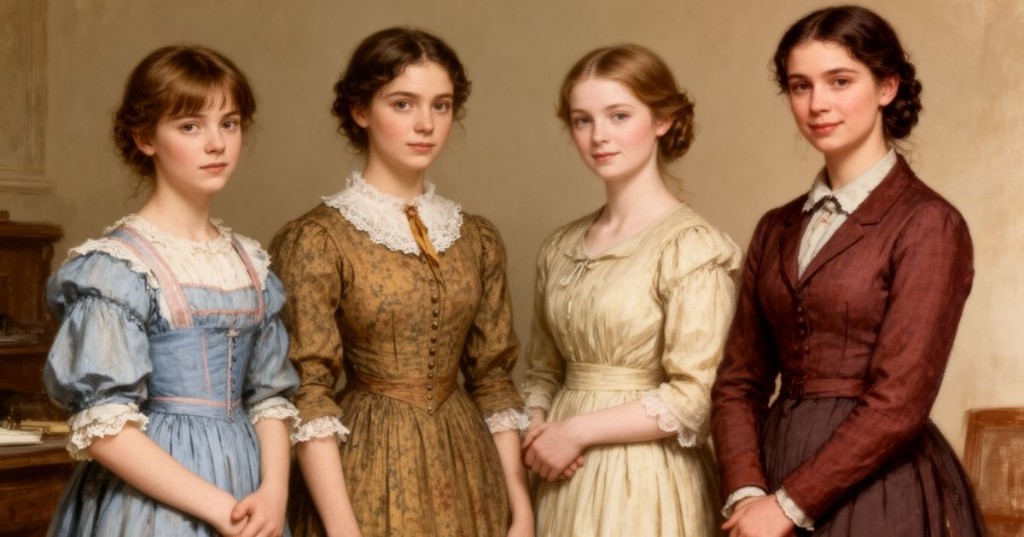
An excerpt from the original text.(complete · 4762 words)
CHAPTER FOUR BURDENS
“Oh, dear, how hard it does seem to take up our packs and go on,”
sighed Meg the morning after the party, for now the holidays were over,
the week of merrymaking did not fit her for going on easily with the
task she never liked.
“I wish it was Christmas or New Year’s all the time. Wouldn’t it be
fun?” answered Jo, yawning dismally.
“We shouldn’t enjoy ourselves half so much as we do now. But it does
seem so nice to have little suppers and bouquets, and go to parties,
and drive home, and read and rest, and not work. It’s like other
people, you know, and I always envy girls who do such things, I’m so
fond of luxury,” said Meg, trying to decide which of two shabby gowns
was the least shabby.
“Well, we can’t have it, so don’t let us grumble but shoulder our
bundles and trudge along as cheerfully as Marmee does. I’m sure Aunt
March is a regular Old Man of the Sea to me, but I suppose when I’ve
learned to carry her without complaining, she will tumble off, or get
so light that I shan’t mind her.”
This idea tickled Jo’s fancy and put her in good spirits, but Meg
didn’t brighten, for her burden, consisting of four spoiled children,
seemed heavier than ever. She had not heart enough even to make herself
pretty as usual by putting on a blue neck ribbon and dressing her hair
in the most becoming way.
“Where’s the use of looking nice, when no one sees me but those cross
midgets, and no one cares whether I’m pretty or not?” she muttered,
shutting her drawer with a jerk. “I shall have to toil and moil all my
days, with only little bits of fun now and then, and get old and ugly
and sour, because I’m poor and can’t enjoy my life as other girls do.
It’s a shame!”
So Meg went down, wearing an injured look, and wasn’t at all agreeable
at breakfast time. Everyone seemed rather out of sorts and inclined to
croak.
Beth had a headache and lay on the sofa, trying to comfort herself with
the cat and three kittens. Amy was fretting because her lessons were
not learned, and she couldn’t find her rubbers. Jo would whistle and
make a great racket getting ready.
Mrs. March was very busy trying to finish a letter, which must go at
once, and Hannah had the grumps, for being up late didn’t suit her.
“There never was such a cross family!” cried Jo, losing her temper when
she had upset an inkstand, broken both boot lacings, and sat down upon
her hat.
“You’re the crossest person in it!” returned Amy, washing out the sum
that was all wrong with the tears that had fallen on her slate.
“Beth, if you don’t keep these horrid cats down cellar I’ll have them
drowned,” exclaimed Meg angrily as she tried to get rid of the kitten
which had scrambled up her back and stuck like a burr just out of
reach.
Jo laughed, Meg scolded, Beth implored, and Amy wailed because she
couldn’t remember how much nine times twelve was.
“Girls, girls, do be quiet one minute! I must get this off by the early
mail, and you drive me distracted with your worry,” cried Mrs. March,
crossing out the third spoiled sentence in her letter.
There was a momentary lull, broken by Hannah, who stalked in, laid two
hot turnovers on the table, and stalked out again. These turnovers were
an institution, and the girls called them ‘muffs’, for they had no
others and found the hot pies very comforting to their hands on cold
mornings.
Hannah never forgot to make them, no matter how busy or grumpy she
might be, for the walk was long and bleak. The poor things got no other
lunch and were seldom home before two.
“Cuddle your cats and get over your headache, Bethy. Goodbye, Marmee.
We are a set of rascals this morning, but we’ll come home regular
angels. Now then, Meg!” And Jo tramped away, feeling that the pilgrims
were not setting out as they ought to do.
They always looked back before turning the corner, for their mother was
always at the window to nod and smile, and wave her hand to them.
Somehow it seemed as if they couldn’t have got through the day without
that, for whatever their mood might be, the last glimpse of that
motherly face was sure to affect them like sunshine.
“If Marmee shook her fist instead of kissing her hand to us, it would
serve us right, for more ungrateful wretches than we are were never
seen,” cried Jo, taking a remorseful satisfaction in the snowy walk and
bitter wind.
“Don’t use such dreadful expressions,” replied Meg from the depths of
the veil in which she had shrouded herself like a nun sick of the
world.
“I like good strong words that mean something,” replied Jo, catching
her hat as it took a leap off her head preparatory to flying away
altogether.
“Call yourself any names you like, but I am neither a rascal nor a
wretch and I don’t choose to be called so.”
“You’re a blighted being, and decidedly cross today because you can’t
sit in the lap of luxury all the time. Poor dear, just wait till I make
my fortune, and you shall revel in carriages and ice cream and
high-heeled slippers, and posies, and red-headed boys to dance with.”
“How ridiculous you are, Jo!” But Meg laughed at the nonsense and felt
better in spite of herself.
“Lucky for you I am, for if I put on crushed airs and tried to be
dismal, as you do, we should be in a nice state. Thank goodness, I can
always find something funny to keep me up. Don’t croak any more, but
come home jolly, there’s a dear.”
Jo gave her sister an encouraging pat on the shoulder as they parted
for the day, each going a different way, each hugging her little warm
turnover, and each trying to be cheerful in spite of wintry weather,
hard work, and the unsatisfied desires of pleasure-loving youth.
When Mr. March lost his property in trying to help an unfortunate
friend, the two oldest girls begged to be allowed to do something
toward their own support, at least. Believing that they could not begin
too early to cultivate energy, industry, and independence, their
parents consented, and both fell to work with the hearty good will
which in spite of all obstacles is sure to succeed at last.
Margaret found a place as nursery governess and felt rich with her
small salary. As she said, she was ‘fond of luxury’, and her chief
trouble was poverty. She found it harder to bear than the others
because she could remember a time when home was beautiful, life full of
ease and pleasure, and want of any kind unknown. She tried not to be
envious or discontented, but it was very natural that the young girl
should long for pretty things, gay friends, accomplishments, and a
happy life. At the Kings’ she daily saw all she wanted, for the
children’s older sisters were just out, and Meg caught frequent
glimpses of dainty ball dresses and bouquets, heard lively gossip about
theaters, concerts, sleighing parties, and merrymakings of all kinds,
and saw money lavished on trifles which would have been so precious to
her. Poor Meg seldom complained, but a sense of injustice made her feel
bitter toward everyone sometimes, for she had not yet learned to know
how rich she was in the blessings which alone can make life happy.
Jo happened to suit Aunt March, who was lame and needed an active
person to wait upon her. The childless old lady had offered to adopt
one of the girls when the troubles came, and was much offended because
her offer was declined. Other friends told the Marches that they had
lost all chance of being remembered in the rich old lady’s will, but
the unworldly Marches only said...
“We can’t give up our girls for a dozen fortunes. Rich or poor, we will
keep together and be happy in one another.”
The old lady wouldn’t speak to them for a time, but happening to meet
Jo at a friend’s, something in her comical face and blunt manners
struck the old lady’s fancy, and she proposed to take her for a
companion. This did not suit Jo at all, but she accepted the place
since nothing better appeared and, to every one’s surprise, got on
remarkably well with her irascible relative. There was an occasional
tempest, and once Jo marched home, declaring she couldn’t bear it
longer, but Aunt March always cleared up quickly, and sent for her to
come back again with such urgency that she could not refuse, for in her
heart she rather liked the peppery old lady.
I suspect that the real attraction was a large library of fine books,
which was left to dust and spiders since Uncle March died. Jo
remembered the kind old gentleman, who used to let her build railroads
and bridges with his big dictionaries, tell her stories about queer
pictures in his Latin books, and buy her cards of gingerbread whenever
he met her in the street. The dim, dusty room, with the busts staring
down from the tall bookcases, the cozy chairs, the globes, and best of
all, the wilderness of books in which she could wander where she liked,
made the library a region of bliss to her.
The moment Aunt March took her nap, or was busy with company, Jo
hurried to this quiet place, and curling herself up in the easy chair,
devoured poetry, romance, history, travels, and pictures like a regular
bookworm. But, like all happiness, it did not last long, for as sure as
she had just reached the heart of the story, the sweetest verse of a
song, or the most perilous adventure of her traveler, a shrill voice
called, “Josy-phine! Josy-phine!” and she had to leave her paradise to
wind yarn, wash the poodle, or read Belsham’s Essays by the hour
together.
Jo’s ambition was to do something very splendid. What it was, she had
no idea as yet, but left it for time to tell her, and meanwhile, found
her greatest affliction in the fact that she couldn’t read, run, and
ride as much as she liked. A quick temper, sharp tongue, and restless
spirit were always getting her into scrapes, and her life was a series
of ups and downs, which were both comic and pathetic. But the training
she received at Aunt March’s was just what she needed, and the thought
that she was doing something to support herself made her happy in spite
of the perpetual “Josy-phine!”
Beth was too bashful to go to school. It had been tried, but she
suffered so much that it was given up, and she did her lessons at home
with her father. Even when he went away, and her mother was called to
devote her skill and energy to Soldiers’ Aid Societies, Beth went
faithfully on by herself and did the best she could. She was a
housewifely little creature, and helped Hannah keep home neat and
comfortable for the workers, never thinking of any reward but to be
loved. Long, quiet days she spent, not lonely nor idle, for her little
world was peopled with imaginary friends, and she was by nature a busy
bee. There were six dolls to be taken up and dressed every morning, for
Beth was a child still and loved her pets as well as ever. Not one
whole or handsome one among them, all were outcasts till Beth took them
in, for when her sisters outgrew these idols, they passed to her
because Amy would have nothing old or ugly. Beth cherished them all the
more tenderly for that very reason, and set up a hospital for infirm
dolls. No pins were ever stuck into their cotton vitals, no harsh words
or blows were ever given them, no neglect ever saddened the heart of
the most repulsive, but all were fed and clothed, nursed and caressed
with an affection which never failed. One forlorn fragment of dollanity
had belonged to Jo and, having led a tempestuous life, was left a wreck
in the rag bag, from which dreary poorhouse it was rescued by Beth and
taken to her refuge. Having no top to its head, she tied on a neat
little cap, and as both arms and legs were gone, she hid these
deficiencies by folding it in a blanket and devoting her best bed to
this chronic invalid. If anyone had known the care lavished on that
dolly, I think it would have touched their hearts, even while they
laughed. She brought it bits of bouquets, she read to it, took it out
to breathe fresh air, hidden under her coat, she sang it lullabies and
never went to bed without kissing its dirty face and whispering
tenderly, “I hope you’ll have a good night, my poor dear.”
Beth had her troubles as well as the others, and not being an angel but
a very human little girl, she often ‘wept a little weep’ as Jo said,
because she couldn’t take music lessons and have a fine piano. She
loved music so dearly, tried so hard to learn, and practiced away so
patiently at the jingling old instrument, that it did seem as if
someone (not to hint Aunt March) ought to help her. Nobody did,
however, and nobody saw Beth wipe the tears off the yellow keys, that
wouldn’t keep in tune, when she was all alone. She sang like a little
lark about her work, never was too tired for Marmee and the girls, and
day after day said hopefully to herself, “I know I’ll get my music some
time, if I’m good.”
There are many Beths in the world, shy and quiet, sitting in corners
till needed, and living for others so cheerfully that no one sees the
sacrifices till the little cricket on the hearth stops chirping, and
the sweet, sunshiny presence vanishes, leaving silence and shadow
behind.
If anybody had asked Amy what the greatest trial of her life was, she
would have answered at once, “My nose.” When she was a baby, Jo had
accidently dropped her into the coal hod, and Amy insisted that the
fall had ruined her nose forever. It was not big nor red, like poor
‘Petrea’s’, it was only rather flat, and all the pinching in the world
could not give it an aristocratic point. No one minded it but herself,
and it was doing its best to grow, but Amy felt deeply the want of a
Grecian nose, and drew whole sheets of handsome ones to console
herself.
“Little Raphael,” as her sisters called her, had a decided talent for
drawing, and was never so happy as when copying flowers, designing
fairies, or illustrating stories with queer specimens of art. Her
teachers complained that instead of doing her sums she covered her
slate with animals, the blank pages of her atlas were used to copy maps
on, and caricatures of the most ludicrous description came fluttering
out of all her books at unlucky moments. She got through her lessons as
well as she could, and managed to escape reprimands by being a model of
deportment. She was a great favorite with her mates, being
good-tempered and possessing the happy art of pleasing without effort.
Her little airs and graces were much admired, so were her
accomplishments, for besides her drawing, she could play twelve tunes,
crochet, and read French without mispronouncing more than two-thirds of
the words. She had a plaintive way of saying, “When Papa was rich we
did so-and-so,” which was very touching, and her long words were
considered ‘perfectly elegant’ by the girls.
Amy was in a fair way to be spoiled, for everyone petted her, and her
small vanities and selfishnesses were growing nicely. One thing,
however, rather quenched the vanities. She had to wear her cousin’s
clothes. Now Florence’s mama hadn’t a particle of taste, and Amy
suffered deeply at having to wear a red instead of a blue bonnet,
unbecoming gowns, and fussy aprons that did not fit. Everything was
good, well made, and little worn, but Amy’s artistic eyes were much
afflicted, especially this winter, when her school dress was a dull
purple with yellow dots and no trimming.
“My only comfort,” she said to Meg, with tears in her eyes, “is that
Mother doesn’t take tucks in my dresses whenever I’m naughty, as Maria
Parks’s mother does. My dear, it’s really dreadful, for sometimes she
is so bad her frock is up to her knees, and she can’t come to school.
When I think of this deggerredation, I feel that I can bear even my
flat nose and purple gown with yellow sky-rockets on it.”
Meg was Amy’s confidant and monitor, and by some strange attraction of
opposites Jo was gentle Beth’s. To Jo alone did the shy child tell her
thoughts, and over her big harum-scarum sister Beth unconsciously
exercised more influence than anyone in the family. The two older girls
were a great deal to one another, but each took one of the younger
sisters into her keeping and watched over her in her own way, ‘playing
mother’ they called it, and put their sisters in the places of
discarded dolls with the maternal instinct of little women.
“Has anybody got anything to tell? It’s been such a dismal day I’m
really dying for some amusement,” said Meg, as they sat sewing together
that evening.
“I had a queer time with Aunt today, and, as I got the best of it, I’ll
tell you about it,” began Jo, who dearly loved to tell stories. “I was
reading that everlasting Belsham, and droning away as I always do, for
Aunt soon drops off, and then I take out some nice book, and read like
fury till she wakes up. I actually made myself sleepy, and before she
began to nod, I gave such a gape that she asked me what I meant by
opening my mouth wide enough to take the whole book in at once.”
“I wish I could, and be done with it,” said I, trying not to be saucy.
“Then she gave me a long lecture on my sins, and told me to sit and
think them over while she just ‘lost’ herself for a moment. She never
finds herself very soon, so the minute her cap began to bob like a
top-heavy dahlia, I whipped the Vicar of Wakefield out of my pocket,
and read away, with one eye on him and one on Aunt. I’d just got to
where they all tumbled into the water when I forgot and laughed out
loud. Aunt woke up and, being more good-natured after her nap, told me
to read a bit and show what frivolous work I preferred to the worthy
and instructive Belsham. I did my very best, and she liked it, though
she only said...
“‘I don’t understand what it’s all about. Go back and begin it,
child.’”
“Back I went, and made the Primroses as interesting as ever I could.
Once I was wicked enough to stop in a thrilling place, and say meekly,
‘I’m afraid it tires you, ma’am. Shan’t I stop now?’”
“She caught up her knitting, which had dropped out of her hands, gave
me a sharp look through her specs, and said, in her short way, ‘Finish
the chapter, and don’t be impertinent, miss’.”
“Did she own she liked it?” asked Meg.
“Oh, bless you, no! But she let old Belsham rest, and when I ran back
after my gloves this afternoon, there she was, so hard at the Vicar
that she didn’t hear me laugh as I danced a jig in the hall because of
the good time coming. What a pleasant life she might have if only she
chose! I don’t envy her much, in spite of her money, for after all rich
people have about as many worries as poor ones, I think,” added Jo.
“That reminds me,” said Meg, “that I’ve got something to tell. It isn’t
funny, like Jo’s story, but I thought about it a good deal as I came
home. At the Kings’ today I found everybody in a flurry, and one of the
children said that her oldest brother had done something dreadful, and
Papa had sent him away. I heard Mrs. King crying and Mr. King talking
very loud, and Grace and Ellen turned away their faces when they passed
me, so I shouldn’t see how red and swollen their eyes were. I didn’t
ask any questions, of course, but I felt so sorry for them and was
rather glad I hadn’t any wild brothers to do wicked things and disgrace
the family.”
“I think being disgraced in school is a great deal tryinger than
anything bad boys can do,” said Amy, shaking her head, as if her
experience of life had been a deep one. “Susie Perkins came to school
today with a lovely red carnelian ring. I wanted it dreadfully, and
wished I was her with all my might. Well, she drew a picture of Mr.
Davis, with a monstrous nose and a hump, and the words, ‘Young ladies,
my eye is upon you!’ coming out of his mouth in a balloon thing. We
were laughing over it when all of a sudden his eye was on us, and he
ordered Susie to bring up her slate. She was parrylized with fright,
but she went, and oh, what do you think he did? He took her by the
ear—the ear! Just fancy how horrid!—and led her to the recitation
platform, and made her stand there half an hour, holding the slate so
everyone could see.”
“Didn’t the girls laugh at the picture?” asked Jo, who relished the
scrape.
“Laugh? Not one! They sat still as mice, and Susie cried quarts, I know
she did. I didn’t envy her then, for I felt that millions of carnelian
rings wouldn’t have made me happy after that. I never, never should
have got over such a agonizing mortification.” And Amy went on with her
work, in the proud consciousness of virtue and the successful utterance
of two long words in a breath.
“I saw something I liked this morning, and I meant to tell it at
dinner, but I forgot,” said Beth, putting Jo’s topsy-turvy basket in
order as she talked. “When I went to get some oysters for Hannah, Mr.
Laurence was in the fish shop, but he didn’t see me, for I kept behind
the fish barrel, and he was busy with Mr. Cutter the fish-man. A poor
woman came in with a pail and a mop, and asked Mr. Cutter if he would
let her do some scrubbing for a bit of fish, because she hadn’t any
dinner for her children, and had been disappointed of a day’s work. Mr.
Cutter was in a hurry and said ‘No’, rather crossly, so she was going
away, looking hungry and sorry, when Mr. Laurence hooked up a big fish
with the crooked end of his cane and held it out to her. She was so
glad and surprised she took it right into her arms, and thanked him
over and over. He told her to ‘go along and cook it’, and she hurried
off, so happy! Wasn’t it good of him? Oh, she did look so funny,
hugging the big, slippery fish, and hoping Mr. Laurence’s bed in heaven
would be ‘aisy’.”
When they had laughed at Beth’s story, they asked their mother for one,
and after a moments thought, she said soberly, “As I sat cutting out
blue flannel jackets today at the rooms, I felt very anxious about
Father, and thought how lonely and helpless we should be, if anything
happened to him. It was not a wise thing to do, but I kept on worrying
till an old man came in with an order for some clothes. He sat down
near me, and I began to talk to him, for he looked poor and tired and
anxious.
“‘Have you sons in the army?’ I asked, for the note he brought was not
to me.”
“Yes, ma’am. I had four, but two were killed, one is a prisoner, and
I’m going to the other, who is very sick in a Washington hospital.’ he
answered quietly.”
“‘You have done a great deal for your country, sir,’ I said, feeling
respect now, instead of pity.”
“‘Not a mite more than I ought, ma’am. I’d go myself, if I was any use.
As I ain’t, I give my boys, and give ’em free.’”
“He spoke so cheerfully, looked so sincere, and seemed so glad to give
his all, that I was ashamed of myself. I’d given one man and thought it
too much, while he gave four without grudging them. I had all my girls
to comfort me at home, and his last son was waiting, miles away, to say
good-by to him, perhaps! I felt so rich, so happy thinking of my
blessings, that I made him a nice bundle, gave him some money, and
thanked him heartily for the lesson he had taught me.”
“Tell another story, Mother, one with a moral to it, like this. I like
to think about them afterward, if they are real and not too preachy,”
said Jo, after a minute’s silence.
Mrs. March smiled and began at once, for she had told stories to this
little audience for many years, and knew how to please them.
“Once upon a time, there were four girls, who had enough to eat and
drink and wear, a good many comforts and pleasures, kind friends and
parents who loved them dearly, and yet they were not contented.” (Here
the listeners stole sly looks at one another, and began to sew
diligently.) “These girls were anxious to be good and made many
excellent resolutions, but they did not keep them very well, and were
constantly saying, ‘If only we had this,’ or ‘If we could only do
that,’ quite forgetting how much they already had, and how many things
they actually could do. So they asked an old woman what spell they
could use to make them happy, and she said, ‘When you feel
discontented, think over your blessings, and be grateful.’” (Here Jo
looked up quickly, as if about to speak, but changed her mind, seeing
that the story was not done yet.)
“Being sensible girls, they decided to try her advice, and soon were
surprised to see how well off they were. One discovered that money
couldn’t keep shame and sorrow out of rich people’s houses, another
that, though she was poor, she was a great deal happier, with her
youth, health, and good spirits, than a certain fretful, feeble old
lady who couldn’t enjoy her comforts, a third that, disagreeable as it
was to help get dinner, it was harder still to go begging for it and
the fourth, that even carnelian rings were not so valuable as good
behavior. So they agreed to stop complaining, to enjoy the blessings
already possessed, and try to deserve them, lest they should be taken
away entirely, instead of increased, and I believe they were never
disappointed or sorry that they took the old woman’s advice.”
“Now, Marmee, that is very cunning of you to turn our own stories
against us, and give us a sermon instead of a romance!” cried Meg.
“I like that kind of sermon. It’s the sort Father used to tell us,”
said Beth thoughtfully, putting the needles straight on Jo’s cushion.
“I don’t complain near as much as the others do, and I shall be more
careful than ever now, for I’ve had warning from Susie’s downfall,”
said Amy morally.
“We needed that lesson, and we won’t forget it. If we do so, you just
say to us, as old Chloe did in Uncle Tom, ‘Tink ob yer marcies,
chillen!’ ‘Tink ob yer marcies!’” added Jo, who could not, for the life
of her, help getting a morsel of fun out of the little sermon, though
she took it to heart as much as any of them.
Master this chapter. Complete your experience
Purchase the complete book to access all chapters and support classic literature
As an Amazon Associate, we earn a small commission from qualifying purchases at no additional cost to you.
Available in paperback, hardcover, and e-book formats
Let's Analyse the Pattern
How the same circumstances can feel unbearable or manageable depending entirely on how we frame them and what we compare them to.
Why This Matters
Connect literature to life
This chapter teaches how to consciously shift perspective to transform your emotional experience of unchanged circumstances.
Practice This Today
This week, notice when you feel stuck or resentful, then ask: 'What would someone facing bigger challenges think about my situation?' and redirect attention to one thing you can improve or appreciate.
Now let's explore the literary elements.
Key Quotes & Analysis
"We can't have it, so don't let us grumble but shoulder our bundles and trudge along as cheerfully as Marmee does."
Context: Jo encourages Meg to accept their circumstances instead of complaining about what they can't have
This shows Jo's practical wisdom and her admiration for her mother's grace under pressure. She understands that complaining doesn't change reality, but attitude can change how you experience that reality.
In Today's Words:
Life isn't fair, but we can choose to handle it with dignity like Mom does instead of making ourselves miserable complaining about it.
"I suppose when I've learned to carry her without complaining, she will tumble off, or get so light that I shan't mind her."
Context: Jo describes how accepting Aunt March as her burden might eventually make the situation more bearable
This reveals Jo's intuitive understanding that resistance creates suffering. When we stop fighting what we can't change, the burden often becomes manageable or even disappears.
In Today's Words:
Once I stop fighting this situation and just deal with it, it probably won't feel so heavy anymore.
"I always envy girls who do such things, I'm so fond of luxury."
Context: Meg admits her jealousy of girls who can afford parties, nice clothes, and leisure time
Meg's honesty about her desires shows the internal conflict between duty and longing that many people face. Her admission makes her relatable rather than perfectly virtuous.
In Today's Words:
I'm jealous of people who can afford nice things and don't have to work so hard - I wish that could be me.
Thematic Threads
Class
In This Chapter
Each sister's work situation reflects their family's economic position—Meg serves wealthy families, Jo depends on rich relatives, Beth can't afford music lessons, Amy wears old clothes
Development
Deepened from earlier chapters—now showing how class affects daily emotional experience, not just material conditions
In Your Life:
You might recognize how economic stress shapes not just what you can afford, but how you feel about yourself every day.
Identity
In This Chapter
Each sister struggles with who they are versus who they want to be—Meg wants luxury, Jo wants independence, Beth wants music, Amy wants beauty
Development
Evolved from Christmas wishes to daily reality checks—identity formation through confronting limitations
In Your Life:
You might see this in the gap between your career dreams and your current job, or between your ideal self and daily struggles.
Social Expectations
In This Chapter
The sisters must work and contribute while maintaining feminine respectability—a delicate balance of duty and propriety
Development
Expanded from family expectations to societal pressures—how women navigate economic necessity while preserving social standing
In Your Life:
You might recognize this in balancing professional ambition with family expectations, or managing multiple roles that sometimes conflict.
Personal Growth
In This Chapter
Mother's wisdom teaches the sisters to transform their relationship to hardship rather than escape it
Development
Introduced here as conscious character development—growth through perspective change rather than circumstance change
In Your Life:
You might apply this when facing unchangeable situations that require internal rather than external solutions.
Human Relationships
In This Chapter
The family gathering and story-sharing creates connection that helps everyone bear their individual burdens
Development
Deepened from earlier chapters—showing how relationships provide emotional support and perspective during difficult times
In Your Life:
You might recognize how sharing struggles with trusted people can make them feel more manageable, even when nothing practical changes.
You now have the context. Time to form your own thoughts.
Discussion Questions
- 1
Why do the March sisters feel so much worse about their responsibilities on Monday morning than they did before Christmas?
analysis • surface - 2
How does their mother's story about the old man who lost four sons change the way the sisters see their own problems?
analysis • medium - 3
Where do you see this same pattern today - people feeling worse about their situation after seeing something better on social media or experiencing a taste of luxury?
application • medium - 4
When you're feeling sorry for yourself about your circumstances, what strategies could you use to shift your perspective like the March sisters learned to do?
application • deep - 5
What does this chapter reveal about why the same situation can feel unbearable one day and manageable the next?
reflection • deep
Critical Thinking Exercise
Practice the Perspective Flip
Think of something in your life that's been bothering you lately - a work situation, living arrangement, relationship issue, or financial stress. Write it down in one sentence. Then practice three different perspective flips: First, imagine how someone with a much bigger version of this problem would view yours. Second, list three things about your situation that someone else might actually envy. Third, identify one small action you could take within your current circumstances to improve things slightly.
Consider:
- •The goal isn't to dismiss your real feelings or problems, but to see them more clearly
- •Notice how your emotional response changes as you shift your focus
- •Pay attention to which perspective flip feels most helpful for moving forward
Journaling Prompt
Write about a time when someone else's story or struggle completely changed how you viewed your own situation. What did you learn about the power of perspective from that experience?
Coming Up Next...
Chapter 5: Breaking Down Barriers Through Kindness
The March family is about to meet their mysterious new neighbor, and this encounter will open up unexpected friendships and opportunities that will change their lives in ways they never imagined.



