
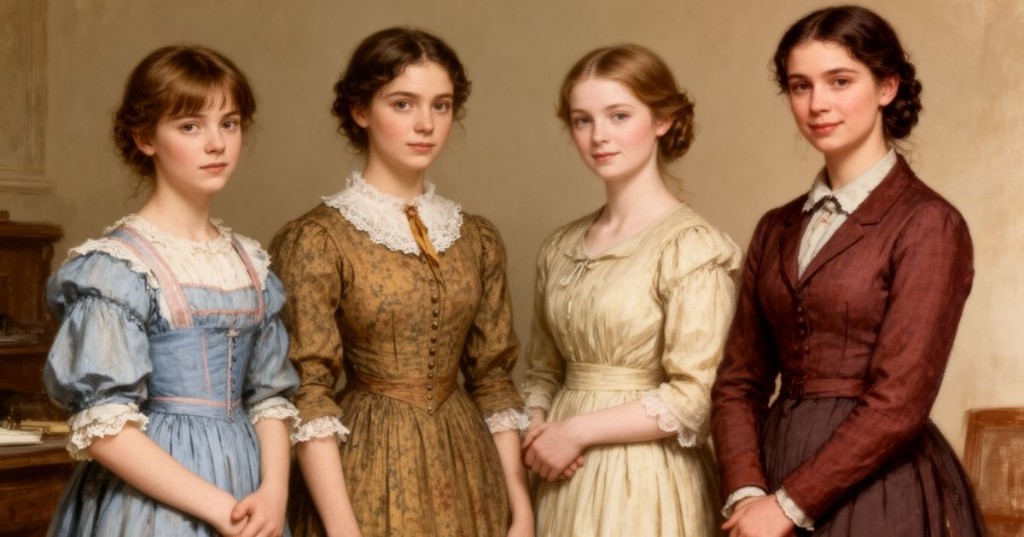
An excerpt from the original text.(complete · 4435 words)
CHAPTER FIVE BEING NEIGHBORLY
“What in the world are you going to do now, Jo?” asked Meg one snowy
afternoon, as her sister came tramping through the hall, in rubber
boots, old sack, and hood, with a broom in one hand and a shovel in the
other.
“Going out for exercise,” answered Jo with a mischievous twinkle in her
eyes.
“I should think two long walks this morning would have been enough!
It’s cold and dull out, and I advise you to stay warm and dry by the
fire, as I do,” said Meg with a shiver.
“Never take advice! Can’t keep still all day, and not being a pussycat,
I don’t like to doze by the fire. I like adventures, and I’m going to
find some.”
Meg went back to toast her feet and read Ivanhoe, and Jo began to dig
paths with great energy. The snow was light, and with her broom she
soon swept a path all round the garden, for Beth to walk in when the
sun came out and the invalid dolls needed air. Now, the garden
separated the Marches’ house from that of Mr. Laurence. Both stood in a
suburb of the city, which was still country-like, with groves and
lawns, large gardens, and quiet streets. A low hedge parted the two
estates. On one side was an old, brown house, looking rather bare and
shabby, robbed of the vines that in summer covered its walls and the
flowers, which then surrounded it. On the other side was a stately
stone mansion, plainly betokening every sort of comfort and luxury,
from the big coach house and well-kept grounds to the conservatory and
the glimpses of lovely things one caught between the rich curtains.
Yet it seemed a lonely, lifeless sort of house, for no children
frolicked on the lawn, no motherly face ever smiled at the windows, and
few people went in and out, except the old gentleman and his grandson.
To Jo’s lively fancy, this fine house seemed a kind of enchanted
palace, full of splendors and delights which no one enjoyed. She had
long wanted to behold these hidden glories, and to know the Laurence
boy, who looked as if he would like to be known, if he only knew how to
begin. Since the party, she had been more eager than ever, and had
planned many ways of making friends with him, but he had not been seen
lately, and Jo began to think he had gone away, when she one day spied
a brown face at an upper window, looking wistfully down into their
garden, where Beth and Amy were snow-balling one another.
“That boy is suffering for society and fun,” she said to herself. “His
grandpa does not know what’s good for him, and keeps him shut up all
alone. He needs a party of jolly boys to play with, or somebody young
and lively. I’ve a great mind to go over and tell the old gentleman
so!”
The idea amused Jo, who liked to do daring things and was always
scandalizing Meg by her queer performances. The plan of ‘going over’
was not forgotten. And when the snowy afternoon came, Jo resolved to
try what could be done. She saw Mr. Lawrence drive off, and then
sallied out to dig her way down to the hedge, where she paused and took
a survey. All quiet, curtains down at the lower windows, servants out
of sight, and nothing human visible but a curly black head leaning on a
thin hand at the upper window.
“There he is,” thought Jo, “Poor boy! All alone and sick this dismal
day. It’s a shame! I’ll toss up a snowball and make him look out, and
then say a kind word to him.”
Up went a handful of soft snow, and the head turned at once, showing a
face which lost its listless look in a minute, as the big eyes
brightened and the mouth began to smile. Jo nodded and laughed, and
flourished her broom as she called out...
“How do you do? Are you sick?”
Laurie opened the window, and croaked out as hoarsely as a raven...
“Better, thank you. I’ve had a bad cold, and been shut up a week.”
“I’m sorry. What do you amuse yourself with?”
“Nothing. It’s dull as tombs up here.”
“Don’t you read?”
“Not much. They won’t let me.”
“Can’t somebody read to you?”
“Grandpa does sometimes, but my books don’t interest him, and I hate to
ask Brooke all the time.”
“Have someone come and see you then.”
“There isn’t anyone I’d like to see. Boys make such a row, and my head
is weak.”
“Isn’t there some nice girl who’d read and amuse you? Girls are quiet
and like to play nurse.”
“Don’t know any.”
“You know us,” began Jo, then laughed and stopped.
“So I do! Will you come, please?” cried Laurie.
“I’m not quiet and nice, but I’ll come, if Mother will let me. I’ll go
ask her. Shut the window, like a good boy, and wait till I come.”
With that, Jo shouldered her broom and marched into the house,
wondering what they would all say to her. Laurie was in a flutter of
excitement at the idea of having company, and flew about to get ready,
for as Mrs. March said, he was ‘a little gentleman’, and did honor to
the coming guest by brushing his curly pate, putting on a fresh color,
and trying to tidy up the room, which in spite of half a dozen
servants, was anything but neat. Presently there came a loud ring, then
a decided voice, asking for ‘Mr. Laurie’, and a surprised-looking
servant came running up to announce a young lady.
“All right, show her up, it’s Miss Jo,” said Laurie, going to the door
of his little parlor to meet Jo, who appeared, looking rosy and quite
at her ease, with a covered dish in one hand and Beth’s three kittens
in the other.
“Here I am, bag and baggage,” she said briskly. “Mother sent her love,
and was glad if I could do anything for you. Meg wanted me to bring
some of her blanc mange, she makes it very nicely, and Beth thought her
cats would be comforting. I knew you’d laugh at them, but I couldn’t
refuse, she was so anxious to do something.”
It so happened that Beth’s funny loan was just the thing, for in
laughing over the kits, Laurie forgot his bashfulness, and grew
sociable at once.
“That looks too pretty to eat,” he said, smiling with pleasure, as Jo
uncovered the dish, and showed the blanc mange, surrounded by a garland
of green leaves, and the scarlet flowers of Amy’s pet geranium.
“It isn’t anything, only they all felt kindly and wanted to show it.
Tell the girl to put it away for your tea. It’s so simple you can eat
it, and being soft, it will slip down without hurting your sore throat.
What a cozy room this is!”
“It might be if it was kept nice, but the maids are lazy, and I don’t
know how to make them mind. It worries me though.”
“I’ll right it up in two minutes, for it only needs to have the hearth
brushed, so—and the things made straight on the mantelpiece, so—and the
books put here, and the bottles there, and your sofa turned from the
light, and the pillows plumped up a bit. Now then, you’re fixed.”
And so he was, for, as she laughed and talked, Jo had whisked things
into place and given quite a different air to the room. Laurie watched
her in respectful silence, and when she beckoned him to his sofa, he
sat down with a sigh of satisfaction, saying gratefully...
“How kind you are! Yes, that’s what it wanted. Now please take the big
chair and let me do something to amuse my company.”
“No, I came to amuse you. Shall I read aloud?” and Jo looked
affectionately toward some inviting books near by.
“Thank you! I’ve read all those, and if you don’t mind, I’d rather
talk,” answered Laurie.
“Not a bit. I’ll talk all day if you’ll only set me going. Beth says I
never know when to stop.”
“Is Beth the rosy one, who stays at home good deal and sometimes goes
out with a little basket?” asked Laurie with interest.
“Yes, that’s Beth. She’s my girl, and a regular good one she is, too.”
“The pretty one is Meg, and the curly-haired one is Amy, I believe?”
“How did you find that out?”
Laurie colored up, but answered frankly, “Why, you see I often hear you
calling to one another, and when I’m alone up here, I can’t help
looking over at your house, you always seem to be having such good
times. I beg your pardon for being so rude, but sometimes you forget to
put down the curtain at the window where the flowers are. And when the
lamps are lighted, it’s like looking at a picture to see the fire, and
you all around the table with your mother. Her face is right opposite,
and it looks so sweet behind the flowers, I can’t help watching it. I
haven’t got any mother, you know.” And Laurie poked the fire to hide a
little twitching of the lips that he could not control.
The solitary, hungry look in his eyes went straight to Jo’s warm heart.
She had been so simply taught that there was no nonsense in her head,
and at fifteen she was as innocent and frank as any child. Laurie was
sick and lonely, and feeling how rich she was in home and happiness,
she gladly tried to share it with him. Her face was very friendly and
her sharp voice unusually gentle as she said...
“We’ll never draw that curtain any more, and I give you leave to look
as much as you like. I just wish, though, instead of peeping, you’d
come over and see us. Mother is so splendid, she’d do you heaps of
good, and Beth would sing to you if I begged her to, and Amy would
dance. Meg and I would make you laugh over our funny stage properties,
and we’d have jolly times. Wouldn’t your grandpa let you?”
“I think he would, if your mother asked him. He’s very kind, though he
does not look so, and he lets me do what I like, pretty much, only he’s
afraid I might be a bother to strangers,” began Laurie, brightening
more and more.
“We are not strangers, we are neighbors, and you needn’t think you’d be
a bother. We want to know you, and I’ve been trying to do it this ever
so long. We haven’t been here a great while, you know, but we have got
acquainted with all our neighbors but you.”
“You see, Grandpa lives among his books, and doesn’t mind much what
happens outside. Mr. Brooke, my tutor, doesn’t stay here, you know, and
I have no one to go about with me, so I just stop at home and get on as
I can.”
“That’s bad. You ought to make an effort and go visiting everywhere you
are asked, then you’ll have plenty of friends, and pleasant places to
go to. Never mind being bashful. It won’t last long if you keep going.”
Laurie turned red again, but wasn’t offended at being accused of
bashfulness, for there was so much good will in Jo it was impossible
not to take her blunt speeches as kindly as they were meant.
“Do you like your school?” asked the boy, changing the subject, after a
little pause, during which he stared at the fire and Jo looked about
her, well pleased.
“Don’t go to school, I’m a businessman—girl, I mean. I go to wait on my
great-aunt, and a dear, cross old soul she is, too,” answered Jo.
Laurie opened his mouth to ask another question, but remembering just
in time that it wasn’t manners to make too many inquiries into people’s
affairs, he shut it again, and looked uncomfortable.
Jo liked his good breeding, and didn’t mind having a laugh at Aunt
March, so she gave him a lively description of the fidgety old lady,
her fat poodle, the parrot that talked Spanish, and the library where
she reveled.
Laurie enjoyed that immensely, and when she told about the prim old
gentleman who came once to woo Aunt March, and in the middle of a fine
speech, how Poll had tweaked his wig off to his great dismay, the boy
lay back and laughed till the tears ran down his cheeks, and a maid
popped her head in to see what was the matter.
“Oh! That does me no end of good. Tell on, please,” he said, taking his
face out of the sofa cushion, red and shining with merriment.
Much elated with her success, Jo did ‘tell on’, all about their plays
and plans, their hopes and fears for Father, and the most interesting
events of the little world in which the sisters lived. Then they got to
talking about books, and to Jo’s delight, she found that Laurie loved
them as well as she did, and had read even more than herself.
“If you like them so much, come down and see ours. Grandfather is out,
so you needn’t be afraid,” said Laurie, getting up.
“I’m not afraid of anything,” returned Jo, with a toss of the head.
“I don’t believe you are!” exclaimed the boy, looking at her with much
admiration, though he privately thought she would have good reason to
be a trifle afraid of the old gentleman, if she met him in some of his
moods.
The atmosphere of the whole house being summerlike, Laurie led the way
from room to room, letting Jo stop to examine whatever struck her
fancy. And so, at last they came to the library, where she clapped her
hands and pranced, as she always did when especially delighted. It was
lined with books, and there were pictures and statues, and distracting
little cabinets full of coins and curiosities, and Sleepy Hollow
chairs, and queer tables, and bronzes, and best of all, a great open
fireplace with quaint tiles all round it.
“What richness!” sighed Jo, sinking into the depth of a velour chair
and gazing about her with an air of intense satisfaction. “Theodore
Laurence, you ought to be the happiest boy in the world,” she added
impressively.
“A fellow can’t live on books,” said Laurie, shaking his head as he
perched on a table opposite.
Before he could say more, a bell rang, and Jo flew up, exclaiming with
alarm, “Mercy me! It’s your grandpa!”
“Well, what if it is? You are not afraid of anything, you know,”
returned the boy, looking wicked.
“I think I am a little bit afraid of him, but I don’t know why I should
be. Marmee said I might come, and I don’t think you’re any the worse
for it,” said Jo, composing herself, though she kept her eyes on the
door.
“I’m a great deal better for it, and ever so much obliged. I’m only
afraid you are very tired of talking to me. It was so pleasant, I
couldn’t bear to stop,” said Laurie gratefully.
“The doctor to see you, sir,” and the maid beckoned as she spoke.
“Would you mind if I left you for a minute? I suppose I must see him,”
said Laurie.
“Don’t mind me. I’m happy as a cricket here,” answered Jo.
Laurie went away, and his guest amused herself in her own way. She was
standing before a fine portrait of the old gentleman when the door
opened again, and without turning, she said decidedly, “I’m sure now
that I shouldn’t be afraid of him, for he’s got kind eyes, though his
mouth is grim, and he looks as if he had a tremendous will of his own.
He isn’t as handsome as my grandfather, but I like him.”
“Thank you, ma’am,” said a gruff voice behind her, and there, to her
great dismay, stood old Mr. Laurence.
Poor Jo blushed till she couldn’t blush any redder, and her heart began
to beat uncomfortably fast as she thought what she had said. For a
minute a wild desire to run away possessed her, but that was cowardly,
and the girls would laugh at her, so she resolved to stay and get out
of the scrape as she could. A second look showed her that the living
eyes, under the bushy eyebrows, were kinder even than the painted ones,
and there was a sly twinkle in them, which lessened her fear a good
deal. The gruff voice was gruffer than ever, as the old gentleman said
abruptly, after the dreadful pause, “So you’re not afraid of me, hey?”
“Not much, sir.”
“And you don’t think me as handsome as your grandfather?”
“Not quite, sir.”
“And I’ve got a tremendous will, have I?”
“I only said I thought so.”
“But you like me in spite of it?”
“Yes, I do, sir.”
That answer pleased the old gentleman. He gave a short laugh, shook
hands with her, and, putting his finger under her chin, turned up her
face, examined it gravely, and let it go, saying with a nod, “You’ve
got your grandfather’s spirit, if you haven’t his face. He was a fine
man, my dear, but what is better, he was a brave and an honest one, and
I was proud to be his friend.”
“Thank you, sir,” And Jo was quite comfortable after that, for it
suited her exactly.
“What have you been doing to this boy of mine, hey?” was the next
question, sharply put.
“Only trying to be neighborly, sir.” And Jo told how her visit came
about.
“You think he needs cheering up a bit, do you?”
“Yes, sir, he seems a little lonely, and young folks would do him good
perhaps. We are only girls, but we should be glad to help if we could,
for we don’t forget the splendid Christmas present you sent us,” said
Jo eagerly.
“Tut, tut, tut! That was the boy’s affair. How is the poor woman?”
“Doing nicely, sir.” And off went Jo, talking very fast, as she told
all about the Hummels, in whom her mother had interested richer friends
than they were.
“Just her father’s way of doing good. I shall come and see your mother
some fine day. Tell her so. There’s the tea bell, we have it early on
the boy’s account. Come down and go on being neighborly.”
“If you’d like to have me, sir.”
“Shouldn’t ask you, if I didn’t.” And Mr. Laurence offered her his arm
with old-fashioned courtesy.
“What would Meg say to this?” thought Jo, as she was marched away,
while her eyes danced with fun as she imagined herself telling the
story at home.
“Hey! Why, what the dickens has come to the fellow?” said the old
gentleman, as Laurie came running downstairs and brought up with a
start of surprise at the astounding sight of Jo arm in arm with his
redoubtable grandfather.
“I didn’t know you’d come, sir,” he began, as Jo gave him a triumphant
little glance.
“That’s evident, by the way you racket downstairs. Come to your tea,
sir, and behave like a gentleman.” And having pulled the boy’s hair by
way of a caress, Mr. Laurence walked on, while Laurie went through a
series of comic evolutions behind their backs, which nearly produced an
explosion of laughter from Jo.
The old gentleman did not say much as he drank his four cups of tea,
but he watched the young people, who soon chatted away like old
friends, and the change in his grandson did not escape him. There was
color, light, and life in the boy’s face now, vivacity in his manner,
and genuine merriment in his laugh.
“She’s right, the lad is lonely. I’ll see what these little girls can
do for him,” thought Mr. Laurence, as he looked and listened. He liked
Jo, for her odd, blunt ways suited him, and she seemed to understand
the boy almost as well as if she had been one herself.
If the Laurences had been what Jo called ‘prim and poky’, she would not
have got on at all, for such people always made her shy and awkward.
But finding them free and easy, she was so herself, and made a good
impression. When they rose she proposed to go, but Laurie said he had
something more to show her, and took her away to the conservatory,
which had been lighted for her benefit. It seemed quite fairylike to
Jo, as she went up and down the walks, enjoying the blooming walls on
either side, the soft light, the damp sweet air, and the wonderful
vines and trees that hung about her, while her new friend cut the
finest flowers till his hands were full. Then he tied them up, saying,
with the happy look Jo liked to see, “Please give these to your mother,
and tell her I like the medicine she sent me very much.”
They found Mr. Laurence standing before the fire in the great drawing
room, but Jo’s attention was entirely absorbed by a grand piano, which
stood open.
“Do you play?” she asked, turning to Laurie with a respectful
expression.
“Sometimes,” he answered modestly.
“Please do now. I want to hear it, so I can tell Beth.”
“Won’t you first?”
“Don’t know how. Too stupid to learn, but I love music dearly.”
So Laurie played and Jo listened, with her nose luxuriously buried in
heliotrope and tea roses. Her respect and regard for the ‘Laurence’ boy
increased very much, for he played remarkably well and didn’t put on
any airs. She wished Beth could hear him, but she did not say so, only
praised him till he was quite abashed, and his grandfather came to his
rescue.
“That will do, that will do, young lady. Too many sugarplums are not
good for him. His music isn’t bad, but I hope he will do as well in
more important things. Going? well, I’m much obliged to you, and I hope
you’ll come again. My respects to your mother. Good night, Doctor Jo.”
He shook hands kindly, but looked as if something did not please him.
When they got into the hall, Jo asked Laurie if she had said something
amiss. He shook his head.
“No, it was me. He doesn’t like to hear me play.”
“Why not?”
“I’ll tell you some day. John is going home with you, as I can’t.”
“No need of that. I am not a young lady, and it’s only a step. Take
care of yourself, won’t you?”
“Yes, but you will come again, I hope?”
“If you promise to come and see us after you are well.”
“I will.”
“Good night, Laurie!”
“Good night, Jo, good night!”
When all the afternoon’s adventures had been told, the family felt
inclined to go visiting in a body, for each found something very
attractive in the big house on the other side of the hedge. Mrs. March
wanted to talk of her father with the old man who had not forgotten
him, Meg longed to walk in the conservatory, Beth sighed for the grand
piano, and Amy was eager to see the fine pictures and statues.
“Mother, why didn’t Mr. Laurence like to have Laurie play?” asked Jo,
who was of an inquiring disposition.
“I am not sure, but I think it was because his son, Laurie’s father,
married an Italian lady, a musician, which displeased the old man, who
is very proud. The lady was good and lovely and accomplished, but he
did not like her, and never saw his son after he married. They both
died when Laurie was a little child, and then his grandfather took him
home. I fancy the boy, who was born in Italy, is not very strong, and
the old man is afraid of losing him, which makes him so careful. Laurie
comes naturally by his love of music, for he is like his mother, and I
dare say his grandfather fears that he may want to be a musician. At
any rate, his skill reminds him of the woman he did not like, and so he
‘glowered’ as Jo said.”
“Dear me, how romantic!” exclaimed Meg.
“How silly!” said Jo. “Let him be a musician if he wants to, and not
plague his life out sending him to college, when he hates to go.”
“That’s why he has such handsome black eyes and pretty manners, I
suppose. Italians are always nice,” said Meg, who was a little
sentimental.
“What do you know about his eyes and his manners? You never spoke to
him, hardly,” cried Jo, who was not sentimental.
“I saw him at the party, and what you tell shows that he knows how to
behave. That was a nice little speech about the medicine Mother sent
him.”
“He meant the blanc mange, I suppose.”
“How stupid you are, child! He meant you, of course.”
“Did he?” And Jo opened her eyes as if it had never occurred to her
before.
“I never saw such a girl! You don’t know a compliment when you get it,”
said Meg, with the air of a young lady who knew all about the matter.
“I think they are great nonsense, and I’ll thank you not to be silly
and spoil my fun. Laurie’s a nice boy and I like him, and I won’t have
any sentimental stuff about compliments and such rubbish. We’ll all be
good to him because he hasn’t got any mother, and he may come over and
see us, mayn’t he, Marmee?”
“Yes, Jo, your little friend is very welcome, and I hope Meg will
remember that children should be children as long as they can.”
“I don’t call myself a child, and I’m not in my teens yet,” observed
Amy. “What do you say, Beth?”
“I was thinking about our ‘Pilgrim’s Progress’,” answered Beth, who
had not heard a word. “How we got out of the Slough and through the
Wicket Gate by resolving to be good, and up the steep hill by trying,
and that maybe the house over there, full of splendid things, is going
to be our Palace Beautiful.”
“We have got to get by the lions first,” said Jo, as if she rather
liked the prospect.
Master this chapter. Complete your experience
Purchase the complete book to access all chapters and support classic literature
As an Amazon Associate, we earn a small commission from qualifying purchases at no additional cost to you.
Available in paperback, hardcover, and e-book formats
Let's Analyse the Pattern
Genuine human connection requires someone to make the first brave move past artificial social barriers.
Why This Matters
Connect literature to life
This chapter teaches how to recognize when someone's withdrawal is actually a cry for connection masked as self-protection.
Practice This Today
This week, notice when someone at work, school, or in your neighborhood seems to be choosing isolation—then consider whether they might actually be waiting for someone to make the first move.
Now let's explore the literary elements.
Key Quotes & Analysis
"Never take advice! Can't keep still all day, and not being a pussycat, I don't like to doze by the fire. I like adventures, and I'm going to find some."
Context: Jo responds to Meg's suggestion that she stay inside on the snowy day
This quote captures Jo's core personality - her rejection of passive, conventional behavior and her active pursuit of life experiences. It shows why she becomes the bridge between families and the catalyst for change.
In Today's Words:
I don't take advice from anyone! I can't just sit around all day like a lazy cat. I need excitement and I'm going to make something happen.
"I'm not afraid of anything"
Context: When deciding whether to visit the intimidating Laurence household
Jo's fearlessness isn't just about physical courage - it's about emotional and social bravery. This attitude allows her to cross class boundaries and form genuine connections where others see only obstacles.
In Today's Words:
Nothing scares me - I'm not backing down from this.
"She has got such a quick tongue"
Context: Describing Jo after their first meeting
Rather than being offended by Jo's directness, Mr. Laurence appreciates her honesty and liveliness. This shows how authentic communication can break down barriers that politeness sometimes reinforces.
In Today's Words:
She's really quick with her words and speaks her mind.
Thematic Threads
Class
In This Chapter
Jo bridges the gap between her modest home and the Laurences' mansion through simple human kindness
Development
Builds on earlier themes of the Marches' dignified poverty, now showing how class barriers can be transcended
In Your Life:
You might hesitate to befriend someone who seems 'above' or 'below' your social level
Courage
In This Chapter
Jo's willingness to throw the snowball and visit despite social awkwardness shows everyday bravery
Development
Continues Jo's pattern of bold action from previous chapters
In Your Life:
You face moments when reaching out to someone requires overcoming your own social anxiety
Loneliness
In This Chapter
Laurie's isolation in his grand house contrasts sharply with the Marches' warm chaos
Development
Introduced here as a counterpoint to the March family's closeness
In Your Life:
You might recognize that material comfort doesn't guarantee emotional fulfillment
Authenticity
In This Chapter
Jo's natural, unguarded personality wins over both Laurie and his intimidating grandfather
Development
Reinforces Jo's established character trait of genuine directness
In Your Life:
You might find that being yourself works better than trying to impress people
Connection
In This Chapter
Simple gestures like bringing food and kittens create lasting bonds between families
Development
Introduced here as a new theme about building relationships across differences
In Your Life:
You might underestimate how much small acts of kindness can mean to others
You now have the context. Time to form your own thoughts.
Discussion Questions
- 1
What specific actions does Jo take when she sees Laurie looking lonely at his window?
analysis • surface - 2
Why do you think Jo succeeds in connecting with both Laurie and his grandfather when others might have failed?
analysis • medium - 3
Where do you see people today being separated by invisible barriers like class, age, or social status?
application • medium - 4
Think of someone in your life who seems isolated or intimidating. How could you make the first move like Jo did?
application • deep - 5
What does this chapter reveal about the difference between material wealth and emotional wealth?
reflection • deep
Critical Thinking Exercise
Map Your Social Barriers
Think about your daily environment - work, neighborhood, school, or community. Identify three people who seem isolated, intimidating, or unreachable. For each person, write down what barriers exist (real or imagined) and what small gesture you could make to bridge the gap, following Jo's example.
Consider:
- •Consider whether the barriers are actual rules or just assumptions you've made
- •Think about what equivalent of 'blanc mange and kittens' you could offer - small, genuine gestures
- •Remember that intimidating people are often just lonely people with impressive facades
Journaling Prompt
Write about a time when someone reached out to you when you felt isolated or invisible. How did their gesture change your day or perspective? What did you learn about the power of making the first move?
Coming Up Next...
Chapter 6: Beth Overcomes Her Fear
Beth, the shyest March sister, will find her own path to the Laurence house, drawn by something that speaks directly to her gentle, music-loving heart. Her quiet courage will surprise everyone, including herself.



