
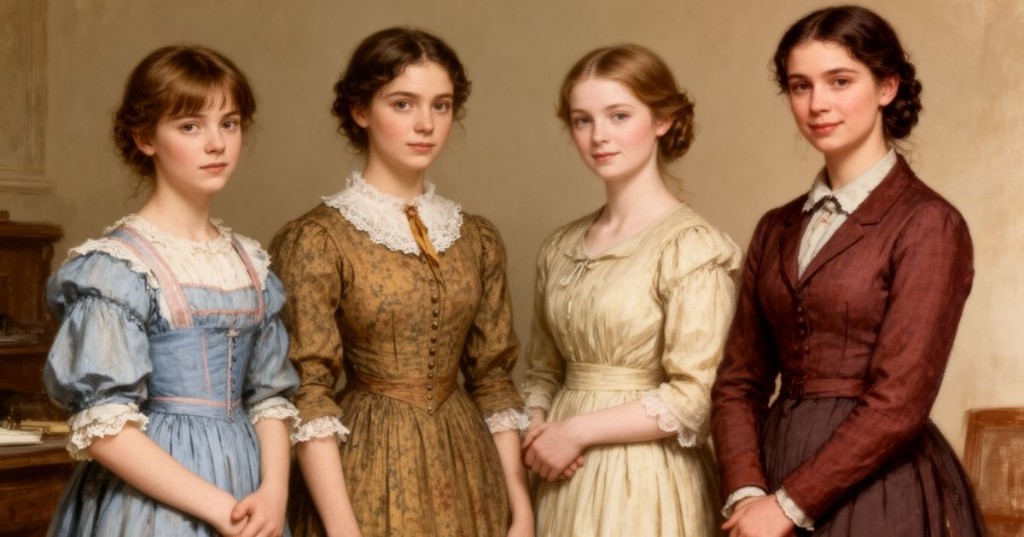
An excerpt from the original text.(complete · 2698 words)
CHAPTER SIX BETH FINDS THE PALACE BEAUTIFUL
The big house did prove a Palace Beautiful, though it took some time
for all to get in, and Beth found it very hard to pass the lions. Old
Mr. Laurence was the biggest one, but after he had called, said
something funny or kind to each one of the girls, and talked over old
times with their mother, nobody felt much afraid of him, except timid
Beth. The other lion was the fact that they were poor and Laurie rich,
for this made them shy of accepting favors which they could not return.
But, after a while, they found that he considered them the benefactors,
and could not do enough to show how grateful he was for Mrs. March’s
motherly welcome, their cheerful society, and the comfort he took in
that humble home of theirs. So they soon forgot their pride and
interchanged kindnesses without stopping to think which was the
greater.
All sorts of pleasant things happened about that time, for the new
friendship flourished like grass in spring. Every one liked Laurie, and
he privately informed his tutor that “the Marches were regularly
splendid girls.” With the delightful enthusiasm of youth, they took the
solitary boy into their midst and made much of him, and he found
something very charming in the innocent companionship of these
simple-hearted girls. Never having known mother or sisters, he was
quick to feel the influences they brought about him, and their busy,
lively ways made him ashamed of the indolent life he led. He was tired
of books, and found people so interesting now that Mr. Brooke was
obliged to make very unsatisfactory reports, for Laurie was always
playing truant and running over to the Marches’.
“Never mind, let him take a holiday, and make it up afterward,” said
the old gentleman. “The good lady next door says he is studying too
hard and needs young society, amusement, and exercise. I suspect she is
right, and that I’ve been coddling the fellow as if I’d been his
grandmother. Let him do what he likes, as long as he is happy. He can’t
get into mischief in that little nunnery over there, and Mrs. March is
doing more for him than we can.”
What good times they had, to be sure. Such plays and tableaux, such
sleigh rides and skating frolics, such pleasant evenings in the old
parlor, and now and then such gay little parties at the great house.
Meg could walk in the conservatory whenever she liked and revel in
bouquets, Jo browsed over the new library voraciously, and convulsed
the old gentleman with her criticisms, Amy copied pictures and enjoyed
beauty to her heart’s content, and Laurie played ‘lord of the manor’ in
the most delightful style.
But Beth, though yearning for the grand piano, could not pluck up
courage to go to the ‘Mansion of Bliss’, as Meg called it. She went
once with Jo, but the old gentleman, not being aware of her infirmity,
stared at her so hard from under his heavy eyebrows, and said “Hey!” so
loud, that he frightened her so much her ‘feet chattered on the floor’,
she never told her mother, and she ran away, declaring she would never
go there any more, not even for the dear piano. No persuasions or
enticements could overcome her fear, till, the fact coming to Mr.
Laurence’s ear in some mysterious way, he set about mending matters.
During one of the brief calls he made, he artfully led the conversation
to music, and talked away about great singers whom he had seen, fine
organs he had heard, and told such charming anecdotes that Beth found
it impossible to stay in her distant corner, but crept nearer and
nearer, as if fascinated. At the back of his chair she stopped and
stood listening, with her great eyes wide open and her cheeks red with
excitement of this unusual performance. Taking no more notice of her
than if she had been a fly, Mr. Laurence talked on about Laurie’s
lessons and teachers. And presently, as if the idea had just occurred
to him, he said to Mrs. March...
“The boy neglects his music now, and I’m glad of it, for he was getting
too fond of it. But the piano suffers for want of use. Wouldn’t some of
your girls like to run over, and practice on it now and then, just to
keep it in tune, you know, ma’am?”
Beth took a step forward, and pressed her hands tightly together to
keep from clapping them, for this was an irresistible temptation, and
the thought of practicing on that splendid instrument quite took her
breath away. Before Mrs. March could reply, Mr. Laurence went on with
an odd little nod and smile...
“They needn’t see or speak to anyone, but run in at any time. For I’m
shut up in my study at the other end of the house, Laurie is out a
great deal, and the servants are never near the drawing room after nine
o’clock.”
Here he rose, as if going, and Beth made up her mind to speak, for that
last arrangement left nothing to be desired. “Please, tell the young
ladies what I say, and if they don’t care to come, why, never mind.”
Here a little hand slipped into his, and Beth looked up at him with a
face full of gratitude, as she said, in her earnest yet timid way...
“Oh sir, they do care, very very much!”
“Are you the musical girl?” he asked, without any startling “Hey!” as
he looked down at her very kindly.
“I’m Beth. I love it dearly, and I’ll come, if you are quite sure
nobody will hear me, and be disturbed,” she added, fearing to be rude,
and trembling at her own boldness as she spoke.
“Not a soul, my dear. The house is empty half the day, so come and drum
away as much as you like, and I shall be obliged to you.”
“How kind you are, sir!”
Beth blushed like a rose under the friendly look he wore, but she was
not frightened now, and gave the hand a grateful squeeze because she
had no words to thank him for the precious gift he had given her. The
old gentleman softly stroked the hair off her forehead, and, stooping
down, he kissed her, saying, in a tone few people ever heard...
“I had a little girl once, with eyes like these. God bless you, my
dear! Good day, madam.” And away he went, in a great hurry.
Beth had a rapture with her mother, and then rushed up to impart the
glorious news to her family of invalids, as the girls were not home.
How blithely she sang that evening, and how they all laughed at her
because she woke Amy in the night by playing the piano on her face in
her sleep. Next day, having seen both the old and young gentleman out
of the house, Beth, after two or three retreats, fairly got in at the
side door, and made her way as noiselessly as any mouse to the drawing
room where her idol stood. Quite by accident, of course, some pretty,
easy music lay on the piano, and with trembling fingers and frequent
stops to listen and look about, Beth at last touched the great
instrument, and straightway forgot her fear, herself, and everything
else but the unspeakable delight which the music gave her, for it was
like the voice of a beloved friend.
She stayed till Hannah came to take her home to dinner, but she had no
appetite, and could only sit and smile upon everyone in a general state
of beatitude.
After that, the little brown hood slipped through the hedge nearly
every day, and the great drawing room was haunted by a tuneful spirit
that came and went unseen. She never knew that Mr. Laurence opened his
study door to hear the old-fashioned airs he liked. She never saw
Laurie mount guard in the hall to warn the servants away. She never
suspected that the exercise books and new songs which she found in the
rack were put there for her especial benefit, and when he talked to her
about music at home, she only thought how kind he was to tell things
that helped her so much. So she enjoyed herself heartily, and found,
what isn’t always the case, that her granted wish was all she had
hoped. Perhaps it was because she was so grateful for this blessing
that a greater was given her. At any rate she deserved both.
“Mother, I’m going to work Mr. Laurence a pair of slippers. He is so
kind to me, I must thank him, and I don’t know any other way. Can I do
it?” asked Beth, a few weeks after that eventful call of his.
“Yes, dear. It will please him very much, and be a nice way of thanking
him. The girls will help you about them, and I will pay for the making
up,” replied Mrs. March, who took peculiar pleasure in granting Beth’s
requests because she so seldom asked anything for herself.
After many serious discussions with Meg and Jo, the pattern was chosen,
the materials bought, and the slippers begun. A cluster of grave yet
cheerful pansies on a deeper purple ground was pronounced very
appropriate and pretty, and Beth worked away early and late, with
occasional lifts over hard parts. She was a nimble little needlewoman,
and they were finished before anyone got tired of them. Then she wrote
a short, simple note, and with Laurie’s help, got them smuggled onto
the study table one morning before the old gentleman was up.
When this excitement was over, Beth waited to see what would happen.
All day passed and a part of the next before any acknowledgement
arrived, and she was beginning to fear she had offended her crochety
friend. On the afternoon of the second day, she went out to do an
errand, and give poor Joanna, the invalid doll, her daily exercise. As
she came up the street, on her return, she saw three, yes, four heads
popping in and out of the parlor windows, and the moment they saw her,
several hands were waved, and several joyful voices screamed...
“Here’s a letter from the old gentleman! Come quick, and read it!”
“Oh, Beth, he’s sent you...” began Amy, gesticulating with unseemly
energy, but she got no further, for Jo quenched her by slamming down
the window.
Beth hurried on in a flutter of suspense. At the door her sisters
seized and bore her to the parlor in a triumphal procession, all
pointing and all saying at once, “Look there! Look there!” Beth did
look, and turned pale with delight and surprise, for there stood a
little cabinet piano, with a letter lying on the glossy lid, directed
like a sign board to “Miss Elizabeth March.”
“For me?” gasped Beth, holding onto Jo and feeling as if she should
tumble down, it was such an overwhelming thing altogether.
“Yes, all for you, my precious! Isn’t it splendid of him? Don’t you
think he’s the dearest old man in the world? Here’s the key in the
letter. We didn’t open it, but we are dying to know what he says,”
cried Jo, hugging her sister and offering the note.
“You read it! I can’t, I feel so queer! Oh, it is too lovely!” and Beth
hid her face in Jo’s apron, quite upset by her present.
Jo opened the paper and began to laugh, for the first words she saw
were...
“Miss March: “Dear Madam—”
“How nice it sounds! I wish someone would write to me so!” said Amy,
who thought the old-fashioned address very elegant.
“‘I have had many pairs of slippers in my life, but I never had any
that suited me so well as yours,’” continues Jo. “‘Heart’s-ease is my
favorite flower, and these will always remind me of the gentle giver. I
like to pay my debts, so I know you will allow ‘the old gentleman’ to
send you something which once belonged to the little grand daughter he
lost. With hearty thanks and best wishes, I remain “‘Your grateful
friend and humble servant, ‘JAMES LAURENCE’.”
“There, Beth, that’s an honor to be proud of, I’m sure! Laurie told me
how fond Mr. Laurence used to be of the child who died, and how he kept
all her little things carefully. Just think, he’s given you her piano.
That comes of having big blue eyes and loving music,” said Jo, trying
to soothe Beth, who trembled and looked more excited than she had ever
been before.
“See the cunning brackets to hold candles, and the nice green silk,
puckered up, with a gold rose in the middle, and the pretty rack and
stool, all complete,” added Meg, opening the instrument and displaying
its beauties.
“‘Your humble servant, James Laurence’. Only think of his writing that
to you. I’ll tell the girls. They’ll think it’s splendid,” said Amy,
much impressed by the note.
“Try it, honey. Let’s hear the sound of the baby pianny,” said Hannah,
who always took a share in the family joys and sorrows.
So Beth tried it, and everyone pronounced it the most remarkable piano
ever heard. It had evidently been newly tuned and put in apple-pie
order, but, perfect as it was, I think the real charm lay in the
happiest of all happy faces which leaned over it, as Beth lovingly
touched the beautiful black and white keys and pressed the bright
pedals.
“You’ll have to go and thank him,” said Jo, by way of a joke, for the
idea of the child’s really going never entered her head.
“Yes, I mean to. I guess I’ll go now, before I get frightened thinking
about it.” And, to the utter amazement of the assembled family, Beth
walked deliberately down the garden, through the hedge, and in at the
Laurences’ door.
“Well, I wish I may die if it ain’t the queerest thing I ever see! The
pianny has turned her head! She’d never have gone in her right mind,”
cried Hannah, staring after her, while the girls were rendered quite
speechless by the miracle.
They would have been still more amazed if they had seen what Beth did
afterward. If you will believe me, she went and knocked at the study
door before she gave herself time to think, and when a gruff voice
called out, “come in!” she did go in, right up to Mr. Laurence, who
looked quite taken aback, and held out her hand, saying, with only a
small quaver in her voice, “I came to thank you, sir, for...” But she
didn’t finish, for he looked so friendly that she forgot her speech
and, only remembering that he had lost the little girl he loved, she
put both arms round his neck and kissed him.
If the roof of the house had suddenly flown off, the old gentleman
wouldn’t have been more astonished. But he liked it. Oh, dear, yes, he
liked it amazingly! And was so touched and pleased by that confiding
little kiss that all his crustiness vanished, and he just set her on
his knee, and laid his wrinkled cheek against her rosy one, feeling as
if he had got his own little granddaughter back again. Beth ceased to
fear him from that moment, and sat there talking to him as cozily as if
she had known him all her life, for love casts out fear, and gratitude
can conquer pride. When she went home, he walked with her to her own
gate, shook hands cordially, and touched his hat as he marched back
again, looking very stately and erect, like a handsome, soldierly old
gentleman, as he was.
When the girls saw that performance, Jo began to dance a jig, by way of
expressing her satisfaction, Amy nearly fell out of the window in her
surprise, and Meg exclaimed, with up-lifted hands, “Well, I do believe
the world is coming to an end.”
Master this chapter. Complete your experience
Purchase the complete book to access all chapters and support classic literature
As an Amazon Associate, we earn a small commission from qualifying purchases at no additional cost to you.
Available in paperback, hardcover, and e-book formats
Let's Analyse the Pattern
Authentic connection builds through patient, indirect approach and mutual vulnerability rather than force or demand.
Why This Matters
Connect literature to life
This chapter teaches how to recognize when someone is creating opportunities for connection without explicitly stating it.
Practice This Today
This week, notice when someone offers help or resources without being asked—they might be extending an invitation for deeper relationship.
Now let's explore the literary elements.
Key Quotes & Analysis
"The big house did prove a Palace Beautiful, though it took some time for all to get in, and Beth found it very hard to pass the lions."
Context: Opening the chapter, explaining how the March girls are gradually becoming comfortable in the Laurence home.
This quote sets up the central metaphor of the chapter - that good things often require courage to obtain. Beth's journey represents anyone who has to overcome fear to reach something wonderful.
In Today's Words:
The fancy house next door turned out to be amazing, but it took a while for everyone to feel comfortable there, especially Beth who was scared of the intimidating parts.
"He considered them the benefactors, and could not do enough to show how grateful he was for Mrs. March's motherly welcome."
Context: Explaining why Laurie doesn't see himself as doing the March family favors.
This reveals the true value exchange happening - the March family's emotional wealth is more precious than Laurie's material wealth. It shows how genuine human connection trumps money.
In Today's Words:
He thought they were the ones helping him out, and he couldn't thank Mrs. March enough for treating him like family.
"Never having known mother or sisters, he was quick to feel the influences they brought about him."
Context: Describing why Laurie is so drawn to the March family's warmth.
This explains Laurie's deep need for the kind of family love he's never experienced. It shows how money can't buy the most important things in life - genuine care and belonging.
In Today's Words:
Since he'd never had a mom or sisters, he immediately felt how different and special their family love was.
Thematic Threads
Class
In This Chapter
Mr. Laurence's wealth and status initially intimidate Beth, creating a barrier that kindness ultimately dissolves
Development
Building on earlier chapters where class differences created both obstacles and opportunities for the March family
In Your Life:
You might feel intimidated by wealthy patients, supervisors, or neighbors until you discover shared humanity beneath surface differences.
Fear
In This Chapter
Beth's terror of Mr. Laurence transforms into affection through gradual exposure and positive experiences
Development
Each sister faces different fears—Beth's social anxiety contrasts with Jo's fear of conformity
In Your Life:
You might avoid difficult conversations or intimidating people until small positive interactions build your confidence.
Generosity
In This Chapter
Both characters give without expecting returns—Beth makes slippers, Mr. Laurence gives a piano
Development
Expanding from family generosity in earlier chapters to kindness between strangers
In Your Life:
You might discover that small acts of appreciation or helpfulness create unexpected connections and opportunities.
Recognition
In This Chapter
Mr. Laurence sees Beth's musical talent and gentle nature, responding with appropriate gifts and attention
Development
Introduced here as a key element in forming meaningful relationships
In Your Life:
You might find that truly seeing and acknowledging others' gifts creates deeper bonds than trying to impress them.
Transformation
In This Chapter
Beth evolves from terrified child to confident young woman through one meaningful relationship
Development
Each sister's growth continues through different challenges and relationships
In Your Life:
You might surprise yourself by becoming braver and more confident when someone believes in you and creates safe space for growth.
You now have the context. Time to form your own thoughts.
Discussion Questions
- 1
What specific steps did Mr. Laurence take to help Beth feel comfortable in his house, and why didn't he just invite her directly?
analysis • surface - 2
Why did Beth's homemade slippers mean more to Mr. Laurence than an expensive gift would have, and what does this reveal about how people really connect?
analysis • medium - 3
Where do you see this same pattern of 'patient approach' working in modern relationships—whether at work, in families, or with difficult people?
application • medium - 4
Think of someone in your life who seems intimidating or closed-off. What would be their version of 'the piano'—something they need that you could quietly provide?
application • deep - 5
What does this chapter teach us about the difference between demanding respect and earning it, and why does authentic gratitude have such power to change relationships?
reflection • deep
Critical Thinking Exercise
Map Your Own 'Palace Beautiful'
Think of a relationship, opportunity, or goal that feels intimidating to you right now—your own 'Palace Beautiful.' Instead of planning a direct approach, map out what small, low-pressure steps you could take to build trust and connection over time. What's their version of the piano? What's your version of the slippers?
Consider:
- •Look for what the other person actually needs, not what you think they should want
- •Consider how you can show appreciation or value without seeming manipulative
- •Think about timing—when would they be most open to small gestures?
Journaling Prompt
Write about a time when someone's patience and indirect kindness won you over when direct pressure would have pushed you away. What did they do differently, and how can you apply that same approach to a current challenge in your life?
Coming Up Next...
Chapter 7: Amy's Valley of Humiliation
While Beth finds triumph in overcoming her fears, Amy is about to face her own humbling experience. Her artistic ambitions and social aspirations are set to collide in a way that will teach her some hard lessons about pride and authenticity.



