
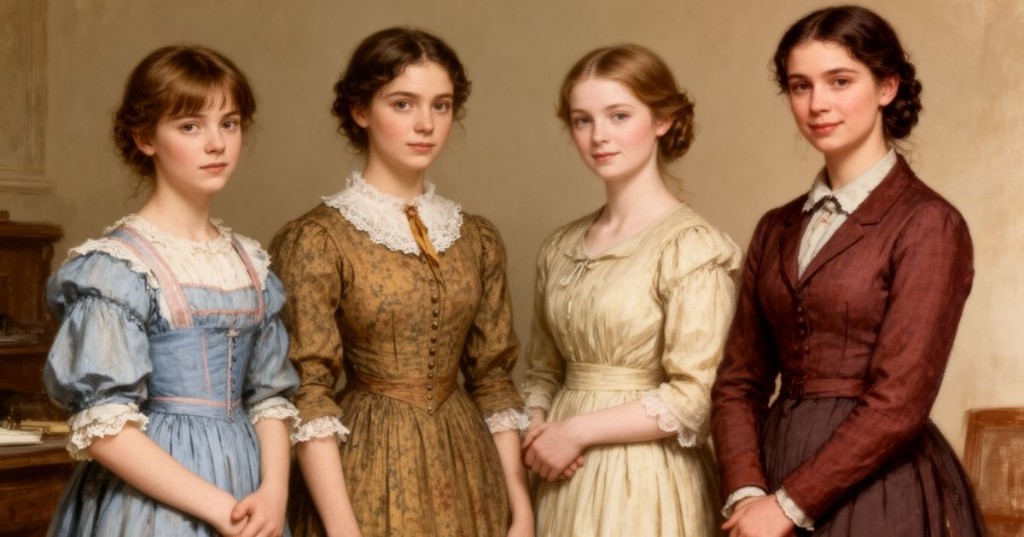
An excerpt from the original text.(complete · 2622 words)
CHAPTER SEVEN
AMY’S VALLEY OF HUMILIATION
“That boy is a perfect cyclops, isn’t he?” said Amy one day, as Laurie
clattered by on horseback, with a flourish of his whip as he passed.
“How dare you say so, when he’s got both his eyes? And very handsome
ones they are, too,” cried Jo, who resented any slighting remarks about
her friend.
“I didn’t say anything about his eyes, and I don’t see why you need
fire up when I admire his riding.”
“Oh, my goodness! That little goose means a centaur, and she called him
a Cyclops,” exclaimed Jo, with a burst of laughter.
“You needn’t be so rude, it’s only a ‘lapse of lingy’, as Mr. Davis
says,” retorted Amy, finishing Jo with her Latin. “I just wish I had a
little of the money Laurie spends on that horse,” she added, as if to
herself, yet hoping her sisters would hear.
“Why?” asked Meg kindly, for Jo had gone off in another laugh at Amy’s
second blunder.
“I need it so much. I’m dreadfully in debt, and it won’t be my turn to
have the rag money for a month.”
“In debt, Amy? What do you mean?” And Meg looked sober.
“Why, I owe at least a dozen pickled limes, and I can’t pay them, you
know, till I have money, for Marmee forbade my having anything charged
at the shop.”
“Tell me all about it. Are limes the fashion now? It used to be
pricking bits of rubber to make balls.” And Meg tried to keep her
countenance, Amy looked so grave and important.
“Why, you see, the girls are always buying them, and unless you want to
be thought mean, you must do it too. It’s nothing but limes now, for
everyone is sucking them in their desks in schooltime, and trading them
off for pencils, bead rings, paper dolls, or something else, at recess.
If one girl likes another, she gives her a lime. If she’s mad with her,
she eats one before her face, and doesn’t offer even a suck. They treat
by turns, and I’ve had ever so many but haven’t returned them, and I
ought for they are debts of honor, you know.”
“How much will pay them off and restore your credit?” asked Meg, taking
out her purse.
“A quarter would more than do it, and leave a few cents over for a
treat for you. Don’t you like limes?”
“Not much. You may have my share. Here’s the money. Make it last as
long as you can, for it isn’t very plenty, you know.”
“Oh, thank you! It must be so nice to have pocket money! I’ll have a
grand feast, for I haven’t tasted a lime this week. I felt delicate
about taking any, as I couldn’t return them, and I’m actually suffering
for one.”
Next day Amy was rather late at school, but could not resist the
temptation of displaying, with pardonable pride, a moist brown-paper
parcel, before she consigned it to the inmost recesses of her desk.
During the next few minutes the rumor that Amy March had got
twenty-four delicious limes (she ate one on the way) and was going to
treat circulated through her ‘set’, and the attentions of her friends
became quite overwhelming. Katy Brown invited her to her next party on
the spot. Mary Kingsley insisted on lending her her watch till recess,
and Jenny Snow, a satirical young lady, who had basely twitted Amy upon
her limeless state, promptly buried the hatchet and offered to furnish
answers to certain appalling sums. But Amy had not forgotten Miss
Snow’s cutting remarks about ‘some persons whose noses were not too
flat to smell other people’s limes, and stuck-up people who were not
too proud to ask for them’, and she instantly crushed ‘that Snow
girl’s’ hopes by the withering telegram, “You needn’t be so polite all
of a sudden, for you won’t get any.”
A distinguished personage happened to visit the school that morning,
and Amy’s beautifully drawn maps received praise, which honor to her
foe rankled in the soul of Miss Snow, and caused Miss March to assume
the airs of a studious young peacock. But, alas, alas! Pride goes
before a fall, and the revengeful Snow turned the tables with
disastrous success. No sooner had the guest paid the usual stale
compliments and bowed himself out, than Jenny, under pretense of asking
an important question, informed Mr. Davis, the teacher, that Amy March
had pickled limes in her desk.
Now Mr. Davis had declared limes a contraband article, and solemnly
vowed to publicly ferrule the first person who was found breaking the
law. This much-enduring man had succeeded in banishing chewing gum
after a long and stormy war, had made a bonfire of the confiscated
novels and newspapers, had suppressed a private post office, had
forbidden distortions of the face, nicknames, and caricatures, and done
all that one man could do to keep half a hundred rebellious girls in
order. Boys are trying enough to human patience, goodness knows, but
girls are infinitely more so, especially to nervous gentlemen with
tyrannical tempers and no more talent for teaching than Dr. Blimber.
Mr. Davis knew any quantity of Greek, Latin, algebra, and ologies of
all sorts so he was called a fine teacher, and manners, morals,
feelings, and examples were not considered of any particular
importance. It was a most unfortunate moment for denouncing Amy, and
Jenny knew it. Mr. Davis had evidently taken his coffee too strong that
morning, there was an east wind, which always affected his neuralgia,
and his pupils had not done him the credit which he felt he deserved.
Therefore, to use the expressive, if not elegant, language of a
schoolgirl, “He was as nervous as a witch and as cross as a bear”. The
word ‘limes’ was like fire to powder, his yellow face flushed, and he
rapped on his desk with an energy which made Jenny skip to her seat
with unusual rapidity.
“Young ladies, attention, if you please!”
At the stern order the buzz ceased, and fifty pairs of blue, black,
gray, and brown eyes were obediently fixed upon his awful countenance.
“Miss March, come to the desk.”
Amy rose to comply with outward composure, but a secret fear oppressed
her, for the limes weighed upon her conscience.
“Bring with you the limes you have in your desk,” was the unexpected
command which arrested her before she got out of her seat.
“Don’t take all.” whispered her neighbor, a young lady of great
presence of mind.
Amy hastily shook out half a dozen and laid the rest down before Mr.
Davis, feeling that any man possessing a human heart would relent when
that delicious perfume met his nose. Unfortunately, Mr. Davis
particularly detested the odor of the fashionable pickle, and disgust
added to his wrath.
“Is that all?”
“Not quite,” stammered Amy.
“Bring the rest immediately.”
With a despairing glance at her set, she obeyed.
“You are sure there are no more?”
“I never lie, sir.”
“So I see. Now take these disgusting things two by two, and throw them
out of the window.”
There was a simultaneous sigh, which created quite a little gust, as
the last hope fled, and the treat was ravished from their longing lips.
Scarlet with shame and anger, Amy went to and fro six dreadful times,
and as each doomed couple, looking oh, so plump and juicy, fell from
her reluctant hands, a shout from the street completed the anguish of
the girls, for it told them that their feast was being exulted over by
the little Irish children, who were their sworn foes. This—this was too
much. All flashed indignant or appealing glances at the inexorable
Davis, and one passionate lime lover burst into tears.
As Amy returned from her last trip, Mr. Davis gave a portentous “Hem!”
and said, in his most impressive manner...
“Young ladies, you remember what I said to you a week ago. I am sorry
this has happened, but I never allow my rules to be infringed, and I
never break my word. Miss March, hold out your hand.”
Amy started, and put both hands behind her, turning on him an imploring
look which pleaded for her better than the words she could not utter.
She was rather a favorite with ‘old Davis’, as, of course, he was
called, and it’s my private belief that he would have broken his word
if the indignation of one irrepressible young lady had not found vent
in a hiss. That hiss, faint as it was, irritated the irascible
gentleman, and sealed the culprit’s fate.
“Your hand, Miss March!” was the only answer her mute appeal received,
and too proud to cry or beseech, Amy set her teeth, threw back her head
defiantly, and bore without flinching several tingling blows on her
little palm. They were neither many nor heavy, but that made no
difference to her. For the first time in her life she had been struck,
and the disgrace, in her eyes, was as deep as if he had knocked her
down.
“You will now stand on the platform till recess,” said Mr. Davis,
resolved to do the thing thoroughly, since he had begun.
That was dreadful. It would have been bad enough to go to her seat, and
see the pitying faces of her friends, or the satisfied ones of her few
enemies, but to face the whole school, with that shame fresh upon her,
seemed impossible, and for a second she felt as if she could only drop
down where she stood, and break her heart with crying. A bitter sense
of wrong and the thought of Jenny Snow helped her to bear it, and,
taking the ignominious place, she fixed her eyes on the stove funnel
above what now seemed a sea of faces, and stood there, so motionless
and white that the girls found it hard to study with that pathetic
figure before them.
During the fifteen minutes that followed, the proud and sensitive
little girl suffered a shame and pain which she never forgot. To others
it might seem a ludicrous or trivial affair, but to her it was a hard
experience, for during the twelve years of her life she had been
governed by love alone, and a blow of that sort had never touched her
before. The smart of her hand and the ache of her heart were forgotten
in the sting of the thought, “I shall have to tell at home, and they
will be so disappointed in me!”
The fifteen minutes seemed an hour, but they came to an end at last,
and the word ‘Recess!’ had never seemed so welcome to her before.
“You can go, Miss March,” said Mr. Davis, looking, as he felt,
uncomfortable.
He did not soon forget the reproachful glance Amy gave him, as she
went, without a word to anyone, straight into the anteroom, snatched
her things, and left the place “forever,” as she passionately declared
to herself. She was in a sad state when she got home, and when the
older girls arrived, some time later, an indignation meeting was held
at once. Mrs. March did not say much but looked disturbed, and
comforted her afflicted little daughter in her tenderest manner. Meg
bathed the insulted hand with glycerine and tears, Beth felt that even
her beloved kittens would fail as a balm for griefs like this, Jo
wrathfully proposed that Mr. Davis be arrested without delay, and
Hannah shook her fist at the ‘villain’ and pounded potatoes for dinner
as if she had him under her pestle.
No notice was taken of Amy’s flight, except by her mates, but the
sharp-eyed demoiselles discovered that Mr. Davis was quite benignant in
the afternoon, also unusually nervous. Just before school closed, Jo
appeared, wearing a grim expression as she stalked up to the desk, and
delivered a letter from her mother, then collected Amy’s property, and
departed, carefully scraping the mud from her boots on the door mat, as
if she shook the dust of the place off her feet.
“Yes, you can have a vacation from school, but I want you to study a
little every day with Beth,” said Mrs. March that evening. “I don’t
approve of corporal punishment, especially for girls. I dislike Mr.
Davis’s manner of teaching and don’t think the girls you associate with
are doing you any good, so I shall ask your father’s advice before I
send you anywhere else.”
“That’s good! I wish all the girls would leave, and spoil his old
school. It’s perfectly maddening to think of those lovely limes,”
sighed Amy, with the air of a martyr.
“I am not sorry you lost them, for you broke the rules, and deserved
some punishment for disobedience,” was the severe reply, which rather
disappointed the young lady, who expected nothing but sympathy.
“Do you mean you are glad I was disgraced before the whole school?”
cried Amy.
“I should not have chosen that way of mending a fault,” replied her
mother, “but I’m not sure that it won’t do you more good than a bolder
method. You are getting to be rather conceited, my dear, and it is
quite time you set about correcting it. You have a good many little
gifts and virtues, but there is no need of parading them, for conceit
spoils the finest genius. There is not much danger that real talent or
goodness will be overlooked long, even if it is, the consciousness of
possessing and using it well should satisfy one, and the great charm of
all power is modesty.”
“So it is!” cried Laurie, who was playing chess in a corner with Jo. “I
knew a girl once, who had a really remarkable talent for music, and she
didn’t know it, never guessed what sweet little things she composed
when she was alone, and wouldn’t have believed it if anyone had told
her.”
“I wish I’d known that nice girl. Maybe she would have helped me, I’m
so stupid,” said Beth, who stood beside him, listening eagerly.
“You do know her, and she helps you better than anyone else could,”
answered Laurie, looking at her with such mischievous meaning in his
merry black eyes that Beth suddenly turned very red, and hid her face
in the sofa cushion, quite overcome by such an unexpected discovery.
Jo let Laurie win the game to pay for that praise of her Beth, who
could not be prevailed upon to play for them after her compliment. So
Laurie did his best, and sang delightfully, being in a particularly
lively humor, for to the Marches he seldom showed the moody side of his
character. When he was gone, Amy, who had been pensive all evening,
said suddenly, as if busy over some new idea, “Is Laurie an
accomplished boy?”
“Yes, he has had an excellent education, and has much talent. He will
make a fine man, if not spoiled by petting,” replied her mother.
“And he isn’t conceited, is he?” asked Amy.
“Not in the least. That is why he is so charming and we all like him so
much.”
“I see. It’s nice to have accomplishments and be elegant, but not to
show off or get perked up,” said Amy thoughtfully.
“These things are always seen and felt in a person’s manner and
conversations, if modestly used, but it is not necessary to display
them,” said Mrs. March.
“Any more than it’s proper to wear all your bonnets and gowns and
ribbons at once, that folks may know you’ve got them,” added Jo, and
the lecture ended in a laugh.
Master this chapter. Complete your experience
Purchase the complete book to access all chapters and support classic literature
As an Amazon Associate, we earn a small commission from qualifying purchases at no additional cost to you.
Available in paperback, hardcover, and e-book formats
Let's Analyse the Pattern
Using external symbols to fake belonging or competence, creating cycles of debt and anxiety that ultimately undermine genuine growth.
Why This Matters
Connect literature to life
This chapter teaches you to distinguish between genuine competence and borrowed confidence in yourself and others.
Practice This Today
This week, notice when you feel pressure to buy, borrow, or fake your way into belonging somewhere—pause and ask what you're really trying to prove.
Now let's explore the literary elements.
Key Quotes & Analysis
"I'm dreadfully in debt, and it won't be my turn to have the rag money for a month."
Context: Amy explains why she needs money for limes
Shows how Amy has gotten trapped in a cycle of social debt, borrowing to keep up appearances. The phrase 'dreadfully in debt' over pickled limes reveals how small social pressures can feel huge to a child.
In Today's Words:
I owe everyone money and won't get my allowance for weeks.
"You broke the rules, and deserved some punishment for disobedience."
Context: Marmee explains to Amy why she faced consequences
Even while comforting her daughter, Marmee insists on accountability. She separates the harsh method from the legitimate need for consequences, teaching Amy to own her choices.
In Today's Words:
You knew the rules and chose to break them, so facing consequences makes sense.
"I shall never go back to school again. I don't care if I never learn anything more."
Context: Amy's dramatic response to her humiliation
Shows Amy's tendency toward melodrama and all-or-nothing thinking when hurt. Her pride makes her want to quit entirely rather than face the situation maturely.
In Today's Words:
I'm never going back there again, I don't care if I ruin my future.
"You are getting to be rather conceited, my dear, and it is quite time you set about correcting it."
Context: Marmee's gentle but firm correction to Amy
Marmee uses this crisis as a teaching moment about Amy's growing vanity. She's direct but loving, showing that sometimes we need others to point out our blind spots.
In Today's Words:
You're getting a big head about yourself, and it's time to work on that.
Thematic Threads
Class Anxiety
In This Chapter
Amy borrows money to buy social acceptance through limes, revealing how economic pressure forces performance of status
Development
Building on earlier hints of the March family's reduced circumstances and social positioning
In Your Life:
When you stretch your budget to 'look the part' at work or social events, you're navigating the same class pressures Amy faces
Pride
In This Chapter
Amy's temporary success with limes inflates her ego, making her vulnerable to Jenny Snow's sabotage and Mr. Davis's punishment
Development
Amy's vanity established in earlier chapters now becomes dangerous when mixed with borrowed confidence
In Your Life:
Your proudest moments at work or home often set you up for the hardest falls when reality checks arrive
Social Performance
In This Chapter
The entire lime economy at school represents artificial social hierarchies based on material possessions rather than character
Development
Introduced here as a new lens for understanding how social pressures shape behavior
In Your Life:
Every workplace, school, or social group has its own 'lime economy'—unspoken rules about what you need to belong
Authentic Growth
In This Chapter
Mrs. March's lesson about modesty and Beth's quiet musical talent represent genuine accomplishment that doesn't need display
Development
Contrasts with Amy's performative approach, reinforcing the book's values of internal development
In Your Life:
The skills and qualities that truly matter in your life are often the ones you don't feel compelled to advertise
Consequences
In This Chapter
Amy faces both immediate punishment (ruler, humiliation) and deeper reckoning with her choices and character
Development
First major consequence sequence in the book, establishing that actions have real costs
In Your Life:
When you cut corners or fake it, the consequences often arrive publicly and at the worst possible moment
You now have the context. Time to form your own thoughts.
Discussion Questions
- 1
Why does Amy borrow money to buy limes, and what happens when she finally gets caught?
analysis • surface - 2
How does the lime-trading system at Amy's school create pressure to spend money she doesn't have?
analysis • medium - 3
Where do you see people today borrowing money or going into debt to fit in or look successful?
application • medium - 4
When you feel pressure to buy something to fit in, what questions could you ask yourself before spending?
application • deep - 5
Why do we sometimes mistake having the right stuff for being the right person?
reflection • deep
Critical Thinking Exercise
Track Your Status Spending
Look at your last month's spending - whether actual purchases or things you wanted to buy. Identify three purchases (or desired purchases) that were more about fitting in or looking successful than meeting a real need. For each one, write down what you were trying to prove and to whom.
Consider:
- •Consider both obvious status items (clothes, gadgets) and subtle ones (expensive coffee, name brands)
- •Think about purchases influenced by social media, coworkers, or family expectations
- •Notice the difference between what you need and what you think you need to belong
Journaling Prompt
Write about a time when you spent money you didn't really have to fit in somewhere. How did it feel in the moment versus later? What would you do differently now?
Coming Up Next...
Chapter 8: When Anger Burns Everything Down
Jo faces her own moral battle when she encounters 'Apollyon' - but this isn't a mythical demon. Sometimes our greatest enemies are the darker impulses within ourselves, and Jo's about to discover just how hard it can be to conquer her own worst tendencies.



