
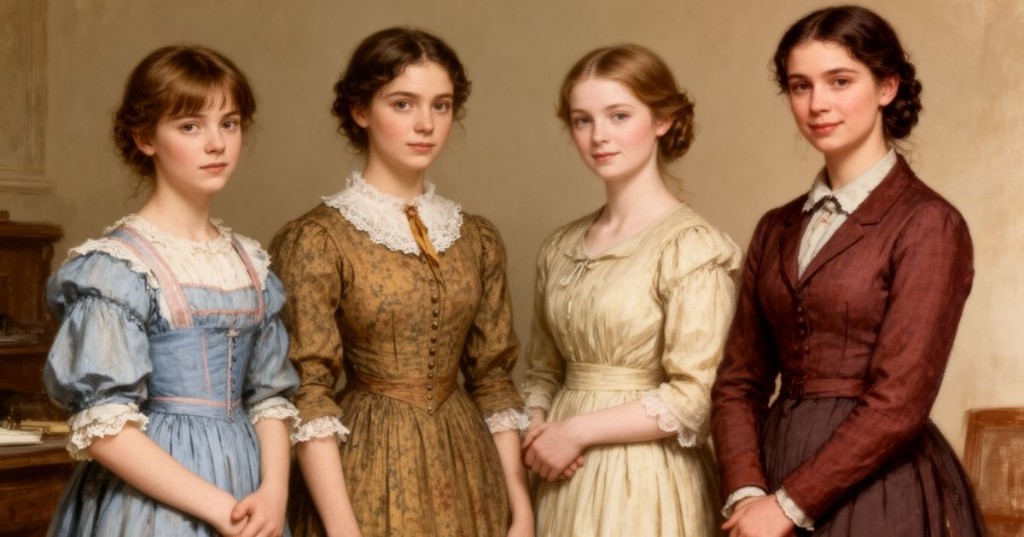
An excerpt from the original text.(complete · 3306 words)
CHAPTER FIFTEEN A TELEGRAM
“November is the most disagreeable month in the whole year,” said
Margaret, standing at the window one dull afternoon, looking out at the
frostbitten garden.
“That’s the reason I was born in it,” observed Jo pensively, quite
unconscious of the blot on her nose.
“If something very pleasant should happen now, we should think it a
delightful month,” said Beth, who took a hopeful view of everything,
even November.
“I dare say, but nothing pleasant ever does happen in this family,”
said Meg, who was out of sorts. “We go grubbing along day after day,
without a bit of change, and very little fun. We might as well be in a
treadmill.”
“My patience, how blue we are!” cried Jo. “I don’t much wonder, poor
dear, for you see other girls having splendid times, while you grind,
grind, year in and year out. Oh, don’t I wish I could manage things for
you as I do for my heroines! You’re pretty enough and good enough
already, so I’d have some rich relation leave you a fortune
unexpectedly. Then you’d dash out as an heiress, scorn everyone who has
slighted you, go abroad, and come home my Lady Something in a blaze of
splendor and elegance.”
“People don’t have fortunes left them in that style nowadays, men have
to work and women marry for money. It’s a dreadfully unjust world,”
said Meg bitterly.
“Jo and I are going to make fortunes for you all. Just wait ten years,
and see if we don’t,” said Amy, who sat in a corner making mud pies, as
Hannah called her little clay models of birds, fruit, and faces.
“Can’t wait, and I’m afraid I haven’t much faith in ink and dirt,
though I’m grateful for your good intentions.”
Meg sighed, and turned to the frostbitten garden again. Jo groaned and
leaned both elbows on the table in a despondent attitude, but Amy
spatted away energetically, and Beth, who sat at the other window,
said, smiling, “Two pleasant things are going to happen right away.
Marmee is coming down the street, and Laurie is tramping through the
garden as if he had something nice to tell.”
In they both came, Mrs. March with her usual question, “Any letter from
Father, girls?” and Laurie to say in his persuasive way, “Won’t some of
you come for a drive? I’ve been working away at mathematics till my
head is in a muddle, and I’m going to freshen my wits by a brisk turn.
It’s a dull day, but the air isn’t bad, and I’m going to take Brooke
home, so it will be gay inside, if it isn’t out. Come, Jo, you and Beth
will go, won’t you?”
“Of course we will.”
“Much obliged, but I’m busy.” And Meg whisked out her workbasket, for
she had agreed with her mother that it was best, for her at least, not
to drive too often with the young gentleman.
“We three will be ready in a minute,” cried Amy, running away to wash
her hands.
“Can I do anything for you, Madam Mother?” asked Laurie, leaning over
Mrs. March’s chair with the affectionate look and tone he always gave
her.
“No, thank you, except call at the office, if you’ll be so kind, dear.
It’s our day for a letter, and the postman hasn’t been. Father is as
regular as the sun, but there’s some delay on the way, perhaps.”
A sharp ring interrupted her, and a minute after Hannah came in with a
letter.
“It’s one of them horrid telegraph things, mum,” she said, handling it
as if she was afraid it would explode and do some damage.
At the word ‘telegraph’, Mrs. March snatched it, read the two lines it
contained, and dropped back into her chair as white as if the little
paper had sent a bullet to her heart. Laurie dashed downstairs for
water, while Meg and Hannah supported her, and Jo read aloud, in a
frightened voice...
Mrs. March:
Your husband is very ill. Come at once.
S. HALE
Blank Hospital, Washington.
How still the room was as they listened breathlessly, how strangely the
day darkened outside, and how suddenly the whole world seemed to
change, as the girls gathered about their mother, feeling as if all the
happiness and support of their lives was about to be taken from them.
Mrs. March was herself again directly, read the message over, and
stretched out her arms to her daughters, saying, in a tone they never
forgot, “I shall go at once, but it may be too late. Oh, children,
children, help me to bear it!”
For several minutes there was nothing but the sound of sobbing in the
room, mingled with broken words of comfort, tender assurances of help,
and hopeful whispers that died away in tears. Poor Hannah was the first
to recover, and with unconscious wisdom she set all the rest a good
example, for with her, work was panacea for most afflictions.
“The Lord keep the dear man! I won’t waste no time a-cryin’, but git
your things ready right away, mum,” she said heartily, as she wiped her
face on her apron, gave her mistress a warm shake of the hand with her
own hard one, and went away to work like three women in one.
“She’s right, there’s no time for tears now. Be calm, girls, and let me
think.”
They tried to be calm, poor things, as their mother sat up, looking
pale but steady, and put away her grief to think and plan for them.
“Where’s Laurie?” she asked presently, when she had collected her
thoughts and decided on the first duties to be done.
“Here, ma’am. Oh, let me do something!” cried the boy, hurrying from
the next room whither he had withdrawn, feeling that their first sorrow
was too sacred for even his friendly eyes to see.
“Send a telegram saying I will come at once. The next train goes early
in the morning. I’ll take that.”
“What else? The horses are ready. I can go anywhere, do anything,” he
said, looking ready to fly to the ends of the earth.
“Leave a note at Aunt March’s. Jo, give me that pen and paper.”
Tearing off the blank side of one of her newly copied pages, Jo drew
the table before her mother, well knowing that money for the long, sad
journey must be borrowed, and feeling as if she could do anything to
add a little to the sum for her father.
“Now go, dear, but don’t kill yourself driving at a desperate pace.
There is no need of that.”
Mrs. March’s warning was evidently thrown away, for five minutes later
Laurie tore by the window on his own fleet horse, riding as if for his
life.
“Jo, run to the rooms, and tell Mrs. King that I can’t come. On the way
get these things. I’ll put them down, they’ll be needed and I must go
prepared for nursing. Hospital stores are not always good. Beth, go and
ask Mr. Laurence for a couple of bottles of old wine. I’m not too proud
to beg for Father. He shall have the best of everything. Amy, tell
Hannah to get down the black trunk, and Meg, come and help me find my
things, for I’m half bewildered.”
Writing, thinking, and directing all at once might well bewilder the
poor lady, and Meg begged her to sit quietly in her room for a little
while, and let them work. Everyone scattered like leaves before a gust
of wind, and the quiet, happy household was broken up as suddenly as if
the paper had been an evil spell.
Mr. Laurence came hurrying back with Beth, bringing every comfort the
kind old gentleman could think of for the invalid, and friendliest
promises of protection for the girls during the mother’s absence, which
comforted her very much. There was nothing he didn’t offer, from his
own dressing gown to himself as escort. But the last was impossible.
Mrs. March would not hear of the old gentleman’s undertaking the long
journey, yet an expression of relief was visible when he spoke of it,
for anxiety ill fits one for traveling. He saw the look, knit his heavy
eyebrows, rubbed his hands, and marched abruptly away, saying he’d be
back directly. No one had time to think of him again till, as Meg ran
through the entry, with a pair of rubbers in one hand and a cup of tea
in the other, she came suddenly upon Mr. Brooke.
“I’m very sorry to hear of this, Miss March,” he said, in the kind,
quiet tone which sounded very pleasantly to her perturbed spirit. “I
came to offer myself as escort to your mother. Mr. Laurence has
commissions for me in Washington, and it will give me real satisfaction
to be of service to her there.”
Down dropped the rubbers, and the tea was very near following, as Meg
put out her hand, with a face so full of gratitude that Mr. Brooke
would have felt repaid for a much greater sacrifice than the trifling
one of time and comfort which he was about to take.
“How kind you all are! Mother will accept, I’m sure, and it will be
such a relief to know that she has someone to take care of her. Thank
you very, very much!”
Meg spoke earnestly, and forgot herself entirely till something in the
brown eyes looking down at her made her remember the cooling tea, and
lead the way into the parlor, saying she would call her mother.
Everything was arranged by the time Laurie returned with a note from
Aunt March, enclosing the desired sum, and a few lines repeating what
she had often said before, that she had always told them it was absurd
for March to go into the army, always predicted that no good would come
of it, and she hoped they would take her advice the next time. Mrs.
March put the note in the fire, the money in her purse, and went on
with her preparations, with her lips folded tightly in a way which Jo
would have understood if she had been there.
The short afternoon wore away. All other errands were done, and Meg and
her mother busy at some necessary needlework, while Beth and Amy got
tea, and Hannah finished her ironing with what she called a ‘slap and a
bang’, but still Jo did not come. They began to get anxious, and Laurie
went off to find her, for no one knew what freak Jo might take into her
head. He missed her, however, and she came walking in with a very queer
expression of countenance, for there was a mixture of fun and fear,
satisfaction and regret in it, which puzzled the family as much as did
the roll of bills she laid before her mother, saying with a little
choke in her voice, “That’s my contribution toward making Father
comfortable and bringing him home!”
“My dear, where did you get it? Twenty-five dollars! Jo, I hope you
haven’t done anything rash?”
“No, it’s mine honestly. I didn’t beg, borrow, or steal it. I earned
it, and I don’t think you’ll blame me, for I only sold what was my
own.”
As she spoke, Jo took off her bonnet, and a general outcry arose, for
all her abundant hair was cut short.
“Your hair! Your beautiful hair!” “Oh, Jo, how could you? Your one
beauty.” “My dear girl, there was no need of this.” “She doesn’t look
like my Jo any more, but I love her dearly for it!”
As everyone exclaimed, and Beth hugged the cropped head tenderly, Jo
assumed an indifferent air, which did not deceive anyone a particle,
and said, rumpling up the brown bush and trying to look as if she liked
it, “It doesn’t affect the fate of the nation, so don’t wail, Beth. It
will be good for my vanity, I was getting too proud of my wig. It will
do my brains good to have that mop taken off. My head feels deliciously
light and cool, and the barber said I could soon have a curly crop,
which will be boyish, becoming, and easy to keep in order. I’m
satisfied, so please take the money and let’s have supper.”
“Tell me all about it, Jo. I am not quite satisfied, but I can’t blame
you, for I know how willingly you sacrificed your vanity, as you call
it, to your love. But, my dear, it was not necessary, and I’m afraid
you will regret it one of these days,” said Mrs. March.
“No, I won’t!” returned Jo stoutly, feeling much relieved that her
prank was not entirely condemned.
“What made you do it?” asked Amy, who would as soon have thought of
cutting off her head as her pretty hair.
“Well, I was wild to do something for Father,” replied Jo, as they
gathered about the table, for healthy young people can eat even in the
midst of trouble. “I hate to borrow as much as Mother does, and I knew
Aunt March would croak, she always does, if you ask for a ninepence.
Meg gave all her quarterly salary toward the rent, and I only got some
clothes with mine, so I felt wicked, and was bound to have some money,
if I sold the nose off my face to get it.”
“You needn’t feel wicked, my child! You had no winter things and got
the simplest with your own hard earnings,” said Mrs. March with a look
that warmed Jo’s heart.
“I hadn’t the least idea of selling my hair at first, but as I went
along I kept thinking what I could do, and feeling as if I’d like to
dive into some of the rich stores and help myself. In a barber’s window
I saw tails of hair with the prices marked, and one black tail, not so
thick as mine, was forty dollars. It came to me all of a sudden that I
had one thing to make money out of, and without stopping to think, I
walked in, asked if they bought hair, and what they would give for
mine.”
“I don’t see how you dared to do it,” said Beth in a tone of awe.
“Oh, he was a little man who looked as if he merely lived to oil his
hair. He rather stared at first, as if he wasn’t used to having girls
bounce into his shop and ask him to buy their hair. He said he didn’t
care about mine, it wasn’t the fashionable color, and he never paid
much for it in the first place. The work put into it made it dear, and
so on. It was getting late, and I was afraid if it wasn’t done right
away that I shouldn’t have it done at all, and you know when I start to
do a thing, I hate to give it up. So I begged him to take it, and told
him why I was in such a hurry. It was silly, I dare say, but it changed
his mind, for I got rather excited, and told the story in my
topsy-turvy way, and his wife heard, and said so kindly, ‘Take it,
Thomas, and oblige the young lady. I’d do as much for our Jimmy any day
if I had a spire of hair worth selling.”
“Who was Jimmy?” asked Amy, who liked to have things explained as they
went along.
“Her son, she said, who was in the army. How friendly such things make
strangers feel, don’t they? She talked away all the time the man
clipped, and diverted my mind nicely.”
“Didn’t you feel dreadfully when the first cut came?” asked Meg, with a
shiver.
“I took a last look at my hair while the man got his things, and that
was the end of it. I never snivel over trifles like that. I will
confess, though, I felt queer when I saw the dear old hair laid out on
the table, and felt only the short rough ends of my head. It almost
seemed as if I’d an arm or leg off. The woman saw me look at it, and
picked out a long lock for me to keep. I’ll give it to you, Marmee,
just to remember past glories by, for a crop is so comfortable I don’t
think I shall ever have a mane again.”
Mrs. March folded the wavy chestnut lock, and laid it away with a short
gray one in her desk. She only said, “Thank you, deary,” but something
in her face made the girls change the subject, and talk as cheerfully
as they could about Mr. Brooke’s kindness, the prospect of a fine day
tomorrow, and the happy times they would have when Father came home to
be nursed.
No one wanted to go to bed when at ten o’clock Mrs. March put by the
last finished job, and said, “Come girls.” Beth went to the piano and
played the father’s favorite hymn. All began bravely, but broke down
one by one till Beth was left alone, singing with all her heart, for to
her music was always a sweet consoler.
“Go to bed and don’t talk, for we must be up early and shall need all
the sleep we can get. Good night, my darlings,” said Mrs. March, as the
hymn ended, for no one cared to try another.
They kissed her quietly, and went to bed as silently as if the dear
invalid lay in the next room. Beth and Amy soon fell asleep in spite of
the great trouble, but Meg lay awake, thinking the most serious
thoughts she had ever known in her short life. Jo lay motionless, and
her sister fancied that she was asleep, till a stifled sob made her
exclaim, as she touched a wet cheek...
“Jo, dear, what is it? Are you crying about father?”
“No, not now.”
“What then?”
“My... My hair!” burst out poor Jo, trying vainly to smother her
emotion in the pillow.
It did not seem at all comical to Meg, who kissed and caressed the
afflicted heroine in the tenderest manner.
“I’m not sorry,” protested Jo, with a choke. “I’d do it again tomorrow,
if I could. It’s only the vain part of me that goes and cries in this
silly way. Don’t tell anyone, it’s all over now. I thought you were
asleep, so I just made a little private moan for my one beauty. How
came you to be awake?”
“I can’t sleep, I’m so anxious,” said Meg.
“Think about something pleasant, and you’ll soon drop off.”
“I tried it, but felt wider awake than ever.”
“What did you think of?”
“Handsome faces—eyes particularly,” answered Meg, smiling to herself in
the dark.
“What color do you like best?”
“Brown, that is, sometimes. Blue are lovely.”
Jo laughed, and Meg sharply ordered her not to talk, then amiably
promised to make her hair curl, and fell asleep to dream of living in
her castle in the air.
The clocks were striking midnight and the rooms were very still as a
figure glided quietly from bed to bed, smoothing a coverlet here,
settling a pillow there, and pausing to look long and tenderly at each
unconscious face, to kiss each with lips that mutely blessed, and to
pray the fervent prayers which only mothers utter. As she lifted the
curtain to look out into the dreary night, the moon broke suddenly from
behind the clouds and shone upon her like a bright, benignant face,
which seemed to whisper in the silence, “Be comforted, dear soul! There
is always light behind the clouds.”
Master this chapter. Complete your experience
Purchase the complete book to access all chapters and support classic literature
As an Amazon Associate, we earn a small commission from qualifying purchases at no additional cost to you.
Available in paperback, hardcover, and e-book formats
Let's Analyse the Pattern
Emergency situations strip away social pretenses and reveal people's true priorities and character.
Why This Matters
Connect literature to life
This chapter teaches how to identify people's true priorities and capabilities when emergency pressure removes social masks and reveals core values.
Practice This Today
This week, notice how people respond to small pressures—a work deadline, a friend's bad news, a family problem—and observe who steps up versus who steps back.
Now let's explore the literary elements.
Key Quotes & Analysis
"People don't have fortunes left them in that style nowadays, men have to work and women marry for money. It's a dreadfully unjust world."
Context: Meg complains about their limited options before the telegram arrives
This quote reveals the economic constraints on women in 1868 and sets up the irony that a real crisis is about to make their complaints seem trivial. It shows how the sisters understand their limited choices.
In Today's Words:
Nobody's getting surprise inheritances anymore - guys have to grind at jobs and women marry for security. Life's not fair.
"My hair! Oh, Jo, how could you? Your one beauty!"
Context: When Jo returns with short hair after selling it
This reaction shows how shocking Jo's sacrifice was to her family and society. It reveals the value placed on women's appearance and the magnitude of Jo's gesture of love.
In Today's Words:
Your hair! Jo, what did you do? That was the one thing you had going for you!
"It will be good for my vanity, I was getting too proud of my wig."
Context: Jo trying to make light of selling her hair
Jo uses humor to downplay her sacrifice and make others feel better about accepting it. This shows her characteristic way of deflecting serious emotions with jokes, even when she's hurting.
In Today's Words:
Maybe it's good for my ego - I was getting too full of myself about my looks anyway.
Thematic Threads
Sacrifice
In This Chapter
Jo sells her hair to fund her mother's journey, giving up her one vanity for family necessity
Development
Evolves from earlier charitable giving to personal sacrifice of something deeply valued
In Your Life:
You might recognize this when choosing between personal wants and family needs during financial stress.
Class
In This Chapter
The family lacks money for travel but receives help from wealthier neighbors like Mr. Laurence
Development
Continues theme of economic vulnerability but shows how community can bridge class gaps
In Your Life:
You see this when needing help you can't afford and having to accept charity from those better off.
Identity
In This Chapter
Jo's hair represents her identity and vanity, yet she sacrifices it without hesitation for family
Development
Builds on earlier themes of personal identity versus family duty
In Your Life:
You face this when asked to give up something that defines you for someone you love.
Community
In This Chapter
Neighbors rally to help with money, escort services, and emotional support during the crisis
Development
Expands from family bonds to show broader social networks activating during emergencies
In Your Life:
You experience this when crisis reveals which people in your life will actually show up with real help.
Leadership
In This Chapter
Mrs. March transforms from gentle mother to decisive organizer, taking charge of crisis response
Development
Shows how emergency can reveal hidden leadership capabilities
In Your Life:
You might discover this when forced to take charge during a family or workplace emergency.
You now have the context. Time to form your own thoughts.
Discussion Questions
- 1
What specific actions did each family member take when they learned about their father's condition, and what do these choices reveal about their personalities?
analysis • surface - 2
Why do you think Jo was able to make such a dramatic sacrifice so quickly, while others might have hesitated or looked for alternatives?
analysis • medium - 3
Think about a recent crisis in your workplace, family, or community. Who stepped up in unexpected ways, and who revealed character traits you hadn't seen before?
application • medium - 4
If you faced a similar family emergency tomorrow, what would you be willing to sacrifice, and what support systems could you activate?
application • deep - 5
What does this chapter suggest about the difference between how people present themselves in normal times versus who they really are when everything is on the line?
reflection • deep
Critical Thinking Exercise
Create Your Crisis Character Map
Draw or list your own crisis character map. First, identify three major challenges you've faced in the past five years. For each crisis, write down what you discovered about yourself, what you were willing to sacrifice, and who showed up to help. Then predict: based on these patterns, how would you likely respond to a future emergency?
Consider:
- •Look for patterns in your responses - do you become more decisive or more paralyzed under pressure?
- •Notice who consistently appears in your support network during tough times
- •Consider what this reveals about your core values versus your everyday priorities
Journaling Prompt
Write about a time when crisis revealed something surprising about your own character or someone close to you. What did you learn that changed how you see yourself or that relationship?
Coming Up Next...
Chapter 16: Letters from the Heart
As Mrs. March begins her anxious journey to Washington with Mr. Brooke, the girls must learn to manage on their own while staying connected through letters that will test their bonds and reveal how much they've grown.



