
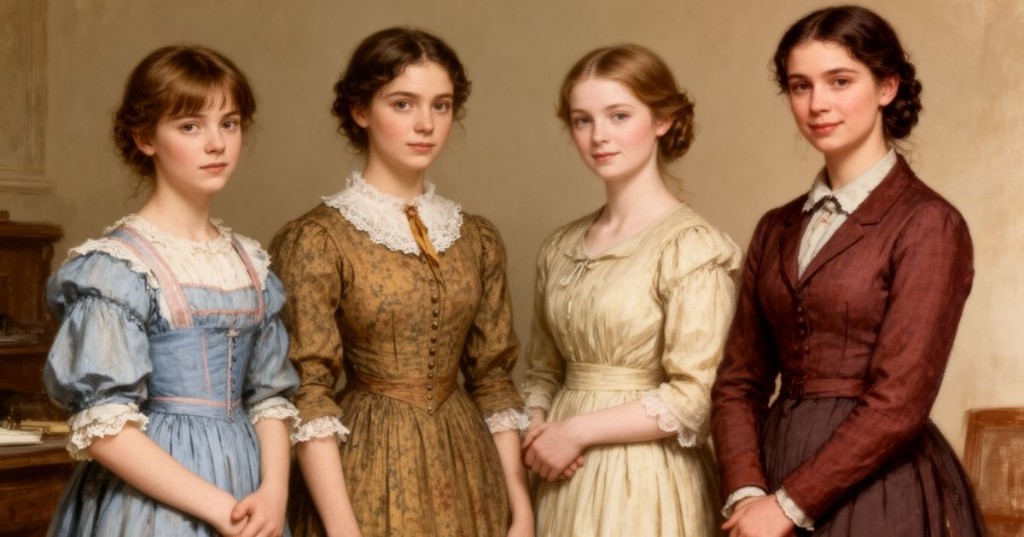
An excerpt from the original text.(complete · 2887 words)
CHAPTER SIXTEEN LETTERS
In the cold gray dawn the sisters lit their lamp and read their chapter
with an earnestness never felt before. For now the shadow of a real
trouble had come, the little books were full of help and comfort, and
as they dressed, they agreed to say goodbye cheerfully and hopefully,
and send their mother on her anxious journey unsaddened by tears or
complaints from them. Everything seemed very strange when they went
down, so dim and still outside, so full of light and bustle within.
Breakfast at that early hour seemed odd, and even Hannah’s familiar
face looked unnatural as she flew about her kitchen with her nightcap
on. The big trunk stood ready in the hall, Mother’s cloak and bonnet
lay on the sofa, and Mother herself sat trying to eat, but looking so
pale and worn with sleeplessness and anxiety that the girls found it
very hard to keep their resolution. Meg’s eyes kept filling in spite of
herself, Jo was obliged to hide her face in the kitchen roller more
than once, and the little girls wore a grave, troubled expression, as
if sorrow was a new experience to them.
Nobody talked much, but as the time drew very near and they sat waiting
for the carriage, Mrs. March said to the girls, who were all busied
about her, one folding her shawl, another smoothing out the strings of
her bonnet, a third putting on her overshoes, and a fourth fastening up
her travelling bag...
“Children, I leave you to Hannah’s care and Mr. Laurence’s protection.
Hannah is faithfulness itself, and our good neighbor will guard you as
if you were his own. I have no fears for you, yet I am anxious that you
should take this trouble rightly. Don’t grieve and fret when I am gone,
or think that you can be idle and comfort yourselves by being idle and
trying to forget. Go on with your work as usual, for work is a blessed
solace. Hope and keep busy, and whatever happens, remember that you
never can be fatherless.”
“Yes, Mother.”
“Meg, dear, be prudent, watch over your sisters, consult Hannah, and in
any perplexity, go to Mr. Laurence. Be patient, Jo, don’t get
despondent or do rash things, write to me often, and be my brave girl,
ready to help and cheer all. Beth, comfort yourself with your music,
and be faithful to the little home duties, and you, Amy, help all you
can, be obedient, and keep happy safe at home.”
“We will, Mother! We will!”
The rattle of an approaching carriage made them all start and listen.
That was the hard minute, but the girls stood it well. No one cried, no
one ran away or uttered a lamentation, though their hearts were very
heavy as they sent loving messages to Father, remembering, as they
spoke that it might be too late to deliver them. They kissed their
mother quietly, clung about her tenderly, and tried to wave their hands
cheerfully when she drove away.
Laurie and his grandfather came over to see her off, and Mr. Brooke
looked so strong and sensible and kind that the girls christened him
‘Mr. Greatheart’ on the spot.
“Good-by, my darlings! God bless and keep us all!” whispered Mrs.
March, as she kissed one dear little face after the other, and hurried
into the carriage.
As she rolled away, the sun came out, and looking back, she saw it
shining on the group at the gate like a good omen. They saw it also,
and smiled and waved their hands, and the last thing she beheld as she
turned the corner was the four bright faces, and behind them like a
bodyguard, old Mr. Laurence, faithful Hannah, and devoted Laurie.
“How kind everyone is to us!” she said, turning to find fresh proof of
it in the respectful sympathy of the young man’s face.
“I don’t see how they can help it,” returned Mr. Brooke, laughing so
infectiously that Mrs. March could not help smiling. And so the journey
began with the good omens of sunshine, smiles, and cheerful words.
“I feel as if there had been an earthquake,” said Jo, as their
neighbors went home to breakfast, leaving them to rest and refresh
themselves.
“It seems as if half the house was gone,” added Meg forlornly.
Beth opened her lips to say something, but could only point to the pile
of nicely mended hose which lay on Mother’s table, showing that even in
her last hurried moments she had thought and worked for them. It was a
little thing, but it went straight to their hearts, and in spite of
their brave resolutions, they all broke down and cried bitterly.
Hannah wisely allowed them to relieve their feelings, and when the
shower showed signs of clearing up, she came to the rescue, armed with
a coffeepot.
“Now, my dear young ladies, remember what your ma said, and don’t fret.
Come and have a cup of coffee all round, and then let’s fall to work
and be a credit to the family.”
Coffee was a treat, and Hannah showed great tact in making it that
morning. No one could resist her persuasive nods, or the fragrant
invitation issuing from the nose of the coffee pot. They drew up to the
table, exchanged their handkerchiefs for napkins, and in ten minutes
were all right again.
“‘Hope and keep busy’, that’s the motto for us, so let’s see who will
remember it best. I shall go to Aunt March, as usual. Oh, won’t she
lecture though!” said Jo, as she sipped with returning spirit.
“I shall go to my Kings, though I’d much rather stay at home and attend
to things here,” said Meg, wishing she hadn’t made her eyes so red.
“No need of that. Beth and I can keep house perfectly well,” put in
Amy, with an important air.
“Hannah will tell us what to do, and we’ll have everything nice when
you come home,” added Beth, getting out her mop and dish tub without
delay.
“I think anxiety is very interesting,” observed Amy, eating sugar
pensively.
The girls couldn’t help laughing, and felt better for it, though Meg
shook her head at the young lady who could find consolation in a sugar
bowl.
The sight of the turnovers made Jo sober again; and when the two went
out to their daily tasks, they looked sorrowfully back at the window
where they were accustomed to see their mother’s face. It was gone, but
Beth had remembered the little household ceremony, and there she was,
nodding away at them like a rosyfaced mandarin.
“That’s so like my Beth!” said Jo, waving her hat, with a grateful
face. “Goodbye, Meggy, I hope the Kings won’t strain today. Don’t fret
about Father, dear,” she added, as they parted.
“And I hope Aunt March won’t croak. Your hair is becoming, and it looks
very boyish and nice,” returned Meg, trying not to smile at the curly
head, which looked comically small on her tall sister’s shoulders.
“That’s my only comfort.” And, touching her hat a la Laurie, away went
Jo, feeling like a shorn sheep on a wintry day.
News from their father comforted the girls very much, for though
dangerously ill, the presence of the best and tenderest of nurses had
already done him good. Mr. Brooke sent a bulletin every day, and as the
head of the family, Meg insisted on reading the dispatches, which grew
more cheerful as the week passed. At first, everyone was eager to
write, and plump envelopes were carefully poked into the letter box by
one or other of the sisters, who felt rather important with their
Washington correspondence. As one of these packets contained
characteristic notes from the party, we will rob an imaginary mail, and
read them.
My dearest Mother:
It is impossible to tell you how happy your last letter made us, for
the news was so good we couldn’t help laughing and crying over it. How
very kind Mr. Brooke is, and how fortunate that Mr. Laurence’s business
detains him near you so long, since he is so useful to you and Father.
The girls are all as good as gold. Jo helps me with the sewing, and
insists on doing all sorts of hard jobs. I should be afraid she might
overdo, if I didn’t know her ‘moral fit’ wouldn’t last long. Beth is as
regular about her tasks as a clock, and never forgets what you told
her. She grieves about Father, and looks sober except when she is at
her little piano. Amy minds me nicely, and I take great care of her.
She does her own hair, and I am teaching her to make buttonholes and
mend her stockings. She tries very hard, and I know you will be pleased
with her improvement when you come. Mr. Laurence watches over us like a
motherly old hen, as Jo says, and Laurie is very kind and neighborly.
He and Jo keep us merry, for we get pretty blue sometimes, and feel
like orphans, with you so far away. Hannah is a perfect saint. She does
not scold at all, and always calls me Miss Margaret, which is quite
proper, you know, and treats me with respect. We are all well and busy,
but we long, day and night, to have you back. Give my dearest love to
Father, and believe me, ever your own...
MEG
This note, prettily written on scented paper, was a great contrast to
the next, which was scribbled on a big sheet of thin foreign paper,
ornamented with blots and all manner of flourishes and curly-tailed
letters.
My precious Marmee:
Three cheers for dear Father! Brooke was a trump to telegraph right
off, and let us know the minute he was better. I rushed up garret when
the letter came, and tried to thank God for being so good to us, but I
could only cry, and say, “I’m glad! I’m glad!” Didn’t that do as well
as a regular prayer? For I felt a great many in my heart. We have such
funny times, and now I can enjoy them, for everyone is so desperately
good, it’s like living in a nest of turtledoves. You’d laugh to see Meg
head the table and try to be motherish. She gets prettier every day,
and I’m in love with her sometimes. The children are regular
archangels, and I—well, I’m Jo, and never shall be anything else. Oh, I
must tell you that I came near having a quarrel with Laurie. I freed my
mind about a silly little thing, and he was offended. I was right, but
didn’t speak as I ought, and he marched home, saying he wouldn’t come
again till I begged pardon. I declared I wouldn’t and got mad. It
lasted all day. I felt bad and wanted you very much. Laurie and I are
both so proud, it’s hard to beg pardon. But I thought he’d come to it,
for I was in the right. He didn’t come, and just at night I remembered
what you said when Amy fell into the river. I read my little book, felt
better, resolved not to let the sun set on my anger, and ran over to
tell Laurie I was sorry. I met him at the gate, coming for the same
thing. We both laughed, begged each other’s pardon, and felt all good
and comfortable again.
I made a ‘pome’ yesterday, when I was helping Hannah wash, and as
Father likes my silly little things, I put it in to amuse him. Give him
my lovingest hug that ever was, and kiss yourself a dozen times for
your...
TOPSY-TURVY JO
A SONG FROM THE SUDS
Queen of my tub, I merrily sing,
While the white foam rises high,
And sturdily wash and rinse and wring,
And fasten the clothes to dry.
Then out in the free fresh air they swing,
Under the sunny sky.
I wish we could wash from our hearts and souls
The stains of the week away,
And let water and air by their magic make
Ourselves as pure as they.
Then on the earth there would be indeed,
A glorious washing day!
Along the path of a useful life,
Will heart’s-ease ever bloom.
The busy mind has no time to think
Of sorrow or care or gloom.
And anxious thoughts may be swept away,
As we bravely wield a broom.
I am glad a task to me is given,
To labor at day by day,
For it brings me health and strength and hope,
And I cheerfully learn to say,
“Head, you may think, Heart, you may feel,
But, Hand, you shall work alway!”
Dear Mother,
There is only room for me to send my love, and some pressed pansies
from the root I have been keeping safe in the house for Father to see.
I read every morning, try to be good all day, and sing myself to sleep
with Father’s tune. I can’t sing ‘LAND OF THE LEAL’ now, it makes me
cry. Everyone is very kind, and we are as happy as we can be without
you. Amy wants the rest of the page, so I must stop. I didn’t forget to
cover the holders, and I wind the clock and air the rooms every day.
Kiss dear Father on the cheek he calls mine. Oh, do come soon to your
loving...
LITTLE BETH
Ma Chere Mamma,
We are all well I do my lessons always and never corroberate the
girls—Meg says I mean contradick so I put in both words and you can
take the properest. Meg is a great comfort to me and lets me have jelly
every night at tea its so good for me Jo says because it keeps me sweet
tempered. Laurie is not as respeckful as he ought to be now I am almost
in my teens, he calls me Chick and hurts my feelings by talking French
to me very fast when I say Merci or Bon jour as Hattie King does. The
sleeves of my blue dress were all worn out, and Meg put in new ones,
but the full front came wrong and they are more blue than the dress. I
felt bad but did not fret I bear my troubles well but I do wish Hannah
would put more starch in my aprons and have buckwheats every day. Can’t
she? Didn’t I make that interrigation point nice? Meg says my
punchtuation and spelling are disgraceful and I am mortyfied but dear
me I have so many things to do, I can’t stop. Adieu, I send heaps of
love to Papa. Your affectionate daughter...
AMY CURTIS MARCH
Dear Mis March,
I jes drop a line to say we git on fust rate. The girls is clever and
fly round right smart. Miss Meg is going to make a proper good
housekeeper. She hes the liking for it, and gits the hang of things
surprisin quick. Jo doos beat all for goin ahead, but she don’t stop to
cal’k’late fust, and you never know where she’s like to bring up. She
done out a tub of clothes on Monday, but she starched ’em afore they
was wrenched, and blued a pink calico dress till I thought I should a
died a laughin. Beth is the best of little creeters, and a sight of
help to me, bein so forehanded and dependable. She tries to learn
everything, and really goes to market beyond her years, likewise keeps
accounts, with my help, quite wonderful. We have got on very economical
so fur. I don’t let the girls hev coffee only once a week, accordin to
your wish, and keep em on plain wholesome vittles. Amy does well
without frettin, wearin her best clothes and eatin sweet stuff. Mr.
Laurie is as full of didoes as usual, and turns the house upside down
frequent, but he heartens the girls, so I let em hev full swing. The
old gentleman sends heaps of things, and is rather wearin, but means
wal, and it aint my place to say nothin. My bread is riz, so no more at
this time. I send my duty to Mr. March, and hope he’s seen the last of
his Pewmonia.
Yours respectful,
Hannah Mullet
Head Nurse of Ward No. 2,
All serene on the Rappahannock, troops in fine condition, commisary
department well conducted, the Home Guard under Colonel Teddy always on
duty, Commander in Chief General Laurence reviews the army daily,
Quartermaster Mullet keeps order in camp, and Major Lion does picket
duty at night. A salute of twenty-four guns was fired on receipt of
good news from Washington, and a dress parade took place at
headquarters. Commander in chief sends best wishes, in which he is
heartily joined by...
COLONEL TEDDY
Dear Madam:
The little girls are all well. Beth and my boy report daily. Hannah is
a model servant, and guards pretty Meg like a dragon. Glad the fine
weather holds. Pray make Brooke useful, and draw on me for funds if
expenses exceed your estimate. Don’t let your husband want anything.
Thank God he is mending.
Your sincere friend and servant, JAMES LAURENCE
Master this chapter. Complete your experience
Purchase the complete book to access all chapters and support classic literature
As an Amazon Associate, we earn a small commission from qualifying purchases at no additional cost to you.
Available in paperback, hardcover, and e-book formats
Let's Analyse the Pattern
Emergency situations strip away social masks and reveal people's authentic character and coping mechanisms.
Why This Matters
Connect literature to life
This chapter teaches how to recognize that people's behavior during emergencies reveals their true personality and values, not their everyday social mask.
Practice This Today
This week, notice how different people in your life respond to small disruptions - a cancelled plan, a work deadline, a minor emergency - and file that information away for understanding how they'll handle bigger challenges.
Now let's explore the literary elements.
Key Quotes & Analysis
"I shall come back to you soon, and if I don't, you must not feel that I have left you willingly."
Context: Said during the emotional goodbye as she prepares to leave for Washington
This shows the depth of family bonds and the sacrifice parents make for each other. It acknowledges that separation is painful for everyone while emphasizing that duty sometimes requires difficult choices.
In Today's Words:
I'll be back as soon as I can, and if something happens to me, know that I never wanted to leave you
"We never are too old for this, my dear, because it is a play we are playing all the time in one way or another."
Context: Referring to their family game of trying to be better people
This reveals that personal growth and moral development are lifelong processes, not just childhood lessons. It frames character building as an ongoing choice rather than a destination.
In Today's Words:
We're all still working on becoming better people - that never stops, no matter how old you get
"The house seems like a different place without Mother, and we girls are like lost sheep without our shepherd."
Context: Describing how the family feels after Mrs. March's departure
This shows how central the mother figure was to family stability and identity. It also reveals Meg's growing awareness of family dynamics and her role in maintaining them.
In Today's Words:
Everything feels wrong without Mom here - we don't really know how to function as a family without her
Thematic Threads
Responsibility
In This Chapter
Meg steps into adult leadership role, managing household and siblings while maintaining emotional stability
Development
Evolved from earlier complaints about domestic duties to genuine pride in competence
In Your Life:
You might recognize this when you surprise yourself by how well you handle a family crisis or workplace emergency
Identity
In This Chapter
Each sister's letter reveals distinct personality through writing style, concerns, and coping mechanisms
Development
Builds on established character traits but shows them under pressure
In Your Life:
You see this when stress brings out either your best or worst qualities in relationships
Communication
In This Chapter
Letters become lifeline maintaining family connection across distance, each reflecting writer's emotional needs
Development
Introduced here as primary plot device and character revelation method
In Your Life:
You experience this when you realize how much your texting style reveals about your emotional state
Class
In This Chapter
Family's financial constraints show in Amy's concern about French lessons and social appearances
Development
Continues thread of economic anxiety affecting daily choices and social positioning
In Your Life:
You might notice this when your own financial stress affects decisions about your children's activities or education
Growth
In This Chapter
Crisis accelerates maturity, particularly in Meg who embraces adult responsibilities with newfound confidence
Development
Continues theme of gradual character development but shows crisis as catalyst
In Your Life:
You see this when unexpected challenges force you to develop skills or confidence you didn't know you had
You now have the context. Time to form your own thoughts.
Discussion Questions
- 1
What specific advice does Mrs. March give each daughter before leaving, and how does each sister respond to the crisis of her departure?
analysis • surface - 2
How do the different letter-writing styles reveal each family member's personality and way of handling stress?
analysis • medium - 3
Think about a time when your family faced a crisis or major change. How did each person's true character show through their response?
application • medium - 4
When you're under pressure at work or in relationships, what does your natural response reveal about who you really are underneath your everyday persona?
application • deep - 5
Why do crisis situations strip away pretense and reveal people's core character? What does this teach us about choosing who to trust in important relationships?
reflection • deep
Critical Thinking Exercise
Crisis Response Profile
Think of three different people in your life - a family member, a coworker, and a friend. Write down how each person typically responds when things go wrong: Do they take charge, withdraw, panic, blame others, or something else? Then reflect on your own crisis response pattern. What does this tell you about the reliability and compatibility of these relationships?
Consider:
- •Notice whether people become more helpful or more demanding under stress
- •Pay attention to who stays calm versus who creates additional drama
- •Consider how different crisis styles might complement or clash with your own
Journaling Prompt
Write about a recent stressful situation you experienced. What was your automatic response, and what did that reveal about your character? How might you want to develop your crisis response for future challenges?
Coming Up Next...
Chapter 17: When Good Intentions Fall Apart
While the March family adapts to life without their mother, Beth's quiet devotion to others will soon put her own health at risk in ways no one could have predicted.



