
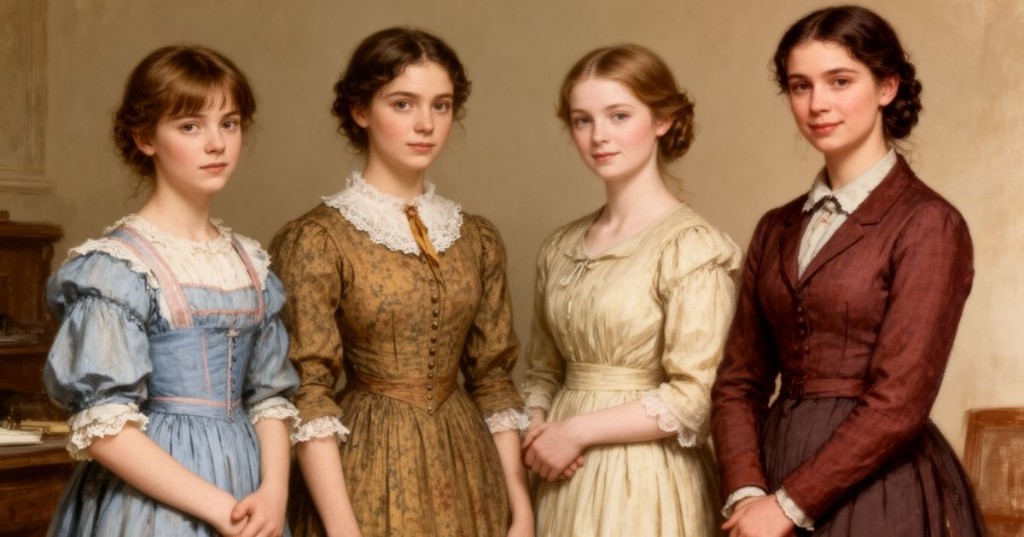
An excerpt from the original text.(complete · 3322 words)
CHAPTER TEN
THE P.C. AND P.O.
As spring came on, a new set of amusements became the fashion, and the
lengthening days gave long afternoons for work and play of all sorts.
The garden had to be put in order, and each sister had a quarter of the
little plot to do what she liked with. Hannah used to say, “I’d know
which each of them gardings belonged to, ef I see ’em in Chiny,” and so
she might, for the girls’ tastes differed as much as their characters.
Meg’s had roses and heliotrope, myrtle, and a little orange tree in it.
Jo’s bed was never alike two seasons, for she was always trying
experiments. This year it was to be a plantation of sun flowers, the
seeds of which cheerful and aspiring plant were to feed Aunt Cockle-top
and her family of chicks. Beth had old-fashioned fragrant flowers in
her garden, sweet peas and mignonette, larkspur, pinks, pansies, and
southernwood, with chickweed for the birds and catnip for the pussies.
Amy had a bower in hers, rather small and earwiggy, but very pretty to
look at, with honeysuckle and morning-glories hanging their colored
horns and bells in graceful wreaths all over it, tall white lilies,
delicate ferns, and as many brilliant, picturesque plants as would
consent to blossom there.
Gardening, walks, rows on the river, and flower hunts employed the fine
days, and for rainy ones, they had house diversions, some old, some
new, all more or less original. One of these was the ‘P.C.’, for as
secret societies were the fashion, it was thought proper to have one,
and as all of the girls admired Dickens, they called themselves the
Pickwick Club. With a few interruptions, they had kept this up for a
year, and met every Saturday evening in the big garret, on which
occasions the ceremonies were as follows: Three chairs were arranged in
a row before a table on which was a lamp, also four white badges, with
a big ‘P.C.’ in different colors on each, and the weekly newspaper
called, The Pickwick Portfolio, to which all contributed something,
while Jo, who reveled in pens and ink, was the editor. At seven
o’clock, the four members ascended to the clubroom, tied their badges
round their heads, and took their seats with great solemnity. Meg, as
the eldest, was Samuel Pickwick, Jo, being of a literary turn, Augustus
Snodgrass, Beth, because she was round and rosy, Tracy Tupman, and Amy,
who was always trying to do what she couldn’t, was Nathaniel Winkle.
Pickwick, the president, read the paper, which was filled with original
tales, poetry, local news, funny advertisements, and hints, in which
they good-naturedly reminded each other of their faults and short
comings. On one occasion, Mr. Pickwick put on a pair of spectacles
without any glass, rapped upon the table, hemmed, and having stared
hard at Mr. Snodgrass, who was tilting back in his chair, till he
arranged himself properly, began to read:
“THE PICKWICK PORTFOLIO”
MAY 20, 18—
POET’S CORNER
ANNIVERSARY ODE
Again we meet to celebrate
With badge and solemn rite,
Our fifty-second anniversary,
In Pickwick Hall, tonight.
We all are here in perfect health,
None gone from our small band:
Again we see each well-known face,
And press each friendly hand.
Our Pickwick, always at his post,
With reverence we greet,
As, spectacles on nose, he reads
Our well-filled weekly sheet.
Although he suffers from a cold,
We joy to hear him speak,
For words of wisdom from him fall,
In spite of croak or squeak.
Old six-foot Snodgrass looms on high,
With elephantine grace,
And beams upon the company,
With brown and jovial face.
Poetic fire lights up his eye,
He struggles ’gainst his lot.
Behold ambition on his brow,
And on his nose, a blot.
Next our peaceful Tupman comes,
So rosy, plump, and sweet,
Who chokes with laughter at the puns,
And tumbles off his seat.
Prim little Winkle too is here,
With every hair in place,
A model of propriety,
Though he hates to wash his face.
The year is gone, we still unite
To joke and laugh and read,
And tread the path of literature
That doth to glory lead.
Long may our paper prosper well,
Our club unbroken be,
And coming years their blessings pour
On the useful, gay ‘P. C.’.
A. SNODGRASS
THE MASKED MARRIAGE
(A Tale Of Venice)
Gondola after gondola swept up to the marble steps, and left its lovely
load to swell the brilliant throng that filled the stately halls of
Count Adelon. Knights and ladies, elves and pages, monks and flower
girls, all mingled gaily in the dance. Sweet voices and rich melody
filled the air, and so with mirth and music the masquerade went on.
“Has your Highness seen the Lady Viola tonight?” asked a gallant
troubadour of the fairy queen who floated down the hall upon his arm.
“Yes, is she not lovely, though so sad! Her dress is well chosen, too,
for in a week she weds Count Antonio, whom she passionately hates.”
“By my faith, I envy him. Yonder he comes, arrayed like a bridegroom,
except the black mask. When that is off we shall see how he regards the
fair maid whose heart he cannot win, though her stern father bestows
her hand,” returned the troubadour.
“Tis whispered that she loves the young English artist who haunts her
steps, and is spurned by the old Count,” said the lady, as they joined
the dance. The revel was at its height when a priest appeared, and
withdrawing the young pair to an alcove, hung with purple velvet, he
motioned them to kneel. Instant silence fell on the gay throng, and not
a sound, but the dash of fountains or the rustle of orange groves
sleeping in the moonlight, broke the hush, as Count de Adelon spoke
thus:
“My lords and ladies, pardon the ruse by which I have gathered you here
to witness the marriage of my daughter. Father, we wait your services.”
All eyes turned toward the bridal party, and a murmur of amazement went
through the throng, for neither bride nor groom removed their masks.
Curiosity and wonder possessed all hearts, but respect restrained all
tongues till the holy rite was over. Then the eager spectators gathered
round the count, demanding an explanation.
“Gladly would I give it if I could, but I only know that it was the
whim of my timid Viola, and I yielded to it. Now, my children, let the
play end. Unmask and receive my blessing.”
But neither bent the knee, for the young bridegroom replied in a tone
that startled all listeners as the mask fell, disclosing the noble face
of Ferdinand Devereux, the artist lover, and leaning on the breast
where now flashed the star of an English earl was the lovely Viola,
radiant with joy and beauty.
“My lord, you scornfully bade me claim your daughter when I could boast
as high a name and vast a fortune as the Count Antonio. I can do more,
for even your ambitious soul cannot refuse the Earl of Devereux and De
Vere, when he gives his ancient name and boundless wealth in return for
the beloved hand of this fair lady, now my wife.”
The count stood like one changed to stone, and turning to the
bewildered crowd, Ferdinand added, with a gay smile of triumph, “To
you, my gallant friends, I can only wish that your wooing may prosper
as mine has done, and that you may all win as fair a bride as I have by
this masked marriage.”
S. PICKWICK
Why is the P. C. like the Tower of Babel?
It is full of unruly members.
THE HISTORY OF A SQUASH
Once upon a time a farmer planted a little seed in his garden, and
after a while it sprouted and became a vine and bore many squashes. One
day in October, when they were ripe, he picked one and took it to
market. A grocerman bought and put it in his shop. That same morning, a
little girl in a brown hat and blue dress, with a round face and snub
nose, went and bought it for her mother. She lugged it home, cut it up,
and boiled it in the big pot, mashed some of it with salt and butter,
for dinner. And to the rest she added a pint of milk, two eggs, four
spoons of sugar, nutmeg, and some crackers, put it in a deep dish, and
baked it till it was brown and nice, and next day it was eaten by a
family named March.
T. TUPMAN
Mr. Pickwick, Sir:—
I address you upon the subject of sin the sinner I mean is a man
named Winkle who makes trouble in his club by laughing and
sometimes won’t write his piece in this fine paper I hope you will
pardon his badness and let him send a French fable because he can’t
write out of his head as he has so many lessons to do and no brains
in future I will try to take time by the fetlock and prepare some
work which will be all commy la fo that means all right I am in
haste as it is nearly school time.
Yours respectably,
N. WINKLE
[The above is a manly and handsome acknowledgment of past misdemeanors.
If our young friend studied punctuation, it would be well.]
A SAD ACCIDENT
On Friday last, we were startled by a violent shock in our basement,
followed by cries of distress. On rushing in a body to the cellar, we
discovered our beloved President prostrate upon the floor, having
tripped and fallen while getting wood for domestic purposes. A perfect
scene of ruin met our eyes, for in his fall Mr. Pickwick had plunged
his head and shoulders into a tub of water, upset a keg of soft soap
upon his manly form, and torn his garments badly. On being removed from
this perilous situation, it was discovered that he had suffered no
injury but several bruises, and we are happy to add, is now doing well.
ED.
THE PUBLIC BEREAVEMENT
It is our painful duty to record the sudden and mysterious
disappearance of our cherished friend, Mrs. Snowball Pat Paw. This
lovely and beloved cat was the pet of a large circle of warm and
admiring friends; for her beauty attracted all eyes, her graces and
virtues endeared her to all hearts, and her loss is deeply felt by the
whole community.
When last seen, she was sitting at the gate, watching the butcher’s
cart, and it is feared that some villain, tempted by her charms,
basely stole her. Weeks have passed, but no trace of her has been
discovered, and we relinquish all hope, tie a black ribbon to her
basket, set aside her dish, and weep for her as one lost to us
forever.
A sympathizing friend sends the following gem:
A LAMENT
FOR S. B. PAT PAW
We mourn the loss of our little pet,
And sigh o’er her hapless fate,
For never more by the fire she’ll sit,
Nor play by the old green gate.
The little grave where her infant sleeps
Is ’neath the chestnut tree.
But o’er her grave we may not weep,
We know not where it may be.
Her empty bed, her idle ball,
Will never see her more;
No gentle tap, no loving purr
Is heard at the parlor door.
Another cat comes after her mice,
A cat with a dirty face,
But she does not hunt as our darling did,
Nor play with her airy grace.
Her stealthy paws tread the very hall
Where Snowball used to play,
But she only spits at the dogs our pet
So gallantly drove away.
She is useful and mild, and does her best,
But she is not fair to see,
And we cannot give her your place dear,
Nor worship her as we worship thee.
A.S.
ADVERTISEMENTS
MISS ORANTHY BLUGGAGE, the accomplished strong-minded lecturer, will
deliver her famous lecture on “WOMAN AND HER POSITION” at Pickwick
Hall, next Saturday Evening, after the usual performances.
A WEEKLY MEETING will be held at Kitchen Place, to teach young ladies
how to cook. Hannah Brown will preside, and all are invited to attend.
THE DUSTPAN SOCIETY will meet on Wednesday next, and parade in the
upper story of the Club House. All members to appear in uniform and
shoulder their brooms at nine precisely.
MRS. BETH BOUNCER will open her new assortment of Doll’s Millinery next
week. The latest Paris fashions have arrived, and orders are
respectfully solicited.
A NEW PLAY will appear at the Barnville Theatre, in the course of a few
weeks, which will surpass anything ever seen on the American stage.
“THE GREEK SLAVE, or Constantine the Avenger,” is the name of this
thrilling drama!!!
HINTS
If S.P. didn’t use so much soap on his hands, he wouldn’t always be
late at breakfast. A.S. is requested not to whistle in the street. T.T.
please don’t forget Amy’s napkin. N.W. must not fret because his dress
has not nine tucks.
WEEKLY REPORT
Meg—Good.
Jo—Bad.
Beth—Very Good.
Amy—Middling.
As the President finished reading the paper (which I beg leave to
assure my readers is a bona fide copy of one written by bona fide girls
once upon a time), a round of applause followed, and then Mr. Snodgrass
rose to make a proposition.
“Mr. President and gentlemen,” he began, assuming a parliamentary
attitude and tone, “I wish to propose the admission of a new member—one
who highly deserves the honor, would be deeply grateful for it, and
would add immensely to the spirit of the club, the literary value of
the paper, and be no end jolly and nice. I propose Mr. Theodore
Laurence as an honorary member of the P. C. Come now, do have him.”
Jo’s sudden change of tone made the girls laugh, but all looked rather
anxious, and no one said a word as Snodgrass took his seat.
“We’ll put it to a vote,” said the President. “All in favor of this
motion please to manifest it by saying, ‘Aye’.”
A loud response from Snodgrass, followed, to everybody’s surprise, by a
timid one from Beth.
“Contrary-minded say, ‘No’.”
Meg and Amy were contrary-minded, and Mr. Winkle rose to say with great
elegance, “We don’t wish any boys, they only joke and bounce about.
This is a ladies’ club, and we wish to be private and proper.”
“I’m afraid he’ll laugh at our paper, and make fun of us afterward,”
observed Pickwick, pulling the little curl on her forehead, as she
always did when doubtful.
Up rose Snodgrass, very much in earnest. “Sir, I give you my word as a
gentleman, Laurie won’t do anything of the sort. He likes to write, and
he’ll give a tone to our contributions and keep us from being
sentimental, don’t you see? We can do so little for him, and he does so
much for us, I think the least we can do is to offer him a place here,
and make him welcome if he comes.”
This artful allusion to benefits conferred brought Tupman to his feet,
looking as if he had quite made up his mind.
“Yes; we ought to do it, even if we are afraid. I say he may come, and
his grandpa, too, if he likes.”
This spirited burst from Beth electrified the club, and Jo left her
seat to shake hands approvingly. “Now then, vote again. Everybody
remember it’s our Laurie, and say, ‘Aye!’” cried Snodgrass excitedly.
“Aye! Aye! Aye!” replied three voices at once.
“Good! Bless you! Now, as there’s nothing like ‘taking time by the
fetlock’, as Winkle characteristically observes, allow me to present
the new member.” And, to the dismay of the rest of the club, Jo threw
open the door of the closet, and displayed Laurie sitting on a rag bag,
flushed and twinkling with suppressed laughter.
“You rogue! You traitor! Jo, how could you?” cried the three girls, as
Snodgrass led her friend triumphantly forth, and producing both a chair
and a badge, installed him in a jiffy.
“The coolness of you two rascals is amazing,” began Mr. Pickwick,
trying to get up an awful frown and only succeeding in producing an
amiable smile. But the new member was equal to the occasion, and
rising, with a grateful salutation to the Chair, said in the most
engaging manner, “Mr. President and ladies—I beg pardon,
gentlemen—allow me to introduce myself as Sam Weller, the very humble
servant of the club.”
“Good! Good!” cried Jo, pounding with the handle of the old warming pan
on which she leaned.
“My faithful friend and noble patron,” continued Laurie with a wave of
the hand, “who has so flatteringly presented me, is not to be blamed
for the base stratagem of tonight. I planned it, and she only gave in
after lots of teasing.”
“Come now, don’t lay it all on yourself. You know I proposed the
cupboard,” broke in Snodgrass, who was enjoying the joke amazingly.
“Never mind what she says. I’m the wretch that did it, sir,” said the
new member, with a Welleresque nod to Mr. Pickwick. “But on my honor, I
never will do so again, and henceforth devote myself to the interest of
this immortal club.”
“Hear! Hear!” cried Jo, clashing the lid of the warming pan like a
cymbal.
“Go on, go on!” added Winkle and Tupman, while the President bowed
benignly.
“I merely wish to say, that as a slight token of my gratitude for the
honor done me, and as a means of promoting friendly relations between
adjoining nations, I have set up a post office in the hedge in the
lower corner of the garden, a fine, spacious building with padlocks on
the doors and every convenience for the mails, also the females, if I
may be allowed the expression. It’s the old martin house, but I’ve
stopped up the door and made the roof open, so it will hold all sorts
of things, and save our valuable time. Letters, manuscripts, books, and
bundles can be passed in there, and as each nation has a key, it will
be uncommonly nice, I fancy. Allow me to present the club key, and with
many thanks for your favor, take my seat.”
Great applause as Mr. Weller deposited a little key on the table and
subsided, the warming pan clashed and waved wildly, and it was some
time before order could be restored. A long discussion followed, and
everyone came out surprising, for everyone did her best. So it was an
unusually lively meeting, and did not adjourn till a late hour, when it
broke up with three shrill cheers for the new member.
No one ever regretted the admittance of Sam Weller, for a more devoted,
well-behaved, and jovial member no club could have. He certainly did
add ‘spirit’ to the meetings, and ‘a tone’ to the paper, for his
orations convulsed his hearers and his contributions were excellent,
being patriotic, classical, comical, or dramatic, but never
sentimental. Jo regarded them as worthy of Bacon, Milton, or
Shakespeare, and remodeled her own works with good effect, she thought.
The P. O. was a capital little institution, and flourished wonderfully,
for nearly as many queer things passed through it as through the real
post office. Tragedies and cravats, poetry and pickles, garden seeds
and long letters, music and gingerbread, rubbers, invitations,
scoldings, and puppies. The old gentleman liked the fun, and amused
himself by sending odd bundles, mysterious messages, and funny
telegrams, and his gardener, who was smitten with Hannah’s charms,
actually sent a love letter to Jo’s care. How they laughed when the
secret came out, never dreaming how many love letters that little post
office would hold in the years to come.
Master this chapter. Complete your experience
Purchase the complete book to access all chapters and support classic literature
As an Amazon Associate, we earn a small commission from qualifying purchases at no additional cost to you.
Available in paperback, hardcover, and e-book formats
Let's Analyse the Pattern
Confident groups grow stronger by welcoming worthy outsiders, while insecure groups weaken themselves through exclusion.
Why This Matters
Connect literature to life
This chapter teaches how to recognize whether resistance to new members comes from legitimate concerns about fit or from insecurity about losing status.
Practice This Today
Next time someone new wants to join your team, friend group, or project, ask yourself: 'Am I protecting something valuable or just afraid of change?'
Now let's explore the literary elements.
Key Quotes & Analysis
"I'd know which each of them gardings belonged to, ef I see 'em in Chiny"
Context: Hannah observes how each sister's garden reflects their distinct personality
This quote shows how our choices reveal who we are, even in small things. Hannah recognizes that personal expression comes through in everything we do, from plant choices to life decisions.
In Today's Words:
I could tell you which garden belongs to which girl from a mile away - they're all so different
"We ought to do something for him, and I think we ought to be grateful that he doesn't turn up his nose at us and our little doings"
Context: Jo argues for including Laurie in their club despite initial resistance
Jo demonstrates emotional intelligence by recognizing that friendship requires mutual respect and gratitude. She understands that welcoming others strengthens rather than weakens their group.
In Today's Words:
We should appreciate that he actually wants to hang out with us instead of thinking he's too good for our stuff
"The post office was a capital little institution, and flourished wonderfully"
Context: Describing how Laurie's message system becomes an important part of their friendship
This shows how small gestures can create lasting connections. The post office becomes more than communication - it's a symbol of ongoing friendship and community building.
In Today's Words:
The message system was brilliant and really took off
Thematic Threads
Leadership
In This Chapter
Jo demonstrates leadership by advocating for Laurie's inclusion despite initial group resistance
Development
Building on Jo's earlier assertiveness, now showing collaborative leadership skills
In Your Life:
You might need to champion someone's inclusion in your workplace team or social group when others resist change
Community Building
In This Chapter
The Pickwick Club creates belonging through shared creative expression and mutual support
Development
Expanding from family bonds to chosen community with neighbors
In Your Life:
You might find meaning in creating or joining groups that celebrate shared interests and provide mutual encouragement
Creative Expression
In This Chapter
Each sister contributes unique talents to their newspaper, finding individual voice within group identity
Development
Continuing theme of each sister developing distinct talents and perspectives
In Your Life:
You might discover your own voice and skills through collaborative creative projects rather than solo efforts
Class Boundaries
In This Chapter
The post office system bridges social class differences between the March and Laurence households
Development
Evolving from class consciousness to practical relationship building across economic differences
In Your Life:
You might find ways to connect meaningfully with people from different economic backgrounds through shared activities
Personal Growth
In This Chapter
Each sister's garden plot reflects their personality while teaching responsibility and patience
Development
Continuing individual character development through practical life experiences
In Your Life:
You might discover aspects of your character through taking on new responsibilities or creative projects
You now have the context. Time to form your own thoughts.
Discussion Questions
- 1
What changes when the March sisters decide to let Laurie join their Pickwick Club, and how does he contribute to their group?
analysis • surface - 2
Why do you think the sisters initially resist adding Laurie to their club, and what makes Jo advocate for including him?
analysis • medium - 3
Where have you seen groups at work, school, or in your community struggle with whether to welcome new members or keep things exclusive?
application • medium - 4
When someone new wants to join your friend group, team, or family traditions, how do you decide whether your resistance comes from legitimate concerns or just fear of change?
application • deep - 5
What does this chapter reveal about the difference between groups that grow stronger over time versus those that eventually fall apart?
reflection • deep
Critical Thinking Exercise
Map Your Circle's Boundaries
Think of a group you belong to - your work team, friend circle, family traditions, or hobby community. Draw or list the 'inner circle' and identify who's on the outside wanting in. For each outsider, write whether your group's resistance comes from protecting quality/values or protecting status/comfort. Then brainstorm one small way you could create a 'post office' - a low-pressure way for newcomers to connect.
Consider:
- •Consider whether your group's exclusivity actually makes it stronger or just makes you feel special
- •Think about what you might gain from fresh perspectives rather than what you might lose
- •Notice if you're more like Jo (advocating for inclusion) or initially resistant like her sisters
Journaling Prompt
Write about a time when you were the outsider wanting into an established group. What did the insiders do that made you feel welcome or unwelcome? How can you use that experience to guide your own choices about inclusion?
Coming Up Next...
Chapter 11: The Vacation Experiment
The March sisters are about to embark on a series of domestic experiments that will test their resolve and teach them valuable lessons about work, responsibility, and the consequences of their choices. Their mother has a surprise plan that will challenge everything they think they know about running a household.



