
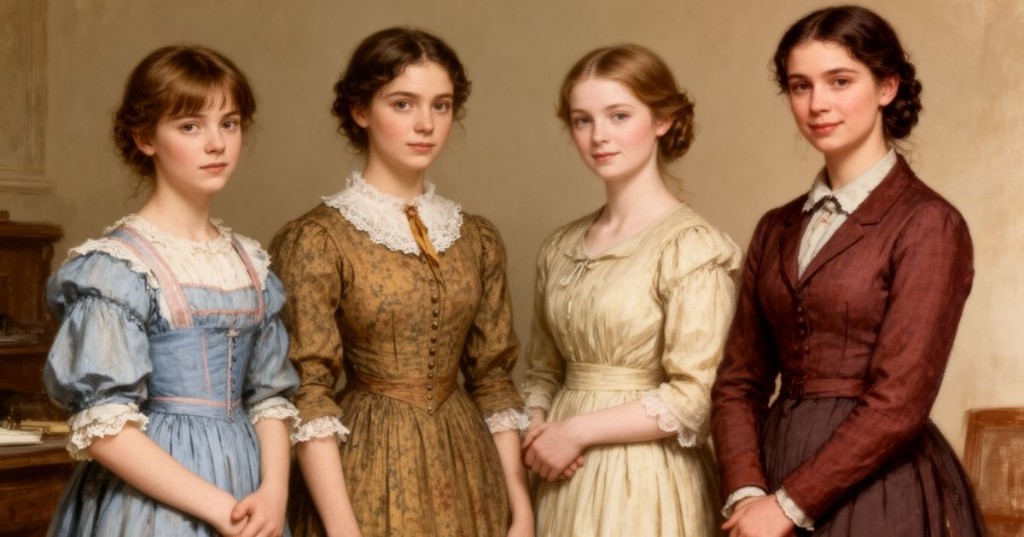
An excerpt from the original text.(complete · 6265 words)
CHAPTER NINE MEG GOES TO VANITY FAIR
“I do think it was the most fortunate thing in the world that those
children should have the measles just now,” said Meg, one April day, as
she stood packing the ‘go abroady’ trunk in her room, surrounded by her
sisters.
“And so nice of Annie Moffat not to forget her promise. A whole
fortnight of fun will be regularly splendid,” replied Jo, looking like
a windmill as she folded skirts with her long arms.
“And such lovely weather, I’m so glad of that,” added Beth, tidily
sorting neck and hair ribbons in her best box, lent for the great
occasion.
“I wish I was going to have a fine time and wear all these nice
things,” said Amy with her mouth full of pins, as she artistically
replenished her sister’s cushion.
“I wish you were all going, but as you can’t, I shall keep my
adventures to tell you when I come back. I’m sure it’s the least I can
do when you have been so kind, lending me things and helping me get
ready,” said Meg, glancing round the room at the very simple outfit,
which seemed nearly perfect in their eyes.
“What did Mother give you out of the treasure box?” asked Amy, who had
not been present at the opening of a certain cedar chest in which Mrs.
March kept a few relics of past splendor, as gifts for her girls when
the proper time came.
“A pair of silk stockings, that pretty carved fan, and a lovely blue
sash. I wanted the violet silk, but there isn’t time to make it over,
so I must be contented with my old tarlaton.”
“It will look nice over my new muslin skirt, and the sash will set it
off beautifully. I wish I hadn’t smashed my coral bracelet, for you
might have had it,” said Jo, who loved to give and lend, but whose
possessions were usually too dilapidated to be of much use.
“There is a lovely old-fashioned pearl set in the treasure chest, but
Mother said real flowers were the prettiest ornament for a young girl,
and Laurie promised to send me all I want,” replied Meg. “Now, let me
see, there’s my new gray walking suit, just curl up the feather in my
hat, Beth, then my poplin for Sunday and the small party, it looks
heavy for spring, doesn’t it? The violet silk would be so nice. Oh,
dear!”
“Never mind, you’ve got the tarlaton for the big party, and you always
look like an angel in white,” said Amy, brooding over the little store
of finery in which her soul delighted.
“It isn’t low-necked, and it doesn’t sweep enough, but it will have to
do. My blue housedress looks so well, turned and freshly trimmed, that
I feel as if I’d got a new one. My silk sacque isn’t a bit the fashion,
and my bonnet doesn’t look like Sallie’s. I didn’t like to say
anything, but I was sadly disappointed in my umbrella. I told Mother
black with a white handle, but she forgot and bought a green one with a
yellowish handle. It’s strong and neat, so I ought not to complain, but
I know I shall feel ashamed of it beside Annie’s silk one with a gold
top,” sighed Meg, surveying the little umbrella with great disfavor.
“Change it,” advised Jo.
“I won’t be so silly, or hurt Marmee’s feelings, when she took so much
pains to get my things. It’s a nonsensical notion of mine, and I’m not
going to give up to it. My silk stockings and two pairs of new gloves
are my comfort. You are a dear to lend me yours, Jo. I feel so rich and
sort of elegant, with two new pairs, and the old ones cleaned up for
common.” And Meg took a refreshing peep at her glove box.
“Annie Moffat has blue and pink bows on her nightcaps. Would you put
some on mine?” she asked, as Beth brought up a pile of snowy muslins,
fresh from Hannah’s hands.
“No, I wouldn’t, for the smart caps won’t match the plain gowns without
any trimming on them. Poor folks shouldn’t rig,” said Jo decidedly.
“I wonder if I shall ever be happy enough to have real lace on my
clothes and bows on my caps?” said Meg impatiently.
“You said the other day that you’d be perfectly happy if you could only
go to Annie Moffat’s,” observed Beth in her quiet way.
“So I did! Well, I am happy, and I won’t fret, but it does seem as if
the more one gets the more one wants, doesn’t it? There now, the trays
are ready, and everything in but my ball dress, which I shall leave for
Mother to pack,” said Meg, cheering up, as she glanced from the
half-filled trunk to the many times pressed and mended white tarlaton,
which she called her ‘ball dress’ with an important air.
The next day was fine, and Meg departed in style for a fortnight of
novelty and pleasure. Mrs. March had consented to the visit rather
reluctantly, fearing that Margaret would come back more discontented
than she went. But she begged so hard, and Sallie had promised to take
good care of her, and a little pleasure seemed so delightful after a
winter of irksome work that the mother yielded, and the daughter went
to take her first taste of fashionable life.
The Moffats were very fashionable, and simple Meg was rather daunted,
at first, by the splendor of the house and the elegance of its
occupants. But they were kindly people, in spite of the frivolous life
they led, and soon put their guest at her ease. Perhaps Meg felt,
without understanding why, that they were not particularly cultivated
or intelligent people, and that all their gilding could not quite
conceal the ordinary material of which they were made. It certainly was
agreeable to fare sumptuously, drive in a fine carriage, wear her best
frock every day, and do nothing but enjoy herself. It suited her
exactly, and soon she began to imitate the manners and conversation of
those about her, to put on little airs and graces, use French phrases,
crimp her hair, take in her dresses, and talk about the fashions as
well as she could. The more she saw of Annie Moffat’s pretty things,
the more she envied her and sighed to be rich. Home now looked bare and
dismal as she thought of it, work grew harder than ever, and she felt
that she was a very destitute and much-injured girl, in spite of the
new gloves and silk stockings.
She had not much time for repining, however, for the three young girls
were busily employed in ‘having a good time’. They shopped, walked,
rode, and called all day, went to theaters and operas or frolicked at
home in the evening, for Annie had many friends and knew how to
entertain them. Her older sisters were very fine young ladies, and one
was engaged, which was extremely interesting and romantic, Meg thought.
Mr. Moffat was a fat, jolly old gentleman, who knew her father, and
Mrs. Moffat, a fat, jolly old lady, who took as great a fancy to Meg as
her daughter had done. Everyone petted her, and ‘Daisey’, as they
called her, was in a fair way to have her head turned.
When the evening for the small party came, she found that the poplin
wouldn’t do at all, for the other girls were putting on thin dresses
and making themselves very fine indeed. So out came the tarlatan,
looking older, limper, and shabbier than ever beside Sallie’s crisp new
one. Meg saw the girls glance at it and then at one another, and her
cheeks began to burn, for with all her gentleness she was very proud.
No one said a word about it, but Sallie offered to dress her hair, and
Annie to tie her sash, and Belle, the engaged sister, praised her white
arms. But in their kindness Meg saw only pity for her poverty, and her
heart felt very heavy as she stood by herself, while the others
laughed, chattered, and flew about like gauzy butterflies. The hard,
bitter feeling was getting pretty bad, when the maid brought in a box
of flowers. Before she could speak, Annie had the cover off, and all
were exclaiming at the lovely roses, heath, and fern within.
“It’s for Belle, of course, George always sends her some, but these are
altogether ravishing,” cried Annie, with a great sniff.
“They are for Miss March, the man said. And here’s a note,” put in the
maid, holding it to Meg.
“What fun! Who are they from? Didn’t know you had a lover,” cried the
girls, fluttering about Meg in a high state of curiosity and surprise.
“The note is from Mother, and the flowers from Laurie,” said Meg
simply, yet much gratified that he had not forgotten her.
“Oh, indeed!” said Annie with a funny look, as Meg slipped the note
into her pocket as a sort of talisman against envy, vanity, and false
pride, for the few loving words had done her good, and the flowers
cheered her up by their beauty.
Feeling almost happy again, she laid by a few ferns and roses for
herself, and quickly made up the rest in dainty bouquets for the
breasts, hair, or skirts of her friends, offering them so prettily that
Clara, the elder sister, told her she was ‘the sweetest little thing
she ever saw’, and they looked quite charmed with her small attention.
Somehow the kind act finished her despondency, and when all the rest
went to show themselves to Mrs. Moffat, she saw a happy, bright-eyed
face in the mirror, as she laid her ferns against her rippling hair and
fastened the roses in the dress that didn’t strike her as so very
shabby now.
She enjoyed herself very much that evening, for she danced to her
heart’s content. Everyone was very kind, and she had three compliments.
Annie made her sing, and some one said she had a remarkably fine voice.
Major Lincoln asked who ‘the fresh little girl with the beautiful eyes’
was, and Mr. Moffat insisted on dancing with her because she ‘didn’t
dawdle, but had some spring in her’, as he gracefully expressed it. So
altogether she had a very nice time, till she overheard a bit of
conversation, which disturbed her extremely. She was sitting just
inside the conservatory, waiting for her partner to bring her an ice,
when she heard a voice ask on the other side of the flowery wall...
“How old is he?”
“Sixteen or seventeen, I should say,” replied another voice.
“It would be a grand thing for one of those girls, wouldn’t it? Sallie
says they are very intimate now, and the old man quite dotes on them.”
“Mrs. M. has made her plans, I dare say, and will play her cards well,
early as it is. The girl evidently doesn’t think of it yet,” said Mrs.
Moffat.
“She told that fib about her momma, as if she did know, and colored up
when the flowers came quite prettily. Poor thing! She’d be so nice if
she was only got up in style. Do you think she’d be offended if we
offered to lend her a dress for Thursday?” asked another voice.
“She’s proud, but I don’t believe she’d mind, for that dowdy tarlaton
is all she has got. She may tear it tonight, and that will be a good
excuse for offering a decent one.”
Here Meg’s partner appeared, to find her looking much flushed and
rather agitated. She was proud, and her pride was useful just then, for
it helped her hide her mortification, anger, and disgust at what she
had just heard. For, innocent and unsuspicious as she was, she could
not help understanding the gossip of her friends. She tried to forget
it, but could not, and kept repeating to herself, “Mrs. M. has made her
plans,” “that fib about her mamma,” and “dowdy tarlaton,” till she was
ready to cry and rush home to tell her troubles and ask for advice. As
that was impossible, she did her best to seem gay, and being rather
excited, she succeeded so well that no one dreamed what an effort she
was making. She was very glad when it was all over and she was quiet in
her bed, where she could think and wonder and fume till her head ached
and her hot cheeks were cooled by a few natural tears. Those foolish,
yet well meant words, had opened a new world to Meg, and much disturbed
the peace of the old one in which till now she had lived as happily as
a child. Her innocent friendship with Laurie was spoiled by the silly
speeches she had overheard. Her faith in her mother was a little shaken
by the worldly plans attributed to her by Mrs. Moffat, who judged
others by herself, and the sensible resolution to be contented with the
simple wardrobe which suited a poor man’s daughter was weakened by the
unnecessary pity of girls who thought a shabby dress one of the
greatest calamities under heaven.
Poor Meg had a restless night, and got up heavy-eyed, unhappy, half
resentful toward her friends, and half ashamed of herself for not
speaking out frankly and setting everything right. Everybody dawdled
that morning, and it was noon before the girls found energy enough even
to take up their worsted work. Something in the manner of her friends
struck Meg at once. They treated her with more respect, she thought,
took quite a tender interest in what she said, and looked at her with
eyes that plainly betrayed curiosity. All this surprised and flattered
her, though she did not understand it till Miss Belle looked up from
her writing, and said, with a sentimental air...
“Daisy, dear, I’ve sent an invitation to your friend, Mr. Laurence, for
Thursday. We should like to know him, and it’s only a proper compliment
to you.”
Meg colored, but a mischievous fancy to tease the girls made her reply
demurely, “You are very kind, but I’m afraid he won’t come.”
“Why not, Cherie?” asked Miss Belle.
“He’s too old.”
“My child, what do you mean? What is his age, I beg to know!” cried
Miss Clara.
“Nearly seventy, I believe,” answered Meg, counting stitches to hide
the merriment in her eyes.
“You sly creature! Of course we meant the young man,” exclaimed Miss
Belle, laughing.
“There isn’t any, Laurie is only a little boy.” And Meg laughed also at
the queer look which the sisters exchanged as she thus described her
supposed lover.
“About your age,” Nan said.
“Nearer my sister Jo’s; I am seventeen in August,” returned Meg,
tossing her head.
“It’s very nice of him to send you flowers, isn’t it?” said Annie,
looking wise about nothing.
“Yes, he often does, to all of us, for their house is full, and we are
so fond of them. My mother and old Mr. Laurence are friends, you know,
so it is quite natural that we children should play together,” and Meg
hoped they would say no more.
“It’s evident Daisy isn’t out yet,” said Miss Clara to Belle with a
nod.
“Quite a pastoral state of innocence all round,” returned Miss Belle
with a shrug.
“I’m going out to get some little matters for my girls. Can I do
anything for you, young ladies?” asked Mrs. Moffat, lumbering in like
an elephant in silk and lace.
“No, thank you, ma’am,” replied Sallie. “I’ve got my new pink silk for
Thursday and don’t want a thing.”
“Nor I...” began Meg, but stopped because it occurred to her that she
did want several things and could not have them.
“What shall you wear?” asked Sallie.
“My old white one again, if I can mend it fit to be seen, it got sadly
torn last night,” said Meg, trying to speak quite easily, but feeling
very uncomfortable.
“Why don’t you send home for another?” said Sallie, who was not an
observing young lady.
“I haven’t got any other.” It cost Meg an effort to say that, but
Sallie did not see it and exclaimed in amiable surprise, “Only that?
How funny...” She did not finish her speech, for Belle shook her head
at her and broke in, saying kindly...
“Not at all. Where is the use of having a lot of dresses when she isn’t
out yet? There’s no need of sending home, Daisy, even if you had a
dozen, for I’ve got a sweet blue silk laid away, which I’ve outgrown,
and you shall wear it to please me, won’t you, dear?”
“You are very kind, but I don’t mind my old dress if you don’t, it does
well enough for a little girl like me,” said Meg.
“Now do let me please myself by dressing you up in style. I admire to
do it, and you’d be a regular little beauty with a touch here and
there. I shan’t let anyone see you till you are done, and then we’ll
burst upon them like Cinderella and her godmother going to the ball,”
said Belle in her persuasive tone.
Meg couldn’t refuse the offer so kindly made, for a desire to see if
she would be ‘a little beauty’ after touching up caused her to accept
and forget all her former uncomfortable feelings toward the Moffats.
On the Thursday evening, Belle shut herself up with her maid, and
between them they turned Meg into a fine lady. They crimped and curled
her hair, they polished her neck and arms with some fragrant powder,
touched her lips with coralline salve to make them redder, and Hortense
would have added ‘a soupcon of rouge’, if Meg had not rebelled. They
laced her into a sky-blue dress, which was so tight she could hardly
breathe and so low in the neck that modest Meg blushed at herself in
the mirror. A set of silver filagree was added, bracelets, necklace,
brooch, and even earrings, for Hortense tied them on with a bit of pink
silk which did not show. A cluster of tea-rose buds at the bosom, and a
ruche, reconciled Meg to the display of her pretty, white shoulders,
and a pair of high-heeled silk boots satisfied the last wish of her
heart. A lace handkerchief, a plumy fan, and a bouquet in a shoulder
holder finished her off, and Miss Belle surveyed her with the
satisfaction of a little girl with a newly dressed doll.
“Mademoiselle is charmante, tres jolie, is she not?” cried Hortense,
clasping her hands in an affected rapture.
“Come and show yourself,” said Miss Belle, leading the way to the room
where the others were waiting.
As Meg went rustling after, with her long skirts trailing, her earrings
tinkling, her curls waving, and her heart beating, she felt as if her
fun had really begun at last, for the mirror had plainly told her that
she was ‘a little beauty’. Her friends repeated the pleasing phrase
enthusiastically, and for several minutes she stood, like a jackdaw in
the fable, enjoying her borrowed plumes, while the rest chattered like
a party of magpies.
“While I dress, do you drill her, Nan, in the management of her skirt
and those French heels, or she will trip herself up. Take your silver
butterfly, and catch up that long curl on the left side of her head,
Clara, and don’t any of you disturb the charming work of my hands,”
said Belle, as she hurried away, looking well pleased with her success.
“You don’t look a bit like yourself, but you are very nice. I’m nowhere
beside you, for Belle has heaps of taste, and you’re quite French, I
assure you. Let your flowers hang, don’t be so careful of them, and be
sure you don’t trip,” returned Sallie, trying not to care that Meg was
prettier than herself.
Keeping that warning carefully in mind, Margaret got safely down stairs
and sailed into the drawing rooms where the Moffats and a few early
guests were assembled. She very soon discovered that there is a charm
about fine clothes which attracts a certain class of people and secures
their respect. Several young ladies, who had taken no notice of her
before, were very affectionate all of a sudden. Several young
gentlemen, who had only stared at her at the other party, now not only
stared, but asked to be introduced, and said all manner of foolish but
agreeable things to her, and several old ladies, who sat on the sofas,
and criticized the rest of the party, inquired who she was with an air
of interest. She heard Mrs. Moffat reply to one of them...
“Daisy March—father a colonel in the army—one of our first families,
but reverses of fortune, you know; intimate friends of the Laurences;
sweet creature, I assure you; my Ned is quite wild about her.”
“Dear me!” said the old lady, putting up her glass for another
observation of Meg, who tried to look as if she had not heard and been
rather shocked at Mrs. Moffat’s fibs. The ‘queer feeling’ did not pass
away, but she imagined herself acting the new part of fine lady and so
got on pretty well, though the tight dress gave her a side-ache, the
train kept getting under her feet, and she was in constant fear lest
her earrings should fly off and get lost or broken. She was flirting
her fan and laughing at the feeble jokes of a young gentleman who tried
to be witty, when she suddenly stopped laughing and looked confused,
for just opposite, she saw Laurie. He was staring at her with
undisguised surprise, and disapproval also, she thought, for though he
bowed and smiled, yet something in his honest eyes made her blush and
wish she had her old dress on. To complete her confusion, she saw Belle
nudge Annie, and both glance from her to Laurie, who, she was happy to
see, looked unusually boyish and shy.
“Silly creatures, to put such thoughts into my head. I won’t care for
it, or let it change me a bit,” thought Meg, and rustled across the
room to shake hands with her friend.
“I’m glad you came, I was afraid you wouldn’t.” she said, with her most
grown-up air.
“Jo wanted me to come, and tell her how you looked, so I did,” answered
Laurie, without turning his eyes upon her, though he half smiled at her
maternal tone.
“What shall you tell her?” asked Meg, full of curiosity to know his
opinion of her, yet feeling ill at ease with him for the first time.
“I shall say I didn’t know you, for you look so grown-up and unlike
yourself, I’m quite afraid of you,” he said, fumbling at his glove
button.
“How absurd of you! The girls dressed me up for fun, and I rather like
it. Wouldn’t Jo stare if she saw me?” said Meg, bent on making him say
whether he thought her improved or not.
“Yes, I think she would,” returned Laurie gravely.
“Don’t you like me so?” asked Meg.
“No, I don’t,” was the blunt reply.
“Why not?” in an anxious tone.
He glanced at her frizzled head, bare shoulders, and fantastically
trimmed dress with an expression that abashed her more than his answer,
which had not a particle of his usual politeness in it.
“I don’t like fuss and feathers.”
That was altogether too much from a lad younger than herself, and Meg
walked away, saying petulantly, “You are the rudest boy I ever saw.”
Feeling very much ruffled, she went and stood at a quiet window to cool
her cheeks, for the tight dress gave her an uncomfortably brilliant
color. As she stood there, Major Lincoln passed by, and a minute after
she heard him saying to his mother...
“They are making a fool of that little girl. I wanted you to see her,
but they have spoiled her entirely. She’s nothing but a doll tonight.”
“Oh, dear!” sighed Meg. “I wish I’d been sensible and worn my own
things, then I should not have disgusted other people, or felt so
uncomfortable and ashamed of myself.”
She leaned her forehead on the cool pane, and stood half hidden by the
curtains, never minding that her favorite waltz had begun, till some
one touched her, and turning, she saw Laurie, looking penitent, as he
said, with his very best bow and his hand out...
“Please forgive my rudeness, and come and dance with me.”
“I’m afraid it will be too disagreeable to you,” said Meg, trying to
look offended and failing entirely.
“Not a bit of it, I’m dying to do it. Come, I’ll be good. I don’t like
your gown, but I do think you are just splendid.” And he waved his
hands, as if words failed to express his admiration.
Meg smiled and relented, and whispered as they stood waiting to catch
the time, “Take care my skirt doesn’t trip you up. It’s the plague of
my life and I was a goose to wear it.”
“Pin it round your neck, and then it will be useful,” said Laurie,
looking down at the little blue boots, which he evidently approved of.
Away they went fleetly and gracefully, for having practiced at home,
they were well matched, and the blithe young couple were a pleasant
sight to see, as they twirled merrily round and round, feeling more
friendly than ever after their small tiff.
“Laurie, I want you to do me a favor, will you?” said Meg, as he stood
fanning her when her breath gave out, which it did very soon though she
would not own why.
“Won’t I!” said Laurie, with alacrity.
“Please don’t tell them at home about my dress tonight. They won’t
understand the joke, and it will worry Mother.”
“Then why did you do it?” said Laurie’s eyes, so plainly that Meg
hastily added...
“I shall tell them myself all about it, and ‘fess’ to Mother how silly
I’ve been. But I’d rather do it myself. So you’ll not tell, will you?”
“I give you my word I won’t, only what shall I say when they ask me?”
“Just say I looked pretty well and was having a good time.”
“I’ll say the first with all my heart, but how about the other? You
don’t look as if you were having a good time. Are you?” And Laurie
looked at her with an expression which made her answer in a whisper...
“No, not just now. Don’t think I’m horrid. I only wanted a little fun,
but this sort doesn’t pay, I find, and I’m getting tired of it.”
“Here comes Ned Moffat. What does he want?” said Laurie, knitting his
black brows as if he did not regard his young host in the light of a
pleasant addition to the party.
“He put his name down for three dances, and I suppose he’s coming for
them. What a bore!” said Meg, assuming a languid air which amused
Laurie immensely.
He did not speak to her again till suppertime, when he saw her drinking
champagne with Ned and his friend Fisher, who were behaving ‘like a
pair of fools’, as Laurie said to himself, for he felt a brotherly sort
of right to watch over the Marches and fight their battles whenever a
defender was needed.
“You’ll have a splitting headache tomorrow, if you drink much of that.
I wouldn’t, Meg, your mother doesn’t like it, you know,” he whispered,
leaning over her chair, as Ned turned to refill her glass and Fisher
stooped to pick up her fan.
“I’m not Meg tonight, I’m ‘a doll’ who does all sorts of crazy things.
Tomorrow I shall put away my ‘fuss and feathers’ and be desperately
good again,” she answered with an affected little laugh.
“Wish tomorrow was here, then,” muttered Laurie, walking off,
ill-pleased at the change he saw in her.
Meg danced and flirted, chattered and giggled, as the other girls did.
After supper she undertook the German, and blundered through it, nearly
upsetting her partner with her long skirt, and romping in a way that
scandalized Laurie, who looked on and meditated a lecture. But he got
no chance to deliver it, for Meg kept away from him till he came to say
good night.
“Remember!” she said, trying to smile, for the splitting headache had
already begun.
“Silence a la mort,” replied Laurie, with a melodramatic flourish, as
he went away.
This little bit of byplay excited Annie’s curiosity, but Meg was too
tired for gossip and went to bed, feeling as if she had been to a
masquerade and hadn’t enjoyed herself as much as she expected. She was
sick all the next day, and on Saturday went home, quite used up with
her fortnight’s fun and feeling that she had ‘sat in the lap of luxury’
long enough.
“It does seem pleasant to be quiet, and not have company manners on all
the time. Home is a nice place, though it isn’t splendid,” said Meg,
looking about her with a restful expression, as she sat with her mother
and Jo on the Sunday evening.
“I’m glad to hear you say so, dear, for I was afraid home would seem
dull and poor to you after your fine quarters,” replied her mother, who
had given her many anxious looks that day. For motherly eyes are quick
to see any change in children’s faces.
Meg had told her adventures gayly and said over and over what a
charming time she had had, but something still seemed to weigh upon her
spirits, and when the younger girls were gone to bed, she sat
thoughtfully staring at the fire, saying little and looking worried. As
the clock struck nine and Jo proposed bed, Meg suddenly left her chair
and, taking Beth’s stool, leaned her elbows on her mother’s knee,
saying bravely...
“Marmee, I want to ‘fess’.”
“I thought so. What is it, dear?”
“Shall I go away?” asked Jo discreetly.
“Of course not. Don’t I always tell you everything? I was ashamed to
speak of it before the younger children, but I want you to know all the
dreadful things I did at the Moffats’.”
“We are prepared,” said Mrs. March, smiling but looking a little
anxious.
“I told you they dressed me up, but I didn’t tell you that they
powdered and squeezed and frizzled, and made me look like a
fashion-plate. Laurie thought I wasn’t proper. I know he did, though he
didn’t say so, and one man called me ‘a doll’. I knew it was silly, but
they flattered me and said I was a beauty, and quantities of nonsense,
so I let them make a fool of me.”
“Is that all?” asked Jo, as Mrs. March looked silently at the downcast
face of her pretty daughter, and could not find it in her heart to
blame her little follies.
“No, I drank champagne and romped and tried to flirt, and was
altogether abominable,” said Meg self-reproachfully.
“There is something more, I think.” And Mrs. March smoothed the soft
cheek, which suddenly grew rosy as Meg answered slowly...
“Yes. It’s very silly, but I want to tell it, because I hate to have
people say and think such things about us and Laurie.”
Then she told the various bits of gossip she had heard at the Moffats’,
and as she spoke, Jo saw her mother fold her lips tightly, as if ill
pleased that such ideas should be put into Meg’s innocent mind.
“Well, if that isn’t the greatest rubbish I ever heard,” cried Jo
indignantly. “Why didn’t you pop out and tell them so on the spot?”
“I couldn’t, it was so embarrassing for me. I couldn’t help hearing at
first, and then I was so angry and ashamed, I didn’t remember that I
ought to go away.”
“Just wait till I see Annie Moffat, and I’ll show you how to settle
such ridiculous stuff. The idea of having ‘plans’ and being kind to
Laurie because he’s rich and may marry us by-and-by! Won’t he shout
when I tell him what those silly things say about us poor children?”
And Jo laughed, as if on second thoughts the thing struck her as a good
joke.
“If you tell Laurie, I’ll never forgive you! She mustn’t, must she,
Mother?” said Meg, looking distressed.
“No, never repeat that foolish gossip, and forget it as soon as you
can,” said Mrs. March gravely. “I was very unwise to let you go among
people of whom I know so little, kind, I dare say, but worldly,
ill-bred, and full of these vulgar ideas about young people. I am more
sorry than I can express for the mischief this visit may have done you,
Meg.”
“Don’t be sorry, I won’t let it hurt me. I’ll forget all the bad and
remember only the good, for I did enjoy a great deal, and thank you
very much for letting me go. I’ll not be sentimental or dissatisfied,
Mother. I know I’m a silly little girl, and I’ll stay with you till I’m
fit to take care of myself. But it is nice to be praised and admired,
and I can’t help saying I like it,” said Meg, looking half ashamed of
the confession.
“That is perfectly natural, and quite harmless, if the liking does not
become a passion and lead one to do foolish or unmaidenly things. Learn
to know and value the praise which is worth having, and to excite the
admiration of excellent people by being modest as well as pretty, Meg.”
Margaret sat thinking a moment, while Jo stood with her hands behind
her, looking both interested and a little perplexed, for it was a new
thing to see Meg blushing and talking about admiration, lovers, and
things of that sort. And Jo felt as if during that fortnight her sister
had grown up amazingly, and was drifting away from her into a world
where she could not follow.
“Mother, do you have ‘plans’, as Mrs. Moffat said?” asked Meg
bashfully.
“Yes, my dear, I have a great many, all mothers do, but mine differ
somewhat from Mrs. Moffat’s, I suspect. I will tell you some of them,
for the time has come when a word may set this romantic little head and
heart of yours right, on a very serious subject. You are young, Meg,
but not too young to understand me, and mothers’ lips are the fittest
to speak of such things to girls like you. Jo, your turn will come in
time, perhaps, so listen to my ‘plans’ and help me carry them out, if
they are good.”
Jo went and sat on one arm of the chair, looking as if she thought they
were about to join in some very solemn affair. Holding a hand of each,
and watching the two young faces wistfully, Mrs. March said, in her
serious yet cheery way...
“I want my daughters to be beautiful, accomplished, and good. To be
admired, loved, and respected. To have a happy youth, to be well and
wisely married, and to lead useful, pleasant lives, with as little care
and sorrow to try them as God sees fit to send. To be loved and chosen
by a good man is the best and sweetest thing which can happen to a
woman, and I sincerely hope my girls may know this beautiful
experience. It is natural to think of it, Meg, right to hope and wait
for it, and wise to prepare for it, so that when the happy time comes,
you may feel ready for the duties and worthy of the joy. My dear girls,
I am ambitious for you, but not to have you make a dash in the world,
marry rich men merely because they are rich, or have splendid houses,
which are not homes because love is wanting. Money is a needful and
precious thing, and when well used, a noble thing, but I never want you
to think it is the first or only prize to strive for. I’d rather see
you poor men’s wives, if you were happy, beloved, contented, than
queens on thrones, without self-respect and peace.”
“Poor girls don’t stand any chance, Belle says, unless they put
themselves forward,” sighed Meg.
“Then we’ll be old maids,” said Jo stoutly.
“Right, Jo. Better be happy old maids than unhappy wives, or unmaidenly
girls, running about to find husbands,” said Mrs. March decidedly.
“Don’t be troubled, Meg, poverty seldom daunts a sincere lover. Some of
the best and most honored women I know were poor girls, but so
love-worthy that they were not allowed to be old maids. Leave these
things to time. Make this home happy, so that you may be fit for homes
of your own, if they are offered you, and contented here if they are
not. One thing remember, my girls. Mother is always ready to be your
confidant, Father to be your friend, and both of us hope and trust that
our daughters, whether married or single, will be the pride and comfort
of our lives.”
“We will, Marmee, we will!” cried both, with all their hearts, as she
bade them good night.
Master this chapter. Complete your experience
Purchase the complete book to access all chapters and support classic literature
As an Amazon Associate, we earn a small commission from qualifying purchases at no additional cost to you.
Available in paperback, hardcover, and e-book formats
Let's Analyse the Pattern
When insecurity makes us adopt someone else's identity to fit in, leading to exhaustion and loss of authentic self.
Why This Matters
Connect literature to life
This chapter teaches how to recognize when social pressure is slowly replacing your authentic self with a performance.
Practice This Today
This week, notice when you feel the urge to hide or change parts of yourself to fit in—that's your early warning system for identity erosion.
Now let's explore the literary elements.
Key Quotes & Analysis
"I'm not Meg tonight, I'm 'a doll' who does all sorts of crazy things."
Context: When she's all dressed up for the party and feeling like she's lost herself
This shows how external transformation can make us feel disconnected from our true selves. Meg recognizes she's become an object for others' entertainment rather than being valued for who she really is.
In Today's Words:
I don't even recognize myself anymore - I'm just playing a role that everyone else wants me to play.
"You don't look like yourself, but you are not spoiled yet."
Context: When he sees Meg at the party, dressed up and acting differently
Laurie's honest reaction serves as a wake-up call. He sees that she's lost herself but believes she can still find her way back to who she really is.
In Today's Words:
This isn't you, but you haven't gone too far down this road to turn back.
"My dear, I have a great many plans, but the favorite one is to see my daughters happy."
Context: When Meg confesses about the gossip suggesting her mother has 'plans' to marry her to Laurie for money
This reveals Mrs. March's true values - she wants authentic happiness for her daughters, not social advancement or financial gain. It's a rejection of using marriage as a business transaction.
In Today's Words:
I do have hopes for you, but mainly I just want you to be genuinely happy, not successful by other people's standards.
Thematic Threads
Class Pressure
In This Chapter
Meg feels ashamed of her simple clothes when surrounded by the Moffats' wealth and begins to see her family's modest means as embarrassing
Development
Building from earlier hints about the March family's reduced circumstances
In Your Life:
You might feel this when you're the only one in your friend group who can't afford certain activities or purchases
Authentic Identity
In This Chapter
Meg loses herself in borrowed finery and artificial behavior, becoming uncomfortable in her own skin
Development
Contrasts with earlier chapters showing the sisters' genuine personalities
In Your Life:
You might recognize this when you catch yourself acting completely different around certain people or in specific situations
Social Performance
In This Chapter
Meg becomes a spectacle at the party, playing a role rather than being herself, leading to gossip and misunderstanding
Development
New theme introduced here
In Your Life:
You might experience this when you feel like you're constantly 'on stage' in social situations rather than just being yourself
Parental Wisdom
In This Chapter
Mrs. March responds to Meg's confession with understanding rather than judgment, offering perspective on true values versus social expectations
Development
Continues the theme of Mrs. March as moral compass established in earlier chapters
In Your Life:
You might need this when you're struggling with decisions about what others expect versus what feels right to you
External Validation
In This Chapter
Meg craves the attention and compliments that come with her makeover but finds them ultimately hollow and exhausting
Development
Introduced here as counterpoint to the family's emphasis on internal worth
In Your Life:
You might notice this when you find yourself constantly seeking approval or feeling empty after receiving praise for things that aren't really 'you'
You now have the context. Time to form your own thoughts.
Discussion Questions
- 1
What specific changes do you see in Meg from the beginning to the end of her visit with the Moffats?
analysis • surface - 2
Why does Meg feel so uncomfortable when Laurie sees her at the party, even though everyone else is complimenting her appearance?
analysis • medium - 3
Where do you see people today changing themselves to fit in with a wealthier or more prestigious group? What are the warning signs?
application • medium - 4
If you were Meg's friend and noticed she was losing herself trying to fit in, how would you help her without making her feel judged?
application • deep - 5
What does this chapter reveal about the difference between wanting to improve yourself versus wanting to become someone else entirely?
reflection • deep
Critical Thinking Exercise
Track Your Identity Compass
Think of a time when you felt pressure to change who you are to fit in somewhere new - a job, school, social group, or relationship. Write down three specific things you changed about yourself and how each change made you feel. Then identify which changes helped you grow versus which ones made you feel like you were performing.
Consider:
- •Notice the difference between adapting your behavior and abandoning your values
- •Pay attention to whether the changes energized you or drained you over time
- •Consider whether the people around you liked the real you or just the performance
Journaling Prompt
Write about a relationship or environment where you feel most authentically yourself. What makes that space safe for you to be genuine, and how can you create more of that in your life?
Coming Up Next...
Chapter 10: The Pickwick Club and Post Office
Back home, the March sisters are about to discover that their own small world has its share of drama and secrets. Jo's literary ambitions are about to take an unexpected turn that will test her principles and her pride.



