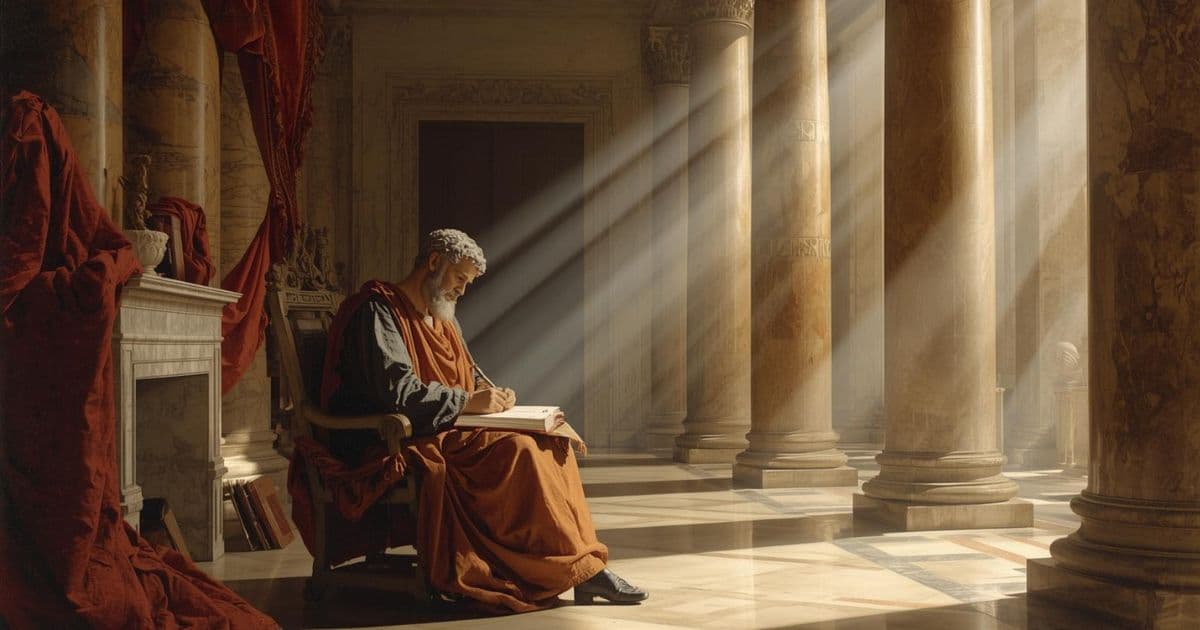
Meditations
by Marcus Aurelius (180)
📚 Quick Summary
Main Themes
Best For
High school and college students studying philosophy, book clubs, and readers interested in personal growth and emotional intelligence
Complete Guide: 12 chapter summaries • Character analysis • Key quotes • Discussion questions • Modern applications • 100% free
How to Use This Study Guide
Review themes and key characters to know what to watch for
Follow along chapter-by-chapter with summaries and analysis
Use discussion questions and quotes for essays and deeper understanding
Book Overview
Meditations is one of the most unlikely books ever written — a private journal by the most powerful man in the world, never meant to be read by anyone else. Marcus Aurelius was Roman Emperor from 161 to 180 AD, commanding armies, presiding over a vast empire, and navigating court intrigue and endless war. Yet every night, he sat alone and wrote notes to himself — not about strategy or politics, but about how to be a better human being. The journal spans twelve books, written mostly on military campaigns along the Danube frontier. The tone is relentlessly honest and often harsh. Marcus doesn't congratulate himself. He reminds himself not to be distracted, not to waste time, not to let flattery corrupt his judgment. He returns to the same themes again and again: that you control only your own mind, that external events are indifferent, that death comes for everyone regardless of rank or achievement. At its core, Meditations is a manual for staying sane under pressure. Marcus draws heavily on the Stoic tradition — particularly Epictetus, a former slave — and applies it to a life of enormous responsibility. His central argument is that virtue is the only real good, and that inner peace comes from focusing on what you can control while accepting what you cannot. What makes the book unusual is its intimacy. You are reading a man argue with himself, catch himself slipping, and start again. The writing is blunt, repetitive at times, and completely without vanity. It doesn't read like philosophy written for an audience — it reads like someone trying hard to live well, one day at a time. Nearly two thousand years later, the struggles Marcus describes — distraction, ego, fear of death, the pressure to perform — feel entirely modern.
Why Read Meditations Today?
Classic literature like Meditations offers more than historical insight—it provides roadmaps for navigating modern challenges. What's really going on, each chapter reveals practical wisdom applicable to contemporary life, from career decisions to personal relationships.
Skills You'll Develop Reading This Book
Beyond literary analysis, Meditations helps readers develop critical real-world skills:
Critical Thinking
Analyze complex characters, motivations, and moral dilemmas that mirror real-life decisions.
Emotional Intelligence
Understand human behavior, relationships, and the consequences of choices through character studies.
Cultural Literacy
Gain historical context and understand timeless themes that shaped and continue to influence society.
Communication Skills
Articulate complex ideas and engage in meaningful discussions about themes, ethics, and human nature.
Major Themes
Key Characters
Marcus Aurelius
Narrator and protagonist
Featured in 12 chapters
Difficult People
Universal antagonists
Featured in 2 chapters
Antoninus Pius
Adoptive father and mentor
Featured in 1 chapter
Verus
Grandfather figure
Featured in 1 chapter
His Mother
Moral teacher
Featured in 1 chapter
The Gods
Moral authorities
Featured in 1 chapter
Alexander the Great
Historical example
Featured in 1 chapter
Alexander's Mule Driver
Symbolic everyman
Featured in 1 chapter
The soldier needing a boost
Example of justified help-seeking
Featured in 1 chapter
Difficult people
Sources of frustration and learning
Featured in 1 chapter
Key Quotes
"From my grandfather Verus I learned good morals and the government of my temper."
"From my mother, piety and beneficence, and abstinence, not only from evil deeds, but even from evil thoughts."
"You have power over your mind - not outside events. Realize this, and you will find strength."
"Very little is needed to make a happy life; it is all within yourself, in your way of thinking."
"The mind that pursues the good, whether it succeeds or not, is honored by the very attempt."
"How much trouble he avoids who does not look to see what his neighbor says or does."
"You can commit injustice by doing nothing"
"The best revenge is not to be like your enemy"
"At dawn, when you have trouble getting out of bed, tell yourself: 'I have to go to work — as a human being.'"
"Don't demand that things happen as you wish — wish that they happen as they do happen, and you will go on well."
"You have power over your mind - not outside events. Realize this, and you will find strength."
"How much trouble he avoids who does not look to see what his neighbor says or does."
Discussion Questions
1. Anthony lists specific people who influenced him and exactly what they taught him. Why do you think he starts his personal journal this way instead of focusing on his own achievements?
From Chapter 1 →2. He mentions learning not to get caught up in 'meaningless controversies' like sports rivalries. What drives people to invest emotional energy in things that don't actually affect their daily lives?
From Chapter 1 →3. Anthony realizes he's been putting off important inner work while the gods gave him chances to grow. What specific wake-up call forced him to face this delay?
From Chapter 2 →4. Why does Anthony say that acting from lust shows weaker character than acting from anger? What does this reveal about how he ranks different motivations?
From Chapter 2 →5. Anthony warns that our mental clarity has an expiration date. What specific signs might indicate someone is wasting their cognitive energy instead of using it wisely?
From Chapter 3 →6. Why does Anthony argue that obsessing over what others think or do is such a dangerous mental habit? What does this pattern cost us in the long run?
From Chapter 3 →7. Anthony says you can retreat into your own mind anytime, anywhere. What does he mean by this mental retreat, and how is it different from just daydreaming or zoning out?
From Chapter 4 →8. Why does Anthony believe our opinions about events cause more suffering than the events themselves? Can you think of a time when changing your perspective about a situation changed how you felt about it?
From Chapter 4 →9. Anthony compares humans to bees and vines, saying we each have a natural function. What does he think humans are naturally designed to do?
From Chapter 5 →10. Why does Anthony argue that seeking comfort and avoiding effort actually makes us more miserable than doing difficult but purposeful work?
From Chapter 5 →11. Anthony suggests seeing expensive wine as 'grape juice' and luxury items as basic materials with fancy marketing. What is he trying to train his mind to do, and why might this be useful?
From Chapter 6 →12. When Anthony says 'revenge isn't getting even; it's refusing to become like those who wronged you,' what does this reveal about how conflict actually affects us?
From Chapter 6 →13. Anthony says there's 'nothing new under the sun' when it comes to human problems. What examples does he give, and why does he think this perspective is helpful rather than discouraging?
From Chapter 7 →14. Why does Anthony argue that asking for help is actually a sign of wisdom rather than weakness? How does he use the soldier example to illustrate this point?
From Chapter 7 →15. Anthony admits he's failed to live up to his own philosophical ideals many times. What's his response to these failures, and how is it different from how most people handle mistakes?
From Chapter 8 →For Educators
Looking for teaching resources? Each chapter includes tiered discussion questions, critical thinking exercises, and modern relevance connections.
View Educator Resources →All Chapters
Chapter 1: Lessons from Those Who Shaped Me
Marcus Aurelius opens his philosophical journal by doing something unexpected for a man with absolute power — he gives credit. Rather than cataloguing...
Chapter 2: Time Is Running Out
Marcus gets brutally honest about time and mortality. Writing from a military camp, he reminds himself that he has been putting off important inner wo...
Chapter 3: Time, Beauty, and Mental Discipline
Marcus opens with a sobering reality check: your mind will not stay sharp forever. While your body might keep functioning, your ability to think clear...
Chapter 4: The Inner Fortress: Finding Peace Within
Marcus Aurelius reveals the central secret of Stoic inner peace: you do not need to escape anywhere to find tranquility. The countryside, the mountain...
Chapter 5: Getting Out of Bed and Living Your Purpose
Marcus starts with something we all know too well — that moment when the alarm goes off and you want to stay in bed. He turns this small everyday stru...
Chapter 6: The Art of Inner Control
Marcus Aurelius works through the fundamental Stoic principle that separates people who are controlled by events from people who are not: understandin...
Chapter 7: The Universal Patterns of Human Experience
Marcus opens this chapter with a grounding observation: there is nothing new under the sun. The betrayals, frustrations, and injustices that trouble y...
Chapter 8: Mastering Your Inner Fortress
Marcus Aurelius is brutally honest about his own failures in this deeply personal chapter. He opens by acknowledging that he has not lived as a philos...
Chapter 9: Living in Harmony with Nature
Marcus opens with a stark claim: injustice is a form of impiety. The universe designed rational creatures to help one another, not harm one another. A...
Chapter 10: The Soul's Journey to Simplicity
In this deeply introspective chapter, Marcus turns his attention inward, addressing his own soul directly and mapping out the path to true contentment...
Chapter 11: The Soul's True Powers
Marcus explores what makes the human soul genuinely unique. Unlike plants or animals, we can examine ourselves, shape our own character, and find mean...
Chapter 12: The Final Reflections
In his final book, Marcus brings together the threads he has been weaving for twelve volumes. He opens with a gift that most people never claim: every...
Frequently Asked Questions
What is Meditations about?
Meditations is one of the most unlikely books ever written — a private journal by the most powerful man in the world, never meant to be read by anyone else. Marcus Aurelius was Roman Emperor from 161 to 180 AD, commanding armies, presiding over a vast empire, and navigating court intrigue and endless war. Yet every night, he sat alone and wrote notes to himself — not about strategy or politics, but about how to be a better human being. The journal spans twelve books, written mostly on military campaigns along the Danube frontier. The tone is relentlessly honest and often harsh. Marcus doesn't congratulate himself. He reminds himself not to be distracted, not to waste time, not to let flattery corrupt his judgment. He returns to the same themes again and again: that you control only your own mind, that external events are indifferent, that death comes for everyone regardless of rank or achievement. At its core, Meditations is a manual for staying sane under pressure. Marcus draws heavily on the Stoic tradition — particularly Epictetus, a former slave — and applies it to a life of enormous responsibility. His central argument is that virtue is the only real good, and that inner peace comes from focusing on what you can control while accepting what you cannot. What makes the book unusual is its intimacy. You are reading a man argue with himself, catch himself slipping, and start again. The writing is blunt, repetitive at times, and completely without vanity. It doesn't read like philosophy written for an audience — it reads like someone trying hard to live well, one day at a time. Nearly two thousand years later, the struggles Marcus describes — distraction, ego, fear of death, the pressure to perform — feel entirely modern.
What are the main themes in Meditations?
The major themes in Meditations include Identity, Social Expectations, Personal Growth, Class, Human Relationships. These themes are explored throughout the book's 12 chapters, offering insights into human nature and society that remain relevant today.
Why is Meditations considered a classic?
Meditations by Marcus Aurelius is considered a classic because it offers timeless insights into personal growth and emotional intelligence. Written in 180, the book continues to be studied in schools and universities for its literary merit and enduring relevance to modern readers.
How long does it take to read Meditations?
Meditations contains 12 chapters with an estimated total reading time of approximately 4 hours. Individual chapters range from 5-15 minutes each, making it manageable to read in shorter sessions.
Who should read Meditations?
Meditations is ideal for students studying philosophy, book club members, and anyone interested in personal growth or emotional intelligence. The book is rated intermediate difficulty and is commonly assigned in high school and college literature courses.
Is Meditations hard to read?
Meditations is rated intermediate difficulty. Our chapter-by-chapter analysis breaks down complex passages, explains historical context, and highlights key themes to make the text more accessible. Each chapter includes summaries, character analysis, and discussion questions to deepen your understanding.
Can I use this study guide for essays and homework?
Yes! Our study guide is designed to supplement your reading of Meditations. Use it to understand themes, analyze characters, and find relevant quotes for your essays. However, always read the original text—this guide enhances but doesn't replace reading Marcus Aurelius's work.
What makes this different from SparkNotes or CliffsNotes?
Unlike traditional study guides, Amplified Classics shows you why Meditations still matters today. Every chapter includes modern applications, life skills connections, and practical wisdom—not just plot summaries. Plus, it's 100% free with no ads or paywalls.
Ready to Dive Deeper?
Each chapter includes our Intelligence Amplifier™ analysis, showing how Meditations's insights apply to modern challenges in career, relationships, and personal growth.
Start Reading Chapter 1Explore Life Skills in This Book
Discover the essential life skills readers develop through Meditationsin our Essential Life Index.
View in Essential Life IndexThemes in This Book
Click a theme to find more books with similar topics