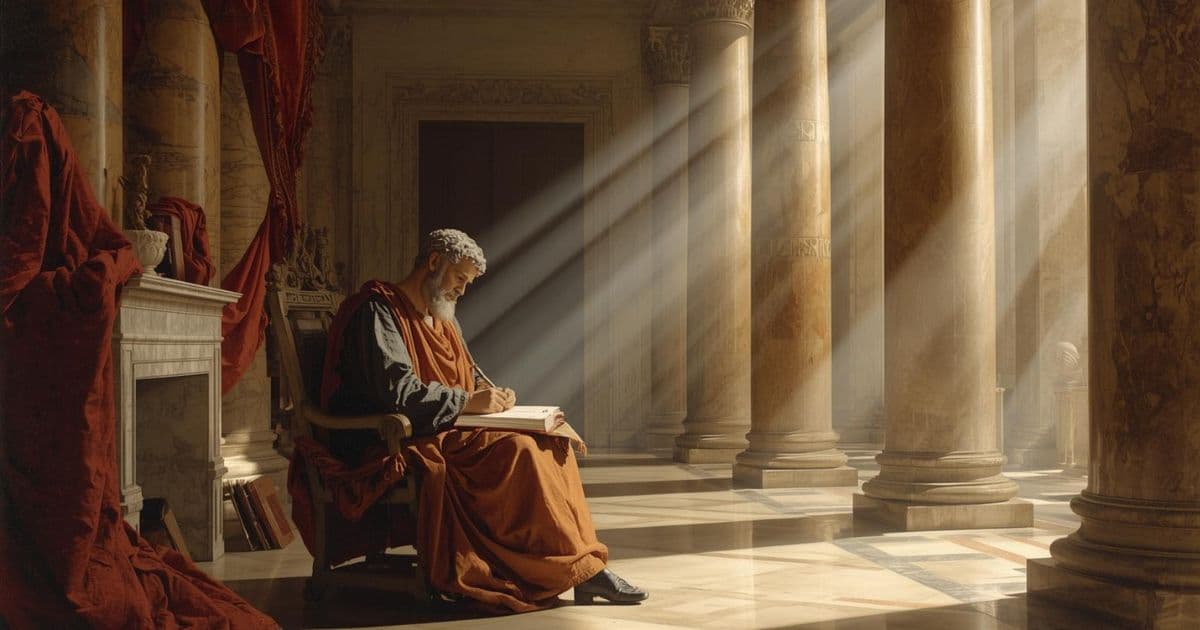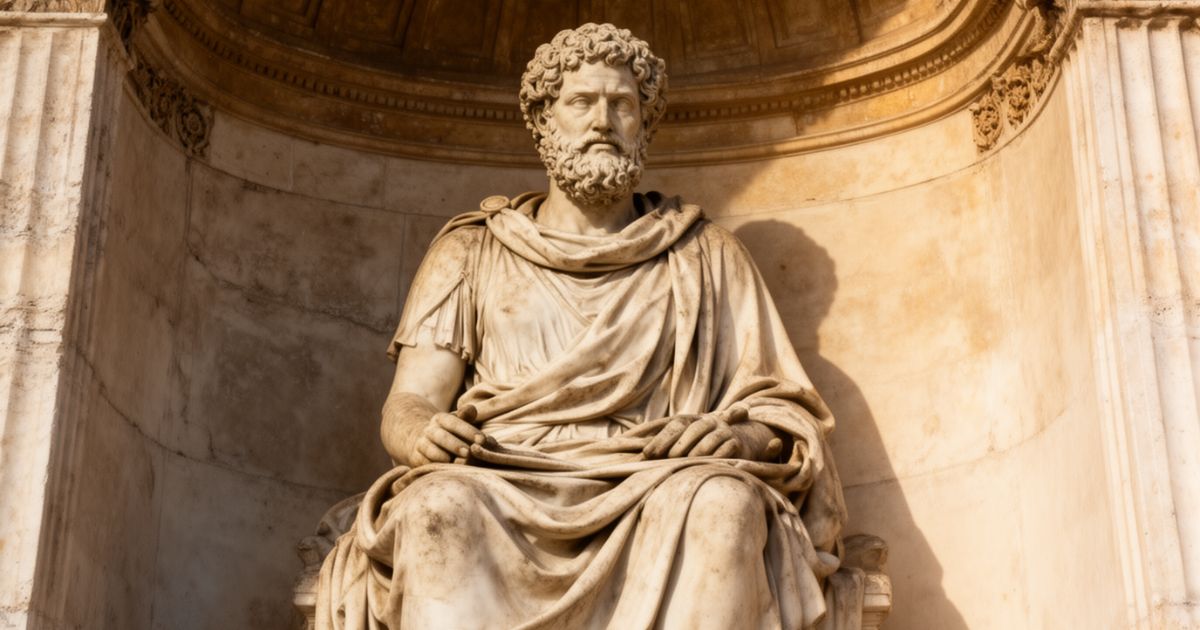
An excerpt from the original text.(complete · 15808 words)
THE TWELFTH BOOK
I. Whatsoever thou doest hereafter aspire unto, thou mayest even now
enjoy and possess, if thou doest not envy thyself thine own happiness.
And that will be, if thou shalt forget all that is past, and for the
future, refer thyself wholly to the Divine Providence, and shalt bend
and apply all thy present thoughts and intentions to holiness and
righteousness. To holiness, in accepting willingly whatsoever is sent
by the Divine Providence, as being that which the nature of the universe
hath appointed unto thee, which also hath appointed thee for that,
whatsoever it be. To righteousness, in speaking the truth freely, and
without ambiguity; and in doing all things justly and discreetly. Now in
this good course, let not other men's either wickedness, or opinion, or
voice hinder thee: no, nor the sense of this thy pampered mass of flesh:
for let that which suffers, look to itself. If therefore whensoever the
time of thy departing shall come, thou shalt readily leave all things,
and shalt respect thy mind only, and that divine part of thine, and this
shall be thine only fear, not that some time or other thou shalt cease
to live, but thou shalt never begin to live according to nature: then
shalt thou be a man indeed, worthy of that world, from which thou hadst
thy beginning; then shalt thou cease to be a stranger in thy country,
and to wonder at those things that happen daily, as things strange and
unexpected, and anxiously to depend of divers things that are not in thy
power.
II. God beholds our minds and understandings, bare and naked from these
material vessels, and outsides, and all earthly dross. For with His
simple and pure understanding, He pierceth into our inmost and purest
parts, which from His, as it were by a water pipe and channel, first
flowed and issued. This if thou also shalt use to do, thou shalt
rid thyself of that manifold luggage, wherewith thou art round about
encumbered. For he that does regard neither his body, nor his clothing,
nor his dwelling, nor any such external furniture, must needs gain unto
himself great rest and ease. Three things there be in all, which thou
doest consist of; thy body, thy life, and thy mind. Of these the two
former, are so far forth thine, as that thou art bound to take care for
them. But the third alone is that which is properly thine. If then thou
shalt separate from thyself, that is from thy mind, whatsoever other men
either do or say, or whatsoever thou thyself hast heretofore either
done or said; and all troublesome thoughts concerning the future, and
whatsoever, (as either belonging to thy body or life:) is without the
jurisdiction of thine own will, and whatsoever in the ordinary course
of human chances and accidents doth happen unto thee; so that thy
mind (keeping herself loose and free from all outward coincidental
entanglements; always in a readiness to depart:) shall live by herself,
and to herself, doing that which is just, accepting whatsoever doth
happen, and speaking the truth always; if, I say, thou shalt separate
from thy mind, whatsoever by sympathy might adhere unto it, and all time
both past and future, and shalt make thyself in all points and respects,
like unto Empedocles his allegorical sphere, 'all round and circular,'
&c., and shalt think of no longer life than that which is now present:
then shalt thou be truly able to pass the remainder of thy days without
troubles and distractions; nobly and generously disposed, and in good
favour and correspondency, with that spirit which is within thee.
III. I have often wondered how it should come to pass, that every man
loving himself best, should more regard other men's opinions concerning
himself than his own. For if any God or grave master standing by,
should command any of us to think nothing by himself but what he should
presently speak out; no man were able to endure it, though but for one
day. Thus do we fear more what our neighbours will think of us, than
what we ourselves.
IV. how come it to pass that the Gods having ordered all other things
so well and so lovingly, should be overseen in this one only thing, that
whereas then hath been some very good men that have made many covenants
as it were with God and by many holy actions and outward services
contracted a kind of familiarity with Him; that these men when once they
are dead, should never be restored to life, but be extinct for ever. But
this thou mayest be sure of, that this (if it be so indeed) would
never have been so ordered by the Gods, had it been fit otherwise. For
certainly it was possible, had it been more just so and had it been
according to nature, the nature of the universe would easily have borne
it. But now because it is not so, (if so be that it be not so indeed) be
therefore confident that it was not fit it should be so for thou seest
thyself, that now seeking after this matter, how freely thou doest argue
and contest with God. But were not the Gods both just and good in the
highest degree, thou durst not thus reason with them. Now if just and
good, it could not be that in the creation of the world, they should
either unjustly or unreasonably oversee anything.
V. Use thyself even unto those things that thou doest at first despair
of. For the left hand we see, which for the most part lieth idle because
not used; yet doth it hold the bridle with more strength than the right,
because it hath been used unto it.
VI. Let these be the objects of thy ordinary meditation: to consider,
what manner of men both for soul and body we ought to be, whensoever
death shall surprise us: the shortness of this our mortal life: the
immense vastness of the time that hath been before, and will he after
us: the frailty of every worldly material object: all these things to
consider, and behold clearly in themselves, all disguisement of external
outside being removed and taken away. Again, to consider the efficient
causes of all things: the proper ends and references of all actions:
what pain is in itself; what pleasure, what death: what fame or
honour, how every man is the true and proper ground of his own rest and
tranquillity, and that no man can truly be hindered by any other: that
all is but conceit and opinion. As for the use of thy dogmata, thou must
carry thyself in the practice of them, rather like unto a pancratiastes,
or one that at the same time both fights and wrestles with hands and
feet, than a gladiator. For this, if he lose his sword that he fights
with, he is gone: whereas the other hath still his hand free, which he
may easily turn and manage at his will.
VII. All worldly things thou must behold and consider, dividing them
into matter, form, and reference, or their proper end.
VIII. How happy is man in this his power that hath been granted unto
him: that he needs not do anything but what God shall approve, and
that he may embrace contentedly, whatsoever God doth send unto him?
IX. Whatsoever doth happen in the ordinary course and consequence of
natural events, neither the Gods, (for it is not possible, that they
either wittingly or unwittingly should do anything amiss) nor men, (for
it is through ignorance, and therefore against their wills that they do
anything amiss) must be accused. None then must be accused.
X. How ridiculous and strange is he, that wonders at anything that
happens in this life in the ordinary course of nature!
XI. Either fate, (and that either an absolute necessity, and unavoidable
decree; or a placable and flexible Providence) or all is a mere
casual confusion, void of all order and government. If an absolute and
unavoidable necessity, why doest thou resist? If a placable and exorable
Providence, make thyself worthy of the divine help and assistance. If
all be a mere confusion without any moderator, or governor, then hast
thou reason to congratulate thyself; that in such a general flood of
confusion thou thyself hast obtained a reasonable faculty, whereby thou
mayest govern thine own life and actions. But if thou beest carried
away with the flood, it must be thy body perchance, or thy life, or some
other thing that belongs unto them that is carried away: thy mind and
understanding cannot. Or should it be so, that the light of a candle
indeed is still bright and lightsome until it be put out: and should
truth, and righteousness, and temperance cease to shine in thee whilest
thou thyself hast any being?
XII. At the conceit and apprehension that such and such a one hath
sinned, thus reason with thyself; What do I know whether this be a sin
indeed, as it seems to be? But if it be, what do I know but that he
himself hath already condemned himself for it? And that is all one as
if a man should scratch and tear his own face, an object of compassion
rather than of anger. Again, that he that would not have a vicious man
to sin, is like unto him that would not have moisture in the fig, nor
children to welp nor a horse to neigh, nor anything else that in the
course of nature is necessary. For what shall he do that hath such an
habit? If thou therefore beest powerful and eloquent, remedy it if thou
canst.
XIII. If it be not fitting, do it not. If it be not true, speak it not.
Ever maintain thine own purpose and resolution free from all compulsion
and necessity.
XIV. Of everything that presents itself unto thee, to consider what the
true nature of it is, and to unfold it, as it were, by dividing it into
that which is formal: that which is material: the true use or end of it,
and the just time that it is appointed to last.
XV. It is high time for thee, to understand that there is somewhat in
thee, better and more divine than either thy passions, or thy sensual
appetites and affections. What is now the object of my mind, is it fear,
or suspicion, or lust, or any such thing? To do nothing rashly without
some certain end; let that be thy first care. The next, to have no other
end than the common good. For, alas! yet a little while, and thou art no
more: no more will any, either of those things that now thou seest, or
of those men that now are living, be any more. For all things are by
nature appointed soon to be changed, turned, and corrupted, that other
things might succeed in their room.
XVI. Remember that all is but opinion, and all opinion depends of the
mind. Take thine opinion away, and then as a ship that hath stricken
in within the arms and mouth of the harbour, a present calm; all things
safe and steady: a bay, not capable of any storms and tempests: as the
poet hath it.
XVII. No operation whatsoever it he, ceasing for a while, can be truly
said to suffer any evil, because it is at an end. Neither can he that
is the author of that operation; for this very respect, because his
operation is at an end, be said to suffer any evil. Likewise then,
neither can the whole body of all our actions (which is our life) if in
time it cease, be said to suffer any evil for this very reason, because
it is at an end; nor he truly be said to have been ill affected, that
did put a period to this series of actions. Now this time or certain
period, depends of the determination of nature: sometimes of particular
nature, as when a man dieth old; but of nature in general, however; the
parts whereof thus changing one after another, the whole world still
continues fresh and new. Now that is ever best and most seasonable,
which is for the good of the whole. Thus it appears that death of
itself can neither be hurtful to any in particular, because it is not a
shameful thing (for neither is it a thing that depends of our own will,
nor of itself contrary to the common good) and generally, as it is both
expedient and seasonable to the whole, that in that respect it must
needs be good. It is that also, which is brought unto us by the order
and appointment of the Divine Providence; so that he whose will and
mind in these things runs along with the Divine ordinance, and by this
concurrence of his will and mind with the Divine Providence, is led
and driven along, as it were by God Himself; may truly be termed and
esteemed the θεοφόρητος, or divinely led and inspired.
XVIII. These three things thou must have always in a readiness: first
concerning thine own actions, whether thou doest nothing either idly,
or otherwise, than justice and equity do require: and concerning those
things that happen unto thee externally, that either they happen unto
thee by chance, or by providence; of which two to accuse either, is
equally against reason. Secondly, what like unto our bodies are
whilest yet rude and imperfect, until they be animated: and from their
animation, until their expiration: of what things they are compounded,
and into what things they shall be dissolved. Thirdly, how vain all
things will appear unto thee when, from on high as it were, looking
down thou shalt contemplate all things upon earth, and the wonderful
mutability, that they are subject unto: considering withal, the infinite
both greatness and variety of things aerial and things celestial that
are round about it. And that as often as thou shalt behold them, thou
shalt still see the same: as the same things, so the same shortness of
continuance of all those things. And, behold, these be the things that
we are so proud and puffed up for.
XIX. Cast away from thee opinion, and thou art safe. And what is it that
hinders thee from casting of it away? When thou art grieved at anything,
hast thou forgotten that all things happen according to the nature
of the universe; and that him only it concerns, who is in fault; and
moreover, that what is now done, is that which from ever hath been done
in the world, and will ever be done, and is now done everywhere: how
nearly all men are allied one to another by a kindred not of blood, nor
of seed, but of the same mind. Thou hast also forgotten that every man's
mind partakes of the Deity, and issueth from thence; and that no man can
properly call anything his own, no not his son, nor his body, nor his
life; for that they all proceed from that One who is the giver of all
things: that all things are but opinion; that no man lives properly, but
that very instant of time which is now present. And therefore that no
man whensoever he dieth can properly be said to lose any more, than an
instant of time.
XX. Let thy thoughts ever run upon them, who once for some one thing or
other, were moved with extraordinary indignation; who were once in
the highest pitch of either honour, or calamity; or mutual hatred and
enmity; or of any other fortune or condition whatsoever. Then consider
what's now become of all those things. All is turned to smoke; all to
ashes, and a mere fable; and perchance not so much as a fable. As also
whatsoever is of this nature, as Fabius Catulinus in the field; Lucius
Lupus, and Stertinius, at Baiæ Tiberius at Capreæ and Velius Rufus,
and all such examples of vehement prosecution in worldly matters; let
these also run in thy mind at the same time; and how vile every object
of such earnest and vehement prosecution is; and how much more agreeable
to true philosophy it is, for a man to carry himself in every matter
that offers itself; justly, and moderately, as one that followeth the
Gods with all simplicity. For, for a man to be proud and high conceited,
that he is not proud and high conceited, is of all kind of pride and
presumption, the most intolerable.
XXI. To them that ask thee, Where hast thou seen the Gods, or how
knowest thou certainly that there be Gods, that thou art so devout in
their worship? I answer first of all, that even to the very eye, they
are in some manner visible and apparent. Secondly, neither have I ever
seen mine own soul, and yet I respect and honour it. So then for the
Gods, by the daily experience that I have of their power and providence
towards myself and others, I know certainly that they are, and therefore
worship them.
XXII. Herein doth consist happiness of life, for a man to know
thoroughly the true nature of everything; what is the matter, and what
is the form of it: with all his heart and soul, ever to do that which is
just, and to speak the truth. What then remaineth but to enjoy thy life
in a course and coherence of good actions, one upon another immediately
succeeding, and never interrupted, though for never so little a while?
XXIII. There is but one light of the sun, though it be intercepted by
walls and mountains, and other thousand objects. There is but one common
substance of the whole world, though it be concluded and restrained into
several different bodies, in number infinite. There is but one common
soul, though divided into innumerable particular essences and natures.
So is there but one common intellectual soul, though it seem to be
divided. And as for all other parts of those generals which we have
mentioned, as either sensitive souls or subjects, these of themselves
(as naturally irrational) have no common mutual reference one unto
another, though many of them contain a mind, or reasonable faculty in
them, whereby they are ruled and governed. But of every reasonable mind,
this the particular nature, that it hath reference to whatsoever is
of her own kind, and desireth to be united: neither can this common
affection, or mutual unity and correspondency, be here intercepted or
divided, or confined to particulars as those other common things are.
XXIV. What doest thou desire? To live long. What? To enjoy the
operations of a sensitive soul; or of the appetitive faculty? or wouldst
thou grow, and then decrease again? Wouldst thou long be able to talk,
to think and reason with thyself? Which of all these seems unto thee a
worthy object of thy desire? Now if of all these thou doest find that
they be but little worth in themselves, proceed on unto the last, which
is, in all things to follow God and reason. But for a man to grieve that
by death he shall be deprived of any of these things, is both against
God and reason.
XXV. What a small portion of vast and infinite eternity it is, that is
allowed unto every one of us, and how soon it vanisheth into the general
age of the world: of the common substance, and of the common soul also
what a small portion is allotted unto us: and in what a little clod of
the whole earth (as it were) it is that thou doest crawl. After thou
shalt rightly have considered these things with thyself; fancy not
anything else in the world any more to be of any weight and moment
but this, to do that only which thine own nature doth require; and to
conform thyself to that which the common nature doth afford.
XXVI. What is the present estate of my understanding? For herein lieth
all indeed. As for all other things, they are without the compass of
mine own will: and if without the compass of my will, then are they as
dead things unto me, and as it were mere smoke.
XXVII. To stir up a man to the contempt of death this among other
things, is of good power and efficacy, that even they who esteemed
pleasure to be happiness, and pain misery, did nevertheless many of them
contemn death as much as any. And can death be terrible to him, to
whom that only seems good, which in the ordinary course of nature is
seasonable? to him, to whom, whether his actions be many or few, so they
be all good, is all one; and who whether he behold the things of the
world being always the same either for many years, or for few years
only, is altogether indifferent? O man! as a citizen thou hast lived,
and conversed in this great city the world. Whether just for so many
years, or no, what is it unto thee? Thou hast lived (thou mayest be
sure) as long as the laws and orders of the city required; which may be
the common comfort of all. Why then should it be grievous unto thee, if
(not a tyrant, nor an unjust judge, but) the same nature that brought
thee in, doth now send thee out of the world? As if the praetor should
fairly dismiss him from the stage, whom he had taken in to act a while.
Oh, but the play is not yet at an end, there are but three acts yet
acted of it? Thou hast well said: for in matter of life, three acts is
the whole play. Now to set a certain time to every man's acting, belongs
unto him only, who as first he was of thy composition, so is now the
cause of thy dissolution. As for thyself; thou hast to do with
neither. Go thy ways then well pleased and contented: for so is He that
dismisseth thee.
APPENDIX
CORRESPONDENCE OF M. AURELIUS ANTONINUS AND M. CORNELIUS FRONTO[1]
M. CORNELIUS FRONTO was a Roman by descent, but of provincial birth,
being native to Cirta, in Numidia. Thence he migrated to Rome in the
reign of Hadrian, and became the most famous rhetorician of his day.
As a pleader and orator he was counted by his contemporaries hardly
inferior to Tully himself, and as a teacher his aid was sought for the
noblest youths of Rome. To him was entrusted the education of M.
Aurelius and of his colleague L. Verus in their boyhood; and he was
rewarded for his efforts by a seat in the Senate and the consular rank
(A.D. 143). By the exercise of his profession he became wealthy; and if
he speaks of his means as not great,[2] he must be comparing his wealth
with the grandees of Rome, not with the ordinary citizen.
Before the present century nothing was known of the works of Fronto,
except a grammatical treatise; but in 1815 Cardinal Mai published a
number of letters and some short essays of Fronto, which he had
discovered in a palimpsest at Milan. Other parts of the same MS. he
found later in the Vatican, the whole being collected
[1] References are made to the edition of Naber, Leipzig (Trübner),
1867.
[2] Ad Verum imp. Aur. Caes., ii, 7. and edited in the year 1823.
We now possess parts of his correspondence with Antoninus Pius, with M.
Aurelius, with L. Verus, and with certain of his friends, and also
several rhetorical and historical fragments. Though none of the more
ambitious works of Fronto have survived, there are enough to give proof
of his powers. Never was a great literary reputation less deserved. It
would be hard to conceive of anything more vapid than the style and
conception of these letters; clearly the man was a pedant without
imagination or taste. Such indeed was the age he lived in, and it is no
marvel that he was like to his age. But there must have been more in him
than mere pedantry; there was indeed a heart in the man, which Marcus
found, and he found also a tongue which could speak the truth. Fronto's
letters are by no means free from exaggeration and laudation, but they
do not show that loathsome flattery which filled the Roman court. He
really admires what he praises, and his way of saying so is not unlike
what often passes for criticism at the present day. He is not afraid to
reprove what he thinks amiss; and the astonishment of Marcus at this
will prove, if proof were needed, that he was not used to plain dealing.
"How happy I am," he writes, "that my friend Marcus Cornelius, so
distinguished as an orator and so noble as a man, thinks me worth
praising and blaming."[3] In another place he deems himself blest
because Pronto had taught him to speak the truth[4] although the context
shows him to be speaking of expression, it is still a point in favour of
Pronto. A sincere heart is better than literary taste; and if Fronto had
not done his duty by the young prince, it is not easy to understand the
friendship which remained between them up to the last.
[3] Ad M. Caes iii. 17
[4] Ad M. Caes iii. 12
An example of the frankness which was between them is given by a
difference they had over the case of Herodes Atticus. Herodes was a
Greek rhetorician who had a school at Rome, and Marcus Aurelius was
among his pupils. Both Marcus and the Emperor Antoninus had a high
opinion of Herodes; and all we know goes to prove he was a man of high
character and princely generosity. When quite young he was made
administrator of the free cities in Asia, nor is it surprising to find
that he made bitter enemies there; indeed, a just ruler was sure to make
enemies. The end of it was that an Athenian deputation, headed by the
orators Theodotus and Demostratus, made serious accusations against his
honour. There is no need to discuss the merits of the case here; suffice
it to say, Herodes succeeded in defending himself to the satisfaction of
the emperor. Pronto appears to have taken the delegates' part, and to
have accepted a brief for the prosecution, urged to some extent by
personal considerations; and in this cause Marcus Aurelius writes to
Fronto as follows:—
'AURELIUS CÆSAR to his friend FRONTO, greeting.[5]
'I know you have often told me you were anxious to find how you might
best please me. Now is the time; now you can increase my love towards
you, if it can be increased. A trial is at hand, in which people seem
likely not only to hear your speech with pleasure, but to see your
indignation with impatience. I see no one who dares give you a hint in
the matter; for those who are less friendly, prefer to see you act with
some inconsistency; and those who are more friendly, fear to seem too
friendly to your opponent if they should dissuade you from your
accusation; then again, in case you have prepared something neat for
the occasion, they cannot endure to rob you of your harangue by
silencing you. Therefore, whether you think me a rash counsellor, or a
bold boy, or too kind to your opponent, not because I think it better,
I will offer my counsel with some caution. But why have I said, offer
my counsel? No, I demand it from you; I demand it boldly, and if I
succeed, I promise to remain under your obligation. What? you will say
if I am attackt, shall I not pay tit for tat? Ah, but you will get
greater glory, if even when attackt you answer nothing. Indeed, if he
begins it, answer as you will and you will have fair excuse; but I have
demanded of him that he shall not begin, and I think I have succeeded.
I love each of you according to your merits and I know that lie was
educated in the house of P. Calvisius, my grandfather, and that I was
educated by you; therefore I am full of anxiety that this most
disagreeable business shall be managed as honourably as possible. I
trust you may approve my advice, for my intention you will approve. At
least I prefer to write unwisely rather than to be silent unkindly.'
[5] Ad M. Caes ii., 2.
Fronto replied, thanking the prince for his advice, and promising that
he will confine himself to the facts of the case. But he points out that
the charges brought against Herodes were such, that they can hardly be
made agreeable; amongst them being spoliation, violence, and murder.
However, he is willing even to let some of these drop if it be the
prince's pleasure. To this Marcus returned the following answer:--[6]
'This one thing, my dearest Fronto, is enough to make me truly grateful
to you, that so far from rejecting my counsel, you have even approved
it. As to the question you raise in your kind letter, my opinion is
this: all that concerns the case which you are supporting must be
clearly brought forward; what concerns your own feelings, though you may
have had just provocation, should be left unsaid.' The story does credit
to both. Fronto shows no loss of temper at the interference, nor shrinks
from stating his case with frankness; and Marcus, with forbearance
remarkable in a prince, does not command that his friend be left
unmolested, but merely stipulates for a fair trial on the merits of the
case.
[6] Ad. M. Caes., iii. 5.
Another example may be given from a letter of Fronto's[7] Here is
something else quarrelsome and querulous. I have sometimes found fault
with you in your absence somewhat seriously in the company of a few
of my most intimate friends: at times, for example, when you mixt in
society with a more solemn look than was fitting, or would read books
in the theatre or in a banquet; nor did I absent myself from theatre
or banquet when you did.[8] Then I used to call you a hard man, no good
company, even disagreeable, sometimes, when anger got the better of me.
But did any one else in the same banquet speak against you, I could
not endure to hear it with equanimity. Thus it was easier for me to say
something to your disadvantage myself, than to hear others do it; just
as I could more easily bear to chastise my daughter Gratia, than to see
her chastised by another.'
[7] Ad. M. Caes., iv. 12.
[8] The text is obscure
The affection between them is clear from every page of the
correspondence. A few instances are now given, which were written at
different periods
To MY MASTER.[9]
'This is how I have past the last few days. My sister was suddenly
seized with an internal pain, so violent that I was horrified at her
looks; my mother in her trepidation on that account accidentally
bruised her side on a corner of the wall; she and we were greatly
troubled about that blow. For myself; on going to rest I found a
scorpion in my bed; but I did not lie down upon him, I killed him
first. If you are getting on better, that is a consolation. My mother
is easier now, thanks be to God. Good-bye, best and sweetest master. My
lady sends you greeting.'
[9] Ad M. Caes., v. 8.
[10]'What words can I find to fit my had luck, or how shall I upbraid as
it deserves the hard constraint which is laid upon me? It ties me fast
here, troubled my heart is, and beset by such anxiety; nor does it allow
me to make haste to my Fronto, my life and delight, to be near him at
such a moment of ill-health in particular, to hold his hands, to chafe
gently that identical foot, so far as may be done without discomfort, to
attend him in the bath, to support his steps with my arm.'
[10] Ad M. Caes., i. 2.
[11]'This morning I did not write to you, because I heard you were
better, and because I was myself engaged in other business, and I
cannot ever endure to write anything to you unless with mind at ease and
untroubled and free. So if we are all right, let me know: what I desire,
you know, and how properly I desire it, I know. Farewell, my master,
always in every chance first in my mind, as you deserve to be. My
master, see I am not asleep, and I compel myself to sleep, that you may
not be angry with me. You gather I am writing this late at night.'
[11] iii. 21.
[12]'What spirit do you suppose is in me, when I remember how long it
is since I have seen you, and why I have not seen you! and it may be
I shall not see you for a few days yet, while you are strengthening
yourself; as you must. So while you lie on the sick-bed, my spirit also
will lie low anti, whenas,[13] by God's mercy you shall stand upright,
my spirit too will stand firm, which is now burning with the strongest
desire for you. Farewell, soul of your prince, your pupil.'
[14]O my dear Fronto, most distinguished Consul! I yield, you have
conquered: all who have ever loved before, you have conquered out and
out in love's contest. Receive the victor's wreath; and the herald
shall proclaim your victory aloud before your own tribunal: "M.
Cornelius Fronto, Consul, wins, and is crowned victor in the Open
International Love-race."[15] But beaten though I may be, I shall
neither slacken nor relax my own zeal. Well, you shall love me more
than any man loves any other man; but I, who possess a faculty of
loving less strong, shall love you more than any one else loves you;
more indeed than you love yourself. Gratia and I will have to fight for
it; I doubt I shall not get the better of her. For, as Plautus says,
her love is like rain, whose big drops not only penetrate the dress,
but drench to the very marrow.'
[12] Ad M. Caes., iii. 19.
[13] The writer sometimes uses archaisms such as quom, which I render
'whenas'.
[14] Ad M. Caes., ii. 2.
[15] The writer parodies the proclamation at the Greek games; the words
also are Greek.
Marcus Aurelius seems to have been about eighteen years of age when
the correspondence begins, Fronto being some thirty years older.[16] The
systematic education of the young prince seems to have been finisht, and
Pronto now acts more as his adviser than his tutor. He recommends
the prince to use simplicity in his public speeches, and to avoid
affectation.[17] Marcus devotes his attention to the old authors who then
had a great vogue at Rome: Ennius, Plautus, Nævius, and such orators
as Cato and Gracchus.[18] Pronto urges on him the study of Cicero, whose
letters, he says, are all worth reading.
[16] From internal evidence: the letters are not arranged in order of
time. See Naher's Prolegomena, p. xx. foll.
[17] Ad M. Caes., iii. x.
[18] Ad M. Caes ii. 10,; iii. 18,; ii. 4.
When he wishes to compliment Marcus he declares one or other of his
letters has the true Tullian ring. Marcus gives his nights to reading
when he ought to be sleeping. He exercises himself in verse composition
and on rhetorical themes.
'It is very nice of you,' he writes to Fronto,[19] 'to ask for my
hexameters; I would have sent them at once if I had them by me. The fact
is my secretary, Anicetus-you know who I mean-did not pack up any of my
compositions for me to take away with me. He knows my weakness; he was
afraid that if I got hold of them I might, as usual, make smoke of them.
However, there was no fear for the hexameters. I must confess the truth
to my master: I love them. I study at night, since the day is taken up
with the theatre. I am weary of an evening, and sleepy in the daylight,
and so I don't do much. Yet I have made extracts from sixty books, five
volumes of them, in these latter days. But when you read remember
that the "sixty" includes plays of Novius, and farces, and some little
speeches of Scipio; don't be too much startled at the number. You
remember your Polemon; but I pray you do not remember Horace, who has
died with Pollio as far as I am concerned.[20] Farewell, my dearest
and most affectionate friend, most distinguished consul and my beloved
master, whom I have not seen these two years. Those who say two months,
count the days. Shall I ever see you again?'
[19] Ad M. Caes., ii. 10.
[20] He implies, as in i. 6, that he has ceased to study Horace.
Sometimes Fronto sends him a theme to work up, as thus: 'M. Lucilius
tribune of the people violently throws into prison a free Roman citizen,
against the opinion of his colleagues who demand his release. For this
act he is branded by the censor. Analyse the case, and then take both
sides in turn, attacking and defending.'[21] Or again: 'A Roman consul,
doffing his state robe, dons the gauntlet and kills a lion amongst
the young men at the Quinquatrus in full view of the people of Rome.
Denunciation before the censors.'[22] The prince has a fair knowledge of
Greek, and quotes from Homer, Plato, Euripides, but for some reason
Fronto dissuaded him from this study.[23] His Meditations are written in
Greek. He continued his literary studies throughout his life, and after
he became emperor we still find him asking his adviser for copies of
Cicero's Letters, by which he hopes to improve his vocabulary.[24] Pronto
helps him with a supply of similes, which, it seems, he did not think of
readily. It is to be feared that the fount of Marcus's eloquence was
pumped up by artificial means.
[21] Pollio was a grammarian, who taught Marcus.
[22] Ad M. Caes., v. 27,; V. 22.
[23] Ep. Gracae, 6.
[24] Ad Anton. Imp., II. 4.
Some idea of his literary style may be gathered from the letter which
follows:[25]
'I heard Polemo declaim the other day, to say something of things
sublunary. If you ask what I thought of him, listen. He seems to me an
industrious farmer, endowed with the greatest skill, who has cultivated
a large estate for corn and vines only, and indeed with a rich return
of fine crops. But yet in that land of his there is no Pompeian fig or
Arician vegetable, no Tarentine rose, or pleasing coppice, or thick
grove, or shady plane tree; all is for use rather than for pleasure,
such as one ought rather to commend, but cares not to love.
[25] Ad M. Caes, ii. 5.
A pretty bold idea, is it not, and rash judgment, to pass censure on a
man of such reputation? But whenas I remember that I am writing to you,
I think I am less bold than you would have me.
'In that point I am wholly undecided.
'There's an unpremeditated hendecasyllable for you. So before I begin to
poetize, I'll take an easy with you. Farewell, my heart's desire, your
Verus's best beloved, most distinguisht consul, master most sweet.
Farewell I ever pray, sweetest soul.
What a letter do you think you have written me I could make bold to
say, that never did she who bore me and nurst me, write anything SO
delightful, so honey-sweet. And this does not come of your fine style
and eloquence: otherwise not my mother only, but all who breathe.'
To the pupil, never was anything on earth so fine as his master's
eloquence; on this theme Marcus fairly bubbles over with enthusiasm.
[26]'Well, if the ancient Greeks ever wrote anything like this, let
those who know decide it: for me, if I dare say so, I never read any
invective of Cato's so fine as your encomtum. O if my Lord[27] could be
sufficiently praised, sufficiently praised he would have been
undoubtedly by you! This kind of thing is not done nowadays.[28] It
were easier to match Pheidias, easier to match Apelles, easier in a
word to match Demosthenes himself, or Cato himself; than to match this
finisht and perfect work. Never have I read anything more refined,
anything more after the ancient type, anything more delicious, anything
more Latin. O happy you, to be endowed with eloquence so great! O happy
I, to be tinder the charge of such a master! O arguments,[29] O
arrangement, O elegance, O wit, O beauty, O words, O brilliancy, O
subtilty, O grace, O treatment, O everything! Mischief take me, if you
ought not to have a rod put in your hand one day, a diadem on your
brow, a tribunal raised for you; then the herald would summon us
all-why do I say "us"? Would summnon all, those scholars and orators:
one by one you would beckon them forward with your rod and admonish
them. Hitherto I have had no fear of this admonition; many things help
me to enter within your school. I write this in the utmost haste; for
whenas I am sending you so kindly a letter from my Lord, what needs a
longer letter of mine? Farewell then, glory of Roman eloquence, boast
of your friends, magnifico, most delightful man, most distinguished
consul, master most sweet.
[26] Ad M. Caes., ii. 3.
[27] The Emperor Antoninus Pius is spoken of as dominus meus.
[28] This sentence is written in Greek.
[29] Several of these words are Greek, and the meaning is not quite
clear.
'After this you will take care not to tell so many fibs of me,
especially in the Senate. A monstrous fine speech this is! O if I could
kiss your head at every heading of it! You have looked down on all with
a vengeance. This oration once read, in vain shall we study, in vain
shall we toil, in vain strain every nerve. Farewell always, most sweet
master.'
Sometimes Fronto descends from the heights of eloquence to offer
practical advice; as when he suggests how Marcus should deal with his
suite. It is more difficult, he admits, to keep courtiers in harmony
than to tame lions with a lute; but if it is to be done, it must be by
eradicating jealousy. 'Do not let your friends,' says Fronto,'[30] 'envy
each other, or think that what you give to another is filched from them.
[30] Ad M Caes., iv. 1.
Keep away envy from your suite, and you will find your friends kindly
and harmonious.'
Here and there we meet with allusions to his daily life, which we could
wish to be more frequent. He goes to the theatre or the law-courts,[31]
or takes part in court ceremony, but his heart is always with his
books. The vintage season, with its religious rites, was always spent by
Antoninus Pius in the country. The following letters give sonic notion
of a day's occupation at that time:(3)
[31] ii. 14
[32] iv. 5,6.
'MY DEAREST MASTER,--I am well. To-day I studied from the ninth hour of
the night to the second hour of day, after taking food. I then put on
my slippers, and from time second to the third hour had a most
enjoyable walk up and down before my chamber. Then booted and
cloaked-for so we were commanded to appear-I went to wait upon my lord
the emperor. We went a-hunting, did doughty deeds, heard a rumour that
boars had been caught, but there was nothing to see. However, we
climbed a pretty steep hill, and in the afternoon returned home. I went
straight to my books. Off with the boots, down with the cloak; I spent
a couple of hours in bed. I read Cato's speech on the Property of
Pulchra, and another in which he impeaches a tribune. Ho, ho! I hear
you cry to your man, Off with you as fast as you can, and bring me
these speeches from the library of Apollo. No use to send: I have those
books with me too. You must get round the Tiberian librarian; you will
have to spend something on the matter; and when I return to town, I
shall expect to go shares with him. Well, after reading these speeches
I wrote a wretched trifle, destined for drowning or burning. No, indeed
my attempt at writing did not come off at all to-day; the composition
of a hunter or a vintager, whose shouts are echoing through my chamber,
hateful and wearisome as the law-courts. What have I said? Yes, it was
rightly said, for my master is an orator. I think I have caught cold,
whether from walking in slippers or from writing badly, I do not know.
I am always annoyed with phlegm, but to-day I seem to snivel more than
usual. Well, I will pour oil on my head and go off to sleep. I don't
mean to put one drop in my lamp to-day, so weary am I from riding and
sneezing. Farewell, dearest and most beloved master, whom I miss, I may
say, more than Rome itself.'
'MY BELOVED MASTER,-I am well. I slept a little more than usual for my
slight cold, which seems to be well again. So I spent the time from the
eleventh hour of the night to the third of the day partly in reading in
Cato's Agriculture, partly in writing, not quite so badly as yesterday
indeed. Then, after waiting upon my father, I soothed my throat with
honey-water, ejecting it without swallowing: I might say gargle, but I
won't, though I think the word is found in Novius and elsewhere. After
attending to my throat I went to my father, and stood by his side as he
sacrificed. Then to luncheon. What do you think I had to eat? A bit of
bread so big, while I watched others gobbling boiled beans, onions,
and fish full of roe. Then we set to work at gathering the grapes,
with plenty of sweat and shouting, and, as the quotation runs, "A few
high-hanging clusters did we leave survivors of the vintage." After the
sixth hour we returned home. I did a little work, and poor work at that.
Then I had a long gossip with my dear mother sitting on the bed. My
conversation was: What do you think my friend Fronto is doing just now?
She said: And what do you think of my friend Gratia?'[33] My turn now:
And what of our little Gratia,[34] the sparrowkin? After this kind of
talk, and an argument as to which of you loved the other most, the gong
sounded, the signal that my father had gone to the bath. We supped,
after ablutions in the oil-cellar-I mean we supped after ablutions, not
after ablutions in the oil-cellar; and listened with enjoyment to the
rustics gibing. After returning, before turning on my side to snore, I
do my task and give an account of the day to my delightful master, whom
if I could long for a little more, I should not mind growing a trifle
thinner. Farewell, Fronto, wherever you are, honey-sweet, my darling, my
delight. Why do I want you? I can love you while far away.'
[33] Fronto's wife.
[34] Fronto's daughter
One anecdote puts Marcus before us in a new light:[35]
[35] Ad M. Caes ii. 12.
'When my father returned home from the vineyards, I mounted my horse as
usual, and rode on ahead some little way. Well, there on the road was a
herd of sheep, standing all crowded together as though the place were
a desert, with four dogs and two shepherds, but nothing else. Then one
shepherd said to another shepherd, on seeing a number of horsemen: 'I
say,' says he, 'look you at those horsemen; they do a deal of robbery.'
When I heard this, I clap spurs to my horse, and ride straight for the
sheep. In consternation the sheep scatter; hither and thither they are
fleeting and bleating. A shepherd throws his fork, and the fork falls
on the horseman who came next to me. We make our escape.' We like Marcus
none the worse for this spice of mischief.
Another letter[36] describes a visit to a country town, and shows the
antiquarian spirit of the writer:—
'M. CÆSAR to his MASTER M. FRONTO, greeting.
'After I entered the carriage, after I took leave of you, we made a
journey comfortable enough, but we had a few drops of rain to wet us.
But before coming to the country-house, we broke our journey at Anagnia,
a mile or so from the highroad. Then we inspected that ancient town, a
miniature it is, but has in it many antiquities, temples, and religious
ceremonies quite out of the way. There is not a corner without its
shrine, or fane, or temple; besides, many books written on linen, which
belongs to things sacred. Then on the gate as we came out was written
twice, as follows: "Priest don the fell."[37] I asked one of the
inhabitants what that word was. He said it was the word in the Hernican
dialect for the victim's skin, which the priest puts over his conical
cap when he enters the city. I found out many other things which I
desired to know, but the only thing I do not desire is that you should
be absent from me; that is my chief anxiety. Now for yourself, when you
left that place, did you go to Aurelia or to Campania? Be sure to write
to me, and say whether you have opened the vintage, or carried a host of
books to the country-house; this also, whether you miss me; I am foolish
to ask it, whenas you tell it me of yourself. Now if you miss me and
if you love me, send me your letters often, which is a comfort and
consolation to me. Indeed I should prefer ten times to read your letters
than all the vines of Gaurus or the Marsians; for these Signian vines
have grapes too rank and fruit too sharp in the taste, but I prefer wine
to must for drinking. Besides, those grapes are nicer to eat dried than
fresh-ripe; I vow I would rather tread them under foot than put my teeth
in them. But I pray they may be gracious and forgiving, and grant me
free pardon for these jests of mine. Farewell, best friend, dearest,
most learned, sweetest master. When you see the must ferment in the vat,
remember that just so in my heart the longing for you is gushing and
flowing and bubbling. Good-bye.'
[36] Ad Verum. Imp ii. 1, s. fin.
[37] Santentum
Making all allowances for conventional exaggerations, it is clear from
the correspondence that there was deep love between Marcus and his
preceptor. The letters cover several years in succession, but soon after
the birth of Marcus's daughter, Faustina, there is a large gap. It does
not follow that the letters ceased entirely, because we know part of
the collection is lost; but there was probably less intercourse between
Marcus and Fronto after Marcus took to the study of philosophy under the
guidance of Rusticus.
When Marcus succeeded to the throne in 161, the letters begin again,
with slightly increased formality on Fronto's part, and they go on for
some four years, when Fronto, who has been continually complaining of
ill-health, appears to have died. One letter of the later period gives
some interesting particulars of the emperor's public life, which are
worth quoting. Fronto speaks of Marcus's victories and eloquence in the
usual strain of high praise, and then continues.[38]
'The army when you took it in hand was sunk in luxury and revelry, and
corrupted with long inactivity. At Antiochia the soldiers had been Wont
to applaud at the stage plays, knew more of the gardens at the nearest
restaurant than of the battlefield. Horses were hairy from lack of
grooming, horsemen smooth because their hairs had been pulled out by
the roots[39] a rare thing it was to see a soldier with hair on arm or
leg. Moreover, they were better drest than armed; so much so, that
Laelianus Pontius, a strict man of the old discipline, broke the
cuirasses of some of them with his finger-tips, and observed cushions
on the horses' backs. At his direction the tufts were cut through, and
out of the horsemen's saddles came what appeared to be feathers pluckt
from geese. Few of the men could vault on horseback, the rest clambered
up with difficulty by aid of heel and knee and leg not many could throw
a lance hurtling, most did it without force or power, as though they
were things of wool-dicing was common in the camp, sleep lasted all
night, or if they kept watch it was over the winecup. By what
regulations to restrain such soldiers as these, and to turn them to
honesty and industry, did you not learn from Hannibal's sternness, the
discipline of Africanus, the acts of Metellus recorded in history.
[38] Ad Verum. imp., ii. I, s.fin.
[39] A common mark of the effeminate at Rome.
After the preceptorial letters cease the others are concerned with
domestic events, health and sickness, visits or introductions, birth or
death. Thus the empperor writes to his old friend, who had shown some
diffidence in seeking an interview:[40]
[40] Ad Verum. Imp. Aur. Caes., i. 3.
'To MY MASTER.
'I have a serious grievance against you, my dear master, yet indeed my
grief is more than my grievance, because after so long a time I neither
embraced you nor spoke to you, though you visited the palace, and the
moment after I had left the prince my brother. I reproached my brother
severely for not recalling me; nor durst he deny the fault.' Fronto
again writes on one occasion: 'I have seen your daughter. It was like
seeing you and Faustina in infancy, so much that is charming her face
has taken from each of yours.' Or again, at a later date:[41] I have seen
your chicks, most delightful sight that ever I saw in my life, so like
you that nothing is more like than the likeness.... By the mercy of
Heaven they have a healthy colour and strong lungs. One held a piece of
white bread, like a little prince, the other a common piece, like a true
philosophers son.'
[41] Ad Ant. Imp i., 3.
Marcus, we know, was devoted to his children. They were delicate in
health, in spite of Fronto's assurance, and only one son survived the
father. We find echoes of this affection now and again in the letters.
'We have summer heat here still,' writes Marcus, 'but since my little
girls are pretty well, if I may say so, it is like the bracing climate
of spring to us.'[42] When little Faustina came back from the valley of
the shadow of death, her father at once writes to inform Fronto.[43]
The sympathy he asks he also gives, and as old age brings more and more
infirmity, Marcus becomes even more solicitous for his beloved teacher.
The poor old man suffered a heavy blow in the death of his grandson, on
which Marcus writes:[44] 'I have just heard of your misfortune. Feeling
grieved as I do when one of your joints gives you pain, what do you
think I feel, dear master, when you have pain of mind?' The old man's
reply, in spite of a certain self-consciousness, is full of pathos. He
recounts with pride the events of a long and upright life, in which he
has wronged no man, and lived in harmony with his friends and family.
His affectations fall away from him, as the cry of pain is forced from
his heart:--
[42] Ad M. Caes., v. 19
[43] iv. 11
[44] De Nepote Amissa
[45]'Many such sorrows has fortune visited me with all my life long. To
pass by my other afflictions, I have lost five children under the most
pitiful conditions possible: for the five I lost one by one when each
was my only child, suffering these blows of bereavement in such a manner
that each child was born to one already bereaved. Thus I ever lost my
children without solace, and got them amidst fresh grief.....'
[45] De Nepote Amissa 2
The letter continues with reflections on the nature of death, 'more to
be rejoiced at than bewailed, the younger one dies,' and an arraignment
of Providence not without dignity, wrung from him as it were by this
last culminating misfortune. It concludes with a summing-up of his life
in protest against the blow which has fallen on his grey head.
'Through my long life I have committed nothing which might bring
dishonour, or disgrace, or shame: no deed of avarice or treachery have
I done in all my day's: nay, but much generosity, much kindness, much
truth and faithfulness have I shown, often at the risk of my own life.
I have lived in amity with my good brother, whom I rejoice to see in
possession of the highest office by your father's goodness, and by your
friendship at peace and perfect rest. The offices which I have myself
obtained I never strove for by any underhand means. I have cultivated
my mind rather than my body; the pursuit of learning I have preferred to
increasing my wealth. I preferred to be poor rather than bound by any'
man's obligation, even to want rather than to beg. I have never been
extravagant in spending money, I have earned it sometimes because I
must. I have scrupulously spoken the truth, and have been glad to hear
it spoken to me. I have thought it better to be neglected than to fawn,
to be dumb than to feign, to be seldom a friend than to be often a
flatterer. I have sought little, deserved not little. So far as I could,
I have assisted each according to my means. I have given help readily
to the deserving, fearlessly to the undeserving. No one by proving to be
ungrateful has made me more slow to bestow promptly all benefits I could
give, nor have I ever been harsh to ingratitude. (A fragmentary passage
follows, in which he appears to speak of his desire for a peaceful
end, and the desolation of his house.) I have suffered long and painful
sickness, my beloved Marcus. Then I was visited by pitiful misfortunes:
my wife I have lost, my grandson I have lost in Germany:[46] woe is me!
I have lost my Decimanus. If I were made of iron, at this tine I could
write no more.'
[46] In the war against the Catti.
It is noteworthy that in his Meditations Marcus Aurelius mentions
Fronto only once.[47] All his literary studies, his oratory and
criticism (such as it was) is forgotten; and, says he, 'Fronto taught
me not to expect natural affection from the highly-born.' Fronto really
said more than this: that 'affection' is not a Roman quality, nor has
it a Latin name.[48] Roman or not Roman, Marcus found affection in
Fronto; and if he outgrew his master's intellectual training, he never
lost touch with the true heart of the man it is that which Fronto's
name brings up to his remembrance, not dissertations on compound verbs
or fatuous criticisms of style.
[47] Book I., 8.
[48] Ad Verum, ii. 7
NOTES
This being neither a critical edition of the text nor an emended edition
of Casaubon's translation, it has not been thought necessary to add full
notes. Casaubon's own notes have been omitted, because for the most part
they are discursive, and not necessary to an understanding of what is
written. In those which here follow, certain emendations of his
are mentioned, which he proposes in his notes, and follows in the
translation. In addition, one or two corrections are made where he has
mistaken the Greek, and the translation might be misleading. Those which
do not come under these two heads will explain themselves.
The text itself has been prepared by a comparison of the editions of
1634 and 1635. It should be borne in mind that Casaubon's is often
rather a paraphrase than a close translation; and it did not seem worth
while to notice every variation or amplification of the original. In
the original editions all that Casaubon conceives as understood, but
not expressed, is enclosed in square brackets. These brackets are here
omitted, as they interfere with the comfort of the reader; and so have
some of the alternative renderings suggested by the translator. In a few
cases, Latin words in the text have been replaced by English.
Numbers in brackets refer to the Teubner text of Stich, but the
divisions of the text are left unaltered. For some of the references
identified I am indebted to Mr. G. H. Rendall's Marcus Aurelius.
BOOK II "Both to frequent" (4). Gr. τὸ μή, C. conjectures τὸ μὲ. The
text is probably right: "I did not frequent public lectures, and I was
taught at home."
VI Idiots.... philosophers (9). The reading is doubtful, but the meaning
seems to be: "simple and unlearned men"
XII "Claudius Maximus" (15). The reading of the Palatine MS. (now lost)
was paraklhsiz Maximon, which C. supposes to conceal the letters kl as
an abbreviation of Claudius.
XIII "Patient hearing... He would not" (16). C. translates his
conjectural reading epimonon ollan. on proapsth Stich suggests a reading
with much the same sense: .....epimonon all antoi "Strict and rigid
dealing" (16). C. translates tonvn (Pal. MS.) as though from tonoz,
in the sense of "strain." "rigour." The reading of other MSS. tonvn is
preferable.
XIII "Congiaries" (13). dianomais, "doles."
XIV "Cajeta" (17). The passage is certainly corrupt. C. spies a
reference to Chryses praying by the sea-shore in the Illiad, and
supposes M. Aurelius to have done the like. None of the emendations
suggested is satisfactory. At § XV. Book II. is usually reckoned to
begin. BOOK II III. "Do, soul" (6). If the received reading be right,
it must be sarcastic; but there are several variants which show how
unsatisfactory it is. C. translates "en gar o bioz ekasty so par eanty",
which I do not understand. The sense required is: "Do not violence to
thyself, for thou hast not long to use self-respect. Life is not (v. 1.
so long for each, and this life for thee is all but done."
X. "honour and credit do proceed" (12). The verb has dropt out of the
text, but C. has supplied one of the required meaning.
XI. "Consider," etc. (52). This verb is not in the Greek, which means:
"(And reason also shows) how man, etc."
BOOK IV XV. "Agathos" (18): This is probably not a proper name, but the
text seems to be unsound. The meaning may be "the good man ought"
XVI. oikonomian (16) is a "practical benefit," a secondary end. XXXIX.
"For herein lieth all...." (~3). C. translates his conjecture olan for
ola.
BOOK V XIV. katorqwseiz (15): Acts of "rightness" or "straightness."
XXIII. "Roarer" (28): Gr. "tragedian." Ed. 1 has whoremonger,' ed.
2 corrects to "harlot," but omits to alter' the word at its second
occurrence.
XXV. "Thou hast... them" (33): A quotation from Homer, Odyssey, iv. 690.
XXVII. "One of the poets" (33): Hesiod, Op. et Dies, 197.
XXIX and XXX. (36). The Greek appears to contain quotations from sources
not known, and the translation is a paraphrase. (One or two alterations
are here made on the authority of the second edition.) BOOK VI XIII.
"Affected and qualified" (i4): exis, the power of cohesion shown in
things inanimate; fusiz, power of growth seen in plants and the like.
XVII. "Wonder at them" (18): i.e. mankind.
XXXVII. "Chrysippus" (42): C. refers to a passage of Plutarch De
Communibus Notitiis (c. xiv.), where Chrysippus is represented as saying
that a coarse phrase may be vile in itself, yet have due place in a
comedy as contributing to a certain effect.
XL. "Man or men..." There is no hiatus in the Greek, which means:
"Whatever (is beneficial) for a man is so for other men also."
XLII. There is no hiatus in the Greek.
BOOK VII IX. C. translates his conjecture mh for h. The Greek means
"straight, or rectified," with a play on the literal and metaphorical
meaning of ortoz.
XIV. endaimonia. contains the word daimwn in composition. XXII. The text
is corrupt, but the words "or if it be but few" should be "that is
little enough."
XXIII. "Plato": Republic, vi. p. 486 A.
XXV. "It will," etc. Euripides, Belerophon, frag. 287 (Nauck).
"Lives," etc. Euripides, Hypsipyle, frag. 757 (Nauck). "As long," etc.
Aristophanes, Acharne, 66 i.
"Plato" Apology, p. 28 B.
"For thus" Apology, p. 28 F.
XXVI. "But, O noble sir," etc. Plato, Gorgias, 512 D. XXVII. "And as
for those parts," etc. A quotation from Euripides, Chryssipus, frag. 839
(Nauck).
"With meats," etc. From Euripides, Supplices, 1110. XXXIII. "They both,"
i.e. life and wrestling.
"Says he" (63): Plato, quoted by Epictetus, Arr. i. 28, 2 and 22.
XXXVII. "How know we," etc. The Greek means: "how know we whether
Telauges were not nobler in character than Sophocles?" The allusion is
unknown.
XXVII. "Frost" The word is written by Casaubon as a proper name,
"Pagus.'
"The hardihood of Socrates was famous"; see Plato, Siymposium, p. 220.
BOOK X XXII. The Greek means, "paltry breath bearing up corpses, so that
the tale of Dead Man's Land is clearer."
XXII. "The poet" (21): Euripides, frag. 898 (Nauck); compare Aeschylus,
Danaides, frag. 44.
XXIV. "Plato" (23): Theaetetus, p. 174 D.
XXXIV. "The poet" (34): Homer, Iliad, vi. 147.
XXXIV. "Wood": A translation of ulh, "matter."
XXXVIII. "Rhetoric" (38): Rather "the gift of speech"; or perhaps the
"decree" of the reasoning faculty.
BOOK XI V. "Cithaeron" (6): Oedipus utters this cry after discovering
that he has fulfilled his awful doom, he was exposed on Cithaeron as
an infant to die, and the cry implies that he wishes he had died there.
Sophocles, Oedipus Tyrannus, 1391.
V. "New Comedy...," etc. C. has here strayed from the Greek rather
widely. Translate: "and understand to what end the New Comedy was
adopted, which by small degrees degenerated into a mere show of skill
in mimicry." C. writes Comedia Vetus, Media, Nova. XII. "Phocion" (13):
When about to be put to death he charged his son to bear no malice
against the Athenians.
XXVIII. "My heart," etc. (31): From Homer, Odyssey ix. 413. "They will"
From Hesiod, Opera et Dies, 184.
"Epictetus" Arr. i. II, 37.
XXX. "Cut down grapes" (35): Correct "ears of corn." "Epictetus"(36):
Arr. 3, 22, 105.
GLOSSARY
This Glossary includes all proper names (excepting a few which are
insignificant or unknown) and all obsolete or obscure words. ADRIANUS,
or Hadrian (76-138 A. D.), 14th Roman Emperor.
Agrippa, M. Vipsanius (63-12 B.C.), a distinguished soldier under
Augustus.
Alexander the Great, King of Macedonia, and Conqueror of the East,
356-323 B.C.
Antisthenes of Athens, founder of the sect of Cynic philosophers, and an
opponent of Plato, 5th century B.C Antoninus Pius, 15th Roman Emperor,
138-161 AD. one of the best princes that ever mounted a throne.
Apathia: the Stoic ideal was calmness in all circumstance an
insensibility to pain, and absence of all exaltation at, pleasure or
good fortune.
Apelles, a famous painter of antiquity.
Apollonius of Alexandria, called Dyscolus, or the 'ill-tempered,'
a great grammarian.
Aposteme, tumour, excrescence.
Archimedes of Syracuse 287-212 B.C., the most famous mathematician of
antiquity.
Athos, a mountain promontory at the N. of the Aegean Sea.
Augustus, first Roman Emperor (ruled 31 B.C.-14 AD.).
Avoid, void.
BACCHIUS: there Were several persons of this name, and the one meant is
perhaps the musician.
Brutus (1) the liberator of the Roman people from their kings, and (2)
the murderer of Cæsar.
Both names were household words.
Cæsar, Caius, Julius, the Dictator and Conqueror.
Caieta, a town in Latium.
Camillus, a famous dictator in the early days of the Roman Republic.
Carnuntum, a town on the Danube in Upper Pannonia.
Cato, called of Utica, a Stoic who died by his own hand after the battle
of Thapsus, 46 B.C. His name was proverbial for virtue and courage.
Cautelous, cautious.
Cecrops, first legendary King of Athens.
Charax, perhaps the priestly historian of that name, whose date is
unknown, except that it must be later than Nero.
Chirurgeon, surgeon.
Chrysippus, 280-207 B.C., a Stoic philosopher, and the founder of
Stoicism as a systematic philosophy.
Circus, the Circus Maximus at Rome, where games were held.
There were four companies who contracted to provide horses, drivers,
etc. These were called Factiones, and each had its distinguishing
colour: russata (red), albata (white), veneta (blue), prasina (green).
There was high rivalry between them, and riots and bloodshed not
infrequently.
Cithaeron, a mountain range N. of Attica.
Comedy, ancient; a term applied to the Attic comedy of Aristophanes and
his time, which criticised persons and politics, like a modern comic
journal, such as Punck. See New Comedy.
Compendious, short.
Conceit, opinion.
Contentation, contentment.
Crates, a Cynic philosopher of the 4th century B.C.
Crœsus, King of Lydia, proverbial for wealth; he reigned 560-546 B.C.
Cynics, a school of philosophers, founded by Antisthenes. Their texts
were a kind of caricature of Socraticism. Nothing was good but virtue,
nothing bad but vice. The Cynics repudiated all civil and social claims,
and attempted to return to what they called a state of nature. Many of
them were very disgusting in their manners.
DEMETRIUS of Phalerum, an Athenian orator, statesman, philosopher, and
poet. Born 345 B.C.
Democritus of Abdera (460-361 B.C.), celebrated as the 'laughing
philosopher,' whose constant thought was 'What fools these mortals be.'
He invented the Atomic Theory.
Dio of Syracuse, a disciple of Plato, and afterwards tyrant of Syracuse.
Murdered 353 B.C.
Diogenes, the Cynic, born about 412 B.C., renowned for his rudeness and
hardihood.
Diognetus, a painter.
Dispense with, put up with.
Dogmata, pithy sayings, or philosophical rules of life.
EMPEDOCLES of Agrigentum, fl.
5th century B.C., a philosopher, who first laid down that there were
"four elements." He believed in the transmigration of souls, and the
indestructibility of matter.
Epictetus, a famous Stoic philosopher. He was of Phrygia, at first a
slave, then freedman, lame, poor, and contented.
The work called Encheiridion was compiled by a pupil from his
discourses.
Epicureans, a sect of philosophers founded by Epicurus, who "combined
the physics of Democritus," i.e. the atomic theory, "with the ethics of
Aristippus."
They proposed to live for happiness, but the word did not bear that
coarse and vulgar sense originally which it soon took.
Epicurus of Samos, 342-270 B.C.
Lived at Athens in his "gardens," an urbane and kindly, if somewhat
useless, life. His character was simple and temperate, and had none of
the vice or indulgence which was afterwards associated with the name of
Epicurean.
Eudoxus of Cnidus, a famous astronomer and physician of the 4th century
B. C.
FATAL, fated.
Fortuit, chance (adj.).
Fronto, M. Cornelius, a rhetorician and pleader, made consul in 143 A.D.
A number of his letters to M, Aur. and others are extant.
GRANUA, a tributary of the Danube.
HELICE, ancient capital city of Achaia, swallowed up by an earthquake,
373 B.C.
Helvidius Priscus, son-in-law of Thrasea Paetus, a noble man and a lover
of liberty. He was banished by Nero, and put to death by Vespasian.
Heraclitus of Ephesus, who lived in the 6th century B.C. He wrote on
philosophy and natural science.
Herculaneum, near Mount Vesuvius, buried by the eruption of 79 AD.
Hercules, p. 167, should be Apollo. See Muses.
Hiatus, gap.
Hipparchus of Bithynia, an astronomer of the 2nd century B.C., "The true
father of astronomy."
Hippocrates of Cos, about 460-357 B.C. One of the most famous physicians
of antiquity.
IDIOT, means merely the non-proficient in anything, the "layman," he who
was not technically trained in any art, craft, or calling.
LEONNATUS, a distinguished general under Alexander the Great.
Lucilla, daughter of M. Aurelius, and wife of Verus, whom she survived.
MÆCENAS, a trusted adviser of Augustus, and a munificent patron of wits
and literary men.
Maximus, Claudius, a Stoic philosopher.
Menippus, a Cynic philosopher.
Meteores, ta metewrologika, "high philosophy," used specially of
astronomy and natural philosophy, which were bound up with other
speculations.
Middle Comedy, something midway between the Old and New Comedy. See
Comedy, Ancient, and New Comedy.
Middle things, Book 7, XXV. The Stoics divided all things into virtue,
vice, and indifferent things; but as "indifferent" they regarded most of
those things which the world regards as good or bad, such as wealth or
poverty. Of these, some were "to be desired," some "to be rejected."
Muses, the nine deities who presided over various kinds of poesy, music,
etc. Their leader was Apollo, one of whose titles is Musegetes, the
Leader of the Muses.
NERVES, strings.
New Comedy, the Attic Comedy of Menander and his school, which
criticised not persons but manners, like a modern comic opera. See
Comedy, Ancient.
PALESTRA, wrestling school.
Pancratiast, competitor in the pancratium, a combined contest which
comprised boxing and wrestling.
Parmularii, gladiators armed with a small round shield (parma).
Pheidias, the most famous sculptor of antiquity.
Philippus, founder of the Macedonian supremacy, and father of Alexander
the Great.
Phocion, an Athenian general and statesman, a noble and high-minded man,
4th century B.C.
He was called by Demosthenes, "the pruner of my periods."
He was put to death by the State in 317, on a false suspicion, and left
a message for his son "to bear no grudge against the Athenians."
Pine, torment.
Plato of Athens, 429-347 B.C. He used the dialectic method invented by
his master Socrates.
He was, perhaps, as much poet as philosopher. He is generally identified
with the Theory of Ideas, that things are what they are by participation
with our eternal Idea. His "Commonwealth" was a kind of Utopia.
Platonics, followers of Plato.
Pompeii, near Mount Vesuvius, buried in the eruption of 79 A. D.
Pompeius, C. Pompeius Magnus, a very successful general at the end of
the Roman Republic (106-48 B.C.).
Prestidigitator, juggler.
Pythagoras of Samos, a philosopher, scientist, and moralist of the 6th
century B.C.
QUADI, a tribe of S. Germany.
M. Aurelius carried on war against them, and part of this book was
written in the field.
RICTUS, gape, jaws.
Rusticus, Q. Junius, or Stoic philosopher, twice made consul by M.
Aurelius.
SACRARY, shrine.
Salaminius, Book 7, XXXVII. Leon of Sala-mis. Socrates was ordered by
the Thirty Tyrants to fetch him before them, and Socrates, at his own
peril, refused.
Sarmatae, a tribe dwelling in Poland.
Sceletum, skeleton.
Sceptics, a school of philosophy founded by Pyrrho (4th century B.C.).
He advocated "suspension of judgment," and taught the relativity of
knowledge and impossibility of proof. The school is not unlike the
Agnostic school.
Scipio, the name of two great soldiers, P. Corn. Scipio Africanus,
conqueror of Hannibal, and P.
Corn. Sc. Afr. Minor, who came into the family by adoption, who
destroyed Carthage.
Secutoriani (a word coined by C.), the Sececutores, light-armed
gladiators, who were pitted against others with net and trident.
Sextus of Chaeronea, a Stoic philosopher, nephew of Plutarch.
Silly, simple, common.
Sinuessa, a town in Latium.
Socrates, an Athenian philosopher (469-399 B.C.), founder of the
dialectic method. Put to death on a trumped-up charge by his countrymen.
Stint, limit (without implying niggardliness).
Stoics, a philosophic system founded by Zeno (4th century B.C.), and
systematised by Chrysippus (3rd century B.C.). Their physical theory
was a pantheistic materialism, their summum bonum "to live according
to nature." Their wise man needs nothing, he is sufficient to himself;
virtue is good, vice bad, external things indifferent.
THEOPHRASTUS, a philosopher, pupil of Aristotle, and his successor as
president of the Lyceum. He wrote a large number of works on philosophy
and natural history. Died 287 B.C.
Thrasea, P. Thrasea Pactus, a senator and Stoic philosopher, a noble and
courageous man. He was condemned to death by Nero.
Tiberius, 2nd Roman Emperor (14-31 AD.). He spent the latter part of his
life at Capreae (Capri), off Naples, in luxury or debauchery, neglecting
his imperial duties.
To-torn, torn to pieces.
Trajan, 13th Roman Emperor, 52-117 A.D.
VERUS, Lucius Aurelius, colleague of M. Aurelius in the Empire.
He married Lucilla, daughter of M. A., and died 169 A.D.
Vespasian, 9th Roman Emperor XENOCRATES of Chalcedon, 396-314 B.C., a
philosopher, and president of the Academy.
*** END OF THE PROJECT GUTENBERG EBOOK MEDITATIONS ***
Updated editions will replace the previous one—the old editions will
be renamed.
Creating the works from print editions not protected by U.S. copyright
law means that no one owns a United States copyright in these works,
so the Foundation (and you!) can copy and distribute it in the United
States without permission and without paying copyright
royalties. Special rules, set forth in the General Terms of Use part
of this license, apply to copying and distributing Project
Gutenberg™ electronic works to protect the PROJECT GUTENBERG™
concept and trademark. Project Gutenberg is a registered trademark,
and may not be used if you charge for an eBook, except by following
the terms of the trademark license, including paying royalties for use
of the Project Gutenberg trademark. If you do not charge anything for
copies of this eBook, complying with the trademark license is very
easy. You may use this eBook for nearly any purpose such as creation
of derivative works, reports, performances and research. Project
Gutenberg eBooks may be modified and printed and given away—you may
do practically ANYTHING in the United States with eBooks not protected
by U.S. copyright law. Redistribution is subject to the trademark
license, especially commercial redistribution.
START: FULL LICENSE
THE FULL PROJECT GUTENBERG LICENSE
PLEASE READ THIS BEFORE YOU DISTRIBUTE OR USE THIS WORK
To protect the Project Gutenberg™ mission of promoting the free
distribution of electronic works, by using or distributing this work
(or any other work associated in any way with the phrase “Project
Gutenberg”), you agree to comply with all the terms of the Full
Project Gutenberg™ License available with this file or online at
www.gutenberg.org/license.
Section 1. General Terms of Use and Redistributing Project Gutenberg™
electronic works
1.A. By reading or using any part of this Project Gutenberg™
electronic work, you indicate that you have read, understand, agree to
and accept all the terms of this license and intellectual property
(trademark/copyright) agreement. If you do not agree to abide by all
the terms of this agreement, you must cease using and return or
destroy all copies of Project Gutenberg™ electronic works in your
possession. If you paid a fee for obtaining a copy of or access to a
Project Gutenberg™ electronic work and you do not agree to be bound
by the terms of this agreement, you may obtain a refund from the person
or entity to whom you paid the fee as set forth in paragraph 1.E.8.
1.B. “Project Gutenberg” is a registered trademark. It may only be
used on or associated in any way with an electronic work by people who
agree to be bound by the terms of this agreement. There are a few
things that you can do with most Project Gutenberg™ electronic works
even without complying with the full terms of this agreement. See
paragraph 1.C below. There are a lot of things you can do with Project
Gutenberg™ electronic works if you follow the terms of this
agreement and help preserve free future access to Project Gutenberg™
electronic works. See paragraph 1.E below.
1.C. The Project Gutenberg Literary Archive Foundation (“the
Foundation” or PGLAF), owns a compilation copyright in the collection
of Project Gutenberg™ electronic works. Nearly all the individual
works in the collection are in the public domain in the United
States. If an individual work is unprotected by copyright law in the
United States and you are located in the United States, we do not
claim a right to prevent you from copying, distributing, performing,
displaying or creating derivative works based on the work as long as
all references to Project Gutenberg are removed. Of course, we hope
that you will support the Project Gutenberg™ mission of promoting
free access to electronic works by freely sharing Project Gutenberg™
works in compliance with the terms of this agreement for keeping the
Project Gutenberg™ name associated with the work. You can easily
comply with the terms of this agreement by keeping this work in the
same format with its attached full Project Gutenberg™ License when
you share it without charge with others.
1.D. The copyright laws of the place where you are located also govern
what you can do with this work. Copyright laws in most countries are
in a constant state of change. If you are outside the United States,
check the laws of your country in addition to the terms of this
agreement before downloading, copying, displaying, performing,
distributing or creating derivative works based on this work or any
other Project Gutenberg™ work. The Foundation makes no
representations concerning the copyright status of any work in any
country other than the United States.
1.E. Unless you have removed all references to Project Gutenberg:
1.E.1. The following sentence, with active links to, or other
immediate access to, the full Project Gutenberg™ License must appear
prominently whenever any copy of a Project Gutenberg™ work (any work
on which the phrase “Project Gutenberg” appears, or with which the
phrase “Project Gutenberg” is associated) is accessed, displayed,
performed, viewed, copied or distributed:
This eBook is for the use of anyone anywhere in the United States and most
other parts of the world at no cost and with almost no restrictions
whatsoever. You may copy it, give it away or re-use it under the terms
of the Project Gutenberg License included with this eBook or online
at www.gutenberg.org. If you
are not located in the United States, you will have to check the laws
of the country where you are located before using this eBook.
1.E.2. If an individual Project Gutenberg™ electronic work is
derived from texts not protected by U.S. copyright law (does not
contain a notice indicating that it is posted with permission of the
copyright holder), the work can be copied and distributed to anyone in
the United States without paying any fees or charges. If you are
redistributing or providing access to a work with the phrase “Project
Gutenberg” associated with or appearing on the work, you must comply
either with the requirements of paragraphs 1.E.1 through 1.E.7 or
obtain permission for the use of the work and the Project Gutenberg™
trademark as set forth in paragraphs 1.E.8 or 1.E.9.
1.E.3. If an individual Project Gutenberg™ electronic work is posted
with the permission of the copyright holder, your use and distribution
must comply with both paragraphs 1.E.1 through 1.E.7 and any
additional terms imposed by the copyright holder. Additional terms
will be linked to the Project Gutenberg™ License for all works
posted with the permission of the copyright holder found at the
beginning of this work.
1.E.4. Do not unlink or detach or remove the full Project Gutenberg™
License terms from this work, or any files containing a part of this
work or any other work associated with Project Gutenberg™.
1.E.5. Do not copy, display, perform, distribute or redistribute this
electronic work, or any part of this electronic work, without
prominently displaying the sentence set forth in paragraph 1.E.1 with
active links or immediate access to the full terms of the Project
Gutenberg™ License.
1.E.6. You may convert to and distribute this work in any binary,
compressed, marked up, nonproprietary or proprietary form, including
any word processing or hypertext form. However, if you provide access
to or distribute copies of a Project Gutenberg™ work in a format
other than “Plain Vanilla ASCII” or other format used in the official
version posted on the official Project Gutenberg™ website
(www.gutenberg.org), you must, at no additional cost, fee or expense
to the user, provide a copy, a means of exporting a copy, or a means
of obtaining a copy upon request, of the work in its original “Plain
Vanilla ASCII” or other form. Any alternate format must include the
full Project Gutenberg™ License as specified in paragraph 1.E.1.
1.E.7. Do not charge a fee for access to, viewing, displaying,
performing, copying or distributing any Project Gutenberg™ works
unless you comply with paragraph 1.E.8 or 1.E.9.
1.E.8. You may charge a reasonable fee for copies of or providing
access to or distributing Project Gutenberg™ electronic works
provided that:
• You pay a royalty fee of 20% of the gross profits you derive from
the use of Project Gutenberg™ works calculated using the method
you already use to calculate your applicable taxes. The fee is owed
to the owner of the Project Gutenberg™ trademark, but he has
agreed to donate royalties under this paragraph to the Project
Gutenberg Literary Archive Foundation. Royalty payments must be paid
within 60 days following each date on which you prepare (or are
legally required to prepare) your periodic tax returns. Royalty
payments should be clearly marked as such and sent to the Project
Gutenberg Literary Archive Foundation at the address specified in
Section 4, “Information about donations to the Project Gutenberg
Literary Archive Foundation.”
• You provide a full refund of any money paid by a user who notifies
you in writing (or by e-mail) within 30 days of receipt that s/he
does not agree to the terms of the full Project Gutenberg™
License. You must require such a user to return or destroy all
copies of the works possessed in a physical medium and discontinue
all use of and all access to other copies of Project Gutenberg™
works.
• You provide, in accordance with paragraph 1.F.3, a full refund of
any money paid for a work or a replacement copy, if a defect in the
electronic work is discovered and reported to you within 90 days of
receipt of the work.
• You comply with all other terms of this agreement for free
distribution of Project Gutenberg™ works.
1.E.9. If you wish to charge a fee or distribute a Project
Gutenberg™ electronic work or group of works on different terms than
are set forth in this agreement, you must obtain permission in writing
from the Project Gutenberg Literary Archive Foundation, the manager of
the Project Gutenberg™ trademark. Contact the Foundation as set
forth in Section 3 below.
1.F.
1.F.1. Project Gutenberg volunteers and employees expend considerable
effort to identify, do copyright research on, transcribe and proofread
works not protected by U.S. copyright law in creating the Project
Gutenberg™ collection. Despite these efforts, Project Gutenberg™
electronic works, and the medium on which they may be stored, may
contain “Defects,” such as, but not limited to, incomplete, inaccurate
or corrupt data, transcription errors, a copyright or other
intellectual property infringement, a defective or damaged disk or
other medium, a computer virus, or computer codes that damage or
cannot be read by your equipment.
1.F.2. LIMITED WARRANTY, DISCLAIMER OF DAMAGES - Except for the “Right
of Replacement or Refund” described in paragraph 1.F.3, the Project
Gutenberg Literary Archive Foundation, the owner of the Project
Gutenberg™ trademark, and any other party distributing a Project
Gutenberg™ electronic work under this agreement, disclaim all
liability to you for damages, costs and expenses, including legal
fees. YOU AGREE THAT YOU HAVE NO REMEDIES FOR NEGLIGENCE, STRICT
LIABILITY, BREACH OF WARRANTY OR BREACH OF CONTRACT EXCEPT THOSE
PROVIDED IN PARAGRAPH 1.F.3. YOU AGREE THAT THE FOUNDATION, THE
TRADEMARK OWNER, AND ANY DISTRIBUTOR UNDER THIS AGREEMENT WILL NOT BE
LIABLE TO YOU FOR ACTUAL, DIRECT, INDIRECT, CONSEQUENTIAL, PUNITIVE OR
INCIDENTAL DAMAGES EVEN IF YOU GIVE NOTICE OF THE POSSIBILITY OF SUCH
DAMAGE.
1.F.3. LIMITED RIGHT OF REPLACEMENT OR REFUND - If you discover a
defect in this electronic work within 90 days of receiving it, you can
receive a refund of the money (if any) you paid for it by sending a
written explanation to the person you received the work from. If you
received the work on a physical medium, you must return the medium
with your written explanation. The person or entity that provided you
with the defective work may elect to provide a replacement copy in
lieu of a refund. If you received the work electronically, the person
or entity providing it to you may choose to give you a second
opportunity to receive the work electronically in lieu of a refund. If
the second copy is also defective, you may demand a refund in writing
without further opportunities to fix the problem.
1.F.4. Except for the limited right of replacement or refund set forth
in paragraph 1.F.3, this work is provided to you ‘AS-IS’, WITH NO
OTHER WARRANTIES OF ANY KIND, EXPRESS OR IMPLIED, INCLUDING BUT NOT
LIMITED TO WARRANTIES OF MERCHANTABILITY OR FITNESS FOR ANY PURPOSE.
1.F.5. Some states do not allow disclaimers of certain implied
warranties or the exclusion or limitation of certain types of
damages. If any disclaimer or limitation set forth in this agreement
violates the law of the state applicable to this agreement, the
agreement shall be interpreted to make the maximum disclaimer or
limitation permitted by the applicable state law. The invalidity or
unenforceability of any provision of this agreement shall not void the
remaining provisions.
1.F.6. INDEMNITY - You agree to indemnify and hold the Foundation, the
trademark owner, any agent or employee of the Foundation, anyone
providing copies of Project Gutenberg™ electronic works in
accordance with this agreement, and any volunteers associated with the
production, promotion and distribution of Project Gutenberg™
electronic works, harmless from all liability, costs and expenses,
including legal fees, that arise directly or indirectly from any of
the following which you do or cause to occur: (a) distribution of this
or any Project Gutenberg™ work, (b) alteration, modification, or
additions or deletions to any Project Gutenberg™ work, and (c) any
Defect you cause.
Section 2. Information about the Mission of Project Gutenberg™
Project Gutenberg™ is synonymous with the free distribution of
electronic works in formats readable by the widest variety of
computers including obsolete, old, middle-aged and new computers. It
exists because of the efforts of hundreds of volunteers and donations
from people in all walks of life.
Volunteers and financial support to provide volunteers with the
assistance they need are critical to reaching Project Gutenberg™’s
goals and ensuring that the Project Gutenberg™ collection will
remain freely available for generations to come. In 2001, the Project
Gutenberg Literary Archive Foundation was created to provide a secure
and permanent future for Project Gutenberg™ and future
generations. To learn more about the Project Gutenberg Literary
Archive Foundation and how your efforts and donations can help, see
Sections 3 and 4 and the Foundation information page at www.gutenberg.org.
Section 3. Information about the Project Gutenberg Literary Archive Foundation
The Project Gutenberg Literary Archive Foundation is a non-profit
501(c)(3) educational corporation organized under the laws of the
state of Mississippi and granted tax exempt status by the Internal
Revenue Service. The Foundation’s EIN or federal tax identification
number is 64-6221541. Contributions to the Project Gutenberg Literary
Archive Foundation are tax deductible to the full extent permitted by
U.S. federal laws and your state’s laws.
The Foundation’s business office is located at 809 North 1500 West,
Salt Lake City, UT 84116, (801) 596-1887. Email contact links and up
to date contact information can be found at the Foundation’s website
and official page at www.gutenberg.org/contact
Section 4. Information about Donations to the Project Gutenberg
Literary Archive Foundation
Project Gutenberg™ depends upon and cannot survive without widespread
public support and donations to carry out its mission of
increasing the number of public domain and licensed works that can be
freely distributed in machine-readable form accessible by the widest
array of equipment including outdated equipment. Many small donations
($1 to $5,000) are particularly important to maintaining tax exempt
status with the IRS.
The Foundation is committed to complying with the laws regulating
charities and charitable donations in all 50 states of the United
States. Compliance requirements are not uniform and it takes a
considerable effort, much paperwork and many fees to meet and keep up
with these requirements. We do not solicit donations in locations
where we have not received written confirmation of compliance. To SEND
DONATIONS or determine the status of compliance for any particular state
visit www.gutenberg.org/donate.
While we cannot and do not solicit contributions from states where we
have not met the solicitation requirements, we know of no prohibition
against accepting unsolicited donations from donors in such states who
approach us with offers to donate.
International donations are gratefully accepted, but we cannot make
any statements concerning tax treatment of donations received from
outside the United States. U.S. laws alone swamp our small staff.
Please check the Project Gutenberg web pages for current donation
methods and addresses. Donations are accepted in a number of other
ways including checks, online payments and credit card donations. To
donate, please visit: www.gutenberg.org/donate.
Section 5. General Information About Project Gutenberg™ electronic works
Professor Michael S. Hart was the originator of the Project
Gutenberg™ concept of a library of electronic works that could be
freely shared with anyone. For forty years, he produced and
distributed Project Gutenberg™ eBooks with only a loose network of
volunteer support.
Project Gutenberg™ eBooks are often created from several printed
editions, all of which are confirmed as not protected by copyright in
the U.S. unless a copyright notice is included. Thus, we do not
necessarily keep eBooks in compliance with any particular paper
edition.
Most people start at our website which has the main PG search
facility: www.gutenberg.org.
This website includes information about Project Gutenberg™,
including how to make donations to the Project Gutenberg Literary
Archive Foundation, how to help produce our new eBooks, and how to
subscribe to our email newsletter to hear about new eBooks.
Master this chapter. Complete your experience
Purchase the complete book to access all chapters and support classic literature
As an Amazon Associate, we earn a small commission from qualifying purchases at no additional cost to you.
Available in paperback, hardcover, and e-book formats
Let's Analyse the Pattern
Extreme pressure strips away pretense and reveals what truly matters, forcing focus on essentials over appearances.
Why This Matters
Connect literature to life
This chapter teaches how to separate what you can directly control from what you can only influence or must accept entirely.
Practice This Today
This week, notice when you feel anxious about a situation and ask yourself: 'What part of this can I actually control?' then focus your energy only there.
Now let's explore the literary elements.
Key Quotes & Analysis
"Whatsoever thou doest hereafter aspire unto, thou mayest even now enjoy and possess, if thou doest not envy thyself thine own happiness."
Context: Opening his final book with advice about finding contentment
Marcus is saying that we often sabotage our own happiness by constantly wanting more or different circumstances. The peace we're seeking is available right now if we stop getting in our own way.
In Today's Words:
You already have what you need to be happy - stop talking yourself out of it.
"Let not other men's either wickedness, or opinion, or voice hinder thee."
Context: Advising himself to stay focused on his own path despite criticism
Even as emperor, Marcus dealt with people questioning his decisions and trying to influence him. He's reminding himself that other people's drama doesn't have to become his drama.
In Today's Words:
Don't let other people's negativity or judgment throw you off course.
"Thou shalt never begin to live according to nature: then shalt thou be a man indeed."
Context: Reflecting on what it means to truly live versus just exist
Marcus distinguishes between merely being alive and actually living with purpose and virtue. He's concerned that people go through life on autopilot without ever becoming who they're meant to be.
In Today's Words:
The real tragedy isn't dying - it's never actually learning how to live.
Thematic Threads
Control
In This Chapter
Marcus focuses intensely on distinguishing what he can control (his responses, virtue) from what he cannot (death, others' actions)
Development
Culmination of earlier themes - now applied under ultimate pressure
In Your Life:
You might recognize this when you stop trying to control your teenager's choices and focus on your own parenting consistency.
Mortality
In This Chapter
Death is presented not as tragedy but as natural transition, removing fear through acceptance
Development
Final integration of death acceptance developed throughout the work
In Your Life:
You might see this when caring for aging parents forces you to confront your own mortality and priorities.
Purpose
In This Chapter
Even questioning the gods' existence, Marcus concludes virtuous living remains worthwhile
Development
Resolution of earlier struggles with meaning and duty
In Your Life:
You might experience this when job loss forces you to question what work actually means to you beyond a paycheck.
Humility
In This Chapter
Despite his power, Marcus acknowledges human frailty and warns himself against pride
Development
Deepening of humility themes as power and mortality intersect
In Your Life:
You might notice this when success at work tempts you to look down on colleagues who struggle.
Interconnection
In This Chapter
Humanity described as parts of one universal body, emphasizing shared fate and mutual responsibility
Development
Expansion of earlier community themes to cosmic scale
In Your Life:
You might feel this when neighborhood crisis makes you realize how much you actually depend on people you barely know.
You now have the context. Time to form your own thoughts.
Discussion Questions
- 1
What does Marcus Aurelius identify as the source of true happiness, and how does this differ from what most people chase?
analysis • surface - 2
Why does Anthony conclude that living virtuously is worthwhile even if the gods don't exist? What does this reveal about his understanding of right and wrong?
analysis • medium - 3
Where do you see people today experiencing 'crisis clarity'—moments when pressure forces them to focus on what really matters?
application • medium - 4
How could you apply Anthony's approach of separating what you can control from what you can't to a current challenge in your life?
application • deep - 5
What does Anthony's ability to maintain his principles while facing enormous pressures teach us about the relationship between values and circumstances?
reflection • deep
Critical Thinking Exercise
Practice Crisis Clarity Without the Crisis
Imagine you have exactly six months to live, but you feel perfectly healthy and energetic. Write down everything you would stop doing immediately, then everything you would start doing. Don't think too hard—let your gut reactions guide you. This exercise helps you access the clarity that crisis brings without waiting for an actual emergency.
Consider:
- •Notice what activities or commitments immediately feel pointless when viewed through this lens
- •Pay attention to relationships or conversations you'd want to prioritize or avoid
- •Consider how your daily routine would change if you knew your time was truly limited
Journaling Prompt
Write about a time when pressure or difficulty forced you to see clearly what mattered most. How did that clarity change your choices, and what did you learn about yourself?