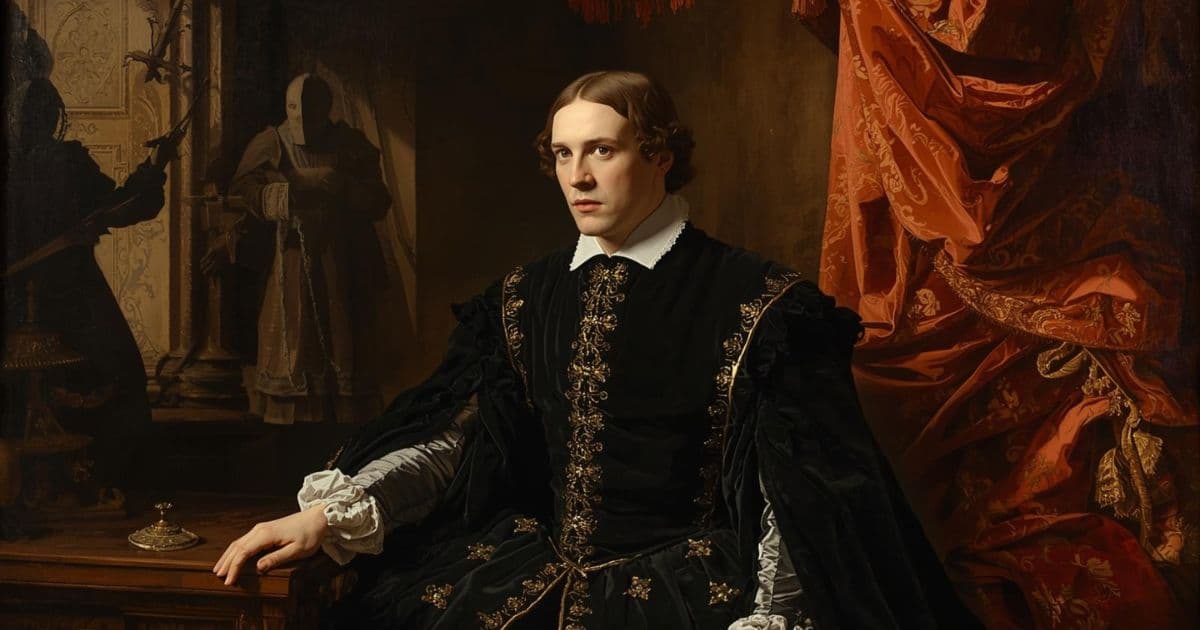
An excerpt from the original text.(complete · 2593 words)
he Second Marriage And The Second Family
Very shortly after getting his four‐year‐old Mitya off his hands Fyodor
Pavlovitch married a second time. His second marriage lasted eight
years. He took this second wife, Sofya Ivanovna, also a very young
girl, from another province, where he had gone upon some small piece of
business in company with a Jew. Though Fyodor Pavlovitch was a drunkard
and a vicious debauchee he never neglected investing his capital, and
managed his business affairs very successfully, though, no doubt, not
over‐ scrupulously. Sofya Ivanovna was the daughter of an obscure
deacon, and was left from childhood an orphan without relations. She
grew up in the house of a general’s widow, a wealthy old lady of good
position, who was at once her benefactress and tormentor. I do not know
the details, but I have only heard that the orphan girl, a meek and
gentle creature, was once cut down from a halter in which she was
hanging from a nail in the loft, so terrible were her sufferings from
the caprice and everlasting nagging of this old woman, who was
apparently not bad‐hearted but had become an insufferable tyrant
through idleness.
Fyodor Pavlovitch made her an offer; inquiries were made about him and
he was refused. But again, as in his first marriage, he proposed an
elopement to the orphan girl. There is very little doubt that she would
not on any account have married him if she had known a little more
about him in time. But she lived in another province; besides, what
could a little girl of sixteen know about it, except that she would be
better at the bottom of the river than remaining with her benefactress.
So the poor child exchanged a benefactress for a benefactor. Fyodor
Pavlovitch did not get a penny this time, for the general’s widow was
furious. She gave them nothing and cursed them both. But he had not
reckoned on a dowry; what allured him was the remarkable beauty of the
innocent girl, above all her innocent appearance, which had a peculiar
attraction for a vicious profligate, who had hitherto admired only the
coarser types of feminine beauty.
“Those innocent eyes slit my soul up like a razor,” he used to say
afterwards, with his loathsome snigger. In a man so depraved this
might, of course, mean no more than sensual attraction. As he had
received no dowry with his wife, and had, so to speak, taken her “from
the halter,” he did not stand on ceremony with her. Making her feel
that she had “wronged” him, he took advantage of her phenomenal
meekness and submissiveness to trample on the elementary decencies of
marriage. He gathered loose women into his house, and carried on orgies
of debauchery in his wife’s presence. To show what a pass things had
come to, I may mention that Grigory, the gloomy, stupid, obstinate,
argumentative servant, who had always hated his first mistress,
Adelaïda Ivanovna, took the side of his new mistress. He championed her
cause, abusing Fyodor Pavlovitch in a manner little befitting a
servant, and on one occasion broke up the revels and drove all the
disorderly women out of the house. In the end this unhappy young woman,
kept in terror from her childhood, fell into that kind of nervous
disease which is most frequently found in peasant women who are said to
be “possessed by devils.” At times after terrible fits of hysterics she
even lost her reason. Yet she bore Fyodor Pavlovitch two sons, Ivan and
Alexey, the eldest in the first year of marriage and the second three
years later. When she died, little Alexey was in his fourth year, and,
strange as it seems, I know that he remembered his mother all his life,
like a dream, of course. At her death almost exactly the same thing
happened to the two little boys as to their elder brother, Mitya. They
were completely forgotten and abandoned by their father. They were
looked after by the same Grigory and lived in his cottage, where they
were found by the tyrannical old lady who had brought up their mother.
She was still alive, and had not, all those eight years, forgotten the
insult done her. All that time she was obtaining exact information as
to her Sofya’s manner of life, and hearing of her illness and hideous
surroundings she declared aloud two or three times to her retainers:
“It serves her right. God has punished her for her ingratitude.”
Exactly three months after Sofya Ivanovna’s death the general’s widow
suddenly appeared in our town, and went straight to Fyodor Pavlovitch’s
house. She spent only half an hour in the town but she did a great
deal. It was evening. Fyodor Pavlovitch, whom she had not seen for
those eight years, came in to her drunk. The story is that instantly
upon seeing him, without any sort of explanation, she gave him two
good, resounding slaps on the face, seized him by a tuft of hair, and
shook him three times up and down. Then, without a word, she went
straight to the cottage to the two boys. Seeing, at the first glance,
that they were unwashed and in dirty linen, she promptly gave Grigory,
too, a box on the ear, and announcing that she would carry off both the
children she wrapped them just as they were in a rug, put them in the
carriage, and drove off to her own town. Grigory accepted the blow like
a devoted slave, without a word, and when he escorted the old lady to
her carriage he made her a low bow and pronounced impressively that,
“God would repay her for the orphans.” “You are a blockhead all the
same,” the old lady shouted to him as she drove away.
Fyodor Pavlovitch, thinking it over, decided that it was a good thing,
and did not refuse the general’s widow his formal consent to any
proposition in regard to his children’s education. As for the slaps she
had given him, he drove all over the town telling the story.
It happened that the old lady died soon after this, but she left the
boys in her will a thousand roubles each “for their instruction, and so
that all be spent on them exclusively, with the condition that it be so
portioned out as to last till they are twenty‐one, for it is more than
adequate provision for such children. If other people think fit to
throw away their money, let them.” I have not read the will myself, but
I heard there was something queer of the sort, very whimsically
expressed. The principal heir, Yefim Petrovitch Polenov, the Marshal of
Nobility of the province, turned out, however, to be an honest man.
Writing to Fyodor Pavlovitch, and discerning at once that he could
extract nothing from him for his children’s education (though the
latter never directly refused but only procrastinated as he always did
in such cases, and was, indeed, at times effusively sentimental), Yefim
Petrovitch took a personal interest in the orphans. He became
especially fond of the younger, Alexey, who lived for a long while as
one of his family. I beg the reader to note this from the beginning.
And to Yefim Petrovitch, a man of a generosity and humanity rarely to
be met with, the young people were more indebted for their education
and bringing up than to any one. He kept the two thousand roubles left
to them by the general’s widow intact, so that by the time they came of
age their portions had been doubled by the accumulation of interest. He
educated them both at his own expense, and certainly spent far more
than a thousand roubles upon each of them. I won’t enter into a
detailed account of their boyhood and youth, but will only mention a
few of the most important events. Of the elder, Ivan, I will only say
that he grew into a somewhat morose and reserved, though far from timid
boy. At ten years old he had realized that they were living not in
their own home but on other people’s charity, and that their father was
a man of whom it was disgraceful to speak. This boy began very early,
almost in his infancy (so they say at least), to show a brilliant and
unusual aptitude for learning. I don’t know precisely why, but he left
the family of Yefim Petrovitch when he was hardly thirteen, entering a
Moscow gymnasium, and boarding with an experienced and celebrated
teacher, an old friend of Yefim Petrovitch. Ivan used to declare
afterwards that this was all due to the “ardor for good works” of Yefim
Petrovitch, who was captivated by the idea that the boy’s genius should
be trained by a teacher of genius. But neither Yefim Petrovitch nor
this teacher was living when the young man finished at the gymnasium
and entered the university. As Yefim Petrovitch had made no provision
for the payment of the tyrannical old lady’s legacy, which had grown
from one thousand to two, it was delayed, owing to formalities
inevitable in Russia, and the young man was in great straits for the
first two years at the university, as he was forced to keep himself all
the time he was studying. It must be noted that he did not even attempt
to communicate with his father, perhaps from pride, from contempt for
him, or perhaps from his cool common sense, which told him that from
such a father he would get no real assistance. However that may have
been, the young man was by no means despondent and succeeded in getting
work, at first giving sixpenny lessons and afterwards getting
paragraphs on street incidents into the newspapers under the signature
of “Eye‐Witness.” These paragraphs, it was said, were so interesting
and piquant that they were soon taken. This alone showed the young
man’s practical and intellectual superiority over the masses of needy
and unfortunate students of both sexes who hang about the offices of
the newspapers and journals, unable to think of anything better than
everlasting entreaties for copying and translations from the French.
Having once got into touch with the editors Ivan Fyodorovitch always
kept up his connection with them, and in his latter years at the
university he published brilliant reviews of books upon various special
subjects, so that he became well known in literary circles. But only in
his last year he suddenly succeeded in attracting the attention of a
far wider circle of readers, so that a great many people noticed and
remembered him. It was rather a curious incident. When he had just left
the university and was preparing to go abroad upon his two thousand
roubles, Ivan Fyodorovitch published in one of the more important
journals a strange article, which attracted general notice, on a
subject of which he might have been supposed to know nothing, as he was
a student of natural science. The article dealt with a subject which
was being debated everywhere at the time—the position of the
ecclesiastical courts. After discussing several opinions on the subject
he went on to explain his own view. What was most striking about the
article was its tone, and its unexpected conclusion. Many of the Church
party regarded him unquestioningly as on their side. And yet not only
the secularists but even atheists joined them in their applause.
Finally some sagacious persons opined that the article was nothing but
an impudent satirical burlesque. I mention this incident particularly
because this article penetrated into the famous monastery in our
neighborhood, where the inmates, being particularly interested in the
question of the ecclesiastical courts, were completely bewildered by
it. Learning the author’s name, they were interested in his being a
native of the town and the son of “that Fyodor Pavlovitch.” And just
then it was that the author himself made his appearance among us.
Why Ivan Fyodorovitch had come amongst us I remember asking myself at
the time with a certain uneasiness. This fateful visit, which was the
first step leading to so many consequences, I never fully explained to
myself. It seemed strange on the face of it that a young man so
learned, so proud, and apparently so cautious, should suddenly visit
such an infamous house and a father who had ignored him all his life,
hardly knew him, never thought of him, and would not under any
circumstances have given him money, though he was always afraid that
his sons Ivan and Alexey would also come to ask him for it. And here
the young man was staying in the house of such a father, had been
living with him for two months, and they were on the best possible
terms. This last fact was a special cause of wonder to many others as
well as to me. Pyotr Alexandrovitch Miüsov, of whom we have spoken
already, the cousin of Fyodor Pavlovitch’s first wife, happened to be
in the neighborhood again on a visit to his estate. He had come from
Paris, which was his permanent home. I remember that he was more
surprised than any one when he made the acquaintance of the young man,
who interested him extremely, and with whom he sometimes argued and not
without an inner pang compared himself in acquirements.
“He is proud,” he used to say, “he will never be in want of pence; he
has got money enough to go abroad now. What does he want here? Every
one can see that he hasn’t come for money, for his father would never
give him any. He has no taste for drink and dissipation, and yet his
father can’t do without him. They get on so well together!”
That was the truth; the young man had an unmistakable influence over
his father, who positively appeared to be behaving more decently and
even seemed at times ready to obey his son, though often extremely and
even spitefully perverse.
It was only later that we learned that Ivan had come partly at the
request of, and in the interests of, his elder brother, Dmitri, whom he
saw for the first time on this very visit, though he had before leaving
Moscow been in correspondence with him about an important matter of
more concern to Dmitri than himself. What that business was the reader
will learn fully in due time. Yet even when I did know of this special
circumstance I still felt Ivan Fyodorovitch to be an enigmatic figure,
and thought his visit rather mysterious.
I may add that Ivan appeared at the time in the light of a mediator
between his father and his elder brother Dmitri, who was in open
quarrel with his father and even planning to bring an action against
him.
The family, I repeat, was now united for the first time, and some of
its members met for the first time in their lives. The younger brother,
Alexey, had been a year already among us, having been the first of the
three to arrive. It is of that brother Alexey I find it most difficult
to speak in this introduction. Yet I must give some preliminary account
of him, if only to explain one queer fact, which is that I have to
introduce my hero to the reader wearing the cassock of a novice. Yes,
he had been for the last year in our monastery, and seemed willing to
be cloistered there for the rest of his life.
Master this chapter. Complete your experience
Purchase the complete book to access all chapters and support classic literature
As an Amazon Associate, we earn a small commission from qualifying purchases at no additional cost to you.
Available in paperback, hardcover, and e-book formats
Let's Analyse the Pattern
When desperation narrows our choices to 'anything but this,' we often choose situations that are different but not better.
Why This Matters
Connect literature to life
This chapter teaches how predators exploit desperation by timing their 'offers' to coincide with someone's crisis moments.
Practice This Today
Next time someone offers you a solution during your worst moment, pause and ask: 'Am I choosing this because it's good, or because I'm drowning?'
Now let's explore the literary elements.
Key Quotes & Analysis
"Though Fyodor Pavlovitch was a drunkard and a vicious debauchee he never neglected investing his capital, and managed his business affairs very successfully"
Context: Describing how Fyodor operates in the world despite his personal vices
This reveals Fyodor's calculating nature - he's not just a drunk, he's a strategic predator who knows exactly what he's doing. His success in business while failing as a human being shows how the system rewards ruthlessness over decency.
In Today's Words:
He was a complete mess as a person, but he knew how to make money and didn't let his drinking affect his business deals.
"The orphan girl, a meek and gentle creature, was once cut down from a halter in which she was hanging from a nail in the loft"
Context: Describing Sofya's desperation under her guardian's abuse
This shocking detail shows how completely powerless Sofya was - her only escape seemed to be death. It explains why marriage to a stranger felt like salvation rather than a risk.
In Today's Words:
She was so miserable that she tried to kill herself, and someone found her just in time.
"There is very little doubt that she would not on any account have married him if she had known a little more about him"
Context: Explaining why Sofya agreed to marry Fyodor
This highlights how desperation clouds judgment and how predators exploit vulnerable people. Sofya couldn't imagine anything worse than her current situation, so she didn't ask the right questions.
In Today's Words:
If she'd known what he was really like, she never would have said yes - but she was too desperate to be careful.
Thematic Threads
Exploitation
In This Chapter
Fyodor specifically targets vulnerable people—first Adelaide's family crisis, now Sofya's desperation—to satisfy his need for corruption and control
Development
Escalated from previous chapter's abandonment to active predatory behavior
In Your Life:
Watch for people who seem most interested in you when you're at your most vulnerable or desperate.
Class
In This Chapter
Sofya's orphaned status and lack of resources make her vulnerable to exploitation, while Fyodor's wealth gives him power to corrupt with impunity
Development
Continues theme from Adelaide's story, showing how economic desperation creates opportunities for abuse
In Your Life:
Financial insecurity can make you vulnerable to people who offer help with hidden costs.
Identity
In This Chapter
Ivan develops his own identity through education and writing, refusing to be defined by his father's abandonment or his traumatic childhood
Development
First example in the book of a Karamazov actively creating his own path despite family dysfunction
In Your Life:
You can build your own identity through skills and accomplishments, even when your family background works against you.
Rescue
In This Chapter
The elderly woman and Yefim Petrovitch step in to save the abandoned children, providing genuine care without ulterior motives
Development
Introduced here as contrast to exploitation—showing that real help exists alongside predatory behavior
In Your Life:
Real helpers focus on your wellbeing without expecting you to be grateful forever or pay hidden costs.
Power
In This Chapter
Ivan's intellectual achievements give him unexpected influence over his father, suggesting that competence can shift family power dynamics
Development
New development showing how individual growth can change established family roles
In Your Life:
Developing your own skills and reputation can change how even difficult family members treat you.
You now have the context. Time to form your own thoughts.
Discussion Questions
- 1
Why did Sofya choose to marry Fyodor when she knew he was a bad man?
analysis • surface - 2
What does Fyodor's treatment of his wives and children reveal about his character and motivations?
analysis • medium - 3
Where do you see people today making desperate choices between 'bad' and 'worse' options?
application • medium - 4
How can someone recognize when they're making decisions from desperation rather than clear thinking?
application • deep - 5
What does this chapter suggest about how trauma and abandonment shape the next generation?
reflection • deep
Critical Thinking Exercise
Map Your Escape Routes
Think of a situation in your life where you felt trapped or desperate to escape. Write down all the options you considered at the time, even the bad ones. Now step back and identify which choices you were considering because they were genuinely good versus which ones you considered simply because they offered escape from your current situation.
Consider:
- •Notice how desperation narrows your vision to just two options: stay or flee
- •Recognize that predatory people often appear during our most vulnerable moments
- •Consider how creating space between crisis and decision leads to better outcomes
Journaling Prompt
Write about a time when you made a major life decision while feeling desperate. What would you do differently if you faced a similar situation today?
Coming Up Next...
Chapter 4: The Heart That Trusts Everyone
Now we meet the third brother, Alexey—the one who chose a completely different path by entering a monastery. What drives a young man to seek God when his family represents everything unholy?