

What to expect ahead
What follows is a compact summary of each chapter in the book, designed to help you quickly grasp the core ideas while inviting you to continue into the full original text. Even when chapter text is presented here, these summaries are meant as a gateway to understanding, so your eventual reading of the complete book feels richer, deeper, and more fully appreciated.
Richard III
A Brief Description
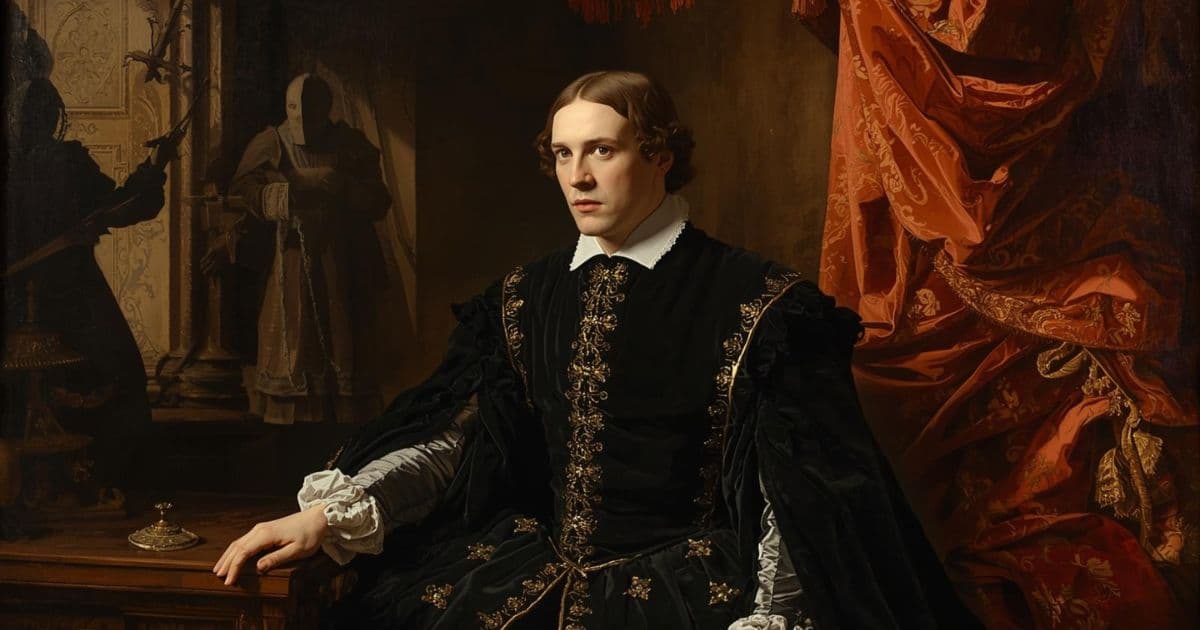
Richard III steps to the front of the stage and tells you exactly who he is. Deformed, overlooked, denied the pleasures that come easily to others—he has decided to be a villain. Not reluctantly. With relish. "I am determined to prove a villain," he says, and then spends five acts making good on the promise.
What Shakespeare gives you is something rare: a predator who narrates his own hunt. Richard doesn't just manipulate people—he explains to the audience precisely how he does it, step by step, then executes the plan in front of us. He seduces the widow of a man he murdered, hours after the funeral, while the body is still in the room. She knows what he is. She says yes anyway. The horror isn't Richard—it's how easily everyone falls.
He reads people the way a pickpocket reads a crowd. He knows what each person needs to hear, what insecurity to flatter, what fear to stoke. He makes allies feel uniquely trusted, enemies feel exposed, and victims feel responsible for their own destruction. He wears a different mask for every room and never loses track of which face he's wearing.
But Shakespeare's real lesson is in the collapse. The same ruthlessness that gets Richard to the throne isolates him there. He can't trust anyone—because he knows exactly how he treats people who trust him. His enemies, who had nothing in common, unite purely in their hatred of him. His charm stops working the moment people compare notes. The invincible manipulator becomes paranoid, sleepless, and broken.
Richard III is a manual written in reverse: here is how the predator operates, so you can see it coming. You'll recognize the instant intimacy, the strategic vulnerability, the charm that's slightly too perfect. You'll understand the mechanism before it's used on you.
Essential Life Skills Deep Dive
Explore chapter-by-chapter breakdowns of the essential life skills taught in this classic novel.
Recognizing Sociopathic Charm
Learn to identify the distinctive patterns of charm used by people without empathy—before they can manipulate you.
Understanding Manipulation Tactics
See exactly how Richard manipulates: gaslighting, triangulation, love-bombing, and making victims blame themselves.
Protecting Yourself from Predators
Learn concrete defenses: trust patterns over words, verify independently, and never ignore gut feelings that something's wrong.
Essential Skills
Life skills and patterns this book helps you develop—drawn from its themes and characters.
Recognizing Sociopathic Charm
Learn to identify the distinctive patterns of charm used by people without empathy: instant intimacy, mirroring, strategic vulnerability, and performance that feels slightly off. Richard shows you the warning signs before it's too late.
Understanding Manipulation Tactics
See exactly how Richard manipulates: isolating victims, gaslighting, triangulation, love-bombing, and making people feel responsible for their own victimization. These tactics haven't changed in 400 years.
Detecting Performative Emotion
Develop the ability to distinguish genuine emotion from performed emotion. Richard cries on cue, displays strategic humility, and mirrors others' feelings—but it's all theater. Learn to spot the difference.
Recognizing Triangulation
Understand how Richard plays people against each other: creating paranoia, controlling narratives about absent third parties, and positioning himself as the only trustworthy person. This divides potential allies and centralizes his power.
Seeing Through Strategic Vulnerability
Learn to recognize when someone's 'openness' is calculated to create false intimacy. Richard confesses his villainy to us but performs humility to others. The confession builds audience complicity; the performance disarms victims.
Understanding the Predator's Playbook
Study the complete pattern: target selection (who's vulnerable), isolation (separate from support), love-bombing (create dependency), exploitation (extract value), discard (when no longer useful). Richard executes this perfectly.
Recognizing When Charm Is a Weapon
Understand the difference between genuine charisma and weaponized charm. Richard's charm is always transactional—it serves a purpose, targets specific people, and disappears when no longer needed. True charm is consistent.
Protecting Yourself from Manipulation
Learn concrete defenses: trust patterns over words, verify narratives independently, maintain outside relationships, watch how someone treats people they don't need, and never ignore gut feelings that something's wrong.
Table of Contents
Act I, Scene 1: The Deformed Villain's Opening
The play opens with Richard, Duke of Gloucester, alone on stage delivering one of Shakespeare's most...
Act I, Scene 2: The Seduction of Lady Anne
Lady Anne mourns over King Henry VI's corpse, delivering elaborate curses against his murderer—wishi...
Act I, Scene 3: The Court Intrigue Begins
Queen Elizabeth and her relatives Rivers and Grey discuss King Edward IV's declining health, fearing...
Act I, Scene 4: Clarence's Murder
Clarence awakens in the Tower from a terrifying prophetic dream: he was aboard a ship with Richard, ...
Act II, Scene 1: King Edward's Death
King Edward IV, gravely ill and knowing death approaches—'I every day expect an embassage from my Re...
Act II, Scene 2: The Princes' Arrival
The Duchess of York comforts Clarence's orphaned children, who sense their father is dead. Clarence'...
Act II, Scene 3: The Citizens' Fears
Three citizens meet on a London street, discussing King Edward's death with foreboding. One tries to...
Act II, Scene 4: The Queen's Flight
The Queen, Duchess, Archbishop, and young Prince York await news of Prince Edward's arrival. Young Y...
Act III, Scene 1: Richard as Protector
Prince Edward arrives in London, greeted warmly by Richard and Buckingham: 'Welcome, sweet prince, t...
Act III, Scene 2: Hastings' Warning
At 4 AM, a messenger from Stanley pounds on Hastings's door with an urgent warning: Stanley dreamed ...
Act III, Scene 3: Hastings' Execution
The chapter opens at Pomfret Castle where Rivers, Grey, and Vaughan are led to execution. Rivers cal...
Act III, Scenes 5-7: The Propaganda Machine
With Hastings's blood still wet, Richard's propaganda machine launches at full force. He instructs B...
Act III, Scene 7 (cont.): The Reluctant King
Richard's theatrical masterpiece reaches its climax. Standing between two bishops with prayer book i...
Act IV, Scenes 1-2: The Princes Imprisoned
Queen Elizabeth, Anne (now Duchess of Gloucester), and the Duchess of York arrive at the Tower to vi...
Act IV, Scene 2 (cont.): The Princes Murdered
Buckingham exits to consider Richard's murder request. Richard seethes: 'High-reaching Buckingham gr...
Act IV, Scene 3: The Mothers' Curses
Queen Margaret emerges from hiding—she's been lurking in England to watch her enemies' destruction. ...
Act IV, Scene 3 (cont.): The Mother's Curse & Monstrous Proposal
The Duchess delivers her final, devastating curse on her own son. Richard dismissively says he's in ...
Act IV, Scene 4 (cont.): The Verbal Duel
Richard's wooing argument continues with devastating absurdity: proposing to 'bury' the murdered boy...
Act IV-V: Paranoia, Rebellion, & Buckingham's End
Richard descends into paranoid chaos, giving contradictory orders, changing his mind mid-sentence. S...
Act V, Scenes 2-3: Eve of Battle at Bosworth
Richmond addresses his forces: 'Fellows in arms, and my most loving friends bruised underneath the y...
Act V, Scene 3 (cont.): The Ghosts & Richard's Conscience
Richmond prays: 'O thou, whose captain I account myself... put in their hands thy bruising irons of ...
Act V, Scene 3 (cont.): Conscience Is a Word Cowards Use
Morning. The clock strikes. Richard asks: 'Who saw the sun today?' No one. 'Then he disdains to shin...
Act V, Scenes 4-5: A Horse, A Horse! & Richmond's Victory
Alarums. The battle begins. Catesby: 'Rescue my Lord of Norfolk, rescue, rescue! The King enacts mor...
Act V, Scene 4: The Battle
The battle rages. Richard fights desperately, but his manipulations have left him isolated. His famo...
Act V, Scene 5: Richard's Death and Richmond's Victory
Richard is killed in battle. Richmond claims victory and the crown, promising to unite the warring h...
About William Shakespeare
Published 1597
William Shakespeare (1564-1616) wrote Richard III early in his career, likely between 1592-1593. The play was immediately popular, performed and published more frequently than any of his other histories during his lifetime. Its appeal lay in its psychological complexity—Shakespeare wasn't just chronicling historical events but exploring the inner workings of a brilliant, amoral mind.
The historical Richard III was likely not as villainous as Shakespeare portrayed him. Shakespeare was writing during the Tudor dynasty, which had defeated Richard at Bosworth Field. The Tudors needed Richard to be a monster to justify their own claim to the throne. Shakespeare drew on Tudor propaganda, particularly Thomas More's History of King Richard III, which painted Richard as a deformed, murdering tyrant.
But Shakespeare's genius was recognizing that whether the historical Richard was truly this evil didn't matter—the character he created was psychologically true. Richard III remains relevant not because it's accurate history but because it perfectly captures how certain people operate: the charm, the manipulation, the complete lack of empathy masked by performed emotion. Shakespeare gave us the template for understanding the kind of personality we'd now recognize as psychopathic or sociopathic.
The play has endured because Machiavellian doesn't begin to cover what Richard does. He's not just ruthless in pursuit of power—he enjoys the manipulation for its own sake. He doesn't merely eliminate threats; he turns victims into accomplices in their own destruction. The role of Richard became one of theater's most coveted because it lets actors explore pure theatrical villainy—the character who knows he's performing and enjoys every minute of it.
Why This Author Matters Today
William Shakespeare's insights into human nature, social constraints, and the search for authenticity remain powerfully relevant. Their work helps us understand the timeless tensions between individual desire and social expectation, making them an essential guide for navigating modern life's complexities.
More by William Shakespeare in Our Library
Amplified Classics is different.
not a sparknotes, nor a cliffnotes
This is a retelling. The story is still told—completely. You walk with the characters, feel what they feel, discover what they discover. The meaning arrives because you experienced it, not because someone explained a summary.
Read this, then read the original. The prose will illuminate—you'll notice what makes the author that author, because you're no longer fighting to follow the story.
Read the original first, then read this. Something will click. You'll want to go back.
Either way, the door opens inward.
Get the Full Book
Purchase the complete book to access all chapters and support classic literature
As an Amazon Associate, we earn a small commission from qualifying purchases at no additional cost to you.
Available in paperback, hardcover, and e-book formats
You Might Also Like



Free to read • No account required