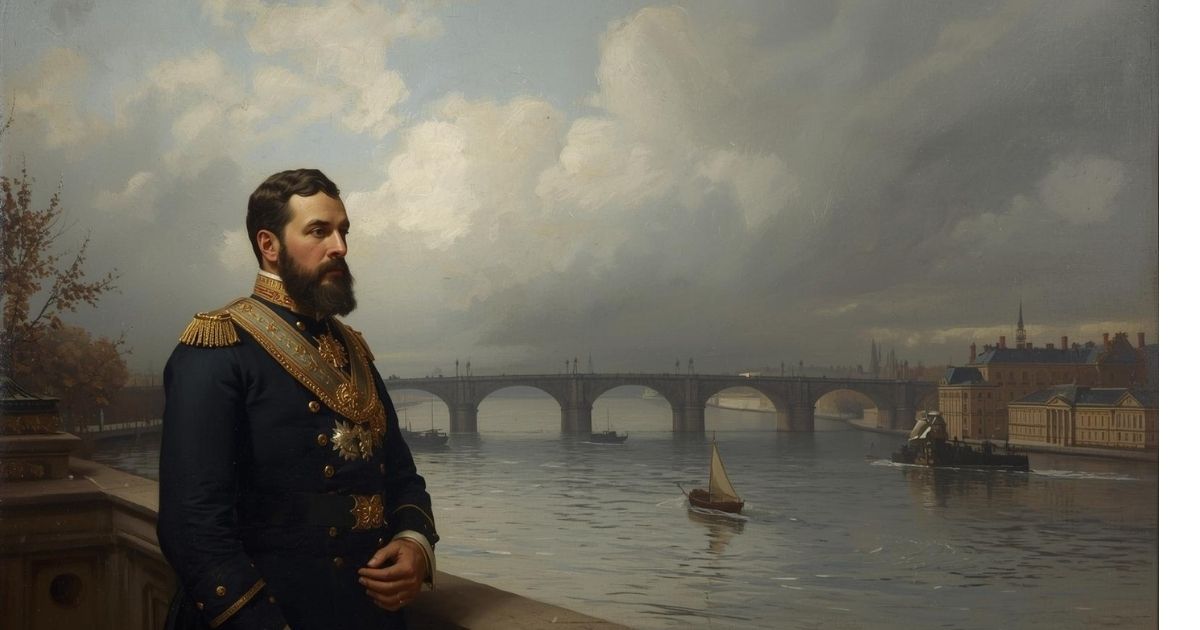
An excerpt from the original text.(complete · 5418 words)
he laughed, but she was rather angry too.
“He’s asleep! You were asleep,” she said, with contemptuous surprise.
“Is it really you?” muttered the prince, not quite himself as yet, and
recognizing her with a start of amazement. “Oh yes, of course,” he
added, “this is our rendezvous. I fell asleep here.”
“So I saw.”
“Did no one awake me besides yourself? Was there no one else here? I
thought there was another woman.”
“There was another woman here?”
At last he was wide awake.
“It was a dream, of course,” he said, musingly. “Strange that I should
have a dream like that at such a moment. Sit down—”
He took her hand and seated her on the bench; then sat down beside her
and reflected.
Aglaya did not begin the conversation, but contented herself with
watching her companion intently.
He looked back at her, but at times it was clear that he did not see
her and was not thinking of her.
Aglaya began to flush up.
“Oh yes!” cried the prince, starting. “Hippolyte’s suicide—”
“What? At your house?” she asked, but without much surprise. “He was
alive yesterday evening, wasn’t he? How could you sleep here after
that?” she cried, growing suddenly animated.
“Oh, but he didn’t kill himself; the pistol didn’t go off.” Aglaya
insisted on hearing the whole story. She hurried the prince along, but
interrupted him with all sorts of questions, nearly all of which were
irrelevant. Among other things, she seemed greatly interested in every
word that Evgenie Pavlovitch had said, and made the prince repeat that
part of the story over and over again.
“Well, that’ll do; we must be quick,” she concluded, after hearing all.
“We have only an hour here, till eight; I must be home by then without
fail, so that they may not find out that I came and sat here with you;
but I’ve come on business. I have a great deal to say to you. But you
have bowled me over considerably with your news. As to Hippolyte, I
think his pistol was bound not to go off; it was more consistent with
the whole affair. Are you sure he really wished to blow his brains out,
and that there was no humbug about the matter?”
“No humbug at all.”
“Very likely. So he wrote that you were to bring me a copy of his
confession, did he? Why didn’t you bring it?”
“Why, he didn’t die! I’ll ask him for it, if you like.”
“Bring it by all means; you needn’t ask him. He will be delighted, you
may be sure; for, in all probability, he shot at himself simply in
order that I might read his confession. Don’t laugh at what I say,
please, Lef Nicolaievitch, because it may very well be the case.”
“I’m not laughing. I am convinced, myself, that that may have been
partly the reason.”
“You are convinced? You don’t really mean to say you think that
honestly?” asked Aglaya, extremely surprised.
She put her questions very quickly and talked fast, every now and then
forgetting what she had begun to say, and not finishing her sentence.
She seemed to be impatient to warn the prince about something or other.
She was in a state of unusual excitement, and though she put on a brave
and even defiant air, she seemed to be rather alarmed. She was dressed
very simply, but this suited her well. She continually trembled and
blushed, and she sat on the very edge of the seat.
The fact that the prince confirmed her idea, about Hippolyte shooting
himself that she might read his confession, surprised her greatly.
“Of course,” added the prince, “he wished us all to applaud his
conduct—besides yourself.”
“How do you mean—applaud?”
“Well—how am I to explain? He was very anxious that we should all come
around him, and say we were so sorry for him, and that we loved him
very much, and all that; and that we hoped he wouldn’t kill himself,
but remain alive. Very likely he thought more of you than the rest of
us, because he mentioned you at such a moment, though perhaps he did
not know himself that he had you in his mind’s eye.”
“I don’t understand you. How could he have me in view, and not be aware
of it himself? And yet, I don’t know—perhaps I do. Do you know I have
intended to poison myself at least thirty times—ever since I was
thirteen or so—and to write to my parents before I did it? I used to
think how nice it would be to lie in my coffin, and have them all
weeping over me and saying it was all their fault for being so cruel,
and all that—what are you smiling at?” she added, knitting her brow.
“What do you think of when you go mooning about alone? I suppose you
imagine yourself a field-marshal, and think you have conquered
Napoleon?”
“Well, I really have thought something of the sort now and then,
especially when just dozing off,” laughed the prince. “Only it is the
Austrians whom I conquer—not Napoleon.”
“I don’t wish to joke with you, Lef Nicolaievitch. I shall see
Hippolyte myself. Tell him so. As for you, I think you are behaving
very badly, because it is not right to judge a man’s soul as you are
judging Hippolyte’s. You have no gentleness, but only justice—so you
are unjust.”
The prince reflected.
“I think you are unfair towards me,” he said. “There is nothing wrong
in the thoughts I ascribe to Hippolyte; they are only natural. But of
course I don’t know for certain what he thought. Perhaps he thought
nothing, but simply longed to see human faces once more, and to hear
human praise and feel human affection. Who knows? Only it all came out
wrong, somehow. Some people have luck, and everything comes out right
with them; others have none, and never a thing turns out fortunately.”
“I suppose you have felt that in your own case,” said Aglaya.
“Yes, I have,” replied the prince, quite unsuspicious of any irony in
the remark.
“H’m—well, at all events, I shouldn’t have fallen asleep here, in your
place. It wasn’t nice of you, that. I suppose you fall asleep wherever
you sit down?”
“But I didn’t sleep a wink all night. I walked and walked about, and
went to where the music was—”
“What music?”
“Where they played last night. Then I found this bench and sat down,
and thought and thought—and at last I fell fast asleep.”
“Oh, is that it? That makes a difference, perhaps. What did you go to
the bandstand for?”
“I don’t know; I—”
“Very well—afterwards. You are always interrupting me. What woman was
it you were dreaming about?”
“It was—about—you saw her—”
“Quite so; I understand. I understand quite well. You are very—Well,
how did she appear to you? What did she look like? No, I don’t want to
know anything about her,” said Aglaya, angrily; “don’t interrupt me—”
She paused a moment as though getting breath, or trying to master her
feeling of annoyance.
“Look here; this is what I called you here for. I wish to make you a—to
ask you to be my friend. What do you stare at me like that for?” she
added, almost angrily.
The prince certainly had darted a rather piercing look at her, and now
observed that she had begun to blush violently. At such moments, the
more Aglaya blushed, the angrier she grew with herself; and this was
clearly expressed in her eyes, which flashed like fire. As a rule, she
vented her wrath on her unfortunate companion, be it who it might. She
was very conscious of her own shyness, and was not nearly so talkative
as her sisters for this reason—in fact, at times she was much too
quiet. When, therefore, she was bound to talk, especially at such
delicate moments as this, she invariably did so with an air of haughty
defiance. She always knew beforehand when she was going to blush, long
before the blush came.
“Perhaps you do not wish to accept my proposition?” she asked, gazing
haughtily at the prince.
“Oh yes, I do; but it is so unnecessary. I mean, I did not think you
need make such a proposition,” said the prince, looking confused.
“What did you suppose, then? Why did you think I invited you out here?
I suppose you think me a ‘little fool,’ as they all call me at home?”
“I didn’t know they called you a fool. I certainly don’t think you
one.”
“You don’t think me one! Oh, dear me!—that’s very clever of you; you
put it so neatly, too.”
“In my opinion, you are far from a fool sometimes—in fact, you are very
intelligent. You said a very clever thing just now about my being
unjust because I had only justice. I shall remember that, and think
about it.”
Aglaya blushed with pleasure. All these changes in her expression came
about so naturally and so rapidly—they delighted the prince; he watched
her, and laughed.
“Listen,” she began again; “I have long waited to tell you all this,
ever since the time when you sent me that letter—even before that. Half
of what I have to say you heard yesterday. I consider you the most
honest and upright of men—more honest and upright than any other man;
and if anybody says that your mind is—is sometimes affected, you
know—it is unfair. I always say so and uphold it, because even if your
surface mind be a little affected (of course you will not feel angry
with me for talking so—I am speaking from a higher point of view) yet
your real mind is far better than all theirs put together. Such a mind
as they have never even dreamed of; because really, there are two
minds—the kind that matters, and the kind that doesn’t matter. Isn’t it
so?”
“May be! may be so!” said the prince, faintly; his heart was beating
painfully.
“I knew you would not misunderstand me,” she said, triumphantly.
“Prince S. and Evgenie Pavlovitch and Alexandra don’t understand
anything about these two kinds of mind, but, just fancy, mamma does!”
“You are very like Lizabetha Prokofievna.”
“What! surely not?” said Aglaya.
“Yes, you are, indeed.”
“Thank you; I am glad to be like mamma,” she said, thoughtfully. “You
respect her very much, don’t you?” she added, quite unconscious of the
naiveness of the question.
“Very much; and I am so glad that you have realized the fact.”
“I am very glad, too, because she is often laughed at by people. But
listen to the chief point. I have long thought over the matter, and at
last I have chosen you. I don’t wish people to laugh at me; I don’t
wish people to think me a ‘little fool.’ I don’t want to be chaffed. I
felt all this of a sudden, and I refused Evgenie Pavlovitch flatly,
because I am not going to be forever thrown at people’s heads to be
married. I want—I want—well, I’ll tell you, I wish to run away from
home, and I have chosen you to help me.”
“Run away from home?” cried the prince.
“Yes—yes—yes! Run away from home!” she repeated, in a transport of
rage. “I won’t, I won’t be made to blush every minute by them all! I
don’t want to blush before Prince S. or Evgenie Pavlovitch, or anyone,
and therefore I have chosen you. I shall tell you everything,
everything, even the most important things of all, whenever I like,
and you are to hide nothing from me on your side. I want to speak to at
least one person, as I would to myself. They have suddenly begun to say
that I am waiting for you, and in love with you. They began this before
you arrived here, and so I didn’t show them the letter, and now they
all say it, every one of them. I want to be brave, and be afraid of
nobody. I don’t want to go to their balls and things—I want to do good.
I have long desired to run away, for I have been kept shut up for
twenty years, and they are always trying to marry me off. I wanted to
run away when I was fourteen years old—I was a little fool then, I
know—but now I have worked it all out, and I have waited for you to
tell me about foreign countries. I have never seen a single Gothic
cathedral. I must go to Rome; I must see all the museums; I must study
in Paris. All this last year I have been preparing and reading
forbidden books. Alexandra and Adelaida are allowed to read anything
they like, but I mayn’t. I don’t want to quarrel with my sisters, but I
told my parents long ago that I wish to change my social position. I
have decided to take up teaching, and I count on you because you said
you loved children. Can we go in for education together—if not at once,
then afterwards? We could do good together. I won’t be a general’s
daughter any more! Tell me, are you a very learned man?”
“Oh no; not at all.”
“Oh-h-h! I’m sorry for that. I thought you were. I wonder why I always
thought so—but at all events you’ll help me, won’t you? Because I’ve
chosen you, you know.”
“Aglaya Ivanovna, it’s absurd.”
“But I will, I will run away!” she cried—and her eyes flashed again
with anger—“and if you don’t agree I shall go and marry Gavrila
Ardalionovitch! I won’t be considered a horrible girl, and accused of
goodness knows what.”
“Are you out of your mind?” cried the prince, almost starting from his
seat. “What do they accuse you of? Who accuses you?”
“At home, everybody, mother, my sisters, Prince S., even that
detestable Colia! If they don’t say it, they think it. I told them all
so to their faces. I told mother and father and everybody. Mamma was
ill all the day after it, and next day father and Alexandra told me
that I didn’t understand what nonsense I was talking. I informed them
that they little knew me—I was not a small child—I understood every
word in the language—that I had read a couple of Paul de Kok’s novels
two years since on purpose, so as to know all about everything. No
sooner did mamma hear me say this than she nearly fainted!”
A strange thought passed through the prince’s brain; he gazed intently
at Aglaya and smiled.
He could not believe that this was the same haughty young girl who had
once so proudly shown him Gania’s letter. He could not understand how
that proud and austere beauty could show herself to be such an utter
child—a child who probably did not even now understand some words.
“Have you always lived at home, Aglaya Ivanovna?” he asked. “I mean,
have you never been to school, or college, or anything?”
“No—never—nowhere! I’ve been at home all my life, corked up in a
bottle; and they expect me to be married straight out of it. What are
you laughing at again? I observe that you, too, have taken to laughing
at me, and range yourself on their side against me,” she added,
frowning angrily. “Don’t irritate me—I’m bad enough without that—I
don’t know what I am doing sometimes. I am persuaded that you came here
today in the full belief that I am in love with you, and that I
arranged this meeting because of that,” she cried, with annoyance.
“I admit I was afraid that that was the case, yesterday,” blundered the
prince (he was rather confused), “but today I am quite convinced that—”
“How?” cried Aglaya—and her lower lip trembled violently. “You were
afraid that I—you dared to think that I—good gracious! you suspected,
perhaps, that I sent for you to come here in order to catch you in a
trap, so that they should find us here together, and make you marry
me—”
“Aglaya Ivanovna, aren’t you ashamed of saying such a thing? How could
such a horrible idea enter your sweet, innocent heart? I am certain you
don’t believe a word of what you say, and probably you don’t even know
what you are talking about.”
Aglaya sat with her eyes on the ground; she seemed to have alarmed even
herself by what she had said.
“No, I’m not; I’m not a bit ashamed!” she murmured. “And how do you
know my heart is innocent? And how dared you send me a love-letter that
time?”
“Love-letter? My letter a love-letter? That letter was the most
respectful of letters; it went straight from my heart, at what was
perhaps the most painful moment of my life! I thought of you at the
time as a kind of light. I—”
“Well, very well, very well!” she said, but quite in a different tone.
She was remorseful now, and bent forward to touch his shoulder, though
still trying not to look him in the face, as if the more persuasively
to beg him not to be angry with her. “Very well,” she continued,
looking thoroughly ashamed of herself, “I feel that I said a very
foolish thing. I only did it just to try you. Take it as unsaid, and if
I offended you, forgive me. Don’t look straight at me like that,
please; turn your head away. You called it a ‘horrible idea’; I only
said it to shock you. Very often I am myself afraid of saying what I
intend to say, and out it comes all the same. You have just told me
that you wrote that letter at the most painful moment of your life. I
know what moment that was!” she added softly, looking at the ground
again.
“Oh, if you could know all!”
“I do know all!” she cried, with another burst of indignation. “You
were living in the same house as that horrible woman with whom you ran
away.” She did not blush as she said this; on the contrary, she grew
pale, and started from her seat, apparently oblivious of what she did,
and immediately sat down again. Her lip continued to tremble for a long
time.
There was silence for a moment. The prince was taken aback by the
suddenness of this last reply, and did not know to what he should
attribute it.
“I don’t love you a bit!” she said suddenly, just as though the words
had exploded from her mouth.
The prince did not answer, and there was silence again. “I love Gavrila
Ardalionovitch,” she said, quickly; but hardly audibly, and with her
head bent lower than ever.
“That is not true,” said the prince, in an equally low voice.
“What! I tell stories, do I? It is true! I gave him my promise a couple
of days ago on this very seat.”
The prince was startled, and reflected for a moment.
“It is not true,” he repeated, decidedly; “you have just invented it!”
“You are wonderfully polite. You know he is greatly improved. He loves
me better than his life. He let his hand burn before my very eyes in
order to prove to me that he loved me better than his life!”
“He burned his hand!”
“Yes, believe it or not! It’s all the same to me!”
The prince sat silent once more. Aglaya did not seem to be joking; she
was too angry for that.
“What! he brought a candle with him to this place? That is, if the
episode happened here; otherwise I can’t.”
“Yes, a candle! What’s there improbable about that?”
“A whole one, and in a candlestick?”
“Yes—no—half a candle—an end, you know—no, it was a whole candle; it’s
all the same. Be quiet, can’t you! He brought a box of matches too, if
you like, and then lighted the candle and held his finger in it for
half an hour and more!—There! Can’t that be?”
“I saw him yesterday, and his fingers were all right!”
Aglaya suddenly burst out laughing, as simply as a child.
“Do you know why I have just told you these lies?” She appealed to the
prince, of a sudden, with the most childlike candour, and with the
laugh still trembling on her lips. “Because when one tells a lie, if
one insists on something unusual and eccentric—something too ‘out of
the way’ for anything, you know—the more impossible the thing is, the
more plausible does the lie sound. I’ve noticed this. But I managed it
badly; I didn’t know how to work it.” She suddenly frowned again at
this point as though at some sudden unpleasant recollection.
“If”—she began, looking seriously and even sadly at him—“if when I read
you all that about the ‘poor knight,’ I wished to-to praise you for one
thing—I also wished to show you that I knew all—and did not approve of
your conduct.”
“You are very unfair to me, and to that unfortunate woman of whom you
spoke just now in such dreadful terms, Aglaya.”
“Because I know all, all—and that is why I speak so. I know very well
how you—half a year since—offered her your hand before everybody. Don’t
interrupt me. You see, I am merely stating facts without any comment
upon them. After that she ran away with Rogojin. Then you lived with
her at some village or town, and she ran away from you.” (Aglaya
blushed dreadfully.) “Then she returned to Rogojin again, who loves her
like a madman. Then you—like a wise man as you are—came back here after
her as soon as ever you heard that she had returned to Petersburg.
Yesterday evening you sprang forward to protect her, and just now you
dreamed about her. You see, I know all. You did come back here for her,
for her—now didn’t you?”
“Yes—for her!” said the prince softly and sadly, and bending his head
down, quite unconscious of the fact that Aglaya was gazing at him with
eyes which burned like live coals. “I came to find out something—I
don’t believe in her future happiness as Rogojin’s wife, although—in a
word, I did not know how to help her or what to do for her—but I came,
on the chance.”
He glanced at Aglaya, who was listening with a look of hatred on her
face.
“If you came without knowing why, I suppose you love her very much
indeed!” she said at last.
“No,” said the prince, “no, I do not love her. Oh! if you only knew
with what horror I recall the time I spent with her!”
A shudder seemed to sweep over his whole body at the recollection.
“Tell me about it,” said Aglaya.
“There is nothing which you might not hear. Why I should wish to tell
you, and only you, this experience of mine, I really cannot say;
perhaps it really is because I love you very much. This unhappy woman
is persuaded that she is the most hopeless, fallen creature in the
world. Oh, do not condemn her! Do not cast stones at her! She has
suffered too much already in the consciousness of her own undeserved
shame.
“And she is not guilty—oh God!—Every moment she bemoans and bewails
herself, and cries out that she does not admit any guilt, that she is
the victim of circumstances—the victim of a wicked libertine.
“But whatever she may say, remember that she does not believe it
herself,—remember that she will believe nothing but that she is a
guilty creature.
“When I tried to rid her soul of this gloomy fallacy, she suffered so
terribly that my heart will never be quite at peace so long as I can
remember that dreadful time!—Do you know why she left me? Simply to
prove to me what is not true—that she is base. But the worst of it is,
she did not realize herself that that was all she wanted to prove by
her departure! She went away in response to some inner prompting to do
something disgraceful, in order that she might say to
herself—‘There—you’ve done a new act of shame—you degraded creature!’
“Oh, Aglaya—perhaps you cannot understand all this. Try to realize that
in the perpetual admission of guilt she probably finds some dreadful
unnatural satisfaction—as though she were revenging herself upon
someone.
“Now and then I was able to persuade her almost to see light around her
again; but she would soon fall, once more, into her old tormenting
delusions, and would go so far as to reproach me for placing myself on
a pedestal above her (I never had an idea of such a thing!), and
informed me, in reply to my proposal of marriage, that she ‘did not
want condescending sympathy or help from anybody.’ You saw her last
night. You don’t suppose she can be happy among such people as
those—you cannot suppose that such society is fit for her? You have no
idea how well-educated she is, and what an intellect she has! She
astonished me sometimes.”
“And you preached her sermons there, did you?”
“Oh no,” continued the prince thoughtfully, not noticing Aglaya’s
mocking tone, “I was almost always silent there. I often wished to
speak, but I really did not know what to say. In some cases it is best
to say nothing, I think. I loved her, yes, I loved her very much
indeed; but afterwards—afterwards she guessed all.”
“What did she guess?”
“That I only pitied her—and—and loved her no longer!”
“How do you know that? How do you know that she is not really in love
with that—that rich cad—the man she eloped with?”
“Oh no! I know she only laughs at him; she has made a fool of him all
along.”
“Has she never laughed at you?”
“No—in anger, perhaps. Oh yes! she reproached me dreadfully in anger;
and suffered herself, too! But afterwards—oh! don’t remind me—don’t
remind me of that!”
He hid his face in his hands.
“Are you aware that she writes to me almost every day?”
“So that is true, is it?” cried the prince, greatly agitated. “I had
heard a report of it, but would not believe it.”
“Whom did you hear it from?” asked Aglaya, alarmed. “Rogojin said
something about it yesterday, but nothing definite.”
“Yesterday! Morning or evening? Before the music or after?”
“After—it was about twelve o’clock.”
“Ah! Well, if it was Rogojin—but do you know what she writes to me
about?”
“I should not be surprised by anything. She is mad!”
“There are the letters.” (Aglaya took three letters out of her pocket
and threw them down before the prince.) “For a whole week she has been
entreating and worrying and persuading me to marry you. She—well, she
is clever, though she may be mad—much cleverer than I am, as you say.
Well, she writes that she is in love with me herself, and tries to see
me every day, if only from a distance. She writes that you love me, and
that she has long known it and seen it, and that you and she talked
about me—there. She wishes to see you happy, and she says that she is
certain only I can ensure you the happiness you deserve. She writes
such strange, wild letters—I haven’t shown them to anyone. Now, do you
know what all this means? Can you guess anything?”
“It is madness—it is merely another proof of her insanity!” said the
prince, and his lips trembled.
“You are crying, aren’t you?”
“No, Aglaya. No, I’m not crying.” The prince looked at her.
“Well, what am I to do? What do you advise me? I cannot go on receiving
these letters, you know.”
“Oh, let her alone, I entreat you!” cried the prince. “What can you do
in this dark, gloomy mystery? Let her alone, and I’ll use all my power
to prevent her writing you any more letters.”
“If so, you are a heartless man!” cried Aglaya. “As if you can’t see
that it is not myself she loves, but you, you, and only you! Surely you
have not remarked everything else in her, and only not this? Do you
know what these letters mean? They mean jealousy, sir—nothing but pure
jealousy! She—do you think she will ever really marry this Rogojin, as
she says here she will? She would take her own life the day after you
and I were married.”
The prince shuddered; his heart seemed to freeze within him. He gazed
at Aglaya in wonderment; it was difficult for him to realize that this
child was also a woman.
“God knows, Aglaya, that to restore her peace of mind and make her
happy I would willingly give up my life. But I cannot love her, and she
knows that.”
“Oh, make a sacrifice of yourself! That sort of thing becomes you well,
you know. Why not do it? And don’t call me ‘Aglaya’; you have done it
several times lately. You are bound, it is your duty to ‘raise’ her;
you must go off somewhere again to soothe and pacify her. Why, you love
her, you know!”
“I cannot sacrifice myself so, though I admit I did wish to do so once.
Who knows, perhaps I still wish to! But I know for certain, that if
she married me it would be her ruin; I know this and therefore I leave
her alone. I ought to go to see her today; now I shall probably not go.
She is proud, she would never forgive me the nature of the love I bear
her, and we should both be ruined. This may be unnatural, I don’t know;
but everything seems unnatural. You say she loves me, as if this were
love! As if she could love me, after what I have been through! No,
no, it is not love.”
“How pale you have grown!” cried Aglaya in alarm.
“Oh, it’s nothing. I haven’t slept, that’s all, and I’m rather tired.
I—we certainly did talk about you, Aglaya.”
“Oh, indeed, it is true then! You could actually talk about me with
her; and—and how could you have been fond of me when you had only seen
me once?”
“I don’t know. Perhaps it was that I seemed to come upon light in the
midst of my gloom. I told you the truth when I said I did not know why
I thought of you before all others. Of course it was all a sort of
dream, a dream amidst the horrors of reality. Afterwards I began to
work. I did not intend to come back here for two or three years—”
“Then you came for her sake?” Aglaya’s voice trembled.
“Yes, I came for her sake.”
There was a moment or two of gloomy silence. Aglaya rose from her seat.
“If you say,” she began in shaky tones, “if you say that this woman of
yours is mad—at all events I have nothing to do with her insane
fancies. Kindly take these three letters, Lef Nicolaievitch, and throw
them back to her, from me. And if she dares,” cried Aglaya suddenly,
much louder than before, “if she dares so much as write me one word
again, tell her I shall tell my father, and that she shall be taken to
a lunatic asylum.”
The prince jumped up in alarm at Aglaya’s sudden wrath, and a mist
seemed to come before his eyes.
“You cannot really feel like that! You don’t mean what you say. It is
not true,” he murmured.
“It is true, it is true,” cried Aglaya, almost beside herself with
rage.
“What’s true? What’s all this? What’s true?” said an alarmed voice just
beside them.
Before them stood Lizabetha Prokofievna.
“Why, it’s true that I am going to marry Gavrila Ardalionovitch, that I
love him and intend to elope with him tomorrow,” cried Aglaya, turning
upon her mother. “Do you hear? Is your curiosity satisfied? Are you
pleased with what you have heard?”
Aglaya rushed away homewards with these words.
“H’m! well, you are not going away just yet, my friend, at all
events,” said Lizabetha, stopping the prince. “Kindly step home with
me, and let me have a little explanation of the mystery. Nice goings
on, these! I haven’t slept a wink all night as it is.”
The prince followed her.
Master this chapter. Complete your experience
Purchase the complete book to access all chapters and support classic literature
As an Amazon Associate, we earn a small commission from qualifying purchases at no additional cost to you.
Available in paperback, hardcover, and e-book formats
Let's Analyse the Pattern
When multiple people try to save each other simultaneously, their good intentions become weapons that damage everyone involved.
Why This Matters
Connect literature to life
This chapter teaches how to recognize when multiple people are trying to 'save' each other simultaneously, creating destructive emotional competition.
Practice This Today
This week, notice when conversations involve three people where each claims to know what's best for the others—step back and ask what each person actually wants instead of assuming they need rescue.
Now let's explore the literary elements.
Key Quotes & Analysis
"It was a dream, of course. Strange that I should have a dream like that at such a moment."
Context: He wakes up confused, having dreamed of another woman while waiting for Aglaya
Shows how his subconscious is torn between different relationships and obligations. Even in sleep, he can't escape the complexity of his emotional situation.
In Today's Words:
Weird that I'd dream about her right before meeting you.
"She says she loves me like her own daughter, and that she loves you more than herself."
Context: Describing Nastasya's letters claiming to love both her and the prince
Reveals the twisted psychological game Nastasya is playing, using love as manipulation and creating impossible emotional triangles.
In Today's Words:
She says she cares about me like family, but she's obsessed with you.
"I thought I loved her, but now I know it was only pity."
Context: Explaining his true feelings about Nastasya to Aglaya
His brutal honesty about confusing pity with love triggers Aglaya's jealousy and shows how good intentions can cause harm when misunderstood.
In Today's Words:
I thought I was in love, but I just felt sorry for her.
"Choose between us! She or I! Make your choice!"
Context: Demanding the prince choose between her and Nastasya
Shows how jealousy transforms love into a competition and ultimatum. Her demand reveals the impossibility of the prince's position.
In Today's Words:
Pick one - me or her. You can't have both.
Thematic Threads
Manipulation
In This Chapter
Aglaya tests Myshkin with lies about loving Ganya, while Nastasya manipulates through self-sacrificing letters
Development
Escalated from subtle social games to direct emotional warfare
In Your Life:
You might recognize this when someone shares 'concerns' about your relationships that feel more like attempts to control your choices.
Class
In This Chapter
Aglaya's mother's horror at finding her daughter in a secret meeting reflects rigid social expectations
Development
Continued tension between individual desires and family social standing
In Your Life:
You might see this when family members judge your career choices or relationships based on what 'looks good' rather than what makes you happy.
Identity
In This Chapter
Aglaya swings between childlike vulnerability and fierce independence, unsure who she really is
Development
Her identity crisis deepens as she faces real choices about her future
In Your Life:
You might experience this when major life decisions force you to choose between who you've been and who you want to become.
Truth
In This Chapter
Truth becomes a weapon as Aglaya deliberately lies to hurt Myshkin, then demands brutal honesty about his feelings
Development
Truth has evolved from revelation to manipulation throughout the story
In Your Life:
You might notice this when someone demands honesty from you but uses your truthful answers to justify their anger or control your behavior.
Sacrifice
In This Chapter
Everyone claims to sacrifice for others' happiness while actually protecting their own emotional needs
Development
Self-sacrifice has become the characters' primary form of manipulation
In Your Life:
You might see this when someone constantly reminds you of what they've given up 'for you' as a way to influence your decisions.
You now have the context. Time to form your own thoughts.
Discussion Questions
- 1
What triggers Aglaya's emotional explosion when Myshkin explains his feelings about Nastasya Filippovna?
analysis • surface - 2
Why does each character believe they're helping while actually making the situation worse?
analysis • medium - 3
Where have you seen this pattern of multiple people trying to 'save' the same person in your workplace, family, or friend group?
application • medium - 4
How could Myshkin have responded to Aglaya's jealousy without betraying either woman or getting deeper into the triangle?
application • deep - 5
What does this chapter reveal about the difference between genuine help and rescue attempts that serve the helper's emotional needs?
reflection • deep
Critical Thinking Exercise
Map the Rescue Triangle
Draw three circles representing Myshkin, Aglaya, and Nastasya. Write what each person is trying to save the others from, and what they hope to gain. Then identify who's actually asking for help versus who's receiving unwanted rescue attempts. This visual will help you recognize similar patterns in your own relationships.
Consider:
- •Notice how each person's 'help' creates new problems for the others
- •Look for whose needs are actually being met by the rescue attempts
- •Consider what each person would want if they felt safe to ask directly
Journaling Prompt
Write about a time when you tried to help someone who didn't ask for it, or when others competed to 'save' you. What did you really need in that situation versus what people offered?
Coming Up Next...
Chapter 37: The Missing Money Mystery
Lizabetha Prokofievna drags the prince home for a reckoning, while Aglaya's explosive declaration sends shockwaves through the household. The family must now confront the truth behind the secret meetings and mysterious letters.