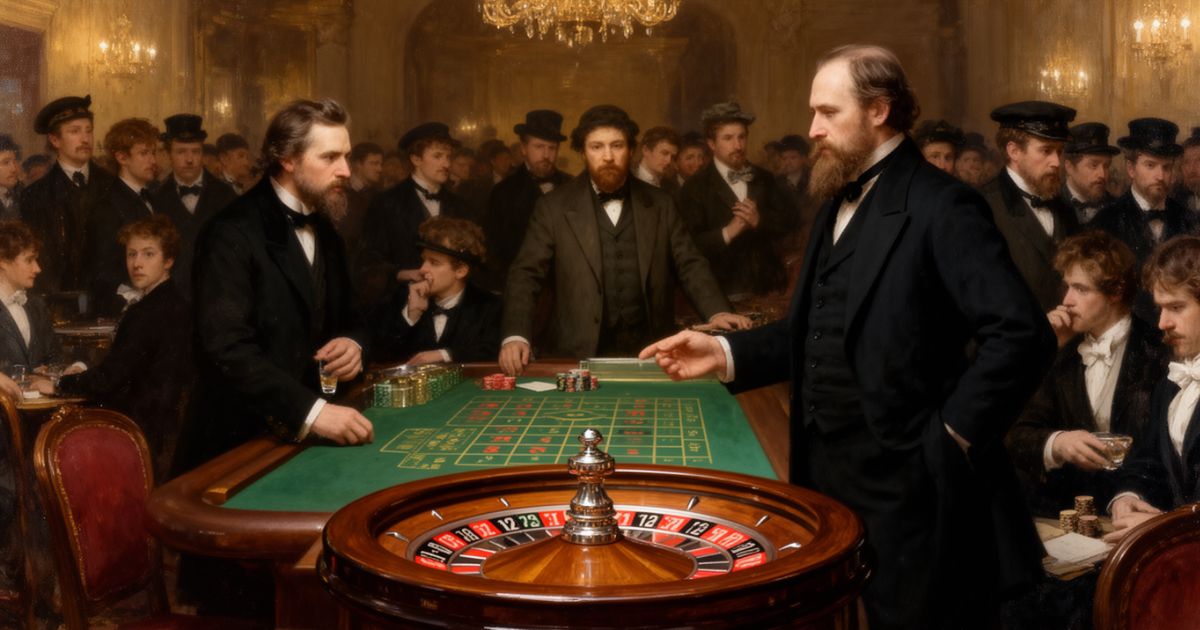
An excerpt from the original text.(complete · 3193 words)
es, she had been extraordinarily meditative. Yet, on leaving the
table, she immediately ordered me to accompany her for a walk. We took
the children with us, and set out for the fountain in the Park.
I was in such an irritated frame of mind that in rude and abrupt
fashion I blurted out a question as to “why our Marquis de Griers had
ceased to accompany her for strolls, or to speak to her for days
together.”
“Because he is a brute,” she replied in rather a curious way. It was
the first time that I had heard her speak so of De Griers:
consequently, I was momentarily awed into silence by this expression of
resentment.
“Have you noticed, too, that today he is by no means on good terms with
the General?” I went on.
“Yes—and I suppose you want to know why,” she replied with dry
captiousness. “You are aware, are you not, that the General is
mortgaged to the Marquis, with all his property? Consequently, if the
General’s mother does not die, the Frenchman will become the absolute
possessor of everything which he now holds only in pledge.”
“Then it is really the case that everything is mortgaged? I have heard
rumours to that effect, but was unaware how far they might be true.”
“Yes, they are true. What then?”
“Why, it will be a case of ‘Farewell, Mlle. Blanche,’” I remarked; “for
in such an event she would never become Madame General. Do you know, I
believe the old man is so much in love with her that he will shoot
himself if she should throw him over. At his age it is a dangerous
thing to fall in love.”
“Yes, something, I believe, will happen to him,” assented Polina
thoughtfully.
“And what a fine thing it all is!” I continued. “Could anything be more
abominable than the way in which she has agreed to marry for money
alone? Not one of the decencies has been observed; the whole affair has
taken place without the least ceremony. And as for the grandmother,
what could be more comical, yet more dastardly, than the sending of
telegram after telegram to know if she is dead? What do you think of
it, Polina Alexandrovna?”
“Yes, it is very horrible,” she interrupted with a shudder.
“Consequently, I am the more surprised that you should be so
cheerful. What are you so pleased about? About the fact that you have
gone and lost my money?”
“What? The money that you gave me to lose? I told you I should never
win for other people—least of all for you. I obeyed you simply because
you ordered me to; but you must not blame me for the result. I warned
you that no good would ever come of it. You seem much depressed at
having lost your money. Why do you need it so greatly?”
“Why do you ask me these questions?”
“Because you promised to explain matters to me. Listen. I am certain
that, as soon as ever I ‘begin to play for myself’ (and I still have
120 gülden left), I shall win. You can then take of me what you
require.”
She made a contemptuous grimace.
“You must not be angry with me,” I continued, “for making such a
proposal. I am so conscious of being only a nonentity in your eyes that
you need not mind accepting money from me. A gift from me could not
possibly offend you. Moreover, it was I who lost your gülden.”
She glanced at me, but, seeing that I was in an irritable, sarcastic
mood, changed the subject.
“My affairs cannot possibly interest you,” she said. “Still, if you
do wish to know, I am in debt. I borrowed some money, and must pay it
back again. I have a curious, senseless idea that I am bound to win at
the gaming-tables. Why I think so I cannot tell, but I do think so, and
with some assurance. Perhaps it is because of that assurance that I now
find myself without any other resource.”
“Or perhaps it is because it is so necessary for you to win. It is
like a drowning man catching at a straw. You yourself will agree that,
unless he were drowning he would not mistake a straw for the trunk of a
tree.”
Polina looked surprised.
“What?” she said. “Do not you also hope something from it? Did you not
tell me again and again, two weeks ago, that you were certain of
winning at roulette if you played here? And did you not ask me not to
consider you a fool for doing so? Were you joking? You cannot have
been, for I remember that you spoke with a gravity which forbade the
idea of your jesting.”
“True,” I replied gloomily. “I always felt certain that I should win.
Indeed, what you say makes me ask myself—Why have my absurd, senseless
losses of today raised a doubt in my mind? Yet I am still positive
that, so soon as ever I begin to play for myself, I shall infallibly
win.”
“And why are you so certain?”
“To tell the truth, I do not know. I only know that I must win—that
it is the one resource I have left. Yes, why do I feel so assured on
the point?”
“Perhaps because one cannot help winning if one is fanatically certain
of doing so.”
“Yet I dare wager that you do not think me capable of serious feeling
in the matter?”
“I do not care whether you are so or not,” answered Polina with calm
indifference. “Well, since you ask me, I do doubt your ability to
take anything seriously. You are capable of worrying, but not deeply.
You are too ill-regulated and unsettled a person for that. But why do
you want money? Not a single one of the reasons which you have given
can be looked upon as serious.”
“By the way,” I interrupted, “you say you want to pay off a debt. It
must be a large one. Is it to the Frenchman?”
“What do you mean by asking all these questions? You are very clever
today. Surely you are not drunk?”
“You know that you and I stand on no ceremony, and that sometimes I put
to you very plain questions. I repeat that I am your slave—and slaves
cannot be shamed or offended.”
“You talk like a child. It is always possible to comport oneself with
dignity. If one has a quarrel it ought to elevate rather than to
degrade one.”
“A maxim straight from the copybook! Suppose I cannot comport myself
with dignity. By that I mean that, though I am a man of self-respect, I
am unable to carry off a situation properly. Do you know the reason? It
is because we Russians are too richly and multifariously gifted to be
able at once to find the proper mode of expression. It is all a
question of mode. Most of us are so bounteously endowed with intellect
as to require also a spice of genius to choose the right form of
behaviour. And genius is lacking in us for the reason that so little
genius at all exists. It belongs only to the French—though a few other
Europeans have elaborated their forms so well as to be able to figure
with extreme dignity, and yet be wholly undignified persons. That is
why, with us, the mode is so all-important. The Frenchman may receive
an insult—a real, a venomous insult: yet, he will not so much as frown.
But a tweaking of the nose he cannot bear, for the reason that such an
act is an infringement of the accepted, of the time-hallowed order of
decorum. That is why our good ladies are so fond of Frenchmen—the
Frenchman’s manners, they say, are perfect! But in my opinion there is
no such thing as a Frenchman’s manners. The Frenchman is only a
bird—the coq gaulois. At the same time, as I am not a woman, I do not
properly understand the question. Cocks may be excellent birds. If I am
wrong you must stop me. You ought to stop and correct me more often
when I am speaking to you, for I am too apt to say everything that is
in my head.
“You see, I have lost my manners. I agree that I have none, nor yet any
dignity. I will tell you why. I set no store upon such things.
Everything in me has undergone a cheek. You know the reason. I have not
a single human thought in my head. For a long while I have been
ignorant of what is going on in the world—here or in Russia. I have
been to Dresden, yet am completely in the dark as to what Dresden is
like. You know the cause of my obsession. I have no hope now, and am a
mere cipher in your eyes; wherefore, I tell you outright that wherever
I go I see only you—all the rest is a matter of indifference.
“Why or how I have come to love you I do not know. It may be that you
are not altogether fair to look upon. Do you know, I am ignorant even
as to what your face is like. In all probability, too, your heart is
not comely, and it is possible that your mind is wholly ignoble.”
“And because you do not believe in my nobility of soul you think to
purchase me with money?” she said.
“When have I thought to do so?” was my reply.
“You are losing the thread of the argument. If you do not wish to
purchase me, at all events you wish to purchase my respect.”
“Not at all. I have told you that I find it difficult to explain
myself. You are hard upon me. Do not be angry at my chattering. You
know why you ought not to be angry with me—that I am simply an
imbecile. However, I do not mind if you are angry. Sitting in my
room, I need but to think of you, to imagine to myself the rustle of
your dress, and at once I fall almost to biting my hands. Why should
you be angry with me? Because I call myself your slave? Revel, I pray
you, in my slavery—revel in it. Do you know that sometimes I could kill
you?—not because I do not love you, or am jealous of you, but, because
I feel as though I could simply devour you... You are laughing!”
“No, I am not,” she retorted. “But I order you, nevertheless, to be
silent.”
She stopped, well nigh breathless with anger. God knows, she may not
have been a beautiful woman, yet I loved to see her come to a halt like
this, and was therefore, the more fond of arousing her temper. Perhaps
she divined this, and for that very reason gave way to rage. I said as
much to her.
“What rubbish!” she cried with a shudder.
“I do not care,” I continued. “Also, do you know that it is not safe
for us to take walks together? Often I have a feeling that I should
like to strike you, to disfigure you, to strangle you. Are you certain
that it will never come to that? You are driving me to frenzy. Am I
afraid of a scandal, or of your anger? Why should I fear your anger? I
love without hope, and know that hereafter I shall love you a thousand
times more. If ever I should kill you I should have to kill myself too.
But I shall put off doing so as long as possible, for I wish to
continue enjoying the unbearable pain which your coldness gives me. Do
you know a very strange thing? It is that, with every day, my love for
you increases—though that would seem to be almost an impossibility. Why
should I not become a fatalist? Remember how, on the third day that we
ascended the Shlangenberg, I was moved to whisper in your ear: ‘Say but
the word, and I will leap into the abyss.’ Had you said it, I should
have leapt. Do you not believe me?”
“What stupid rubbish!” she cried.
“I care not whether it be wise or stupid,” I cried in return. “I only
know that in your presence I must speak, speak, speak. Therefore, I am
speaking. I lose all conceit when I am with you, and everything ceases
to matter.”
“Why should I have wanted you to leap from the Shlangenberg?” she said
drily, and (I think) with wilful offensiveness. “That would have been
of no use to me.”
“Splendid!” I shouted. “I know well that you must have used the words
‘of no use’ in order to crush me. I can see through you. ‘Of no use,’
did you say? Why, to give pleasure is always of use; and, as for
barbarous, unlimited power—even if it be only over a fly—why, it is a
kind of luxury. Man is a despot by nature, and loves to torture. You,
in particular, love to do so.”
I remember that at this moment she looked at me in a peculiar way. The
fact is that my face must have been expressing all the maze of
senseless, gross sensations which were seething within me. To this day
I can remember, word for word, the conversation as I have written it
down. My eyes were suffused with blood, and the foam had caked itself
on my lips. Also, on my honour I swear that, had she bidden me cast
myself from the summit of the Shlangenberg, I should have done it. Yes,
had she bidden me in jest, or only in contempt and with a spit in my
face, I should have cast myself down.
“Oh no! Why so? I believe you,” she said, but in such a manner—in the
manner of which, at times, she was a mistress—and with such a note of
disdain and viperish arrogance in her tone, that God knows I could have
killed her.
Yes, at that moment she stood in peril. I had not lied to her about
that.
“Surely you are not a coward?” suddenly she asked me.
“I do not know,” I replied. “Perhaps I am, but I do not know. I have
long given up thinking about such things.”
“If I said to you, ‘Kill that man,’ would you kill him?”
“Whom?”
“Whomsoever I wish?”
“The Frenchman?”
“Do not ask me questions; return me answers. I repeat, whomsoever I
wish? I desire to see if you were speaking seriously just now.”
She awaited my reply with such gravity and impatience that I found the
situation unpleasant.
“Do you, rather, tell me,” I said, “what is going on here? Why do you
seem half-afraid of me? I can see for myself what is wrong. You are the
step-daughter of a ruined and insensate man who is smitten with love
for this devil of a Blanche. And there is this Frenchman, too, with his
mysterious influence over you. Yet, you actually ask me such a
question! If you do not tell me how things stand, I shall have to put
in my oar and do something. Are you ashamed to be frank with me? Are
you shy of me?”
“I am not going to talk to you on that subject. I have asked you a
question, and am waiting for an answer.”
“Well, then—I will kill whomsoever you wish,” I said. “But are you
really going to bid me do such deeds?”
“Why should you think that I am going to let you off? I shall bid you
do it, or else renounce me. Could you ever do the latter? No, you know
that you couldn’t. You would first kill whom I had bidden you, and then
kill me for having dared to send you away!”
Something seemed to strike upon my brain as I heard these words. Of
course, at the time I took them half in jest and half as a challenge;
yet, she had spoken them with great seriousness. I felt thunderstruck
that she should so express herself, that she should assert such a right
over me, that she should assume such authority and say outright:
“Either you kill whom I bid you, or I will have nothing more to do with
you.” Indeed, in what she had said there was something so cynical and
unveiled as to pass all bounds. For how could she ever regard me as the
same after the killing was done? This was more than slavery and
abasement; it was sufficient to bring a man back to his right senses.
Yet, despite the outrageous improbability of our conversation, my heart
shook within me.
Suddenly, she burst out laughing. We were seated on a bench near the
spot where the children were playing—just opposite the point in the
alley-way before the Casino where the carriages drew up in order to set
down their occupants.
“Do you see that fat Baroness?” she cried. “It is the Baroness
Burmergelm. She arrived three days ago. Just look at her husband—that
tall, wizened Prussian there, with the stick in his hand. Do you
remember how he stared at us the other day? Well, go to the Baroness,
take off your hat to her, and say something in French.”
“Why?”
“Because you have sworn that you would leap from the Shlangenberg for
my sake, and that you would kill any one whom I might bid you kill.
Well, instead of such murders and tragedies, I wish only for a good
laugh. Go without answering me, and let me see the Baron give you a
sound thrashing with his stick.”
“Then you throw me out a challenge?—you think that I will not do it?”
“Yes, I do challenge you. Go, for such is my will.”
“Then I will go, however mad be your fancy. Only, look here: shall
you not be doing the General a great disservice, as well as, through
him, a great disservice to yourself? It is not about myself I am
worrying—it is about you and the General. Why, for a mere fancy, should
I go and insult a woman?”
“Ah! Then I can see that you are only a trifler,” she said
contemptuously. “Your eyes are swimming with blood—but only because you
have drunk a little too much at luncheon. Do I not know that what I
have asked you to do is foolish and wrong, and that the General will be
angry about it? But I want to have a good laugh, all the same. I want
that, and nothing else. Why should you insult a woman, indeed? Well,
you will be given a sound thrashing for so doing.”
I turned away, and went silently to do her bidding. Of course the thing
was folly, but I could not get out of it. I remember that, as I
approached the Baroness, I felt as excited as a schoolboy. I was in a
frenzy, as though I were drunk.
Master this chapter. Complete your experience
Purchase the complete book to access all chapters and support classic literature
As an Amazon Associate, we earn a small commission from qualifying purchases at no additional cost to you.
Available in paperback, hardcover, and e-book formats
Let's Analyse the Pattern
Desperation makes people vulnerable to manipulation by those who offer false hope while gradually increasing their control.
Why This Matters
Connect literature to life
This chapter teaches how to spot when someone uses your desperation to test your boundaries and establish control over you.
Practice This Today
This week, notice when someone asks you to do something that makes you uncomfortable but frames it as a test of loyalty or trust - that's a red flag worth examining.
Now let's explore the literary elements.
Key Quotes & Analysis
"Because he is a brute"
Context: When the narrator asks why the Marquis no longer speaks to her
This is the first time Polina has openly criticized the Marquis, showing how the financial pressure is making everyone's true feelings surface. It reveals that even she, who usually keeps her emotions hidden, is cracking under the stress.
In Today's Words:
Because he's a complete jerk
"The General is mortgaged to the Marquis, with all his property"
Context: Explaining why everyone is on edge and desperate
This reveals the core crisis driving everyone's behavior. The General doesn't just owe money - he's literally signed away his entire life to the Marquis. It explains why gambling feels like their only escape route.
In Today's Words:
He owes everything he owns to this guy - if grandma doesn't die soon, we lose it all
"Would you kill a man if I commanded it?"
Context: Testing how far the narrator's devotion goes
This shows how Polina uses the narrator's obsession as entertainment and control. She's pushing boundaries to see what kind of power she has over him, which reveals both her cruelty and her own sense of powerlessness in other areas of her life.
In Today's Words:
If I told you to do something really crazy, would you actually do it?
Thematic Threads
Power
In This Chapter
Polina uses the narrator's obsession to test how much control she has over him, making him agree to humiliate himself
Development
Evolving from earlier hints to explicit manipulation and boundary testing
In Your Life:
You might recognize this when someone consistently asks you to prove your loyalty through increasingly uncomfortable actions.
Desperation
In This Chapter
Financial ruin drives the family to depend on the Marquis, while emotional desperation makes the narrator Polina's puppet
Development
Building from previous chapters' hints about money troubles to full revelation of their dire situation
In Your Life:
You see this when bill collectors call and suddenly every 'opportunity' starts looking reasonable, even the sketchy ones.
Class
In This Chapter
The family's aristocratic pretensions crumble as they become dependent on a creditor who holds their fate
Development
Deepening from earlier status anxiety to complete financial subjugation
In Your Life:
This appears when you realize your job title means nothing if you can't pay rent without it.
Identity
In This Chapter
The narrator agrees to act against his better judgment, sacrificing his dignity for Polina's approval
Development
Escalating from previous internal conflicts to active self-betrayal
In Your Life:
You experience this when you find yourself saying 'yes' to things that make you uncomfortable just to keep someone happy.
Rationalization
In This Chapter
Characters justify increasingly irrational behavior as their only option, from gambling to humiliation
Development
Introduced here as the mental mechanism that enables self-destructive choices
In Your Life:
This shows up when you catch yourself explaining why you 'had to' do something you know was wrong.
You now have the context. Time to form your own thoughts.
Discussion Questions
- 1
What desperate situation is the General's family facing, and why are they all so focused on gambling?
analysis • surface - 2
Why does Polina test the narrator by asking if he would kill someone for her, and what does his response reveal about their relationship?
analysis • medium - 3
Where do you see this pattern today - people using someone's desperation or feelings to make them do things they know are wrong?
application • medium - 4
How would you recognize if someone was using your emotions or needs to manipulate you, and what would you do about it?
application • deep - 5
What does this chapter teach us about how desperation changes our decision-making and makes us vulnerable to exploitation?
reflection • deep
Critical Thinking Exercise
Map the Leverage Points
Create a simple chart showing what each character desperately wants and what they're willing to sacrifice to get it. Then identify who has power over whom and why. Finally, think about a situation in your own life where someone might have similar leverage over you.
Consider:
- •Notice how desperation makes people accept worse and worse deals
- •Pay attention to who benefits from keeping others desperate
- •Consider how someone could break free from this cycle
Journaling Prompt
Write about a time when you felt pressured to do something you knew was wrong because you needed something from that person. How did you handle it, and what would you do differently now?
Coming Up Next...
Chapter 6: The Aftermath of Defiance
The narrator approaches the Baroness to carry out Polina's humiliating dare. Will he actually go through with insulting a stranger just to prove his devotion? And what consequences will this reckless act bring down on everyone?