An excerpt from the original text.(complete · 2276 words)
oday has been a day of folly, stupidity, and ineptness. The time is
now eleven o’clock in the evening, and I am sitting in my room and
thinking. It all began, this morning, with my being forced to go and
play roulette for Polina Alexandrovna. When she handed me over her
store of six hundred gülden I exacted two conditions—namely, that I
should not go halves with her in her winnings, if any (that is to say,
I should not take anything for myself), and that she should explain to
me, that same evening, why it was so necessary for her to win, and how
much was the sum which she needed. For, I could not suppose that she
was doing all this merely for the sake of money. Yet clearly she did
need some money, and that as soon as possible, and for a special
purpose. Well, she promised to explain matters, and I departed. There
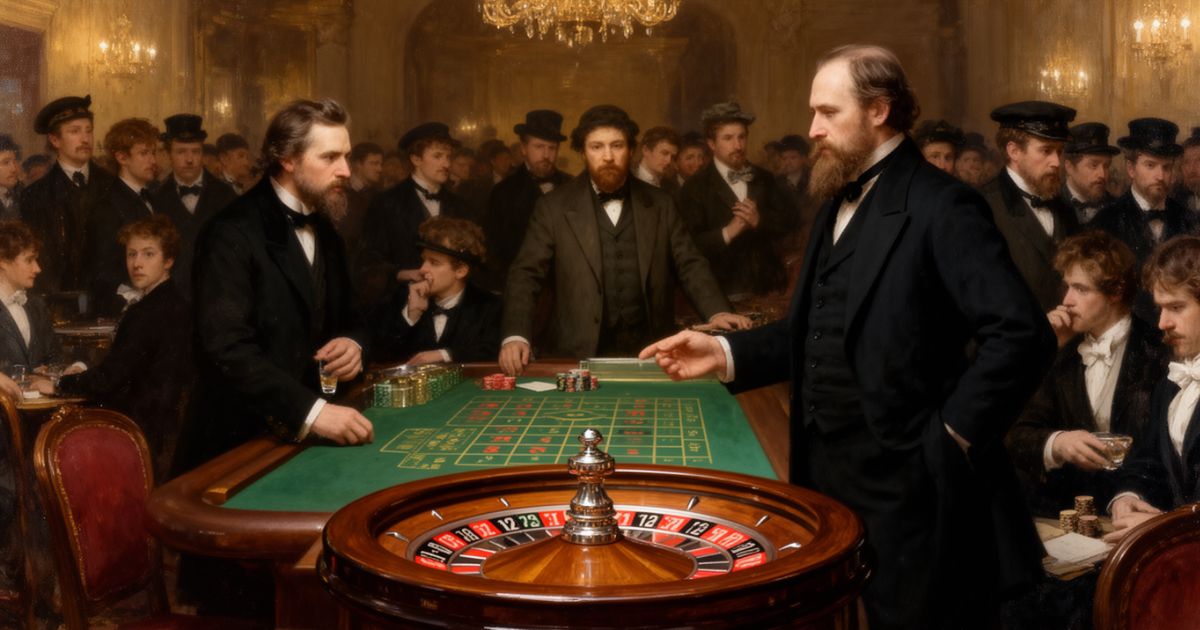
was a tremendous crowd in the gaming-rooms. What an arrogant, greedy
crowd it was! I pressed forward towards the middle of the room until I
had secured a seat at a croupier’s elbow. Then I began to play in timid
fashion, venturing only twenty or thirty gülden at a time. Meanwhile, I
observed and took notes. It seemed to me that calculation was
superfluous, and by no means possessed of the importance which certain
other players attached to it, even though they sat with ruled papers in
their hands, whereon they set down the coups, calculated the chances,
reckoned, staked, and—lost exactly as we more simple mortals did who
played without any reckoning at all.
However, I deduced from the scene one conclusion which seemed to me
reliable—namely, that in the flow of fortuitous chances there is, if
not a system, at all events a sort of order. This, of course, is a very
strange thing. For instance, after a dozen middle figures there would
always occur a dozen or so outer ones. Suppose the ball stopped twice
at a dozen outer figures; it would then pass to a dozen of the first
ones, and then, again, to a dozen of the middle ciphers, and fall upon
them three or four times, and then revert to a dozen outers; whence,
after another couple of rounds, the ball would again pass to the first
figures, strike upon them once, and then return thrice to the middle
series—continuing thus for an hour and a half, or two hours. One,
three, two: one, three, two. It was all very curious. Again, for the
whole of a day or a morning the red would alternate with the black, but
almost without any order, and from moment to moment, so that scarcely
two consecutive rounds would end upon either the one or the other. Yet,
next day, or, perhaps, the next evening, the red alone would turn up,
and attain a run of over two score, and continue so for quite a length
of time—say, for a whole day. Of these circumstances the majority were
pointed out to me by Mr. Astley, who stood by the gaming-table the
whole morning, yet never once staked in person.
For myself, I lost all that I had on me, and with great speed. To begin
with, I staked two hundred gülden on “even,” and won. Then I staked the
same amount again, and won: and so on some two or three times. At one
moment I must have had in my hands—gathered there within a space of
five minutes—about 4000 gülden. That, of course, was the proper moment
for me to have departed, but there arose in me a strange sensation as
of a challenge to Fate—as of a wish to deal her a blow on the cheek,
and to put out my tongue at her. Accordingly I set down the largest
stake allowed by the rules—namely, 4000 gülden—and lost. Fired by this
mishap, I pulled out all the money left to me, staked it all on the
same venture, and—again lost! Then I rose from the table, feeling as
though I were stupefied. What had happened to me I did not know; but,
before luncheon I told Polina of my losses—until which time I walked
about the Park.
At luncheon I was as excited as I had been at the meal three days ago.
Mlle. Blanche and the Frenchman were lunching with us, and it appeared
that the former had been to the Casino that morning, and had seen my
exploits there. So now she showed me more attention when talking to me;
while, for his part, the Frenchman approached me, and asked outright if
it had been my own money that I had lost. He appeared to be suspicious
as to something being on foot between Polina and myself, but I merely
fired up, and replied that the money had been all my own.
At this the General seemed extremely surprised, and asked me whence I
had procured it; whereupon I replied that, though I had begun only with
100 gülden, six or seven rounds had increased my capital to 5000 or
6000 gülden, and that subsequently I had lost the whole in two rounds.
All this, of course, was plausible enough. During my recital I glanced
at Polina, but nothing was to be discerned on her face. However, she
had allowed me to fire up without correcting me, and from that I
concluded that it was my cue to fire up, and to conceal the fact that
I had been playing on her behalf. “At all events,” I thought to myself,
“she, in her turn, has promised to give me an explanation to-night, and
to reveal to me something or another.”
Although the General appeared to be taking stock of me, he said
nothing. Yet I could see uneasiness and annoyance in his face. Perhaps
his straitened circumstances made it hard for him to have to hear of
piles of gold passing through the hands of an irresponsible fool like
myself within the space of a quarter of an hour. Now, I have an idea
that, last night, he and the Frenchman had a sharp encounter with one
another. At all events they closeted themselves together, and then had
a long and vehement discussion; after which the Frenchman departed in
what appeared to be a passion, but returned, early this morning, to
renew the combat. On hearing of my losses, however, he only remarked
with a sharp, and even a malicious, air that “a man ought to go more
carefully.” Next, for some reason or another, he added that, “though a
great many Russians go in for gambling, they are no good at the game.”
“I think that roulette was devised specially for Russians,” I
retorted; and when the Frenchman smiled contemptuously at my reply I
further remarked that I was sure I was right; also that, speaking of
Russians in the capacity of gamblers, I had far more blame for them
than praise—of that he could be quite sure.
“Upon what do you base your opinion?” he inquired.
“Upon the fact that to the virtues and merits of the civilised
Westerner there has become historically added—though this is not his
chief point—a capacity for acquiring capital; whereas, not only is the
Russian incapable of acquiring capital, but also he exhausts it
wantonly and of sheer folly. None the less we Russians often need
money; wherefore, we are glad of, and greatly devoted to, a method of
acquisition like roulette—whereby, in a couple of hours, one may grow
rich without doing any work. This method, I repeat, has a great
attraction for us, but since we play in wanton fashion, and without
taking any trouble, we almost invariably lose.”
“To a certain extent that is true,” assented the Frenchman with a
self-satisfied air.
“Oh no, it is not true,” put in the General sternly. “And you,” he
added to me, “you ought to be ashamed of yourself for traducing your
own country!”
“I beg pardon,” I said. “Yet it would be difficult to say which is the
worst of the two—Russian ineptitude or the German method of growing
rich through honest toil.”
“What an extraordinary idea,” cried the General.
“And what a Russian idea!” added the Frenchman.
I smiled, for I was rather glad to have a quarrel with them.
“I would rather live a wandering life in tents,” I cried, “than bow the
knee to a German idol!”
“To what idol?” exclaimed the General, now seriously angry.
“To the German method of heaping up riches. I have not been here very
long, but I can tell you that what I have seen and verified makes my
Tartar blood boil. Good Lord! I wish for no virtues of that kind.
Yesterday I went for a walk of about ten versts; and, everywhere I
found that things were even as we read of them in good German
picture-books—that every house has its ‘Vater,’ who is horribly
beneficent and extraordinarily honourable. So honourable is he that it
is dreadful to have anything to do with him; and I cannot bear people
of that sort. Each such ‘Vater’ has his family, and in the evenings
they read improving books aloud. Over their roof-trees there murmur
elms and chestnuts; the sun has sunk to his rest; a stork is roosting
on the gable; and all is beautifully poetic and touching. Do not be
angry, General. Let me tell you something that is even more touching
than that. I can remember how, of an evening, my own father, now dead,
used to sit under the lime trees in his little garden, and to read
books aloud to myself and my mother. Yes, I know how things ought to be
done. Yet every German family is bound to slavery and to submission to
its ‘Vater.’ They work like oxen, and amass wealth like Jews. Suppose
the ‘Vater’ has put by a certain number of gülden which he hands over
to his eldest son, in order that the said son may acquire a trade or a
small plot of land. Well, one result is to deprive the daughter of a
dowry, and so leave her among the unwedded. For the same reason, the
parents will have to sell the younger son into bondage or the ranks of
the army, in order that he may earn more towards the family capital.
Yes, such things ARE done, for I have been making inquiries on the
subject. It is all done out of sheer rectitude—out of a rectitude which
is magnified to the point of the younger son believing that he has been
rightly sold, and that it is simply idyllic for the victim to rejoice
when he is made over into pledge. What more have I to tell? Well,
this—that matters bear just as hardly upon the eldest son. Perhaps he
has his Gretchen to whom his heart is bound; but he cannot marry her,
for the reason that he has not yet amassed sufficient gülden. So, the
pair wait on in a mood of sincere and virtuous expectation, and
smilingly deposit themselves in pawn the while. Gretchen’s cheeks grow
sunken, and she begins to wither; until at last, after some twenty
years, their substance has multiplied, and sufficient gülden have been
honourably and virtuously accumulated. Then the ‘Vater’ blesses his
forty-year-old heir and the thirty-five-year-old Gretchen with the
sunken bosom and the scarlet nose; after which he bursts, into tears,
reads the pair a lesson on morality, and dies. In turn the eldest son
becomes a virtuous ‘Vater,’ and the old story begins again. In fifty or
sixty years’ time the grandson of the original ‘Vater’ will have
amassed a considerable sum; and that sum he will hand over to, his son,
and the latter to his son, and so on for several generations; until
at length there will issue a Baron Rothschild, or a ‘Hoppe and
Company,’ or the devil knows what! Is it not a beautiful spectacle—the
spectacle of a century or two of inherited labour, patience, intellect,
rectitude, character, perseverance, and calculation, with a stork
sitting on the roof above it all? What is more; they think there can
never be anything better than this; wherefore, from their point of
view they begin to judge the rest of the world, and to censure all who
are at fault—that is to say, who are not exactly like themselves. Yes,
there you have it in a nutshell. For my own part, I would rather grow
fat after the Russian manner, or squander my whole substance at
roulette. I have no wish to be ‘Hoppe and Company’ at the end of five
generations. I want the money for myself, for in no way do I look
upon my personality as necessary to, or meet to be given over to,
capital. I may be wrong, but there you have it. Those are my views.”
“How far you may be right in what you have said I do not know,”
remarked the General moodily; “but I do know that you are becoming an
insufferable farçeur whenever you are given the least chance.”
As usual, he left his sentence unfinished. Indeed, whenever he embarked
upon anything that in the least exceeded the limits of daily
small-talk, he left unfinished what he was saying. The Frenchman had
listened to me contemptuously, with a slight protruding of his eyes;
but, he could not have understood very much of my harangue. As for
Polina, she had looked on with serene indifference. She seemed to have
heard neither my voice nor any other during the progress of the meal.
Master this chapter. Complete your experience
Purchase the complete book to access all chapters and support classic literature
As an Amazon Associate, we earn a small commission from qualifying purchases at no additional cost to you.
Available in paperback, hardcover, and e-book formats
Let's Analyse the Pattern
Creating elaborate philosophical frameworks to make destructive personal choices seem noble or meaningful rather than taking responsibility for poor decisions.
Why This Matters
Connect literature to life
This chapter teaches how to recognize when elaborate explanations mask simple failures or poor choices.
Practice This Today
This week, notice when you find yourself building complex reasons for basic mistakes - catch yourself and ask what you're trying not to admit.
Now let's explore the literary elements.
Key Quotes & Analysis
"I could not suppose that she was doing all this merely for the sake of money. Yet clearly she did need some money, and that as soon as possible, and for a special purpose."
Context: Reflecting on why Polina asked him to gamble with her money
Shows the narrator creating mystery and romance around what's probably a simple financial transaction. He can't accept that their relationship might be purely practical.
In Today's Words:
I figured she must have some deeper reason for needing cash, not just regular money problems
"It seemed to me that calculation was superfluous, and by no means possessed of the importance which certain other players attached to it."
Context: Dismissing other gamblers' attempts to track patterns
The narrator rejects systematic thinking in favor of intuition and 'fate.' This attitude sets him up for disaster by ignoring the mathematical reality of gambling.
In Today's Words:
I thought all those people with their systems and tracking sheets were wasting their time
"To win money by the mere pressure of will—is not that better than to slave and save?"
Context: During his rant defending Russian gambling culture against German work ethic
Reveals the narrator's fundamental delusion that gambling is about willpower rather than chance. He's romanticizing his addiction as a superior way of life.
In Today's Words:
Isn't it better to get rich quick through pure determination than to work and save like a robot?
Thematic Threads
Self-Deception
In This Chapter
The narrator transforms his gambling addiction into a philosophical stance about Russian passion versus German methodical saving
Development
Deepening from earlier hints of rationalization into full-blown ideological justification
In Your Life:
You might catch yourself creating noble reasons for behaviors you know are actually harmful or self-defeating
Class Resentment
In This Chapter
His anti-German tirade masks deeper feelings of inadequacy about his own financial failures and social position
Development
Evolved from subtle class anxiety to open hostility toward different cultural approaches to wealth
In Your Life:
You might find yourself criticizing others' success strategies when you're actually frustrated with your own results
Transactional Relationships
In This Chapter
Polina's complete indifference to his loss suggests their connection is based on utility, not genuine care
Development
Building on earlier hints that their relationship lacks authentic emotional foundation
In Your Life:
You might recognize when someone only engages with you when they need something, showing little interest in your actual wellbeing
Addiction Psychology
In This Chapter
The classic pattern of starting cautiously, winning big, then betting everything and losing it all while calling it 'challenging fate'
Development
First clear demonstration of the gambling addiction that drives the entire narrative
In Your Life:
You might notice this escalation pattern in any compulsive behavior—shopping, social media, or risky decisions
Cultural Identity
In This Chapter
Using national stereotypes to justify personal failures, claiming Russian recklessness is superior to German discipline
Development
Introduced here as a new defense mechanism
In Your Life:
You might catch yourself using group identity to avoid personal accountability for individual choices
You now have the context. Time to form your own thoughts.
Discussion Questions
- 1
The narrator wins big at roulette but then bets everything and loses it all. What specific moment could he have walked away, and why didn't he?
analysis • surface - 2
After losing Polina's money, the narrator launches into a bitter speech against German work habits and values. What is he really trying to accomplish with this rant?
analysis • medium - 3
Think about someone you know who creates elaborate explanations for their repeated mistakes. How do their justifications protect them from facing the real problem?
application • medium - 4
When you've made a serious error in judgment, how do you catch yourself before building a whole philosophy to justify it?
application • deep - 5
The narrator transforms his gambling addiction into a statement about national character and fate. What does this reveal about how people protect their self-image when their actions contradict their values?
reflection • deep
Critical Thinking Exercise
Decode Your Own Rationalizations
Think of a recent mistake or failure you made. Write down the first explanation you gave yourself or others about why it happened. Then write what actually happened without any justifications. Notice the difference between your protective story and the simple truth.
Consider:
- •Look for language that makes you sound noble or victimized rather than responsible
- •Notice if your explanation involves attacking others or entire groups of people
- •Pay attention to how elaborate your justification is compared to how simple the actual mistake was
Journaling Prompt
Write about a time when you caught yourself building an elaborate justification for a simple mistake. How did it feel to drop the story and just admit what really happened?
Coming Up Next...
Chapter 5: The Power of Dangerous Questions
The narrator's losses have consequences beyond his own shame. Polina still owes him an explanation for why she needed the money so desperately, and the mysterious dynamics between the General, the Frenchman, and the household's financial troubles are about to become clearer.