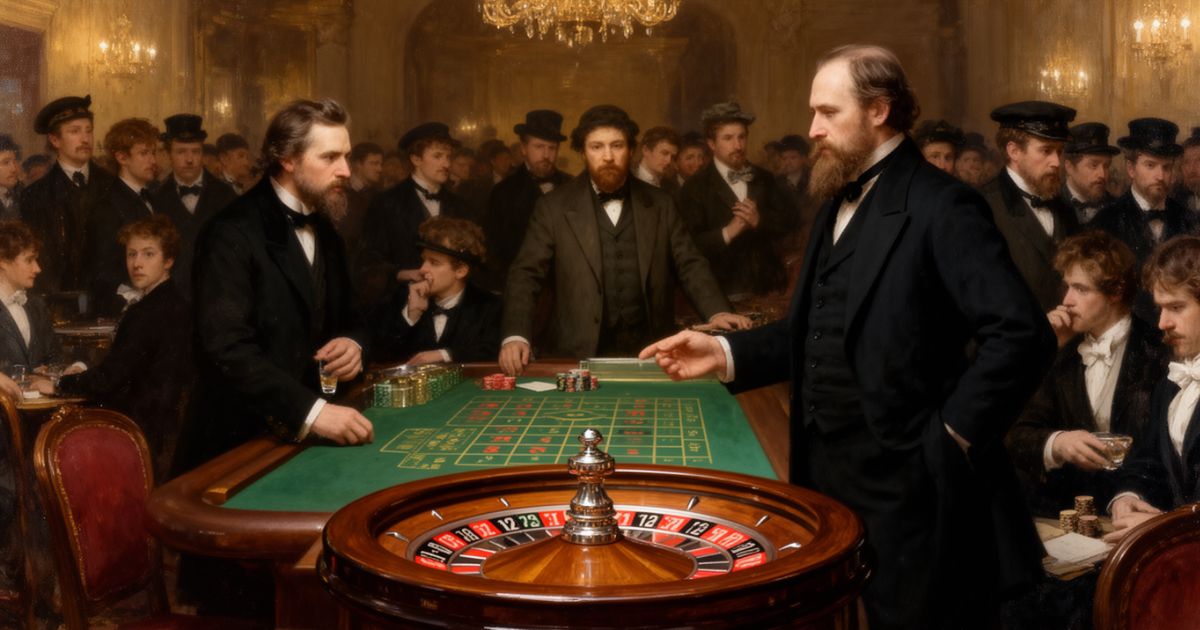
An excerpt from the original text.(complete · 1985 words)
n the morrow she said not a word to me about gambling. In fact, she
purposely avoided me, although her old manner to me had not changed:
the same serene coolness was hers on meeting me—a coolness that was
mingled even with a spice of contempt and dislike. In short, she was at
no pains to conceal her aversion to me. That I could see plainly. Also,
she did not trouble to conceal from me the fact that I was necessary to
her, and that she was keeping me for some end which she had in view.
Consequently there became established between us relations which, to a
large extent, were incomprehensible to me, considering her general
pride and aloofness. For example, although she knew that I was madly in
love with her, she allowed me to speak to her of my passion (though she
could not well have showed her contempt for me more than by permitting
me, unhindered and unrebuked, to mention to her my love).
“You see,” her attitude expressed, “how little I regard your feelings,
as well as how little I care for what you say to me, or for what you
feel for me.” Likewise, though she spoke as before concerning her
affairs, it was never with complete frankness. In her contempt for me
there were refinements. Although she knew well that I was aware of a
certain circumstance in her life of something which might one day cause
her trouble, she would speak to me about her affairs (whenever she had
need of me for a given end) as though I were a slave or a passing
acquaintance—yet tell them me only in so far as one would need to know
them if one were going to be made temporary use of. Had I not known the
whole chain of events, or had she not seen how much I was pained and
disturbed by her teasing insistency, she would never have thought it
worthwhile to soothe me with this frankness—even though, since she not
infrequently used me to execute commissions that were not only
troublesome, but risky, she ought, in my opinion, to have been frank in
any case. But, forsooth, it was not worth her while to trouble about
my feelings—about the fact that I was uneasy, and, perhaps, thrice
as put about by her cares and misfortunes as she was herself!
For three weeks I had known of her intention to take to roulette. She
had even warned me that she would like me to play on her behalf, since
it was unbecoming for her to play in person; and, from the tone of her
words I had gathered that there was something on her mind besides a
mere desire to win money. As if money could matter to her! No, she
had some end in view, and there were circumstances at which I could
guess, but which I did not know for certain. True, the slavery and
abasement in which she held me might have given me (such things often
do so) the power to question her with abrupt directness (seeing that,
inasmuch as I figured in her eyes as a mere slave and nonentity, she
could not very well have taken offence at any rude curiosity); but the
fact was that, though she let me question her, she never returned me a
single answer, and at times did not so much as notice me. That is how
matters stood.
Next day there was a good deal of talk about a telegram which, four
days ago, had been sent to St. Petersburg, but to which there had come
no answer. The General was visibly disturbed and moody, for the matter
concerned his mother. The Frenchman, too, was excited, and after dinner
the whole party talked long and seriously together—the Frenchman’s tone
being extraordinarily presumptuous and offhand to everybody. It almost
reminded one of the proverb, “Invite a man to your table, and soon he
will place his feet upon it.” Even to Polina he was brusque almost to
the point of rudeness. Yet still he seemed glad to join us in our walks
in the Casino, or in our rides and drives about the town. I had long
been aware of certain circumstances which bound the General to him; I
had long been aware that in Russia they had hatched some scheme
together although I did not know whether the plot had come to anything,
or whether it was still only in the stage of being talked of. Likewise
I was aware, in part, of a family secret—namely, that, last year, the
Frenchman had bailed the General out of debt, and given him 30,000
roubles wherewith to pay his Treasury dues on retiring from the
service. And now, of course, the General was in a vice—although the
chief part in the affair was being played by Mlle. Blanche. Yes, of
this last I had no doubt.
But who was this Mlle. Blanche? It was said of her that she was a
Frenchwoman of good birth who, living with her mother, possessed a
colossal fortune. It was also said that she was some relation to the
Marquis, but only a distant one a cousin, or cousin-german, or
something of the sort. Likewise I knew that, up to the time of my
journey to Paris, she and the Frenchman had been more ceremonious
towards our party—they had stood on a much more precise and delicate
footing with them; but that now their acquaintanceship—their
friendship, their intimacy—had taken on a much more off-hand and
rough-and-ready air. Perhaps they thought that our means were too
modest for them, and, therefore, unworthy of politeness or reticence.
Also, for the last three days I had noticed certain looks which Astley
had kept throwing at Mlle. Blanche and her mother; and it had occurred
to me that he must have had some previous acquaintance with the pair. I
had even surmised that the Frenchman too must have met Mr. Astley
before. Astley was a man so shy, reserved, and taciturn in his manner
that one might have looked for anything from him. At all events the
Frenchman accorded him only the slightest of greetings, and scarcely
even looked at him. Certainly he did not seem to be afraid of him;
which was intelligible enough. But why did Mlle. Blanche also never
look at the Englishman?—particularly since, à propos of something or
another, the Marquis had declared the Englishman to be immensely and
indubitably rich? Was not that a sufficient reason to make Mlle.
Blanche look at the Englishman? Anyway the General seemed extremely
uneasy; and, one could well understand what a telegram to announce the
death of his mother would mean for him!
Although I thought it probable that Polina was avoiding me for a
definite reason, I adopted a cold and indifferent air; for I felt
pretty certain that it would not be long before she herself approached
me. For two days, therefore, I devoted my attention to Mlle. Blanche.
The poor General was in despair! To fall in love at fifty-five, and
with such vehemence, is indeed a misfortune! And add to that his
widowerhood, his children, his ruined property, his debts, and the
woman with whom he had fallen in love! Though Mlle. Blanche was
extremely good-looking, I may or may not be understood when I say that
she had one of those faces which one is afraid of. At all events, I
myself have always feared such women. Apparently about twenty-five
years of age, she was tall and broad-shouldered, with shoulders that
sloped; yet though her neck and bosom were ample in their proportions,
her skin was dull yellow in colour, while her hair (which was extremely
abundant—sufficient to make two coiffures) was as black as Indian ink.
Add to that a pair of black eyes with yellowish whites, a proud glance,
gleaming teeth, and lips which were perennially pomaded and redolent of
musk. As for her dress, it was invariably rich, effective, and chic,
yet in good taste. Lastly, her feet and hands were astonishing, and her
voice a deep contralto. Sometimes, when she laughed, she displayed her
teeth, but at ordinary times her air was taciturn and
haughty—especially in the presence of Polina and Maria Philipovna. Yet
she seemed to me almost destitute of education, and even of wits,
though cunning and suspicious. This, apparently, was not because her
life had been lacking in incident. Perhaps, if all were known, the
Marquis was not her kinsman at all, nor her mother, her mother; but
there was evidence that, in Berlin, where we had first come across the
pair, they had possessed acquaintances of good standing. As for the
Marquis himself, I doubt to this day if he was a Marquis—although about
the fact that he had formerly belonged to high society (for instance,
in Moscow and Germany) there could be no doubt whatever. What he had
formerly been in France I had not a notion. All I knew was that he was
said to possess a château. During the last two weeks I had looked for
much to transpire, but am still ignorant whether at that time anything
decisive ever passed between Mademoiselle and the General. Everything
seemed to depend upon our means—upon whether the General would be able
to flourish sufficient money in her face. If ever the news should
arrive that the grandmother was not dead, Mlle. Blanche, I felt sure,
would disappear in a twinkling. Indeed, it surprised and amused me to
observe what a passion for intrigue I was developing. But how I loathed
it all! With what pleasure would I have given everybody and everything
the go-by! Only—I could not leave Polina. How, then, could I show
contempt for those who surrounded her? Espionage is a base thing,
but—what have I to do with that?
Mr. Astley, too, I found a curious person. I was only sure that he had
fallen in love with Polina. A remarkable and diverting circumstance is
the amount which may lie in the mien of a shy and painfully modest man
who has been touched with the divine passion—especially when he would
rather sink into the earth than betray himself by a single word or
look. Though Mr. Astley frequently met us when we were out walking, he
would merely take off his hat and pass us by, though I knew he was
dying to join us. Even when invited to do so, he would refuse. Again,
in places of amusement—in the Casino, at concerts, or near the
fountain—he was never far from the spot where we were sitting. In fact,
wherever we were in the Park, in the forest, or on the
Shlangenberg—one needed but to raise one’s eyes and glance around to
catch sight of at least a portion of Mr. Astley’s frame sticking
out—whether on an adjacent path or behind a bush. Yet never did he lose
any chance of speaking to myself; and, one morning when we had met, and
exchanged a couple of words, he burst out in his usual abrupt way,
without saying “Good-morning.”
“That Mlle. Blanche,” he said. “Well, I have seen a good many women
like her.”
After that he was silent as he looked me meaningly in the face. What he
meant I did not know, but to my glance of inquiry he returned only a
dry nod, and a reiterated “It is so.” Presently, however, he resumed:
“Does Mlle. Polina like flowers?”
“I really cannot say,” was my reply.
“What? You cannot say?” he cried in great astonishment.
“No; I have never noticed whether she does so or not,” I repeated with
a smile.
“Hm! Then I have an idea in my mind,” he concluded. Lastly, with a nod,
he walked away with a pleased expression on his face. The conversation
had been carried on in execrable French.
Master this chapter. Complete your experience
Purchase the complete book to access all chapters and support classic literature
As an Amazon Associate, we earn a small commission from qualifying purchases at no additional cost to you.
Available in paperback, hardcover, and e-book formats
Let's Analyse the Pattern
When emotional attachment blinds us to mistreatment and keeps us participating in relationships that degrade us.
Why This Matters
Connect literature to life
This chapter teaches how to recognize when someone uses your emotional investment against you to maintain control while offering nothing in return.
Practice This Today
This week, notice when someone asks for your time, energy, or loyalty while treating you poorly—then ask yourself if you're staying because it's genuinely good for you or because you're afraid to lose what you've already invested.
Now let's explore the literary elements.
Key Quotes & Analysis
"You see, how little I regard your feelings, as well as how little I care for what you say to me, or for what you feel for me."
Context: The narrator explains how Polina's behavior communicates her complete indifference to his feelings
This shows how some people will openly display their contempt while still expecting you to remain available to them. It's a particularly cruel form of manipulation because it's so honest about the disrespect.
In Today's Words:
I don't care about your feelings at all, and I'm not even going to pretend I do.
"Although she knew that I was madly in love with her, she allowed me to speak to her of my passion."
Context: Describing how Polina permits him to express his love while showing contempt for it
This reveals how toxic relationships can involve someone letting you be vulnerable while they use that vulnerability against you. The permission to speak becomes another form of humiliation.
In Today's Words:
She knew I was crazy about her and let me embarrass myself by talking about it.
"I was necessary to her, and that she was keeping me for some end which she had in view."
Context: Realizing that Polina keeps him around because she needs him for something
This shows the painful clarity that can come in toxic relationships - you can see exactly how you're being used but feel powerless to stop it. It's about being reduced to your utility rather than valued as a person.
In Today's Words:
She needed me for something and was keeping me around until she was ready to use me.
Thematic Threads
Toxic Power Dynamics
In This Chapter
Polina maintains control over the narrator through contempt mixed with just enough attention to keep him hoping
Development
Expanding from earlier hints about their relationship to show the full manipulative dynamic
In Your Life:
You might recognize this in relationships where someone keeps you off-balance with hot-and-cold treatment
Financial Desperation
In This Chapter
Everyone's behavior shifts based on money—the General's debt, waiting for his mother's death, Blanche's calculations
Development
Building on previous financial tensions to show how money corrupts all relationships in this world
In Your Life:
You see this when financial stress makes family members or coworkers treat each other as resources rather than people
Self-Deception
In This Chapter
The narrator believes he sees through everyone's games while remaining trapped in the worst one
Development
Introduced here as the narrator's particular blind spot
In Your Life:
You might catch yourself staying in bad situations while telling yourself you're 'choosing' to be there
Social Performance
In This Chapter
Everyone performs roles based on what they think others want—Blanche playing the sophisticated woman, the General playing the gentleman
Development
Continuing the theme of people as performers rather than authentic selves
In Your Life:
You see this in workplace dynamics where everyone performs their 'professional self' while hiding their real motivations
Unrequited Obsession
In This Chapter
Both the narrator with Polina and Mr. Astley with Polina show how one-sided attraction creates suffering
Development
Introduced here as a parallel pattern affecting multiple characters
In Your Life:
You might recognize this in your own past relationships where you invested more energy than you received back
You now have the context. Time to form your own thoughts.
Discussion Questions
- 1
Why does the narrator stay with Polina even though he admits she treats him with contempt and uses him as a tool?
analysis • surface - 2
How does Polina maintain control over the narrator through her pattern of giving just enough attention mixed with poor treatment?
analysis • medium - 3
Where do you see this same pattern of emotional hostage-taking in modern workplaces, relationships, or family dynamics?
application • medium - 4
What specific boundaries would you set if you found yourself in the narrator's position, and how would you enforce them even when it felt painful?
application • deep - 5
Why do people often find it harder to leave toxic situations the more they've already invested in them?
reflection • deep
Critical Thinking Exercise
Map Your Investment vs. Treatment Ratio
Think of a relationship (work, personal, or family) where you feel frustrated or undervalued. Draw two columns: 'What I Give/Invest' and 'What I Receive/Get Back.' List everything honestly in each column. Then ask yourself: If a friend showed you this list about their situation, what would you advise them to do?
Consider:
- •Include emotional investment, not just time or money
- •Look at actual treatment received, not potential or promises
- •Consider whether you're staying because it's good or because you're afraid to lose what you've already put in
Journaling Prompt
Write about a time when you stayed in a situation longer than you should have because you'd already invested so much. What would you tell your past self now?
Coming Up Next...
Chapter 4: The Gambler's Delusion and Cultural Clash
The tension around the General's mother reaches a breaking point, while the narrator's observations of the power dynamics begin to reveal dangerous undercurrents that could destroy them all.