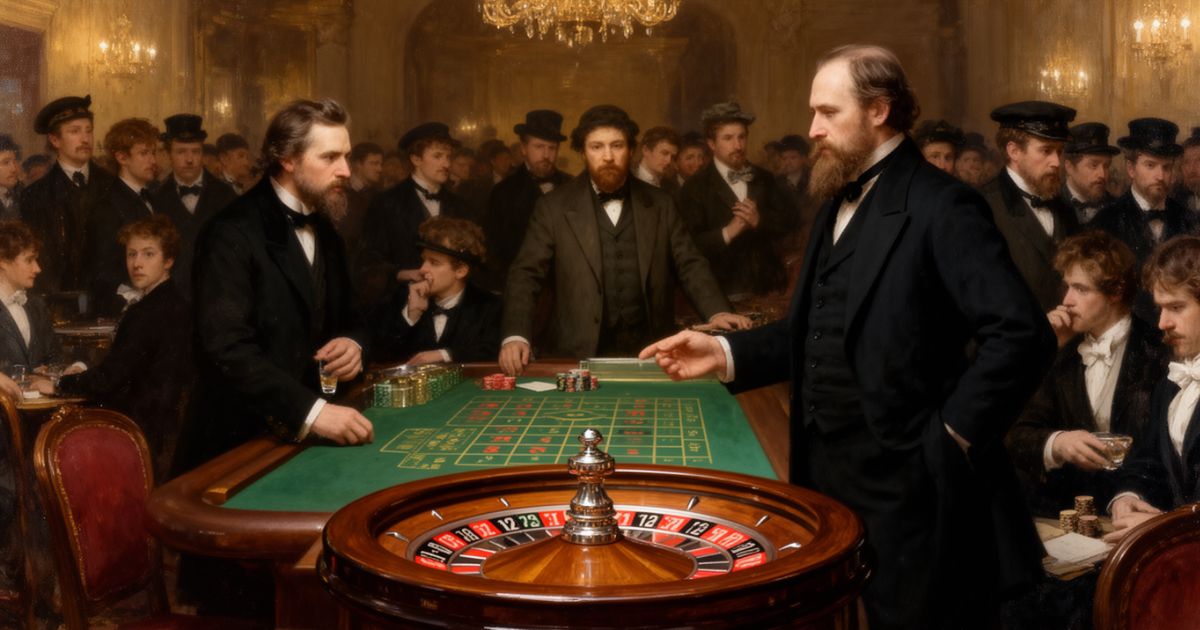
An excerpt from the original text.(complete · 2491 words)
confess I did not like it. Although I had made up my mind to play, I
felt averse to doing so on behalf of some one else. In fact, it almost
upset my balance, and I entered the gaming rooms with an angry feeling
at my heart. At first glance the scene irritated me. Never at any time
have I been able to bear the flunkeyishness which one meets in the
Press of the world at large, but more especially in that of Russia,
where, almost every evening, journalists write on two subjects in
particular—namely, on the splendour and luxury of the casinos to be
found in the Rhenish towns, and on the heaps of gold which are daily to
be seen lying on their tables. Those journalists are not paid for doing
so: they write thus merely out of a spirit of disinterested
complaisance. For there is nothing splendid about the establishments in
question; and, not only are there no heaps of gold to be seen lying on
their tables, but also there is very little money to be seen at all. Of
course, during the season, some madman or another may make his
appearance—generally an Englishman, or an Asiatic, or a Turk—and (as
had happened during the summer of which I write) win or lose a great
deal; but, as regards the rest of the crowd, it plays only for petty
gülden, and seldom does much wealth figure on the board.
When, on the present occasion, I entered the gaming-rooms (for the
first time in my life), it was several moments before I could even make
up my mind to play. For one thing, the crowd oppressed me. Had I been
playing for myself, I think I should have left at once, and never have
embarked upon gambling at all, for I could feel my heart beginning to
beat, and my heart was anything but cold-blooded. Also, I knew, I had
long ago made up my mind, that never should I depart from Roulettenberg
until some radical, some final, change had taken place in my fortunes.
Thus, it must and would be. However ridiculous it may seem to you that
I was expecting to win at roulette, I look upon the generally accepted
opinion concerning the folly and the grossness of hoping to win at
gambling as a thing even more absurd. For why is gambling a whit worse
than any other method of acquiring money? How, for instance, is it
worse than trade? True, out of a hundred persons, only one can win; yet
what business is that of yours or of mine?
At all events, I confined myself at first simply to looking on, and
decided to attempt nothing serious. Indeed, I felt that, if I began to
do anything at all, I should do it in an absent-minded, haphazard sort
of way—of that I felt certain. Also, it behoved me to learn the game
itself; since, despite a thousand descriptions of roulette which I had
read with ceaseless avidity, I knew nothing of its rules, and had never
even seen it played.
In the first place, everything about it seemed to me so foul—so morally
mean and foul. Yet I am not speaking of the hungry, restless folk who,
by scores nay, even by hundreds—could be seen crowded around the
gaming-tables. For in a desire to win quickly and to win much I can see
nothing sordid; I have always applauded the opinion of a certain dead
and gone, but cocksure, moralist who replied to the excuse that “one
may always gamble moderately”, by saying that to do so makes things
worse, since, in that case, the profits too will always be moderate.
Insignificant profits and sumptuous profits do not stand on the same
footing. No, it is all a matter of proportion. What may seem a small
sum to a Rothschild may seem a large sum to me, and it is not the fault
of stakes or of winnings that everywhere men can be found winning, can
be found depriving their fellows of something, just as they do at
roulette. As to the question whether stakes and winnings are, in
themselves, immoral is another question altogether, and I wish to
express no opinion upon it. Yet the very fact that I was full of a
strong desire to win caused this gambling for gain, in spite of its
attendant squalor, to contain, if you will, something intimate,
something sympathetic, to my eyes: for it is always pleasant to see men
dispensing with ceremony, and acting naturally, and in an unbuttoned
mood....
Yet why should I so deceive myself? I could see that the whole thing
was a vain and unreasoning pursuit; and what, at the first glance,
seemed to me the ugliest feature in this mob of roulette players was
their respect for their occupation—the seriousness, and even the
humility, with which they stood around the gaming tables. Moreover, I
had always drawn sharp distinctions between a game which is de mauvais
genre and a game which is permissible to a decent man. In fact, there
are two sorts of gaming—namely, the game of the gentleman and the game
of the plebs—the game for gain, and the game of the herd. Herein, as
said, I draw sharp distinctions. Yet how essentially base are the
distinctions! For instance, a gentleman may stake, say, five or ten
louis d’or—seldom more, unless he is a very rich man, when he may
stake, say, a thousand francs; but, he must do this simply for the love
of the game itself—simply for sport, simply in order to observe the
process of winning or of losing, and, above all things, as a man who
remains quite uninterested in the possibility of his issuing a winner.
If he wins, he will be at liberty, perhaps, to give vent to a laugh, or
to pass a remark on the circumstance to a bystander, or to stake again,
or to double his stake; but, even this he must do solely out of
curiosity, and for the pleasure of watching the play of chances and of
calculations, and not because of any vulgar desire to win. In a word,
he must look upon the gaming-table, upon roulette, and upon trente et
quarante, as mere relaxations which have been arranged solely for his
amusement. Of the existence of the lures and gains upon which the bank
is founded and maintained he must profess to have not an inkling. Best
of all, he ought to imagine his fellow-gamblers and the rest of the mob
which stands trembling over a coin to be equally rich and gentlemanly
with himself, and playing solely for recreation and pleasure. This
complete ignorance of the realities, this innocent view of mankind, is
what, in my opinion, constitutes the truly aristocratic. For instance,
I have seen even fond mothers so far indulge their guileless, elegant
daughters—misses of fifteen or sixteen—as to give them a few gold coins
and teach them how to play; and though the young ladies may have won or
have lost, they have invariably laughed, and departed as though they
were well pleased. In the same way, I saw our General once approach the
table in a stolid, important manner. A lacquey darted to offer him a
chair, but the General did not even notice him. Slowly he took out his
money bags, and slowly extracted 300 francs in gold, which he staked on
the black, and won. Yet he did not take up his winnings—he left them
there on the table. Again the black turned up, and again he did not
gather in what he had won; and when, in the third round, the red
turned up he lost, at a stroke, 1200 francs. Yet even then he rose with
a smile, and thus preserved his reputation; yet I knew that his money
bags must be chafing his heart, as well as that, had the stake been
twice or thrice as much again, he would still have restrained himself
from venting his disappointment.
On the other hand, I saw a Frenchman first win, and then lose, 30,000
francs cheerfully, and without a murmur. Yes; even if a gentleman
should lose his whole substance, he must never give way to annoyance.
Money must be so subservient to gentility as never to be worth a
thought. Of course, the supremely aristocratic thing is to be
entirely oblivious of the mire of rabble, with its setting; but
sometimes a reverse course may be aristocratic to remark, to scan, and
even to gape at, the mob (for preference, through a lorgnette), even as
though one were taking the crowd and its squalor for a sort of raree
show which had been organised specially for a gentleman’s diversion.
Though one may be squeezed by the crowd, one must look as though one
were fully assured of being the observer—of having neither part nor lot
with the observed. At the same time, to stare fixedly about one is
unbecoming; for that, again, is ungentlemanly, seeing that no spectacle
is worth an open stare—are no spectacles in the world which merit from
a gentleman too pronounced an inspection.
However, to me personally the scene did seem to be worth undisguised
contemplation—more especially in view of the fact that I had come there
not only to look at, but also to number myself sincerely and
wholeheartedly with, the mob. As for my secret moral views, I had no
room for them amongst my actual, practical opinions. Let that stand as
written: I am writing only to relieve my conscience. Yet let me say
also this: that from the first I have been consistent in having an
intense aversion to any trial of my acts and thoughts by a moral
standard. Another standard altogether has directed my life....
As a matter of fact, the mob was playing in exceedingly foul fashion.
Indeed, I have an idea that sheer robbery was going on around that
gaming-table. The croupiers who sat at the two ends of it had not only
to watch the stakes, but also to calculate the game—an immense amount
of work for two men! As for the crowd itself—well, it consisted mostly
of Frenchmen. Yet I was not then taking notes merely in order to be
able to give you a description of roulette, but in order to get my
bearings as to my behaviour when I myself should begin to play. For
example, I noticed that nothing was more common than for another’s hand
to stretch out and grab one’s winnings whenever one had won. Then there
would arise a dispute, and frequently an uproar; and it would be a case
of “I beg of you to prove, and to produce witnesses to the fact, that
the stake is yours.”
At first the proceedings were pure Greek to me. I could only divine and
distinguish that stakes were hazarded on numbers, on “odd” or “even,”
and on colours. Polina’s money I decided to risk, that evening, only to
the amount of 100 gülden. The thought that I was not going to play for
myself quite unnerved me. It was an unpleasant sensation, and I tried
hard to banish it. I had a feeling that, once I had begun to play for
Polina, I should wreck my own fortunes. Also, I wonder if any one has
ever approached a gaming-table without falling an immediate prey to
superstition? I began by pulling out fifty gülden, and staking them on
“even.” The wheel spun and stopped at 13. I had lost! With a feeling
like a sick qualm, as though I would like to make my way out of the
crowd and go home, I staked another fifty gülden—this time on the red.
The red turned up. Next time I staked the 100 gülden just where they
lay—and again the red turned up. Again I staked the whole sum, and
again the red turned up. Clutching my 400 gülden, I placed 200 of them
on twelve figures, to see what would come of it. The result was that
the croupier paid me out three times my total stake! Thus from 100
gülden my store had grown to 800! Upon that such a curious, such an
inexplicable, unwonted feeling overcame me that I decided to depart.
Always the thought kept recurring to me that if I had been playing for
myself alone I should never have had such luck. Once more I staked the
whole 800 gülden on the “even.” The wheel stopped at 4. I was paid out
another 800 gülden, and, snatching up my pile of 1600, departed in
search of Polina Alexandrovna.
I found the whole party walking in the park, and was able to get an
interview with her only after supper. This time the Frenchman was
absent from the meal, and the General seemed to be in a more expansive
vein. Among other things, he thought it necessary to remind me that he
would be sorry to see me playing at the gaming-tables. In his opinion,
such conduct would greatly compromise him—especially if I were to lose
much. “And even if you were to win much I should be compromised,” he
added in a meaning sort of way. “Of course I have no right to order
your actions, but you yourself will agree that...” As usual, he did not
finish his sentence. I answered drily that I had very little money in
my possession, and that, consequently, I was hardly in a position to
indulge in any conspicuous play, even if I did gamble. At last, when
ascending to my own room, I succeeded in handing Polina her winnings,
and told her that, next time, I should not play for her.
“Why not?” she asked excitedly.
“Because I wish to play for myself,” I replied with a feigned glance
of astonishment. “That is my sole reason.”
“Then are you so certain that your roulette-playing will get us out of
our difficulties?” she inquired with a quizzical smile.
I said very seriously, “Yes,” and then added: “Possibly my certainty
about winning may seem to you ridiculous; yet, pray leave me in peace.”
Nonetheless she insisted that I ought to go halves with her in the
day’s winnings, and offered me 800 gülden on condition that henceforth,
I gambled only on those terms; but I refused to do so, once and for
all—stating, as my reason, that I found myself unable to play on behalf
of any one else, “I am not unwilling so to do,” I added, “but in all
probability I should lose.”
“Well, absurd though it be, I place great hopes on your playing of
roulette,” she remarked musingly; “wherefore, you ought to play as my
partner and on equal shares; wherefore, of course, you will do as I
wish.”
Then she left me without listening to any further protests on my part.
Master this chapter. Complete your experience
Purchase the complete book to access all chapters and support classic literature
As an Amazon Associate, we earn a small commission from qualifying purchases at no additional cost to you.
Available in paperback, hardcover, and e-book formats
Let's Analyse the Pattern
Success achieved through others' resources feels hollow and creates psychological dependence rather than empowerment.
Why This Matters
Connect literature to life
This chapter teaches how to spot when someone's offer of help or opportunity is really about serving their interests, not yours.
Practice This Today
This week, notice when someone offers you an opportunity and ask yourself: what do they get out of this, and what control are they expecting in return?
Now let's explore the literary elements.
Key Quotes & Analysis
"I felt averse to doing so on behalf of some one else. In fact, it almost upset my balance, and I entered the gaming rooms with an angry feeling at my heart."
Context: As he prepares to gamble with Polina's money rather than his own
This reveals how gambling with someone else's money creates psychological discomfort. The narrator understands that true gambling requires personal risk - when it's not your money, the entire emotional experience is corrupted.
In Today's Words:
I hated the idea of gambling with her money instead of my own. It felt wrong and made me angry before I even started.
"Those journalists are not paid for doing so: they write thus merely out of a spirit of disinterested complaisance."
Context: Criticizing journalists who write glowing reports about casino luxury without compensation
The narrator sees through the performative nature of social climbing. These writers aren't even being paid - they're just desperate to seem connected to wealth and sophistication.
In Today's Words:
These reporters aren't even getting paid to write this stuff - they just want to look like they're part of the cool, rich crowd.
"I want to play for my own sake."
Context: When Polina asks him to continue gambling as her partner after his big win
This declaration marks a crucial turning point where the narrator asserts his independence. He realizes that gambling has meaning only when the stakes are truly personal - both the risk and the reward must be his own.
In Today's Words:
I want to gamble with my own money and for my own reasons, not yours.
Thematic Threads
Class
In This Chapter
The narrator observes stark differences between how wealthy and poor people gamble - aristocrats play with detached amusement while common folk tremble with desperation
Development
Building from previous chapter's class tensions between the narrator and his employers
In Your Life:
You might notice how differently people with financial security approach risks compared to those living paycheck to paycheck
Identity
In This Chapter
The narrator feels caught between social worlds and uncomfortable playing for someone else's interests rather than his own
Development
Deepening the narrator's struggle to define himself outside his servant role
In Your Life:
You might recognize the discomfort of not knowing where you truly belong or whose agenda you're serving
Control
In This Chapter
Despite winning, the narrator feels powerless because he's not playing for himself and refuses to continue as Polina's partner
Development
Introduced here as the narrator begins asserting personal agency
In Your Life:
You might feel this when others try to direct your choices even when they're helping you succeed
Expectations
In This Chapter
The narrator's beginner's luck feels almost supernatural, but he questions whether it would continue if he played for himself
Development
Introduced here as doubt about sustainable success
In Your Life:
You might wonder if your achievements are real or just temporary luck that won't last
Relationships
In This Chapter
The dynamic between the narrator and Polina becomes strained when money and gambling enter their relationship
Development
Evolving from previous tension to active conflict over independence
In Your Life:
You might see how financial arrangements can complicate personal relationships and create power imbalances
You now have the context. Time to form your own thoughts.
Discussion Questions
- 1
Why does the narrator feel uncomfortable winning money at the casino, even though he's successful?
analysis • surface - 2
What does the narrator's observation about wealthy versus poor gamblers reveal about how class affects risk-taking?
analysis • medium - 3
Where do you see this pattern of 'hollow victories' in modern workplaces or relationships?
application • medium - 4
How would you maintain your sense of ownership and agency when accepting help or resources from others?
application • deep - 5
What does this chapter suggest about the relationship between independence and self-worth?
reflection • deep
Critical Thinking Exercise
Map Your Resource Dependencies
List three current situations where you're using someone else's resources, connections, or support to achieve something. For each one, identify what you contribute versus what they contribute, and what obligations or expectations come with their help. Then consider how you could increase your own 'skin in the game' to maintain more agency.
Consider:
- •Notice the difference between collaboration and dependency
- •Consider both tangible resources (money, tools) and intangible ones (connections, reputation)
- •Think about how the power dynamic affects your decision-making freedom
Journaling Prompt
Write about a time when someone else's help made your success feel less meaningful. What would you do differently now to preserve your sense of ownership while still accepting support?
Coming Up Next...
Chapter 3: Power Games and Hidden Motives
With his pockets full of winnings and his confidence building, the narrator prepares to gamble for his own future. But will his luck continue when the stakes become personal?