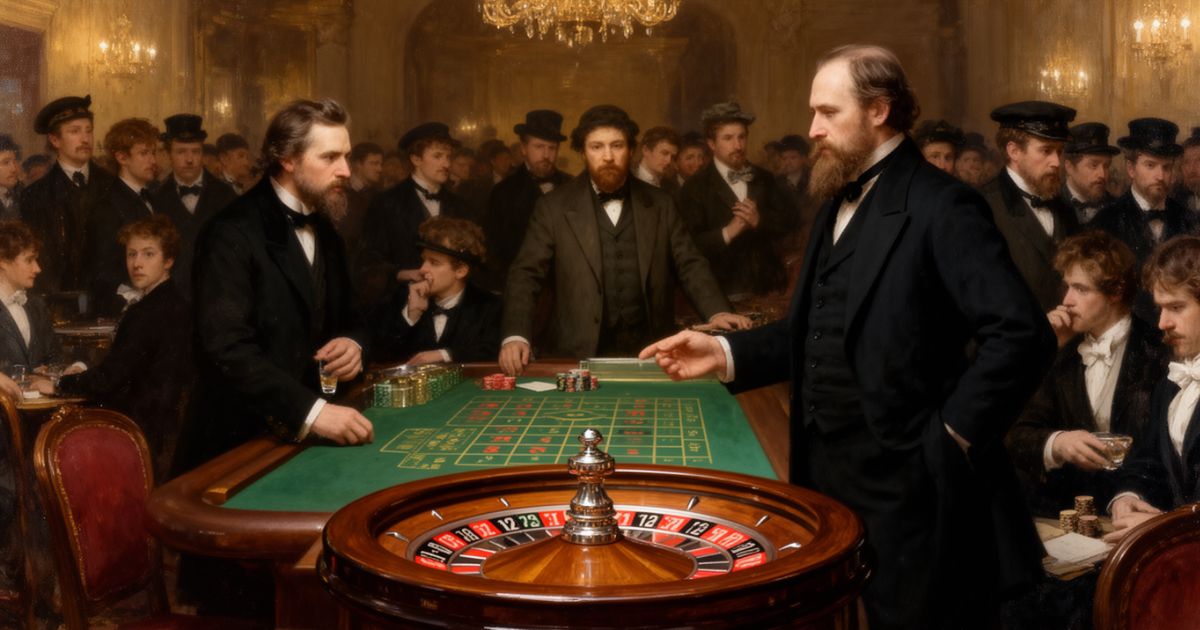
An excerpt from the original text.(complete · 3247 words)
wo days have passed since that day of lunacy. What a noise and a fuss
and a chattering and an uproar there was! And what a welter of
unseemliness and disorder and stupidity and bad manners! And I the
cause of it all! Yet part of the scene was also ridiculous—at all
events to myself it was so. I am not quite sure what was the matter
with me—whether I was merely stupefied or whether I purposely broke
loose and ran amok. At times my mind seems all confused; while at other
times I seem almost to be back in my childhood, at the school desk, and
to have done the deed simply out of mischief.
It all came of Polina—yes, of Polina. But for her, there might never
have been a fracas. Or perhaps I did the deed in a fit of despair
(though it may be foolish of me to think so)? What there is so
attractive about her I cannot think. Yet there is something
attractive about her—something passing fair, it would seem. Others
besides myself she has driven to distraction. She is tall and straight,
and very slim. Her body looks as though it could be tied into a knot,
or bent double, like a cord. The imprint of her foot is long and
narrow. It is, a maddening imprint—yes, simply a maddening one! And her
hair has a reddish tint about it, and her eyes are like cat’s
eyes—though able also to glance with proud, disdainful mien. On the
evening of my first arrival, four months ago, I remember that she was
sitting and holding an animated conversation with De Griers in the
salon. And the way in which she looked at him was such that later, when
I retired to my own room upstairs, I kept fancying that she had smitten
him in the face—that she had smitten him right on the cheek, so
peculiar had been her look as she stood confronting him. Ever since
that evening I have loved her.
But to my tale.
I stepped from the path into the carriage-way, and took my stand in the
middle of it. There I awaited the Baron and the Baroness. When they
were but a few paces distant from me I took off my hat, and bowed.
I remember that the Baroness was clad in a voluminous silk dress, pale
grey in colour, and adorned with flounces and a crinoline and train.
Also, she was short and inordinately stout, while her gross, flabby
chin completely concealed her neck. Her face was purple, and the little
eyes in it had an impudent, malicious expression. Yet she walked as
though she were conferring a favour upon everybody by so doing. As for
the Baron, he was tall, wizened, bony-faced after the German fashion,
spectacled, and, apparently, about forty-five years of age. Also, he
had legs which seemed to begin almost at his chest—or, rather, at his
chin! Yet, for all his air of peacock-like conceit, his clothes sagged
a little, and his face wore a sheepish air which might have passed for
profundity.
These details I noted within a space of a few seconds.
At first my bow and the fact that I had my hat in my hand barely caught
their attention. The Baron only scowled a little, and the Baroness
swept straight on.
“Madame la Baronne,” said I, loudly and distinctly—embroidering each
word, as it were—“j’ai l’honneur d’être votre esclave.”
Then I bowed again, put on my hat, and walked past the Baron with a
rude smile on my face.
Polina had ordered me merely to take off my hat: the bow and the
general effrontery were of my own invention. God knows what instigated
me to perpetrate the outrage! In my frenzy I felt as though I were
walking on air.
“Hein!” ejaculated—or, rather, growled—the Baron as he turned towards
me in angry surprise.
I too turned round, and stood waiting in pseudo-courteous expectation.
Yet still I wore on my face an impudent smile as I gazed at him. He
seemed to hesitate, and his brows contracted to their utmost limits.
Every moment his visage was growing darker. The Baroness also turned in
my direction, and gazed at me in wrathful perplexity, while some of the
passers-by also began to stare at us, and others of them halted
outright.
“Hein!” the Baron vociferated again, with a redoubled growl and a note
of growing wrath in his voice.
“Ja wohl!” I replied, still looking him in the eyes.
“Sind Sie rasend?” he exclaimed, brandishing his stick, and,
apparently, beginning to feel nervous. Perhaps it was my costume which
intimidated him, for I was well and fashionably dressed, after the
manner of a man who belongs to indisputably good society.
“Ja wo-o-ohl!” cried I again with all my might with a longdrawn rolling
of the “ohl” sound after the fashion of the Berliners (who constantly
use the phrase “Ja wohl!” in conversation, and more or less prolong the
syllable “ohl” according as they desire to express different shades of
meaning or of mood).
At this the Baron and the Baroness faced sharply about, and almost fled
in their alarm. Some of the bystanders gave vent to excited
exclamations, and others remained staring at me in astonishment. But I
do not remember the details very well.
Wheeling quietly about, I returned in the direction of Polina
Alexandrovna. But, when I had got within a hundred paces of her seat, I
saw her rise and set out with the children towards the hotel.
At the portico I caught up to her.
“I have perpetrated the—the piece of idiocy,” I said as I came level
with her.
“Have you? Then you can take the consequences,” she replied without so
much as looking at me. Then she moved towards the staircase.
I spent the rest of the evening walking in the park. Thence I passed
into the forest, and walked on until I found myself in a neighbouring
principality. At a wayside restaurant I partook of an omelette and some
wine, and was charged for the idyllic repast a thaler and a half.
Not until eleven o’clock did I return home—to find a summons awaiting
me from the General.
Our party occupied two suites in the hotel; each of which contained two
rooms. The first (the larger suite) comprised a salon and a
smoking-room, with, adjoining the latter, the General’s study. It was
here that he was awaiting me as he stood posed in a majestic attitude
beside his writing-table. Lolling on a divan close by was De Griers.
“My good sir,” the General began, “may I ask you what this is that you
have gone and done?”
“I should be glad,” I replied, “if we could come straight to the point.
Probably you are referring to my encounter of today with a German?”
“With a German? Why, the German was the Baron Burmergelm—a most
important personage! I hear that you have been rude both to him and to
the Baroness?”
“No, I have not.”
“But I understand that you simply terrified them, my good sir?” shouted
the General.
“Not in the least,” I replied. “You must know that when I was in Berlin
I frequently used to hear the Berliners repeat, and repellently
prolong, a certain phrase—namely, ‘Ja wohl!’; and, happening to meet
this couple in the carriage-drive, I found, for some reason or another,
that this phrase suddenly recurred to my memory, and exercised a
rousing effect upon my spirits. Moreover, on the three previous
occasions that I have met the Baroness she has walked towards me as
though I were a worm which could easily be crushed with the foot. Not
unnaturally, I too possess a measure of self-respect; wherefore, on
this occasion I took off my hat, and said politely (yes, I assure you
it was said politely): ‘Madame, j’ai l’honneur d’être votre esclave.’
Then the Baron turned round, and said ‘Hein!’; whereupon I felt moved
to ejaculate in answer ‘Ja wohl!’ Twice I shouted it at him—the first
time in an ordinary tone, and the second time with the greatest
prolonging of the words of which I was capable. That is all.”
I must confess that this puerile explanation gave me great pleasure. I
felt a strong desire to overlay the incident with an even added measure
of grossness; so, the further I proceeded, the more did the gusto of my
proceeding increase.
“You are only making fun of me!” vociferated the General as, turning to
the Frenchman, he declared that my bringing about of the incident had
been gratuitous. De Griers smiled contemptuously, and shrugged his
shoulders.
“Do not think that,” I put in. “It was not so at all. I grant you
that my behaviour was bad—I fully confess that it was so, and make no
secret of the fact. I would even go so far as to grant you that my
behaviour might well be called stupid and indecent tomfoolery; but,
more than that it was not. Also, let me tell you that I am very sorry
for my conduct. Yet there is one circumstance which, in my eyes, almost
absolves me from regret in the matter. Of late—that is to say, for the
last two or three weeks—I have been feeling not at all well. That is to
say, I have been in a sick, nervous, irritable, fanciful condition, so
that I have periodically lost control over myself. For instance, on
more than one occasion I have tried to pick a quarrel even with
Monsieur le Marquise here; and, under the circumstances, he had no
choice but to answer me. In short, I have recently been showing signs
of ill-health. Whether the Baroness Burmergelm will take this
circumstance into consideration when I come to beg her pardon (for I
do intend to make her amends) I do not know; but I doubt if she will,
and the less so since, so far as I know, the circumstance is one which,
of late, has begun to be abused in the legal world, in that advocates
in criminal cases have taken to justifying their clients on the ground
that, at the moment of the crime, they (the clients) were unconscious
of what they were doing—that, in short, they were out of health. ‘My
client committed the murder—that is true; but he has no recollection of
having committed it.’ And doctors actually support these advocates by
affirming that there really is such a malady—that there really can
arise temporary delusions which make a man remember nothing of a given
deed, or only a half or a quarter of it! But the Baron and Baroness are
members of an older generation, as well as Prussian Junkers and
landowners. To them such a process in the medico-judicial world will be
unknown, and therefore, they are the more unlikely to accept any such
explanation. What is your opinion about it, General?”
“Enough, sir!” he thundered with barely restrained fury. “Enough, I
say! Once and for all I must endeavour to rid myself of you and your
impertinence. To justify yourself in the eyes of the Baron and Baroness
will be impossible. Any intercourse with you, even though it be
confined to a begging of their pardons, they would look upon as a
degradation. I may tell you that, on learning that you formed part of
my household, the Baron approached me in the Casino, and demanded of me
additional satisfaction. Do you understand, then, what it is that you
have entailed upon me—upon me, my good sir? You have entailed upon me
the fact of my being forced to sue humbly to the Baron, and to give him
my word of honour that this very day you shall cease to belong to my
establishment!”
“Excuse me, General,” I interrupted, “but did he make an express point
of it that I should ‘cease to belong to your establishment,’ as you
call it?”
“No; I, of my own initiative, thought that I ought to afford him that
satisfaction; and, with it he was satisfied. So we must part, good sir.
It is my duty to hand over to you forty gülden, three florins, as per
the accompanying statement. Here is the money, and here the account,
which you are at liberty to verify. Farewell. From henceforth we are
strangers. From you I have never had anything but trouble and
unpleasantness. I am about to call the landlord, and explain to him
that from tomorrow onwards I shall no longer be responsible for your
hotel expenses. Also I have the honour to remain your obedient
servant.”
I took the money and the account (which was indicted in pencil), and,
bowing low to the General, said to him very gravely:
“The matter cannot end here. I regret very much that you should have
been put to unpleasantness at the Baron’s hands; but, the fault (pardon
me) is your own. How came you to answer for me to the Baron? And what
did you mean by saying that I formed part of your household? I am
merely your family tutor—not a son of yours, nor yet your ward, nor a
person of any kind for whose acts you need be responsible. I am a
judicially competent person, a man of twenty-five years of age, a
university graduate, a gentleman, and, until I met yourself, a complete
stranger to you. Only my boundless respect for your merits restrains me
from demanding satisfaction at your hands, as well as a further
explanation as to the reasons which have led you to take it upon
yourself to answer for my conduct.”
So struck was he with my words that, spreading out his hands, he turned
to the Frenchman, and interpreted to him that I had challenged himself
(the General) to a duel. The Frenchman laughed aloud.
“Nor do I intend to let the Baron off,” I continued calmly, but with
not a little discomfiture at De Griers’ merriment. “And since you,
General, have today been so good as to listen to the Baron’s
complaints, and to enter into his concerns—since you have made yourself
a participator in the affair—I have the honour to inform you that,
tomorrow morning at the latest, I shall, in my own name, demand of the
said Baron a formal explanation as to the reasons which have led him to
disregard the fact that the matter lies between him and myself alone,
and to put a slight upon me by referring it to another person, as
though I were unworthy to answer for my own conduct.”
Then there happened what I had foreseen. The General on hearing of this
further intended outrage, showed the white feather.
“What?” he cried. “Do you intend to go on with this damned nonsense? Do
you not realise the harm that it is doing me? I beg of you not to laugh
at me, sir—not to laugh at me, for we have police authorities here who,
out of respect for my rank, and for that of the Baron... In short, sir,
I swear to you that I will have you arrested, and marched out of the
place, to prevent any further brawling on your part. Do you understand
what I say?” He was almost breathless with anger, as well as in a
terrible fright.
“General,” I replied with that calmness which he never could abide,
“one cannot arrest a man for brawling until he has brawled. I have not
so much as begun my explanations to the Baron, and you are altogether
ignorant as to the form and time which my intended procedure is likely
to assume. I wish but to disabuse the Baron of what is, to me, a
shameful supposition—namely, that I am under the guardianship of a
person who is qualified to exercise control over my free will. It is
vain for you to disturb and alarm yourself.”
“For God’s sake, Alexis Ivanovitch, do put an end to this senseless
scheme of yours!” he muttered, but with a sudden change from a
truculent tone to one of entreaty as he caught me by the hand. “Do you
know what is likely to come of it? Merely further unpleasantness. You
will agree with me, I am sure, that at present I ought to move with
especial care—yes, with very especial care. You cannot be fully aware
of how I am situated. When we leave this place I shall be ready to
receive you back into my household; but, for the time being I— Well, I
cannot tell you all my reasons.” With that he wound up in a despairing
voice: “O Alexis Ivanovitch, Alexis Ivanovitch!”
I moved towards the door—begging him to be calm, and promising that
everything should be done decently and in order; whereafter I departed.
Russians, when abroad, are over-apt to play the poltroon, to watch all
their words, and to wonder what people are thinking of their conduct,
or whether such and such a thing is comme il faut. In short, they are
over-apt to cosset themselves, and to lay claim to great importance.
Always they prefer the form of behaviour which has once and for all
become accepted and established. This they will follow slavishly
whether in hotels, on promenades, at meetings, or when on a journey.
But the General had avowed to me that, over and above such
considerations as these, there were circumstances which compelled him
to “move with especial care at present”, and that the fact had actually
made him poor-spirited and a coward—it had made him altogether change
his tone towards me. This fact I took into my calculations, and duly
noted it, for, of course, he might apply to the authorities tomorrow,
and it behoved me to go carefully.
Yet it was not the General but Polina that I wanted to anger. She had
treated me with such cruelty, and had got me into such a hole, that I
felt a longing to force her to beseech me to stop. Of course, my
tomfoolery might compromise her; yet certain other feelings and desires
had begun to form themselves in my brain. If I was never to rank in her
eyes as anything but a nonentity, it would not greatly matter if I
figured as a draggle-tailed cockerel, and the Baron were to give me a
good thrashing; but, the fact was that I desired to have the laugh of
them all, and to come out myself unscathed. Let people see what they
would see. Let Polina, for once, have a good fright, and be forced to
whistle me to heel again. But, however much she might whistle, she
should see that I was at least no draggle-tailed cockerel!
I have just received a surprising piece of news. I have just met our
chambermaid on the stairs, and been informed by her that Maria
Philipovna departed today, by the night train, to stay with a cousin at
Carlsbad. What can that mean? The maid declares that Madame packed her
trunks early in the day. Yet how is it that no one else seems to have
been aware of the circumstance? Or is it that I have been the only
person to be unaware of it? Also, the maid has just told me that, three
days ago, Maria Philipovna had some high words with the General. I
understand, then! Probably the words were concerning Mlle. Blanche.
Certainly something decisive is approaching.
Master this chapter. Complete your experience
Purchase the complete book to access all chapters and support classic literature
As an Amazon Associate, we earn a small commission from qualifying purchases at no additional cost to you.
Available in paperback, hardcover, and e-book formats
Let's Analyse the Pattern
When we feel powerless in one area of life, we create dramatic conflicts in another to feel in control.
Why This Matters
Connect literature to life
This chapter teaches how to recognize when we create manageable conflicts to avoid dealing with uncontrollable frustrations.
Practice This Today
This week, notice when you feel like picking a fight—ask yourself what you're really upset about that you can't control.
Now let's explore the literary elements.
Key Quotes & Analysis
"It all came of Polina—yes, of Polina. But for her, there might never have been a fracas."
Context: He's reflecting on what drove him to create the public scene with the German nobles
This shows how he blames his obsession with Polina for his self-destructive behavior. He can't take full responsibility for his actions because admitting his powerlessness over her would be too painful.
In Today's Words:
This whole mess happened because I'm obsessed with her and can't think straight.
"I am not quite sure what was the matter with me—whether I was merely stupefied or whether I purposely broke loose and ran amok."
Context: He's trying to understand his own motivations for the bizarre confrontation
This reveals his psychological confusion and possible self-deception. He may be protecting his ego by pretending he doesn't know why he acted so destructively when the real reason is his humiliation over Polina.
In Today's Words:
I honestly don't know if I just lost it or if I deliberately went crazy on purpose.
"What there is so attractive about her I cannot think. Yet there is something attractive about her—something passing fair, it would seem."
Context: He's describing his obsession with Polina despite her cruel treatment of him
This contradiction shows how destructive attraction works - he knows logically that she's bad for him but can't resist her pull. His obsession has nothing to do with rational evaluation of her character.
In Today's Words:
I can't figure out why I'm so drawn to her, but there's definitely something about her that drives me crazy.
Thematic Threads
Class
In This Chapter
The narrator insists on his status as a gentleman and university graduate when fired, refusing to be treated like a servant
Development
Evolved from earlier observations about social hierarchy to direct confrontation over class dignity
In Your Life:
You might recognize this when you feel your professional qualifications or personal worth being dismissed by someone in authority
Identity
In This Chapter
The narrator struggles between who he thinks he is (gentleman) versus how others treat him (employee/dependent)
Development
Building from previous chapters where he observed social roles to now actively defending his self-concept
In Your Life:
This appears when there's a gap between how you see yourself and how others treat you at work or in relationships
Power
In This Chapter
Unable to control Polina's feelings, he seeks power through defying authority figures and creating confrontations
Development
Escalated from passive observation of power dynamics to active rebellion against them
In Your Life:
You might see this when you feel powerless in one relationship so you become controlling or argumentative in others
Self-destruction
In This Chapter
The narrator admits his behavior was childish but continues it anyway, knowing it damages his position
Development
Introduced here as a conscious choice to harm his own interests for emotional satisfaction
In Your Life:
This shows up when you know you're making things worse for yourself but can't stop because it feels emotionally satisfying in the moment
Love
In This Chapter
His obsession with Polina drives all his destructive behavior, yet he can't directly address their relationship
Development
Deepened from earlier attraction to acknowledged obsession that controls his actions
In Your Life:
You might recognize this pattern when your feelings for someone make you act irrationally in completely unrelated situations
You now have the context. Time to form your own thoughts.
Discussion Questions
- 1
Why does the narrator refuse to apologize to the Baron and Baroness, even when it costs him his job?
analysis • surface - 2
What's really driving the narrator's dramatic confrontation with the German couple - is it about them, or something else?
analysis • medium - 3
When have you seen someone pick fights with easier targets when they're actually frustrated about something they can't control?
application • medium - 4
How could the narrator have handled his frustration with Polina in a way that didn't sabotage his own position?
application • deep - 5
What does this chapter reveal about how powerlessness in one area of life can poison other areas?
reflection • deep
Critical Thinking Exercise
Map Your Displacement Patterns
Think of a recent time when you felt frustrated or powerless about something important. Write down what you were really upset about, then trace whether you took that frustration out somewhere else - maybe snapping at family, being extra critical at work, or picking fights about minor issues. Map the connection between your real frustration and where you displaced it.
Consider:
- •Look for patterns - do you always displace in the same direction (work stress to home, relationship issues to work)?
- •Notice the emotional payoff - what did creating drama give you that dealing with the real problem didn't?
- •Consider the cost - what relationships or opportunities did the displacement damage?
Journaling Prompt
Write about a current frustration you can't immediately control. What would healthy ways of managing that energy look like, instead of letting it spill over into areas where you do have influence?
Coming Up Next...
Chapter 7: The Power Behind the Throne
The narrator's confrontation with the Baron looms, while mysterious departures and hidden tensions within the household suggest that everyone's carefully maintained facades are beginning to crumble. What started as personal rebellion may trigger consequences no one anticipated.