An excerpt from the original text.(complete · 3588 words)
he shock made me utter an exclamation.
“What is the matter? What is the matter?” she asked in a strange voice.
She was looking pale, and her eyes were dim.
“What is the matter?” I re-echoed. “Why, the fact that you are here!”
“If I am here, I have come with all that I have to bring,” she said.
“Such has always been my way, as you shall presently see. Please light
a candle.”
I did so; whereupon she rose, approached the table, and laid upon it an
open letter.
“Read it,” she added.
“It is De Griers’ handwriting!” I cried as I seized the document. My
hands were so tremulous that the lines on the pages danced before my
eyes. Although, at this distance of time, I have forgotten the exact
phraseology of the missive, I append, if not the precise words, at all
events the general sense.
“Mademoiselle,” the document ran, “certain untoward circumstances
compel me to depart in haste. Of course, you have of yourself remarked
that hitherto I have always refrained from having any final explanation
with you, for the reason that I could not well state the whole
circumstances; and now to my difficulties the advent of the aged
Grandmother, coupled with her subsequent proceedings, has put the final
touch. Also, the involved state of my affairs forbids me to write with
any finality concerning those hopes of ultimate bliss upon which, for a
long while past, I have permitted myself to feed. I regret the past,
but at the same time hope that in my conduct you have never been able
to detect anything that was unworthy of a gentleman and a man of
honour. Having lost, however, almost the whole of my money in debts
incurred by your stepfather, I find myself driven to the necessity of
saving the remainder; wherefore, I have instructed certain friends of
mine in St. Petersburg to arrange for the sale of all the property
which has been mortgaged to myself. At the same time, knowing that, in
addition, your frivolous stepfather has squandered money which is
exclusively yours, I have decided to absolve him from a certain moiety
of the mortgages on his property, in order that you may be in a
position to recover of him what you have lost, by suing him in legal
fashion. I trust, therefore, that, as matters now stand, this action of
mine may bring you some advantage. I trust also that this same action
leaves me in the position of having fulfilled every obligation which is
incumbent upon a man of honour and refinement. Rest assured that your
memory will for ever remain graven in my heart.”
“All this is clear enough,” I commented. “Surely you did not expect
aught else from him?” Somehow I was feeling annoyed.
“I expected nothing at all from him,” she replied—quietly enough, to
all outward seeming, yet with a note of irritation in her tone. “Long
ago I made up my mind on the subject, for I could read his thoughts,
and knew what he was thinking. He thought that possibly I should sue
him—that one day I might become a nuisance.” Here Polina halted for a
moment, and stood biting her lips. “So of set purpose I redoubled my
contemptuous treatment of him, and waited to see what he would do. If a
telegram to say that we had become legatees had arrived from, St.
Petersburg, I should have flung at him a quittance for my foolish
stepfather’s debts, and then dismissed him. For a long time I have
hated him. Even in earlier days he was not a man; and now!—Oh, how
gladly I could throw those fifty thousand roubles in his face, and spit
in it, and then rub the spittle in!”
“But the document returning the fifty-thousand rouble mortgage—has the
General got it? If so, possess yourself of it, and send it to De
Griers.”
“No, no; the General has not got it.”
“Just as I expected! Well, what is the General going to do?” Then an
idea suddenly occurred to me. “What about the Grandmother?” I asked.
Polina looked at me with impatience and bewilderment.
“What makes you speak of her?” was her irritable inquiry. “I cannot
go and live with her. Nor,” she added hotly, “will I go down upon my
knees to any one.”
“Why should you?” I cried. “Yet to think that you should have loved De
Griers! The villain, the villain! But I will kill him in a duel. Where
is he now?”
“In Frankfort, where he will be staying for the next three days.”
“Well, bid me do so, and I will go to him by the first train tomorrow,”
I exclaimed with enthusiasm.
She smiled.
“If you were to do that,” she said, “he would merely tell you to be so
good as first to return him the fifty thousand francs. What, then,
would be the use of having a quarrel with him? You talk sheer
nonsense.”
I ground my teeth.
“The question,” I went on, “is how to raise the fifty thousand francs.
We cannot expect to find them lying about on the floor. Listen. What of
Mr. Astley?” Even as I spoke a new and strange idea formed itself in my
brain.
Her eyes flashed fire.
“What? you yourself wish me to leave you for him?” she cried with a
scornful look and a proud smile. Never before had she addressed me
thus.
Then her head must have turned dizzy with emotion, for suddenly she
seated herself upon the sofa, as though she were powerless any longer
to stand.
A flash of lightning seemed to strike me as I stood there. I could
scarcely believe my eyes or my ears. She did love me, then! It was
to me, and not to Mr. Astley, that she had turned! Although she, an
unprotected girl, had come to me in my room—in an hotel room—and had
probably compromised herself thereby, I had not understood!
Then a second mad idea flashed into my brain.
“Polina,” I said, “give me but an hour. Wait here just one hour until I
return. Yes, you MUST do so. Do you not see what I mean? Just stay here
for that time.”
And I rushed from the room without so much as answering her look of
inquiry. She called something after me, but I did not return.
Sometimes it happens that the most insane thought, the most impossible
conception, will become so fixed in one’s head that at length one
believes the thought or the conception to be reality. Moreover, if with
the thought or the conception there is combined a strong, a passionate,
desire, one will come to look upon the said thought or conception as
something fated, inevitable, and foreordained—something bound to
happen. Whether by this there is connoted something in the nature of a
combination of presentiments, or a great effort of will, or a
self-annulment of one’s true expectations, and so on, I do not know;
but, at all events that night saw happen to me (a night which I shall
never forget) something in the nature of the miraculous. Although the
occurrence can easily be explained by arithmetic, I still believe it to
have been a miracle. Yet why did this conviction take such a hold upon
me at the time, and remain with me ever since? Previously, I had
thought of the idea, not as an occurrence which was ever likely to come
about, but as something which never could come about.
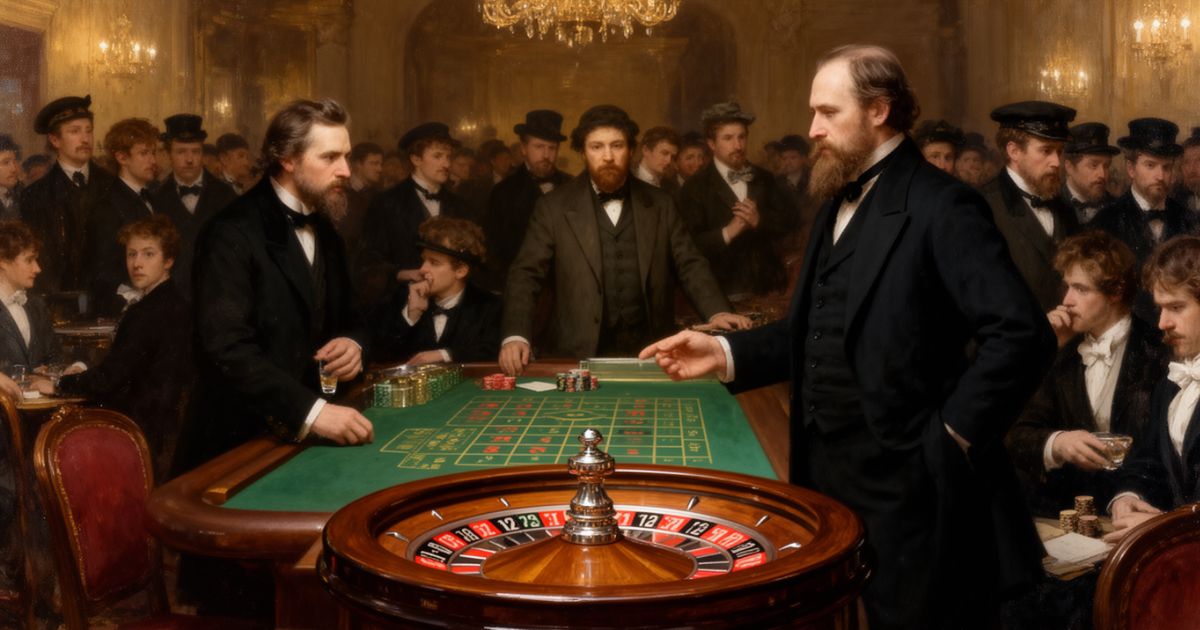
The time was a quarter past eleven o’clock when I entered the Casino in
such a state of hope (though, at the same time, of agitation) as I had
never before experienced. In the gaming-rooms there were still a large
number of people, but not half as many as had been present in the
morning.
At eleven o’clock there usually remained behind only the real, the
desperate gamblers—persons for whom, at spas, there existed nothing
beyond roulette, and who went thither for that alone. These gamesters
took little note of what was going on around them, and were interested
in none of the appurtenances of the season, but played from morning
till night, and would have been ready to play through the night until
dawn had that been possible. As it was, they used to disperse
unwillingly when, at midnight, roulette came to an end. Likewise, as
soon as ever roulette was drawing to a close and the head croupier had
called “Les trois derniers coups,” most of them were ready to stake on
the last three rounds all that they had in their pockets—and, for the
most part, lost it. For my own part I proceeded towards the table at
which the Grandmother had lately sat; and, since the crowd around it
was not very large, I soon obtained standing room among the ring of
gamblers, while directly in front of me, on the green cloth, I saw
marked the word “Passe.”
“Passe” was a row of numbers from 19 to 36 inclusive; while a row of
numbers from 1 to 18 inclusive was known as “Manque.” But what had that
to do with me? I had not noticed—I had not so much as heard the numbers
upon which the previous coup had fallen, and so took no bearings when I
began to play, as, in my place, any systematic gambler would have
done. No, I merely extended my stock of twenty ten-gülden pieces, and
threw them down upon the space “Passe” which happened to be confronting
me.
“Vingt-deux!” called the croupier.
I had won! I staked upon the same again—both my original stake and my
winnings.
“Trente-et-un!” called the croupier.
Again I had won, and was now in possession of eighty ten-gülden pieces.
Next, I moved the whole eighty on to twelve middle numbers (a stake
which, if successful, would bring me in a triple profit, but also
involved a risk of two chances to one). The wheel revolved, and stopped
at twenty-four. Upon this I was paid out notes and gold until I had by
my side a total sum of two thousand gülden.
It was as in a fever that I moved the pile, en bloc, on to the red.
Then suddenly I came to myself (though that was the only time during
the evening’s play when fear cast its cold spell over me, and showed
itself in a trembling of the hands and knees). For with horror I had
realised that I must win, and that upon that stake there depended all
my life.
“Rouge!” called the croupier. I drew a long breath, and hot shivers
went coursing over my body. I was paid out my winnings in
bank-notes—amounting, of course, to a total of four thousand florins,
eight hundred gülden (I could still calculate the amounts).
After that, I remember, I again staked two thousand florins upon twelve
middle numbers, and lost. Again I staked the whole of my gold, with
eight hundred gülden, in notes, and lost. Then madness seemed to come
upon me, and seizing my last two thousand florins, I staked them upon
twelve of the first numbers—wholly by chance, and at random, and
without any sort of reckoning. Upon my doing so there followed a moment
of suspense only comparable to that which Madame Blanchard must have
experienced when, in Paris, she was descending earthwards from a
balloon.
“Quatre!” called the croupier.
Once more, with the addition of my original stake, I was in possession
of six thousand florins! Once more I looked around me like a
conqueror—once more I feared nothing as I threw down four thousand of
these florins upon the black. The croupiers glanced around them, and
exchanged a few words; the bystanders murmured expectantly.
The black turned up. After that I do not exactly remember either my
calculations or the order of my stakings. I only remember that, as in a
dream, I won in one round sixteen thousand florins; that in the three
following rounds, I lost twelve thousand; that I moved the remainder
(four thousand) on to “Passe” (though quite unconscious of what I was
doing—I was merely waiting, as it were, mechanically, and without
reflection, for something) and won; and that, finally, four times in
succession I lost. Yes, I can remember raking in money by thousands—but
most frequently on the twelve, middle numbers, to which I constantly
adhered, and which kept appearing in a sort of regular order—first,
three or four times running, and then, after an interval of a couple of
rounds, in another break of three or four appearances. Sometimes, this
astonishing regularity manifested itself in patches; a thing to upset
all the calculations of note—taking gamblers who play with a pencil and
a memorandum-book in their hands Fortune perpetrates some terrible
jests at roulette!
Since my entry not more than half an hour could have elapsed. Suddenly
a croupier informed me that I had, won thirty thousand florins, as well
as that, since the latter was the limit for which, at any one time, the
bank could make itself responsible, roulette at that table must close
for the night. Accordingly, I caught up my pile of gold, stuffed it
into my pocket, and, grasping my sheaf of bank-notes, moved to the
table in an adjoining salon where a second game of roulette was in
progress. The crowd followed me in a body, and cleared a place for me
at the table; after which, I proceeded to stake as before—that is to
say, at random and without calculating. What saved me from ruin I do
not know.
Of course there were times when fragmentary reckonings did come
flashing into my brain. For instance, there were times when I attached
myself for a while to certain figures and coups—though always leaving
them, again before long, without knowing what I was doing.
In fact, I cannot have been in possession of all my faculties, for I
can remember the croupiers correcting my play more than once, owing to
my having made mistakes of the gravest order. My brows were damp with
sweat, and my hands were shaking. Also, Poles came around me to proffer
their services, but I heeded none of them. Nor did my luck fail me now.
Suddenly, there arose around me a loud din of talking and laughter.
“Bravo, bravo!” was the general shout, and some people even clapped
their hands. I had raked in thirty thousand florins, and again the bank
had had to close for the night!
“Go away now, go away now,” a voice whispered to me on my right. The
person who had spoken to me was a certain Jew of Frankfurt—a man who
had been standing beside me the whole while, and occasionally helping
me in my play.
“Yes, for God’s sake go,” whispered a second voice in my left ear.
Glancing around, I perceived that the second voice had come from a
modestly, plainly dressed lady of rather less than thirty—a woman whose
face, though pale and sickly-looking, bore also very evident traces of
former beauty. At the moment, I was stuffing the crumpled bank-notes
into my pockets and collecting all the gold that was left on the table.
Seizing up my last note for five hundred gülden, I contrived to
insinuate it, unperceived, into the hand of the pale lady. An
overpowering impulse had made me do so, and I remember how her thin
little fingers pressed mine in token of her lively gratitude. The whole
affair was the work of a moment.
Then, collecting my belongings, I crossed to where trente et quarante
was being played—a game which could boast of a more aristocratic
public, and was played with cards instead of with a wheel. At this
diversion the bank made itself responsible for a hundred thousand
thalers as the limit, but the highest stake allowable was, as in
roulette, four thousand florins. Although I knew nothing of the
game—and I scarcely knew the stakes, except those on black and red—I
joined the ring of players, while the rest of the crowd massed itself
around me. At this distance of time I cannot remember whether I ever
gave a thought to Polina; I seemed only to be conscious of a vague
pleasure in seizing and raking in the bank-notes which kept massing
themselves in a pile before me.
But, as ever, fortune seemed to be at my back. As though of set
purpose, there came to my aid a circumstance which not infrequently
repeats itself in gaming. The circumstance is that not infrequently
luck attaches itself to, say, the red, and does not leave it for a
space of say, ten, or even fifteen, rounds in succession. Three days
ago I had heard that, during the previous week there had been a run of
twenty-two coups on the red—an occurrence never before known at
roulette—so that men spoke of it with astonishment. Naturally enough,
many deserted the red after a dozen rounds, and practically no one
could now be found to stake upon it. Yet upon the black also—the
antithesis of the red—no experienced gambler would stake anything, for
the reason that every practised player knows the meaning of “capricious
fortune.” That is to say, after the sixteenth (or so) success of the
red, one would think that the seventeenth coup would inevitably fall
upon the black; wherefore, novices would be apt to back the latter in
the seventeenth round, and even to double or treble their stakes upon
it—only, in the end, to lose.
Yet some whim or other led me, on remarking that the red had come up
consecutively for seven times, to attach myself to that colour.
Probably this was mostly due to self-conceit, for I wanted to astonish
the bystanders with the riskiness of my play. Also, I remember that—oh,
strange sensation!—I suddenly, and without any challenge from my own
presumption, became obsessed with a desire to take risks. If the
spirit has passed through a great many sensations, possibly it can no
longer be sated with them, but grows more excited, and demands more
sensations, and stronger and stronger ones, until at length it falls
exhausted. Certainly, if the rules of the game had permitted even of my
staking fifty thousand florins at a time, I should have staked them.
All of a sudden I heard exclamations arising that the whole thing was a
marvel, since the red was turning up for the fourteenth time!
“Monsieur a gagné cent mille florins,” a voice exclaimed beside me.
I awoke to my senses. What? I had won a hundred thousand florins? If
so, what more did I need to win? I grasped the banknotes, stuffed them
into my pockets, raked in the gold without counting it, and started to
leave the Casino. As I passed through the salons people smiled to see
my bulging pockets and unsteady gait, for the weight which I was
carrying must have amounted to half a pood! Several hands I saw
stretched out in my direction, and as I passed I filled them with all
the money that I could grasp in my own. At length two Jews stopped me
near the exit.
“You are a bold young fellow,” one said, “but mind you depart early
tomorrow—as early as you can—for if you do not you will lose everything
that you have won.”
But I did not heed them. The Avenue was so dark that it was barely
possible to distinguish one’s hand before one’s face, while the
distance to the hotel was half a verst or so; but I feared neither
pickpockets nor highwaymen. Indeed, never since my boyhood have I done
that. Also, I cannot remember what I thought about on the way. I only
felt a sort of fearful pleasure—the pleasure of success, of conquest,
of power (how can I best express it?). Likewise, before me there
flitted the image of Polina; and I kept remembering, and reminding
myself, that it was to her I was going, that it was in her presence
I should soon be standing, that it was she to whom I should soon be
able to relate and show everything. Scarcely once did I recall what she
had lately said to me, or the reason why I had left her, or all those
varied sensations which I had been experiencing a bare hour and a half
ago. No, those sensations seemed to be things of the past, to be things
which had righted themselves and grown old, to be things concerning
which we needed to trouble ourselves no longer, since, for us, life was
about to begin anew. Yet I had just reached the end of the Avenue when
there did come upon me a fear of being robbed or murdered. With each
step the fear increased until, in my terror, I almost started to run.
Suddenly, as I issued from the Avenue, there burst upon me the lights
of the hotel, sparkling with a myriad lamps! Yes, thanks be to God, I
had reached home!
Running up to my room, I flung open the door of it. Polina was still on
the sofa, with a lighted candle in front of her, and her hands clasped.
As I entered she stared at me in astonishment (for, at the moment, I
must have presented a strange spectacle). All I did, however, was to
halt before her, and fling upon the table my burden of wealth.
Master this chapter. Complete your experience
Purchase the complete book to access all chapters and support classic literature
As an Amazon Associate, we earn a small commission from qualifying purchases at no additional cost to you.
Available in paperback, hardcover, and e-book formats
Let's Analyse the Pattern
When love or desperation convinces us that our feelings can override probability and justify extreme risks.
Why This Matters
Connect literature to life
This chapter teaches how to distinguish between genuine intuition and desperation-fueled delusion.
Practice This Today
Next time you feel certain that your strong emotions guarantee a good outcome, pause and ask: 'Am I confusing my feelings with actual odds?'
Now let's explore the literary elements.
Key Quotes & Analysis
"I staked four thousand florins upon even, and won. Then I staked the whole eight thousand upon red, and won again."
Context: Alexei describes his methodical but increasingly wild betting strategy during his winning streak
This quote captures the mathematical progression of his wins, but also the madness of doubling down repeatedly. It shows how winning can create its own momentum, making each bet feel inevitable rather than risky.
In Today's Words:
I bet everything I had and won, then bet all of that and won again - it felt like I couldn't lose.
"I felt that I was a conqueror, and that nothing could withstand me."
Context: After several consecutive wins, Alexei describes the psychological transformation that comes with sudden success
This reveals how winning changes not just your bank account but your entire sense of self. The gambling high makes him feel invincible, which is exactly what makes it so dangerous and addictive.
In Today's Words:
I felt like I was unstoppable, like I had some kind of superpower and nothing could go wrong.
"The croupier was now paying out thirty-five times my stake."
Context: When Alexei wins on a single number bet, the highest-risk, highest-reward bet possible
This moment represents the peak of his impossible luck. The 35-to-1 odds make this win almost miraculous, showing how sometimes life delivers exactly what we desperately need, even when it seems impossible.
In Today's Words:
I just hit the jackpot - the kind of win that almost never happens but changes everything when it does.
Thematic Threads
Desperation
In This Chapter
The narrator's complete abandonment of rational thought in favor of magical thinking about gambling
Development
Evolved from earlier financial anxiety into full crisis mode with supernatural beliefs
In Your Life:
You might recognize this when you find yourself believing that wanting something badly enough will make it happen.
Love
In This Chapter
His obsessive need to win for Polina drives every bet, making gambling feel like devotion
Development
His feelings for Polina have progressed from attraction to desperate, all-consuming need to save her
In Your Life:
You see this when love makes you take risks you'd never take for yourself.
Power
In This Chapter
The winning streak transforms him from powerless tutor to someone who can 'break the bank'
Development
His powerlessness throughout the story suddenly reverses into intoxicating control
In Your Life:
You might experience this when sudden success makes you feel invincible and exempt from normal rules.
Identity
In This Chapter
He becomes the legendary gambler others watch in awe, completely different from his servant-like status
Development
His identity has shifted from invisible employee to mythical figure through pure chance
In Your Life:
You see this when external circumstances temporarily change how others see you and how you see yourself.
Class
In This Chapter
Sudden wealth instantly elevates him above his employers and their financial troubles
Development
Money temporarily erases all the class barriers that have defined his relationships
In Your Life:
You might notice this when financial changes suddenly shift your social position and relationships.
You now have the context. Time to form your own thoughts.
Discussion Questions
- 1
What drives the narrator to the casino, and how does his approach to gambling differ from strategic play?
analysis • surface - 2
Why does the narrator interpret his winning streak as confirmation that love can influence luck?
analysis • medium - 3
Where do you see people today making desperate 'miracle bets' when someone they love is in crisis?
application • medium - 4
How can you tell the difference between calculated risk-taking and emotional gambling in your own decisions?
application • deep - 5
What does this chapter reveal about how love can both motivate us and cloud our judgment?
reflection • deep
Critical Thinking Exercise
Map Your Miracle-Seeking Patterns
Think about a time when you or someone close to you faced a serious crisis. Write down three 'miracle solutions' that seemed tempting—the big, dramatic gestures that promised to fix everything at once. Then list three smaller, practical steps that actually helped (or could have helped) address the problem sustainably.
Consider:
- •Notice how crisis makes dramatic solutions feel more appealing than steady progress
- •Consider whether your 'miracle thinking' was driven by genuine problem-solving or emotional overwhelm
- •Identify the warning signs that tell you when you're confusing feelings with actual odds
Journaling Prompt
Write about a time when you took a major risk for someone you loved. What drove that decision? Looking back, what would you do differently while still showing the same level of care and commitment?
Coming Up Next...
Chapter 15: Money Can't Buy Love
With a fortune in hand and Polina waiting, the narrator finally has the power to change everything. But will his miraculous winnings be enough to win her heart, or will his gambling triumph reveal deeper truths about what she really wants from him?