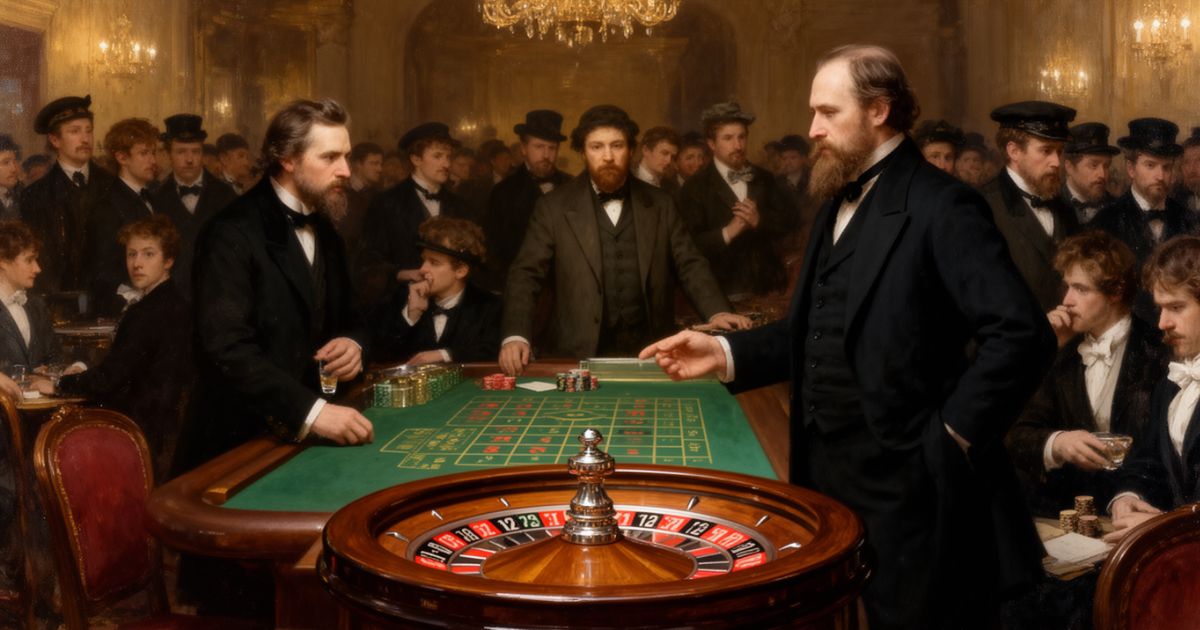
An excerpt from the original text.(complete · 4884 words)
lmost a month has passed since I last touched these notes—notes which
I began under the influence of impressions at once poignant and
disordered. The crisis which I then felt to be approaching has now
arrived, but in a form a hundred times more extensive and unexpected
than I had looked for. To me it all seems strange, uncouth, and tragic.
Certain occurrences have befallen me which border upon the marvellous.
At all events, that is how I view them. I view them so in one regard at
least. I refer to the whirlpool of events in which, at the time, I was
revolving. But the most curious feature of all is my relation to those
events, for hitherto I had never clearly understood myself. Yet now the
actual crisis has passed away like a dream. Even my passion for Polina
is dead. Was it ever so strong and genuine as I thought? If so, what
has become of it now? At times I fancy that I must be mad; that
somewhere I am sitting in a madhouse; that these events have merely
seemed to happen; that still they merely seem to be happening.
I have been arranging and re-perusing my notes (perhaps for the purpose
of convincing myself that I am not in a madhouse). At present I am
lonely and alone. Autumn is coming—already it is mellowing the leaves;
and, as I sit brooding in this melancholy little town (and how
melancholy the little towns of Germany can be!), I find myself taking
no thought for the future, but living under the influence of passing
moods, and of my recollections of the tempest which recently drew me
into its vortex, and then cast me out again. At times I seem still to
be caught within that vortex. At times, the tempest seems once more to
be gathering, and, as it passes overhead, to be wrapping me in its
folds, until I have lost my sense of order and reality, and continue
whirling and whirling and whirling around.
Yet, it may be that I shall be able to stop myself from revolving if
once I can succeed in rendering myself an exact account of what has
happened within the month just past. Somehow I feel drawn towards the
pen; on many and many an evening I have had nothing else in the world
to do. But, curiously enough, of late I have taken to amusing myself
with the works of M. Paul de Kock, which I read in German translations
obtained from a wretched local library. These works I cannot abide, yet
I read them, and find myself marvelling that I should be doing so.
Somehow I seem to be afraid of any serious book—afraid of permitting
any serious preoccupation to break the spell of the passing moment.
So dear to me is the formless dream of which I have spoken, so dear to
me are the impressions which it has left behind it, that I fear to
touch the vision with anything new, lest it should dissolve in smoke.
But is it so dear to me? Yes, it is dear to me, and will ever be
fresh in my recollections—even forty years hence....
So let me write of it, but only partially, and in a more abridged form
than my full impressions might warrant.
First of all, let me conclude the history of the Grandmother. Next day
she lost every gülden that she possessed. Things were bound to happen
so, for persons of her type who have once entered upon that road
descend it with ever-increasing rapidity, even as a sledge descends a
toboggan-slide. All day until eight o’clock that evening did she play;
and, though I personally did not witness her exploits, I learnt of them
later through report.
All that day Potapitch remained in attendance upon her; but the Poles
who directed her play she changed more than once. As a beginning she
dismissed her Pole of the previous day—the Pole whose hair she had
pulled—and took to herself another one; but the latter proved worse
even than the former, and incurred dismissal in favour of the first
Pole, who, during the time of his unemployment, had nevertheless
hovered around the Grandmother’s chair, and from time to time obtruded
his head over her shoulder. At length the old lady became desperate,
for the second Pole, when dismissed, imitated his predecessor by
declining to go away; with the result that one Pole remained standing
on the right of the victim, and the other on her left; from which
vantage points the pair quarrelled, abused each other concerning the
stakes and rounds, and exchanged the epithet “laidak”[4] and other
Polish terms of endearment. Finally, they effected a mutual
reconciliation, and, tossing the money about anyhow, played simply at
random. Once more quarrelling, each of them staked money on his own
side of the Grandmother’s chair (for instance, the one Pole staked upon
the red, and the other one upon the black), until they had so confused
and browbeaten the old lady that, nearly weeping, she was forced to
appeal to the head croupier for protection, and to have the two Poles
expelled. No time was lost in this being done, despite the rascals’
cries and protestations that the old lady was in their debt, that she
had cheated them, and that her general behaviour had been mean and
dishonourable. The same evening the unfortunate Potapitch related the
story to me with tears complaining that the two men had filled their
pockets with money (he himself had seen them do it) which had been
shamelessly pilfered from his mistress. For instance, one Pole demanded
of the Grandmother fifty gülden for his trouble, and then staked the
money by the side of her stake. She happened to win; whereupon he cried
out that the winning stake was his, and hers the loser. As soon as the
two Poles had been expelled, Potapitch left the room, and reported to
the authorities that the men’s pockets were full of gold; and, on the
Grandmother also requesting the head croupier to look into the affair,
the police made their appearance, and, despite the protests of the
Poles (who, indeed, had been caught redhanded), their pockets were
turned inside out, and the contents handed over to the Grandmother. In
fact, in, view of the circumstance that she lost all day, the croupiers
and other authorities of the Casino showed her every attention; and on
her fame spreading through the town, visitors of every nationality—even
the most knowing of them, the most distinguished—crowded to get a
glimpse of “la vieille comtesse russe, tombée en enfance,” who had lost
“so many millions.”
[4] Rascal
Yet with the money which the authorities restored to her from the
pockets of the Poles the Grandmother effected very, very little, for
there soon arrived to take his countrymen’s place, a third Pole—a man
who could speak Russian fluently, was dressed like a gentleman (albeit
in lacqueyish fashion), and sported a huge moustache. Though polite
enough to the old lady, he took a high hand with the bystanders. In
short, he offered himself less as a servant than as an entertainer.
After each round he would turn to the old lady, and swear terrible
oaths to the effect that he was a “Polish gentleman of honour” who
would scorn to take a kopeck of her money; and, though he repeated
these oaths so often that at length she grew alarmed, he had her play
in hand, and began to win on her behalf; wherefore, she felt that she
could not well get rid of him. An hour later the two Poles who, earlier
in the day, had been expelled from the Casino, made a reappearance
behind the old lady’s chair, and renewed their offers of service—even
if it were only to be sent on messages; but from Potapitch I
subsequently had it that between these rascals and the said “gentleman
of honour” there passed a wink, as well as that the latter put
something into their hands. Next, since the Grandmother had not yet
lunched—she had scarcely for a moment left her chair—one of the two
Poles ran to the restaurant of the Casino, and brought her thence a cup
of soup, and afterwards some tea. In fact, both the Poles hastened to
perform this office. Finally, towards the close of the day, when it was
clear that the Grandmother was about to play her last bank-note, there
could be seen standing behind her chair no fewer than six natives of
Poland—persons who, as yet, had been neither audible nor visible; and
as soon as ever the old lady played the note in question, they took no
further notice of her, but pushed their way past her chair to the
table; seized the money, and staked it—shouting and disputing the
while, and arguing with the “gentleman of honour” (who also had
forgotten the Grandmother’s existence), as though he were their equal.
Even when the Grandmother had lost her all, and was returning (about
eight o’clock) to the hotel, some three or four Poles could not bring
themselves to leave her, but went on running beside her chair and
volubly protesting that the Grandmother had cheated them, and that she
ought to be made to surrender what was not her own. Thus the party
arrived at the hotel; whence, presently, the gang of rascals was
ejected neck and crop.
According to Potapitch’s calculations, the Grandmother lost, that day,
a total of ninety thousand roubles, in addition to the money which she
had lost the day before. Every paper security which she had brought
with her—five percent bonds, internal loan scrip, and what not—she had
changed into cash. Also, I could not but marvel at the way in which,
for seven or eight hours at a stretch, she sat in that chair of hers,
almost never leaving the table. Again, Potapitch told me that there
were three occasions on which she really began to win; but that, led on
by false hopes, she was unable to tear herself away at the right
moment. Every gambler knows how a person may sit a day and a night at
cards without ever casting a glance to right or to left.
Meanwhile, that day some other very important events were passing in
our hotel. As early as eleven o’clock—that is to say, before the
Grandmother had quitted her rooms—the General and De Griers decided
upon their last stroke. In other words, on learning that the old lady
had changed her mind about departing, and was bent on setting out for
the Casino again, the whole of our gang (Polina only excepted)
proceeded en masse to her rooms, for the purpose of finally and frankly
treating with her. But the General, quaking and greatly apprehensive as
to his possible future, overdid things. After half an hour’s prayers
and entreaties, coupled with a full confession of his debts, and even
of his passion for Mlle. Blanche (yes, he had quite lost his head), he
suddenly adopted a tone of menace, and started to rage at the old
lady—exclaiming that she was sullying the family honour, that she was
making a public scandal of herself, and that she was smirching the fair
name of Russia. The upshot was that the Grandmother turned him out of
the room with her stick (it was a real stick, too!). Later in the
morning he held several consultations with De Griers—the question which
occupied him being: Is it in any way possible to make use of the
police—to tell them that “this respected, but unfortunate, old lady has
gone out of her mind, and is squandering her last kopeck,” or something
of the kind? In short, is it in any way possible to engineer a species
of supervision over, or of restraint upon, the old lady? De Griers,
however, shrugged his shoulders at this, and laughed in the General’s
face, while the old warrior went on chattering volubly, and running up
and down his study. Finally De Griers waved his hand, and disappeared
from view; and by evening it became known that he had left the hotel,
after holding a very secret and important conference with Mlle.
Blanche. As for the latter, from early morning she had taken decisive
measures, by completely excluding the General from her presence, and
bestowing upon him not a glance. Indeed, even when the General pursued
her to the Casino, and met her walking arm in arm with the Prince, he
(the General) received from her and her mother not the slightest
recognition. Nor did the Prince himself bow. The rest of the day Mlle.
spent in probing the Prince, and trying to make him declare himself;
but in this she made a woeful mistake. The little incident occurred in
the evening. Suddenly Mlle. Blanche realised that the Prince had not
even a copper to his name, but, on the contrary, was minded to borrow
of her money wherewith to play at roulette. In high displeasure she
drove him from her presence, and shut herself up in her room.
The same morning I went to see—or, rather, to look for—Mr. Astley, but
was unsuccessful in my quest. Neither in his rooms nor in the Casino
nor in the Park was he to be found; nor did he, that day, lunch at his
hotel as usual. However, at about five o’clock I caught sight of him
walking from the railway station to the Hôtel d’Angleterre. He seemed
to be in a great hurry and much preoccupied, though in his face I could
discern no actual traces of worry or perturbation. He held out to me a
friendly hand, with his usual ejaculation of “Ah!” but did not check
his stride. I turned and walked beside him, but found, somehow, that
his answers forbade any putting of definite questions. Moreover, I felt
reluctant to speak to him of Polina; nor, for his part, did he ask me
any questions concerning her, although, on my telling him of the
Grandmother’s exploits, he listened attentively and gravely, and then
shrugged his shoulders.
“She is gambling away everything that she has,” I remarked.
“Indeed? She arrived at the Casino even before I had taken my departure
by train, so I knew she had been playing. If I should have time I will
go to the Casino to-night, and take a look at her. The thing interests
me.”
“Where have you been today?” I asked—surprised at myself for having, as
yet, omitted to put to him that question.
“To Frankfort.”
“On business?”
“On business.”
What more was there to be asked after that? I accompanied him until, as
we drew level with the Hotel des Quatre Saisons, he suddenly nodded to
me and disappeared. For myself, I returned home, and came to the
conclusion that, even had I met him at two o’clock in the afternoon, I
should have learnt no more from him than I had done at five o’clock,
for the reason that I had no definite question to ask. It was bound to
have been so. For me to formulate the query which I really wished to
put was a simple impossibility.
Polina spent the whole of that day either in walking about the park
with the nurse and children or in sitting in her own room. For a long
while past she had avoided the General and had scarcely had a word to
say to him (scarcely a word, I mean, on any serious topic). Yes, that
I had noticed. Still, even though I was aware of the position in which
the General was placed, it had never occurred to me that he would have
any reason to avoid her, or to trouble her with family explanations.
Indeed, when I was returning to the hotel after my conversation with
Astley, and chanced to meet Polina and the children, I could see that
her face was as calm as though the family disturbances had never
touched her. To my salute she responded with a slight bow, and I
retired to my room in a very bad humour.
Of course, since the affair with the Burmergelms I had exchanged not a
word with Polina, nor had with her any kind of intercourse. Yet I had
been at my wits’ end, for, as time went on, there was arising in me an
ever-seething dissatisfaction. Even if she did not love me she ought
not to have trampled upon my feelings, nor to have accepted my
confessions with such contempt, seeing that she must have been aware
that I loved her (of her own accord she had allowed me to tell her as
much). Of course the situation between us had arisen in a curious
manner. About two months ago, I had noticed that she had a desire to
make me her friend, her confidant—that she was making trial of me for
the purpose; but, for some reason or another, the desired result had
never come about, and we had fallen into the present strange relations,
which had led me to address her as I had done. At the same time, if my
love was distasteful to her, why had she not forbidden me to speak of
it to her?
But she had not so forbidden me. On the contrary, there had been
occasions when she had even invited me to speak. Of course, this
might have been done out of sheer wantonness, for I well knew—I had
remarked it only too often—that, after listening to what I had to say,
and angering me almost beyond endurance, she loved suddenly to torture
me with some fresh outburst of contempt and aloofness! Yet she must
have known that I could not live without her. Three days had elapsed
since the affair with the Baron, and I could bear the severance no
longer. When, that afternoon, I met her near the Casino, my heart
almost made me faint, it beat so violently. She too could not live
without me, for had she not said that she had need of me? Or had that
too been spoken in jest?
That she had a secret of some kind there could be no doubt. What she
had said to the Grandmother had stabbed me to the heart. On a thousand
occasions I had challenged her to be open with me, nor could she have
been ignorant that I was ready to give my very life for her. Yet always
she had kept me at a distance with that contemptuous air of hers; or
else she had demanded of me, in lieu of the life which I offered to lay
at her feet, such escapades as I had perpetrated with the Baron. Ah,
was it not torture to me, all this? For could it be that her whole
world was bound up with the Frenchman? What, too, about Mr. Astley? The
affair was inexplicable throughout. My God, what distress it caused me!
Arrived home, I, in a fit of frenzy, indited the following:
“Polina Alexandrovna, I can see that there is approaching us an
exposure which will involve you too. For the last time I ask of
you—have you, or have you not, any need of my life? If you have, then
make such dispositions as you wish, and I shall always be discoverable
in my room if required. If you have need of my life, write or send for
me.”
I sealed the letter, and dispatched it by the hand of a corridor
lacquey, with orders to hand it to the addressee in person. Though I
expected no answer, scarcely three minutes had elapsed before the
lacquey returned with “the compliments of a certain person.”
Next, about seven o’clock, I was sent for by the General. I found him
in his study, apparently preparing to go out again, for his hat and
stick were lying on the sofa. When I entered he was standing in the
middle of the room—his feet wide apart, and his head bent down. Also,
he appeared to be talking to himself. But as soon as ever he saw me at
the door he came towards me in such a curious manner that involuntarily
I retreated a step, and was for leaving the room; whereupon he seized
me by both hands, and, drawing me towards the sofa, and seating himself
thereon, he forced me to sit down on a chair opposite him. Then,
without letting go of my hands, he exclaimed with quivering lips and a
sparkle of tears on his eyelashes:
“Oh, Alexis Ivanovitch! Save me, save me! Have some mercy upon me!”
For a long time I could not make out what he meant, although he kept
talking and talking, and constantly repeating to himself, “Have mercy,
mercy!” At length, however, I divined that he was expecting me to give
him something in the nature of advice—or, rather, that, deserted by
every one, and overwhelmed with grief and apprehension, he had
bethought himself of my existence, and sent for me to relieve his
feelings by talking and talking and talking.
In fact, he was in such a confused and despondent state of mind that,
clasping his hands together, he actually went down upon his knees and
begged me to go to Mlle. Blanche, and beseech and advise her to return
to him, and to accept him in marriage.
“But, General,” I exclaimed, “possibly Mlle. Blanche has scarcely even
remarked my existence? What could I do with her?”
It was in vain that I protested, for he could understand nothing that
was said to him, Next he started talking about the Grandmother, but
always in a disconnected sort of fashion—his one thought being to send
for the police.
“In Russia,” said he, suddenly boiling over with indignation, “or in
any well-ordered State where there exists a government, old women like
my mother are placed under proper guardianship. Yes, my good sir,” he
went on, relapsing into a scolding tone as he leapt to his feet and
started to pace the room, “do you not know this” (he seemed to be
addressing some imaginary auditor in the corner) “—do you not know
this, that in Russia old women like her are subjected to restraint, the
devil take them?” Again he threw himself down upon the sofa.
A minute later, though sobbing and almost breathless, he managed to
gasp out that Mlle. Blanche had refused to marry him, for the reason
that the Grandmother had turned up in place of a telegram, and it was
therefore clear that he had no inheritance to look for. Evidently, he
supposed that I had hitherto been in entire ignorance of all this.
Again, when I referred to De Griers, the General made a gesture of
despair. “He has gone away,” he said, “and everything which I possess
is mortgaged to him. I stand stripped to my skin. Even of the money
which you brought me from Paris, I know not if seven hundred francs be
left. Of course that sum will do to go on with, but, as regards the
future, I know nothing, I know nothing.”
“Then how will you pay your hotel bill?” I cried in consternation. “And
what shall you do afterwards?”
He looked at me vaguely, but it was clear that he had not
understood—perhaps had not even heard—my questions. Then I tried to get
him to speak of Polina and the children, but he only returned brief
answers of “Yes, yes,” and again started to maunder about the Prince,
and the likelihood of the latter marrying Mlle. Blanche. “What on earth
am I to do?” he concluded. “What on earth am I to do? Is this not
ingratitude? Is it not sheer ingratitude?” And he burst into tears.
Nothing could be done with such a man. Yet to leave him alone was
dangerous, for something might happen to him. I withdrew from his rooms
for a little while, but warned the nursemaid to keep an eye upon him,
as well as exchanged a word with the corridor lacquey (a very talkative
fellow), who likewise promised to remain on the look-out.
Hardly had I left the General, when Potapitch approached me with a
summons from the Grandmother. It was now eight o’clock, and she had
returned from the Casino after finally losing all that she possessed. I
found her sitting in her chair—much distressed and evidently fatigued.
Presently Martha brought her up a cup of tea and forced her to drink
it; yet, even then I could detect in the old lady’s tone and manner a
great change.
“Good evening, Alexis Ivanovitch,” she said slowly, with her head
drooping. “Pardon me for disturbing you again. Yes, you must pardon an
old, old woman like myself, for I have left behind me all that I
possess—nearly a hundred thousand roubles! You did quite right in
declining to come with me this evening. Now I am without money—without
a single groat. But I must not delay a moment; I must leave by the 9:30
train. I have sent for that English friend of yours, and am going to
beg of him three thousand francs for a week. Please try and persuade
him to think nothing of it, nor yet to refuse me, for I am still a rich
woman who possesses three villages and a couple of mansions. Yes, the
money shall be found, for I have not yet squandered everything. I
tell you this in order that he may have no doubts about—Ah, but here he
is! Clearly he is a good fellow.”
True enough, Astley had come hot-foot on receiving the Grandmother’s
appeal. Scarcely stopping even to reflect, and with scarcely a word, he
counted out the three thousand francs under a note of hand which she
duly signed. Then, his business done, he bowed, and lost no time in
taking his departure.
“You too leave me, Alexis Ivanovitch,” said the Grandmother. “All my
bones are aching, and I still have an hour in which to rest. Do not be
hard upon me, old fool that I am. Never again shall I blame young
people for being frivolous. I should think it wrong even to blame that
unhappy General of yours. Nevertheless, I do not mean to let him have
any of my money (which is all that he desires), for the reason that I
look upon him as a perfect blockhead, and consider myself, simpleton
though I be, at least wiser than he is. How surely does God visit old
age, and punish it for its presumption! Well, good-bye. Martha, come
and lift me up.”
However, I had a mind to see the old lady off; and, moreover, I was in
an expectant frame of mind—somehow I kept thinking that something was
going to happen; wherefore, I could not rest quietly in my room, but
stepped out into the corridor, and then into the Chestnut Avenue for a
few minutes’ stroll. My letter to Polina had been clear and firm, and
in the present crisis, I felt sure, would prove final. I had heard of
De Griers’ departure, and, however much Polina might reject me as a
friend, she might not reject me altogether as a servant. She would
need me to fetch and carry for her, and I was ready to do so. How could
it have been otherwise?
Towards the hour of the train’s departure I hastened to the station,
and put the Grandmother into her compartment—she and her party
occupying a reserved family saloon.
“Thanks for your disinterested assistance,” she said at parting. “Oh,
and please remind Prascovia of what I said to her last night. I expect
soon to see her.”
Then I returned home. As I was passing the door of the General’s suite,
I met the nursemaid, and inquired after her master. “There is nothing
new to report, sir,” she replied quietly. Nevertheless I decided to
enter, and was just doing so when I halted thunderstruck on the
threshold. For before me I beheld the General and Mlle.
Blanche—laughing gaily at one another!—while beside them, on the sofa,
there was seated her mother. Clearly the General was almost out of his
mind with joy, for he was talking all sorts of nonsense, and bubbling
over with a long-drawn, nervous laugh—a laugh which twisted his face
into innumerable wrinkles, and caused his eyes almost to disappear.
Afterwards I learnt from Mlle. Blanche herself that, after dismissing
the Prince and hearing of the General’s tears, she bethought her of
going to comfort the old man, and had just arrived for the purpose when
I entered. Fortunately, the poor General did not know that his fate had
been decided—that Mlle. had long ago packed her trunks in readiness for
the first morning train to Paris!
Hesitating a moment on the threshold I changed my mind as to entering,
and departed unnoticed. Ascending to my own room, and opening the door,
I perceived in the semi-darkness a figure seated on a chair in the
corner by the window. The figure did not rise when I entered, so I
approached it swiftly, peered at it closely, and felt my heart almost
stop beating. The figure was Polina!
Master this chapter. Complete your experience
Purchase the complete book to access all chapters and support classic literature
As an Amazon Associate, we earn a small commission from qualifying purchases at no additional cost to you.
Available in paperback, hardcover, and e-book formats
Let's Analyse the Pattern
Crisis strips away social facades and reveals people's true character and core values.
Why This Matters
Connect literature to life
This chapter teaches how to distinguish between someone's comfortable-times personality and their crisis-times character.
Practice This Today
This week, notice how people around you handle small stresses—a busy shift, a family emergency, or unexpected bills—as practice for reading their true character.
Now let's explore the literary elements.
Key Quotes & Analysis
"At times I fancy that I must be mad; that somewhere I am sitting in a madhouse; that these events have merely seemed to happen."
Context: Reflecting on the surreal nature of recent events and his emotional state
This reveals how trauma and obsession can make reality feel unreal. The narrator questions his own sanity because the events seem too extreme to be true. It shows how gambling and emotional addiction can create a dissociative state where nothing feels solid or reliable.
In Today's Words:
Sometimes I wonder if I'm losing my mind, like maybe I'm imagining all this crazy stuff that's been happening.
"Even my passion for Polina is dead. Was it ever so strong and genuine as I thought?"
Context: Questioning the nature of his feelings after the crisis has passed
This shows how extreme situations can provide clarity about our true feelings. The narrator realizes his 'love' might have been obsession or fantasy rather than genuine emotion. It suggests that what we think is love might sometimes be addiction or projection.
In Today's Words:
I don't even care about Polina anymore. Did I ever really love her, or was I just obsessed?
"The crisis which I then felt to be approaching has now arrived, but in a form a hundred times more extensive and unexpected than I had looked for."
Context: Opening reflection on how events unfolded beyond his worst expectations
This captures how financial and emotional disasters often exceed our worst fears. The narrator expected trouble but not complete devastation. It shows how cascading failures can spiral beyond anyone's control or imagination.
In Today's Words:
I knew something bad was coming, but this disaster was way worse than anything I could have imagined.
Thematic Threads
Class
In This Chapter
Financial ruin instantly dissolves class pretensions—the General begs, aristocrats become desperate
Development
Evolved from earlier class tensions to complete collapse of social hierarchy
In Your Life:
Economic pressure reveals whether your social circle is based on genuine connection or financial status
Identity
In This Chapter
Each character's true self emerges when their constructed identity fails—Blanche's cold calculation, the General's weakness
Development
Built from earlier hints to full exposure of authentic versus performed selves
In Your Life:
Stressful situations show you who you really are beneath your professional or social persona
Loyalty
In This Chapter
Opportunists abandon ship while the narrator searches for genuine connection with Polina and Astley
Development
Introduced here as crisis separates fair-weather friends from true allies
In Your Life:
Life challenges quickly separate people who care about you from those who care about what you can do for them
Dignity
In This Chapter
The Grandmother maintains composure in total ruin while others collapse or flee
Development
Introduced here as the ultimate test of character
In Your Life:
How you handle failure and loss defines your character more than how you handle success
Isolation
In This Chapter
Everyone scatters—Polina avoids contact, Astley becomes evasive, the narrator is left searching for connection
Development
Escalated from earlier social tensions to complete fragmentation of relationships
In Your Life:
Crisis often isolates you, making it crucial to identify who will actually show up when things get difficult
You now have the context. Time to form your own thoughts.
Discussion Questions
- 1
What happened to each character after the Grandmother lost everything, and how did their reactions differ?
analysis • surface - 2
Why did Blanche and De Griers abandon the General immediately after learning about his financial ruin?
analysis • medium - 3
Think about a time when someone you knew faced a major crisis—job loss, illness, divorce. How did people around them react, and what did those reactions reveal?
application • medium - 4
If you were building a support network for tough times, what qualities would you look for in people, and how would you test whether someone has your back?
application • deep - 5
The Grandmother maintained dignity despite losing everything, while the General begged and broke down. What determines how someone handles catastrophic loss?
reflection • deep
Critical Thinking Exercise
Crisis Character Assessment
List five important people in your life. For each person, write down how you think they would react if they suddenly lost their job, faced a serious illness, or had a major financial setback. Consider their past behavior during smaller stresses as evidence. Then honestly assess how you think you would handle each of these crises.
Consider:
- •Look at past behavior during smaller stresses as your best predictor
- •Notice the difference between who people say they are and how they act under pressure
- •Consider both emotional reactions and practical actions people would take
Journaling Prompt
Write about a time when crisis revealed something unexpected about someone close to you—either positively or negatively. How did this change your relationship with them?
Coming Up Next...
Chapter 14: The Miracle of Desperate Luck
With Polina finally in his room after days of silence, the narrator faces the confrontation he's both dreaded and desperately wanted. What has brought her to him now, and what secrets will finally be revealed?