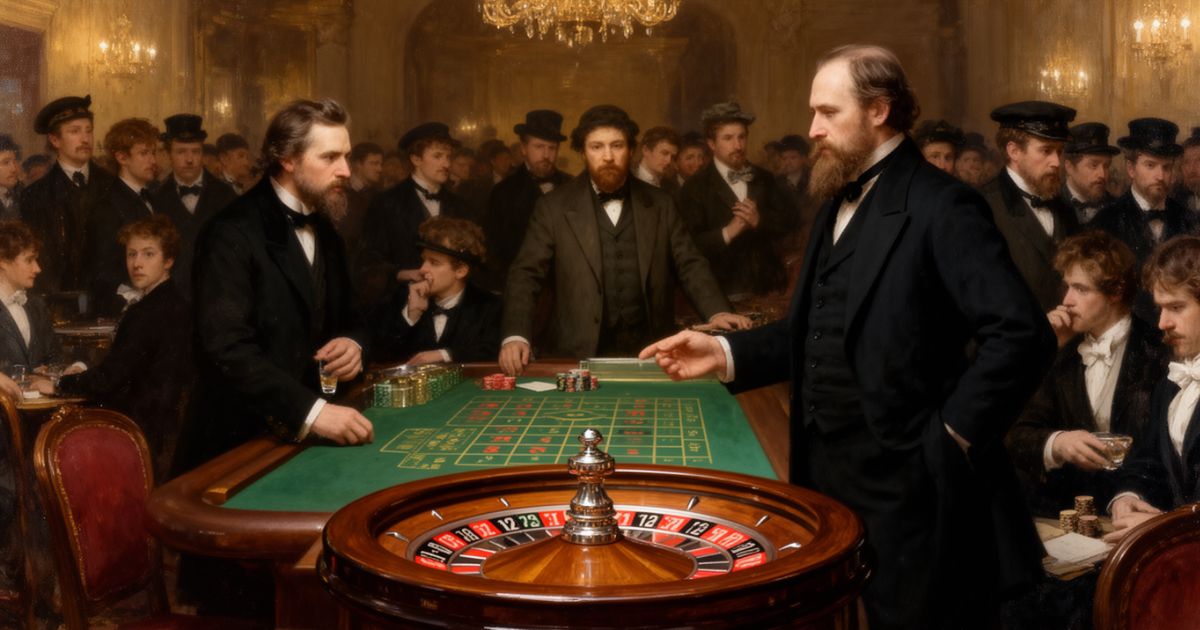
An excerpt from the original text.(complete · 4670 words)
he Grandmother was in an impatient, irritable frame of mind. Without
doubt the roulette had turned her head, for she appeared to be
indifferent to everything else, and, in general, seemed much
distraught. For instance, she asked me no questions about objects en
route, except that, when a sumptuous barouche passed us and raised a
cloud of dust, she lifted her hand for a moment, and inquired, “What
was that?” Yet even then she did not appear to hear my reply, although
at times her abstraction was interrupted by sallies and fits of sharp,
impatient fidgeting. Again, when I pointed out to her the Baron and
Baroness Burmergelm walking to the Casino, she merely looked at them in
an absent-minded sort of way, and said with complete indifference,
“Ah!” Then, turning sharply to Potapitch and Martha, who were walking
behind us, she rapped out:
“Why have you attached yourselves to the party? We are not going to
take you with us every time. Go home at once.” Then, when the servants
had pulled hasty bows and departed, she added to me: “You are all the
escort I need.”
At the Casino the Grandmother seemed to be expected, for no time was
lost in procuring her former place beside the croupier. It is my
opinion that though croupiers seem such ordinary, humdrum officials—men
who care nothing whether the bank wins or loses—they are, in reality,
anything but indifferent to the bank’s losing, and are given
instructions to attract players, and to keep a watch over the bank’s
interests; as also, that for such services, these officials are awarded
prizes and premiums. At all events, the croupiers of Roulettenberg
seemed to look upon the Grandmother as their lawful prey—whereafter
there befell what our party had foretold.
It happened thus:
As soon as ever we arrived the Grandmother ordered me to stake twelve
ten-gülden pieces in succession upon zero. Once, twice, and thrice I
did so, yet zero never turned up.
“Stake again,” said the old lady with an impatient nudge of my elbow,
and I obeyed.
“How many times have we lost?” she inquired—actually grinding her teeth
in her excitement.
“We have lost 144 ten-gülden pieces,” I replied. “I tell you, Madame,
that zero may not turn up until nightfall.”
“Never mind,” she interrupted. “Keep on staking upon zero, and also
stake a thousand gülden upon rouge. Here is a banknote with which to do
so.”
The red turned up, but zero missed again, and we only got our thousand
gülden back.
“But you see, you see,” whispered the old lady. “We have now recovered
almost all that we staked. Try zero again. Let us do so another ten
times, and then leave off.”
By the fifth round, however, the Grandmother was weary of the scheme.
“To the devil with that zero!” she exclaimed. “Stake four thousand
gülden upon the red.”
“But, Madame, that will be so much to venture!” I remonstrated.
“Suppose the red should not turn up?” The Grandmother almost struck me
in her excitement. Her agitation was rapidly making her quarrelsome.
Consequently, there was nothing for it but to stake the whole four
thousand gülden as she had directed.
The wheel revolved while the Grandmother sat as bolt upright, and with
as proud and quiet a mien, as though she had not the least doubt of
winning.
“Zero!” cried the croupier.
At first the old lady failed to understand the situation; but, as soon
as she saw the croupier raking in her four thousand gülden, together
with everything else that happened to be lying on the table, and
recognised that the zero which had been so long turning up, and on
which we had lost nearly two hundred ten-gülden pieces, had at length,
as though of set purpose, made a sudden reappearance—why, the poor old
lady fell to cursing it, and to throwing herself about, and wailing and
gesticulating at the company at large. Indeed, some people in our
vicinity actually burst out laughing.
“To think that that accursed zero should have turned up now!” she
sobbed. “The accursed, accursed thing! And, it is all your fault,”
she added, rounding upon me in a frenzy. “It was you who persuaded me
to cease staking upon it.”
“But, Madame, I only explained the game to you. How am I to answer
for every mischance which may occur in it?”
“You and your mischances!” she whispered threateningly. “Go! Away at
once!”
“Farewell, then, Madame.” And I turned to depart.
“No—stay,” she put in hastily. “Where are you going to? Why should you
leave me? You fool! No, no... stay here. It is I who was the fool.
Tell me what I ought to do.”
“I cannot take it upon myself to advise you, for you will only blame me
if I do so. Play at your own discretion. Say exactly what you wish
staked, and I will stake it.”
“Very well. Stake another four thousand gülden upon the red. Take this
banknote to do it with. I have still got twenty thousand roubles in
actual cash.”
“But,” I whispered, “such a quantity of money—”
“Never mind. I cannot rest until I have won back my losses. Stake!”
I staked, and we lost.
“Stake again, stake again—eight thousand at a stroke!”
“I cannot, Madame. The largest stake allowed is four thousand gülden.”
“Well, then; stake four thousand.”
This time we won, and the Grandmother recovered herself a little.
“You see, you see!” she exclaimed as she nudged me. “Stake another four
thousand.”
I did so, and lost. Again, and yet again, we lost. “Madame, your twelve
thousand gülden are now gone,” at length I reported.
“I see they are,” she replied with, as it were, the calmness of
despair. “I see they are,” she muttered again as she gazed straight in
front of her, like a person lost in thought. “Ah well, I do not mean to
rest until I have staked another four thousand.”
“But you have no money with which to do it, Madame. In this satchel I
can see only a few five percent bonds and some transfers—no actual
cash.”
“And in the purse?”
“A mere trifle.”
“But there is a money-changer’s office here, is there not? They told me
I should be able to get any sort of paper security changed!”
“Quite so; to any amount you please. But you will lose on the
transaction what would frighten even a Jew.”
“Rubbish! I am determined to retrieve my losses. Take me away, and
call those fools of bearers.”
I wheeled the chair out of the throng, and, the bearers making their
appearance, we left the Casino.
“Hurry, hurry!” commanded the Grandmother. “Show me the nearest way to
the money-changer’s. Is it far?”
“A couple of steps, Madame.”
At the turning from the square into the Avenue we came face to face
with the whole of our party—the General, De Griers, Mlle. Blanche, and
her mother. Only Polina and Mr. Astley were absent.
“Well, well, well!” exclaimed the Grandmother. “But we have no time to
stop. What do you want? I can’t talk to you here.”
I dropped behind a little, and immediately was pounced upon by De
Griers.
“She has lost this morning’s winnings,” I whispered, “and also twelve
thousand gülden of her original money. At the present moment we are
going to get some bonds changed.”
De Griers stamped his foot with vexation, and hastened to communicate
the tidings to the General. Meanwhile we continued to wheel the old
lady along.
“Stop her, stop her,” whispered the General in consternation.
“You had better try and stop her yourself,” I returned—also in a
whisper.
“My good mother,” he said as he approached her, “—my good mother, pray
let, let—” (his voice was beginning to tremble and sink) “—let us hire
a carriage, and go for a drive. Near here there is an enchanting view
to be obtained. We-we-we were just coming to invite you to go and see
it.”
“Begone with you and your views!” said the Grandmother angrily as she
waved him away.
“And there are trees there, and we could have tea under them,”
continued the General—now in utter despair.
“Nous boirons du lait, sur l’herbe fraiche,” added De Griers with the
snarl almost of a wild beast.
“Du lait, de l’herbe fraiche”—the idyll, the ideal of the Parisian
bourgeois—his whole outlook upon “la nature et la verité”!
“Have done with you and your milk!” cried the old lady. “Go and stuff
yourself as much as you like, but my stomach simply recoils from the
idea. What are you stopping for? I have nothing to say to you.”
“Here we are, Madame,” I announced. “Here is the moneychanger’s
office.”
I entered to get the securities changed, while the Grandmother remained
outside in the porch, and the rest waited at a little distance, in
doubt as to their best course of action. At length the old lady turned
such an angry stare upon them that they departed along the road towards
the Casino.
The process of changing involved complicated calculations which soon
necessitated my return to the Grandmother for instructions.
“The thieves!” she exclaimed as she clapped her hands together. “Never
mind, though. Get the documents cashed—No; send the banker out to me,”
she added as an afterthought.
“Would one of the clerks do, Madame?”
“Yes, one of the clerks. The thieves!”
The clerk consented to come out when he perceived that he was being
asked for by an old lady who was too infirm to walk; after which the
Grandmother began to upbraid him at length, and with great vehemence,
for his alleged usuriousness, and to bargain with him in a mixture of
Russian, French, and German—I acting as interpreter. Meanwhile, the
grave-faced official eyed us both, and silently nodded his head. At the
Grandmother, in particular, he gazed with a curiosity which almost
bordered upon rudeness. At length, too, he smiled.
“Pray recollect yourself!” cried the old lady. “And may my money choke
you! Alexis Ivanovitch, tell him that we can easily repair to someone
else.”
“The clerk says that others will give you even less than he.”
Of what the ultimate calculations consisted I do not exactly remember,
but at all events they were alarming. Receiving twelve thousand florins
in gold, I took also the statement of accounts, and carried it out to
the Grandmother.
“Well, well,” she said, “I am no accountant. Let us hurry away, hurry
away.” And she waved the paper aside.
“Neither upon that accursed zero, however, nor upon that equally
accursed red do I mean to stake a cent,” I muttered to myself as I
entered the Casino.
This time I did all I could to persuade the old lady to stake as little
as possible—saying that a turn would come in the chances when she would
be at liberty to stake more. But she was so impatient that, though at
first she agreed to do as I suggested, nothing could stop her when once
she had begun. By way of prelude she won stakes of a hundred and two
hundred gülden.
“There you are!” she said as she nudged me. “See what we have won!
Surely it would be worth our while to stake four thousand instead of a
hundred, for we might win another four thousand, and then—! Oh, it was
YOUR fault before—all your fault!”
I felt greatly put out as I watched her play, but I decided to hold my
tongue, and to give her no more advice.
Suddenly De Griers appeared on the scene. It seemed that all this while
he and his companions had been standing beside us—though I noticed that
Mlle. Blanche had withdrawn a little from the rest, and was engaged in
flirting with the Prince. Clearly the General was greatly put out at
this. Indeed, he was in a perfect agony of vexation. But Mlle. was
careful never to look his way, though he did his best to attract her
notice. Poor General! By turns his face blanched and reddened, and he
was trembling to such an extent that he could scarcely follow the old
lady’s play. At length Mlle. and the Prince took their departure, and
the General followed them.
“Madame, Madame,” sounded the honeyed accents of De Griers as he leant
over to whisper in the Grandmother’s ear. “That stake will never win.
No, no, it is impossible,” he added in Russian with a writhe. “No, no!”
“But why not?” asked the Grandmother, turning round. “Show me what I
ought to do.”
Instantly De Griers burst into a babble of French as he advised, jumped
about, declared that such and such chances ought to be waited for, and
started to make calculations of figures. All this he addressed to me in
my capacity as translator—tapping the table the while with his finger,
and pointing hither and thither. At length he seized a pencil, and
began to reckon sums on paper until he had exhausted the Grandmother’s
patience.
“Away with you!” she interrupted. “You talk sheer nonsense, for, though
you keep on saying ‘Madame, Madame,’ you haven’t the least notion what
ought to be done. Away with you, I say!”
“Mais, Madame,” cooed De Griers—and straightway started afresh with his
fussy instructions.
“Stake just once, as he advises,” the Grandmother said to me, “and
then we shall see what we shall see. Of course, his stake might
win.”
As a matter of fact, De Grier’s one object was to distract the old lady
from staking large sums; wherefore, he now suggested to her that she
should stake upon certain numbers, singly and in groups. Consequently,
in accordance with his instructions, I staked a ten-gülden piece upon
several odd numbers in the first twenty, and five ten-gülden pieces
upon certain groups of numbers-groups of from twelve to eighteen, and
from eighteen to twenty-four. The total staked amounted to 160 gülden.
The wheel revolved. “Zero!” cried the croupier.
We had lost it all!
“The fool!” cried the old lady as she turned upon De Griers. “You
infernal Frenchman, to think that you should advise! Away with you!
Though you fuss and fuss, you don’t even know what you’re talking
about.”
Deeply offended, De Griers shrugged his shoulders, favoured the
Grandmother with a look of contempt, and departed. For some time past
he had been feeling ashamed of being seen in such company, and this had
proved the last straw.
An hour later we had lost everything in hand.
“Home!” cried the Grandmother.
Not until we had turned into the Avenue did she utter a word; but from
that point onwards, until we arrived at the hotel, she kept venting
exclamations of “What a fool I am! What a silly old fool I am, to be
sure!”
Arrived at the hotel, she called for tea, and then gave orders for her
luggage to be packed.
“We are off again,” she announced.
“But whither, Madame?” inquired Martha.
“What business is that of yours? Let the cricket stick to its
hearth.[2] Potapitch, have everything packed, for we are returning to
Moscow at once. I have fooled away fifteen thousand roubles.”
[2] The Russian form of “Mind your own business.”
“Fifteen thousand roubles, good mistress? My God!” And Potapitch spat
upon his hands—probably to show that he was ready to serve her in any
way he could.
“Now then, you fool! At once you begin with your weeping and wailing!
Be quiet, and pack. Also, run downstairs, and get my hotel bill.”
“The next train leaves at 9:30, Madame,” I interposed, with a view to
checking her agitation.
“And what is the time now?”
“Half-past eight.”
“How vexing! But, never mind. Alexis Ivanovitch, I have not a kopeck
left; I have but these two bank notes. Please run to the office and get
them changed. Otherwise I shall have nothing to travel with.”
Departing on her errand, I returned half an hour later to find the
whole party gathered in her rooms. It appeared that the news of her
impending departure for Moscow had thrown the conspirators into
consternation even greater than her losses had done. For, said they,
even if her departure should save her fortune, what will become of the
General later? And who is to repay De Griers? Clearly Mlle. Blanche
would never consent to wait until the Grandmother was dead, but would
at once elope with the Prince or someone else. So they had all gathered
together—endeavouring to calm and dissuade the Grandmother. Only Polina
was absent. For her part the Grandmother had nothing for the party but
abuse.
“Away with you, you rascals!” she was shouting. “What have my affairs
to do with you? Why, in particular, do you”—here she indicated De
Griers—“come sneaking here with your goat’s beard? And what do
you”—here she turned to Mlle. Blanche “want of me? What are you
finicking for?”
“Diantre!” muttered Mlle. under her breath, but her eyes were flashing.
Then all at once she burst into a laugh and left the room—crying to the
General as she did so: “Elle vivra cent ans!”
“So you have been counting upon my death, have you?” fumed the old
lady. “Away with you! Clear them out of the room, Alexis Ivanovitch.
What business is it of theirs? It is not their money that I have
been squandering, but my own.”
The General shrugged his shoulders, bowed, and withdrew, with De Griers
behind him.
“Call Prascovia,” commanded the Grandmother, and in five minutes Martha
reappeared with Polina, who had been sitting with the children in her
own room (having purposely determined not to leave it that day). Her
face looked grave and careworn.
“Prascovia,” began the Grandmother, “is what I have just heard through
a side wind true—namely, that this fool of a stepfather of yours is
going to marry that silly whirligig of a Frenchwoman—that actress, or
something worse? Tell me, is it true?”
“I do not know for certain, Grandmamma,” replied Polina; “but from
Mlle. Blanche’s account (for she does not appear to think it necessary
to conceal anything) I conclude that—”
“You need not say any more,” interrupted the Grandmother energetically.
“I understand the situation. I always thought we should get something
like this from him, for I always looked upon him as a futile, frivolous
fellow who gave himself unconscionable airs on the fact of his being a
general (though he only became one because he retired as a colonel).
Yes, I know all about the sending of the telegrams to inquire whether
‘the old woman is likely to turn up her toes soon.’ Ah, they were
looking for the legacies! Without money that wretched woman (what is
her name?—Oh, De Cominges) would never dream of accepting the General
and his false teeth—no, not even for him to be her lacquey—since she
herself, they say, possesses a pile of money, and lends it on interest,
and makes a good thing out of it. However, it is not you, Prascovia,
that I am blaming; it was not you who sent those telegrams. Nor, for
that matter, do I wish to recall old scores. True, I know that you are
a vixen by nature—that you are a wasp which will sting one if one
touches it—yet, my heart is sore for you, for I loved your mother,
Katerina. Now, will you leave everything here, and come away with me?
Otherwise, I do not know what is to become of you, and it is not right
that you should continue living with these people. Nay,” she
interposed, the moment that Polina attempted to speak, “I have not yet
finished. I ask of you nothing in return. My house in Moscow is, as you
know, large enough for a palace, and you could occupy a whole floor of
it if you liked, and keep away from me for weeks together. Will you
come with me or will you not?”
“First of all, let me ask of you,” replied Polina, “whether you are
intending to depart at once?”
“What? You suppose me to be jesting? I have said that I am going, and I
am going. Today I have squandered fifteen thousand roubles at that
accursed roulette of yours, and though, five years ago, I promised the
people of a certain suburb of Moscow to build them a stone church in
place of a wooden one, I have been fooling away my money here! However,
I am going back now to build my church.”
“But what about the waters, Grandmamma? Surely you came here to take
the waters?”
“You and your waters! Do not anger me, Prascovia. Surely you are trying
to? Say, then: will you, or will you not, come with me?”
“Grandmamma,” Polina replied with deep feeling, “I am very, very
grateful to you for the shelter which you have so kindly offered me.
Also, to a certain extent you have guessed my position aright, and I am
beholden to you to such an extent that it may be that I will come and
live with you, and that very soon; yet there are important reasons
why—why I cannot make up my mind just yet. If you would let me have,
say, a couple of weeks to decide in—?”
“You mean that you are not coming?”
“I mean only that I cannot come just yet. At all events, I could not
well leave my little brother and sister here, since, since—if I were to
leave them—they would be abandoned altogether. But if, Grandmamma, you
would take the little ones and myself, then, of course, I could come
with you, and would do all I could to serve you” (this she said with
great earnestness). “Only, without the little ones I cannot come.”
“Do not make a fuss” (as a matter of fact Polina never at any time
either fussed or wept). “The Great Foster-Father[3] can find for all
his chicks a place. You are not coming without the children? But see
here, Prascovia. I wish you well, and nothing but well: yet I have
divined the reason why you will not come. Yes, I know all, Prascovia.
That Frenchman will never bring you good of any sort.”
[3] Translated literally—The Great Poulterer.
Polina coloured hotly, and even I started. “For,” thought I to myself,
“every one seems to know about that affair. Or perhaps I am the only
one who does not know about it?”
“Now, now! Do not frown,” continued the Grandmother. “But I do not
intend to slur things over. You will take care that no harm befalls
you, will you not? For you are a girl of sense, and I am sorry for
you—I regard you in a different light to the rest of them. And now,
please, leave me. Good-bye.”
“But let me stay with you a little longer,” said Polina.
“No,” replied the other; “you need not. Do not bother me, for you and
all of them have tired me out.”
Yet when Polina tried to kiss the Grandmother’s hand, the old lady
withdrew it, and herself kissed the girl on the cheek. As she passed
me, Polina gave me a momentary glance, and then as swiftly averted her
eyes.
“And good-bye to you, also, Alexis Ivanovitch. The train starts in an
hour’s time, and I think that you must be weary of me. Take these five
hundred gülden for yourself.”
“I thank you humbly, Madame, but I am ashamed to—”
“Come, come!” cried the Grandmother so energetically, and with such an
air of menace, that I did not dare refuse the money further.
“If, when in Moscow, you have no place where you can lay your head,”
she added, “come and see me, and I will give you a recommendation. Now,
Potapitch, get things ready.”
I ascended to my room, and lay down upon the bed. A whole hour I must
have lain thus, with my head resting upon my hand. So the crisis had
come! I needed time for its consideration. To-morrow I would have a
talk with Polina. Ah! The Frenchman! So, it was true? But how could it
be so? Polina and De Griers! What a combination!
No, it was too improbable. Suddenly I leapt up with the idea of seeking
Astley and forcing him to speak. There could be no doubt that he knew
more than I did. Astley? Well, he was another problem for me to solve.
Suddenly there came a knock at the door, and I opened it to find
Potapitch awaiting me.
“Sir,” he said, “my mistress is asking for you.”
“Indeed? But she is just departing, is she not? The train leaves in ten
minutes’ time.”
“She is uneasy, sir; she cannot rest. Come quickly, sir; do not delay.”
I ran downstairs at once. The Grandmother was just being carried out of
her rooms into the corridor. In her hands she held a roll of
bank-notes.
“Alexis Ivanovitch,” she cried, “walk on ahead, and we will set out
again.”
“But whither, Madame?”
“I cannot rest until I have retrieved my losses. March on ahead, and
ask me no questions. Play continues until midnight, does it not?”
For a moment I stood stupefied—stood deep in thought; but it was not
long before I had made up my mind.
“With your leave, Madame,” I said, “I will not go with you.”
“And why not? What do you mean? Is every one here a stupid
good-for-nothing?”
“Pardon me, but I have nothing to reproach myself with. I merely will
not go. I merely intend neither to witness nor to join in your play. I
also beg to return you your five hundred gülden. Farewell.”
Laying the money upon a little table which the Grandmother’s chair
happened to be passing, I bowed and withdrew.
“What folly!” the Grandmother shouted after me. “Very well, then. Do
not come, and I will find my way alone. Potapitch, you must come with
me. Lift up the chair, and carry me along.”
I failed to find Mr. Astley, and returned home. It was now growing
late—it was past midnight, but I subsequently learnt from Potapitch how
the Grandmother’s day had ended. She had lost all the money which,
earlier in the day, I had got for her paper securities—a sum amounting
to about ten thousand roubles. This she did under the direction of the
Pole whom, that afternoon, she had dowered with two ten-gülden pieces.
But before his arrival on the scene, she had commanded Potapitch to
stake for her; until at length she had told him also to go about his
business. Upon that the Pole had leapt into the breach. Not only did it
happen that he knew the Russian language, but also he could speak a
mixture of three different dialects, so that the pair were able to
understand one another. Yet the old lady never ceased to abuse him,
despite his deferential manner, and to compare him unfavourably with
myself (so, at all events, Potapitch declared). “You,” the old
chamberlain said to me, “treated her as a gentleman should, but he—he
robbed her right and left, as I could see with my own eyes. Twice she
caught him at it, and rated him soundly. On one occasion she even
pulled his hair, so that the bystanders burst out laughing. Yet she
lost everything, sir—that is to say, she lost all that you had changed
for her. Then we brought her home, and, after asking for some water and
saying her prayers, she went to bed. So worn out was she that she fell
asleep at once. May God send her dreams of angels! And this is all
that foreign travel has done for us! Oh, my own Moscow! For what have
we not at home there, in Moscow? Such a garden and flowers as you could
never see here, and fresh air and apple-trees coming into blossom,—and
a beautiful view to look upon. Ah, but what must she do but go
travelling abroad? Alack, alack!”
Master this chapter. Complete your experience
Purchase the complete book to access all chapters and support classic literature
As an Amazon Associate, we earn a small commission from qualifying purchases at no additional cost to you.
Available in paperback, hardcover, and e-book formats
Let's Analyse the Pattern
The way well-meaning people become complicit in someone else's self-destruction by continuing to participate in behaviors they claim to oppose.
Why This Matters
Connect literature to life
This chapter teaches how to recognize when your assistance is actually making someone's destructive behavior possible rather than preventing worse outcomes.
Practice This Today
This week, notice when someone asks for help with something that seems to repeat endlessly—ask yourself if your help is solving the problem or just delaying its natural consequences.
Now let's explore the literary elements.
Key Quotes & Analysis
"You are all the escort I need."
Context: She dismisses her servants, wanting only the narrator to witness her gambling
Shows how addiction isolates people and makes them push away those who might intervene. She only wants enablers around her, not people who might question her choices.
In Today's Words:
I only want people around me who won't judge my bad decisions.
"Why have you attached yourselves to the party? We are not going to take you with us every time."
Context: She snaps at her servants for following her to the casino
Reveals her irritability and shame about her gambling. She's becoming paranoid and defensive, typical behavior of someone losing control of their addiction.
In Today's Words:
Stop following me around and judging what I'm doing.
"I am going home tomorrow."
Context: After losing everything, she announces her immediate departure
This abrupt decision shows the crash that follows a gambling binge. She's fleeing in shame and trying to cut herself off from temptation, but the damage is already done.
In Today's Words:
I'm getting out of here before I mess up even worse.
Thematic Threads
Addiction
In This Chapter
The Grandmother's gambling spirals into complete compulsion, requiring others to facilitate her destruction
Development
Escalated from curiosity to obsession to total loss of control
In Your Life:
You might recognize this in how family members enable a relative's drinking or spending problems
Boundaries
In This Chapter
The narrator finally refuses to participate, returning money and walking away from the casino
Development
Introduced here as the healthy response to enabling
In Your Life:
You might need to set similar boundaries with friends who repeatedly make destructive choices
Class
In This Chapter
The family's financial schemes crumble as their inheritance disappears through gambling losses
Development
Continued theme of how money determines social position and family dynamics
In Your Life:
You might see this when family financial crises expose everyone's hidden agendas and dependencies
Responsibility
In This Chapter
Polina can't abandon her siblings despite the Grandmother's offer of escape to Moscow
Development
Ongoing theme of duty versus self-preservation
In Your Life:
You might face similar choices between your own wellbeing and family obligations
Consequences
In This Chapter
The Grandmother's losses affect everyone around her, destroying the family's financial future
Development
Escalated from personal choices to widespread destruction
In Your Life:
You might recognize how one person's addiction or poor decisions can devastate an entire family system
You now have the context. Time to form your own thoughts.
Discussion Questions
- 1
What specific actions does the narrator take to try to help the Grandmother, and how do these actions actually make her gambling worse?
analysis • surface - 2
Why does the narrator continue to escort the Grandmother to the casino even though he can see she's destroying herself?
analysis • medium - 3
Where do you see this pattern of 'helping someone hurt themselves' in modern families, workplaces, or relationships?
application • medium - 4
What would you have done differently if you were in the narrator's position, and what boundaries would you set?
application • deep - 5
What does this chapter reveal about the difference between caring for someone and enabling their destructive behavior?
reflection • deep
Critical Thinking Exercise
Map Your Enablement Patterns
Think of a situation where someone you care about repeatedly makes poor choices that hurt them. List three specific ways you've tried to 'help' them, then honestly evaluate whether each action made it easier or harder for them to continue the destructive behavior. Finally, write what boundary you could set that would show love without enabling.
Consider:
- •Consider how your good intentions might be funding bad outcomes
- •Think about the difference between rescuing someone and letting them learn from consequences
- •Reflect on whether you're helping them or helping yourself feel less guilty
Journaling Prompt
Write about a time when someone refused to enable your poor choices. How did it feel in the moment, and how do you view their decision now?
Coming Up Next...
Chapter 13: The Aftermath of Ruin
With the Grandmother's departure imminent and the family's schemes in ruins, desperate measures are about to be taken. The narrator's relationship with Polina reaches a crucial turning point as hidden truths finally surface.