An excerpt from the original text.(complete · 4965 words)
t spas—and, probably, all over Europe—hotel landlords and managers are
guided in their allotment of rooms to visitors, not so much by the
wishes and requirements of those visitors, as by their personal
estimate of the same. It may also be said that these landlords and
managers seldom make a mistake. To the Grandmother, however, our
landlord, for some reason or another, allotted such a sumptuous suite
that he fairly overreached himself; for he assigned her a suite
consisting of four magnificently appointed rooms, with bathroom,
servants’ quarters, a separate room for her maid, and so on. In fact,
during the previous week the suite had been occupied by no less a
personage than a Grand Duchess: which circumstance was duly explained
to the new occupant, as an excuse for raising the price of these
apartments. The Grandmother had herself carried—or, rather,
wheeled—through each room in turn, in order that she might subject the
whole to a close and attentive scrutiny; while the landlord—an elderly,
bald-headed man—walked respectfully by her side.
What every one took the Grandmother to be I do not know, but it
appeared, at least, that she was accounted a person not only of great
importance, but also, and still more, of great wealth; and without
delay they entered her in the hotel register as “Madame la générale,
Princesse de Tarassevitcheva,” although she had never been a princess
in her life. Her retinue, her reserved compartment in the train, her
pile of unnecessary trunks, portmanteaux, and strong-boxes, all helped
to increase her prestige; while her wheeled chair, her sharp tone and
voice, her eccentric questions (put with an air of the most overbearing
and unbridled imperiousness), her whole figure—upright, rugged, and
commanding as it was—completed the general awe in which she was held.
As she inspected her new abode she ordered her chair to be stopped at
intervals in order that, with finger extended towards some article of
furniture, she might ply the respectfully smiling, yet secretly
apprehensive, landlord with unexpected questions. She addressed them to
him in French, although her pronunciation of the language was so bad
that sometimes I had to translate them. For the most part, the
landlord’s answers were unsatisfactory, and failed to please her; nor
were the questions themselves of a practical nature, but related,
generally, to God knows what.
For instance, on one occasion she halted before a picture which, a poor
copy of a well-known original, had a mythological subject.
“Of whom is this a portrait?” she inquired.
The landlord explained that it was probably that of a countess.
“But how know you that?” the old lady retorted.
“You live here, yet you cannot say for certain! And why is the picture
there at all? And why do its eyes look so crooked?”
To all these questions the landlord could return no satisfactory reply,
despite his floundering endeavours.
“The blockhead!” exclaimed the Grandmother in Russian.
Then she proceeded on her way—only to repeat the same story in front of
a Saxon statuette which she had sighted from afar, and had commanded,
for some reason or another, to be brought to her. Finally, she inquired
of the landlord what was the value of the carpet in her bedroom, as
well as where the said carpet had been manufactured; but, the landlord
could do no more than promise to make inquiries.
“What donkeys these people are!” she commented. Next, she turned her
attention to the bed.
“What a huge counterpane!” she exclaimed. “Turn it back, please.” The
lacqueys did so.
“Further yet, further yet,” the old lady cried. “Turn it right back.
Also, take off those pillows and bolsters, and lift up the feather
bed.”
The bed was opened for her inspection.
“Mercifully it contains no bugs,” she remarked.
“Pull off the whole thing, and then put on my own pillows and sheets.
The place is too luxurious for an old woman like myself. It is too
large for any one person. Alexis Ivanovitch, come and see me whenever
you are not teaching your pupils.”
“After tomorrow I shall no longer be in the General’s service,” I
replied, “but merely living in the hotel on my own account.”
“Why so?”
“Because, the other day, there arrived from Berlin a German and his
wife—persons of some importance; and, it chanced that, when taking a
walk, I spoke to them in German without having properly compassed the
Berlin accent.”
“Indeed?”
“Yes: and this action on my part the Baron held to be an insult, and
complained about it to the General, who yesterday dismissed me from his
employ.”
“But I suppose you must have threatened that precious Baron, or
something of the kind? However, even if you did so, it was a matter of
no moment.”
“No, I did not. The Baron was the aggressor by raising his stick at
me.”
Upon that the Grandmother turned sharply to the General.
“What? You permitted yourself to treat your tutor thus, you nincompoop,
and to dismiss him from his post? You are a blockhead—an utter
blockhead! I can see that clearly.”
“Do not alarm yourself, my dear mother,” the General replied with a
lofty air—an air in which there was also a tinge of familiarity. “I am
quite capable of managing my own affairs. Moreover, Alexis Ivanovitch
has not given you a true account of the matter.”
“What did you do next?” The old lady inquired of me.
“I wanted to challenge the Baron to a duel,” I replied as modestly as
possible; “but the General protested against my doing so.”
“And why did you so protest?” she inquired of the General. Then she
turned to the landlord, and questioned him as to whether he would not
have fought a duel, if challenged. “For,” she added, “I can see no
difference between you and the Baron; nor can I bear that German visage
of yours.” Upon this the landlord bowed and departed, though he could
not have understood the Grandmother’s compliment.
“Pardon me, Madame,” the General continued with a sneer, “but are duels
really feasible?”
“Why not? All men are crowing cocks, and that is why they quarrel.
You, though, I perceive, are a blockhead—a man who does not even know
how to carry his breeding. Lift me up. Potapitch, see to it that you
always have two bearers ready. Go and arrange for their hire. But we
shall not require more than two, for I shall need only to be carried
upstairs. On the level or in the street I can be wheeled along. Go
and tell them that, and pay them in advance, so that they may show me
some respect. You too, Potapitch, are always to come with me, and
you, Alexis Ivanovitch, are to point out to me this Baron as we go
along, in order that I may get a squint at the precious ‘Von.’ And
where is that roulette played?”
I explained to her that the game was carried on in the salons of the
Casino; whereupon there ensued a string of questions as to whether
there were many such salons, whether many people played in them,
whether those people played a whole day at a time, and whether the game
was managed according to fixed rules. At length, I thought it best to
say that the most advisable course would be for her to go and see it
for herself, since a mere description of it would be a difficult
matter.
“Then take me straight there,” she said, “and do you walk on in front
of me, Alexis Ivanovitch.”
“What, mother? Before you have so much as rested from your journey?”
the General inquired with some solicitude. Also, for some reason which
I could not divine, he seemed to be growing nervous; and, indeed, the
whole party was evincing signs of confusion, and exchanging glances
with one another. Probably they were thinking that it would be a
ticklish—even an embarrassing—business to accompany the Grandmother to
the Casino, where, very likely, she would perpetrate further
eccentricities, and in public too! Yet on their own initiative they had
offered to escort her!
“Why should I rest?” she retorted. “I am not tired, for I have been
sitting still these past five days. Let us see what your medicinal
springs and waters are like, and where they are situated. What, too,
about that, that—what did you call it, Prascovia?—oh, about that
mountain top?”
“Yes, we are going to see it, Grandmamma.”
“Very well. Is there anything else for me to see here?”
“Yes! Quite a number of things,” Polina forced herself to say.
“Martha, you must come with me as well,” went on the old lady to her
maid.
“No, no, mother!” ejaculated the General. “Really she cannot come. They
would not admit even Potapitch to the Casino.”
“Rubbish! Because she is my servant, is that a reason for turning her
out? Why, she is only a human being like the rest of us; and as she has
been travelling for a week she might like to look about her. With whom
else could she go out but myself? She would never dare to show her nose
in the street alone.”
“But, mother—”
“Are you ashamed to be seen with me? Stop at home, then, and you will
be asked no questions. A pretty General you are, to be sure! I am a
general’s widow myself. But, after all, why should I drag the whole
party with me? I will go and see the sights with only Alexis Ivanovitch
as my escort.”
De Griers strongly insisted that every one ought to accompany her.
Indeed, he launched out into a perfect shower of charming phrases
concerning the pleasure of acting as her cicerone, and so forth. Every
one was touched with his words.
“Mais elle est tombée en enfance,” he added aside to the General.
“Seule, elle fera des bêtises.” More than this I could not overhear,
but he seemed to have got some plan in his mind, or even to be feeling
a slight return of his hopes.
The distance to the Casino was about half a verst, and our route led us
through the Chestnut Avenue until we reached the square directly
fronting the building. The General, I could see, was a trifle reassured
by the fact that, though our progress was distinctly eccentric in its
nature, it was, at least, correct and orderly. As a matter of fact, the
spectacle of a person who is unable to walk is not anything to excite
surprise at a spa. Yet it was clear that the General had a great fear
of the Casino itself: for why should a person who had lost the use of
her limbs—more especially an old woman—be going to rooms which were set
apart only for roulette? On either side of the wheeled chair walked
Polina and Mlle. Blanche—the latter smiling, modestly jesting, and, in
short, making herself so agreeable to the Grandmother that in the end
the old lady relented towards her. On the other side of the chair
Polina had to answer an endless flow of petty questions—such as “Who
was it passed just now?” “Who is that coming along?” “Is the town a
large one?” “Are the public gardens extensive?” “What sort of trees are
those?” “What is the name of those hills?” “Do I see eagles flying
yonder?” “What is that absurd-looking building?” and so forth.
Meanwhile Astley whispered to me, as he walked by my side, that he
looked for much to happen that morning. Behind the old lady’s chair
marched Potapitch and Martha—Potapitch in his frockcoat and white
waistcoat, with a cloak over all, and the forty-year-old and rosy, but
slightly grey-headed, Martha in a mobcap, cotton dress, and squeaking
shoes. Frequently the old lady would twist herself round to converse
with these servants. As for De Griers, he spoke as though he had made
up his mind to do something (though it is also possible that he spoke
in this manner merely in order to hearten the General, with whom he
appeared to have held a conference). But, alas, the Grandmother had
uttered the fatal words, “I am not going to give you any of my money;”
and though De Griers might regard these words lightly, the General knew
his mother better. Also, I noticed that De Griers and Mlle. Blanche
were still exchanging looks; while of the Prince and the German savant
I lost sight at the end of the Avenue, where they had turned back and
left us.
Into the Casino we marched in triumph. At once, both in the person of
the commissionaire and in the persons of the footmen, there sprang to
life the same reverence as had arisen in the lacqueys of the hotel. Yet
it was not without some curiosity that they eyed us.
Without loss of time, the Grandmother gave orders that she should be
wheeled through every room in the establishment; of which apartments
she praised a few, while to others she remained indifferent. Concerning
everything, however, she asked questions. Finally we reached the
gaming-salons, where a lacquey who was, acting as guard over the doors,
flung them open as though he were a man possessed.
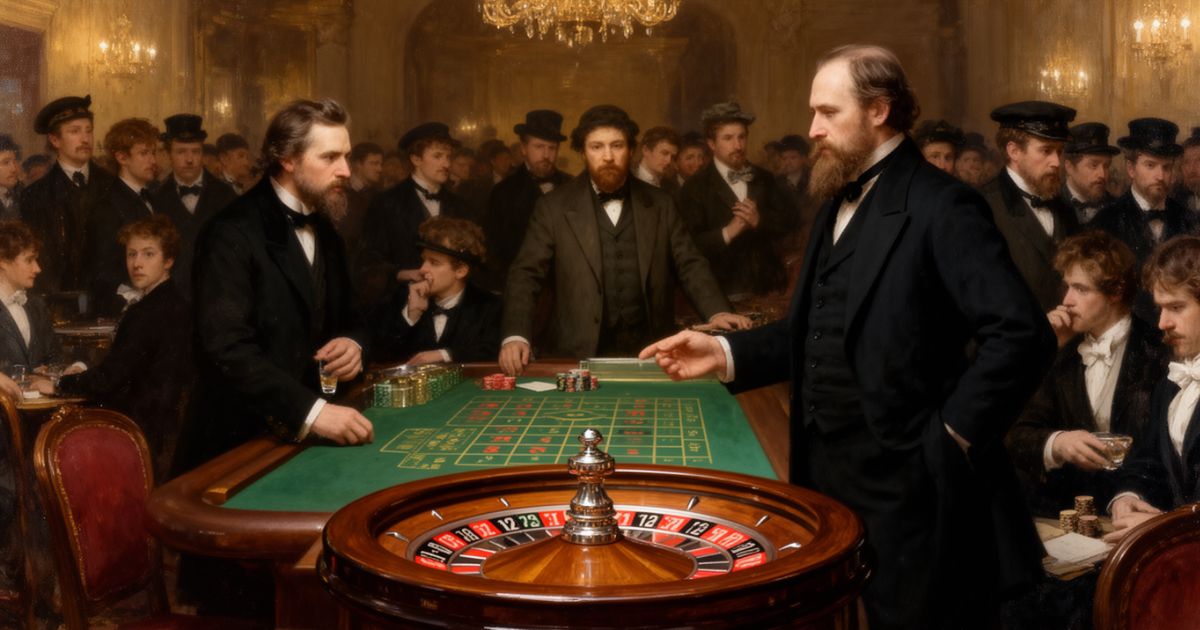
The Grandmother’s entry into the roulette-salon produced a profound
impression upon the public. Around the tables, and at the further end
of the room where the trente-et-quarante table was set out, there may
have been gathered from 150 to 200 gamblers, ranged in several rows.
Those who had succeeded in pushing their way to the tables were
standing with their feet firmly planted, in order to avoid having to
give up their places until they should have finished their game (since
merely to stand looking on—thus occupying a gambler’s place for
nothing—was not permitted). True, chairs were provided around the
tables, but few players made use of them—more especially if there was a
large attendance of the general public; since to stand allowed of a
closer approach; and, therefore, of greater facilities for calculation
and staking. Behind the foremost row were herded a second and a third
row of people awaiting their turn; but sometimes their impatience led
these people to stretch a hand through the first row, in order to
deposit their stakes. Even third-row individuals would dart forward to
stake; whence seldom did more than five or ten minutes pass without a
scene over disputed money arising at one or another end of the table.
On the other hand, the police of the Casino were an able body of men;
and though to escape the crush was an impossibility, however much one
might wish it, the eight croupiers apportioned to each table kept an
eye upon the stakes, performed the necessary reckoning, and decided
disputes as they arose.
In the last resort they always called in the Casino police, and the
disputes would immediately come to an end. Policemen were stationed
about the Casino in ordinary costume, and mingled with the spectators
so as to make it impossible to recognise them. In particular they kept
a lookout for pickpockets and swindlers, who simply swanned in the
roulette salons, and reaped a rich harvest. Indeed, in every direction
money was being filched from pockets or purses—though, of course, if
the attempt miscarried, a great uproar ensued. One had only to approach
a roulette table, begin to play, and then openly grab some one else’s
winnings, for a din to be raised, and the thief to start vociferating
that the stake was his; and, if the coup had been carried out with
sufficient skill, and the witnesses wavered at all in their testimony,
the thief would as likely as not succeed in getting away with the
money, provided that the sum was not a large one—not large enough to
have attracted the attention of the croupiers or some fellow-player.
Moreover, if it were a stake of insignificant size, its true owner
would sometimes decline to continue the dispute, rather than become
involved in a scandal. Conversely, if the thief was detected, he was
ignominiously expelled the building.
Upon all this the Grandmother gazed with open-eyed curiosity; and, on
some thieves happening to be turned out of the place, she was
delighted. Trente-et-quarante interested her but little; she preferred
roulette, with its ever-revolving wheel. At length she expressed a wish
to view the game closer; whereupon in some mysterious manner, the
lacqueys and other officious agents (especially one or two ruined Poles
of the kind who keep offering their services to successful gamblers and
foreigners in general) at once found and cleared a space for the old
lady among the crush, at the very centre of one of the tables, and next
to the chief croupier; after which they wheeled her chair thither. Upon
this a number of visitors who were not playing, but only looking on
(particularly some Englishmen with their families), pressed closer
forward towards the table, in order to watch the old lady from among
the ranks of the gamblers. Many a lorgnette I saw turned in her
direction, and the croupiers’ hopes rose high that such an eccentric
player was about to provide them with something out of the common. An
old lady of seventy-five years who, though unable to walk, desired to
play was not an everyday phenomenon. I too pressed forward towards the
table, and ranged myself by the Grandmother’s side; while Martha and
Potapitch remained somewhere in the background among the crowd, and the
General, Polina, and De Griers, with Mlle. Blanche, also remained
hidden among the spectators.
At first the old lady did no more than watch the gamblers, and ply me,
in a half-whisper, with sharp-broken questions as to who was so-and-so.
Especially did her favour light upon a very young man who was plunging
heavily, and had won (so it was whispered) as much as 40,000 francs,
which were lying before him on the table in a heap of gold and
bank-notes. His eyes kept flashing, and his hands shaking; yet all the
while he staked without any sort of calculation—just what came to his
hand, as he kept winning and winning, and raking and raking in his
gains. Around him lacqueys fussed—placing chairs just behind where he
was standing—and clearing the spectators from his vicinity, so that he
should have more room, and not be crowded—the whole done, of course, in
expectation of a generous largesse. From time to time other gamblers
would hand him part of their winnings—being glad to let him stake for
them as much as his hand could grasp; while beside him stood a Pole in
a state of violent, but respectful, agitation, who, also in expectation
of a generous largesse, kept whispering to him at intervals (probably
telling him what to stake, and advising and directing his play). Yet
never once did the player throw him a glance as he staked and staked,
and raked in his winnings. Evidently, the player in question was dead
to all besides.
For a few minutes the Grandmother watched him.
“Go and tell him,” suddenly she exclaimed with a nudge at my elbow,
“—go and tell him to stop, and to take his money with him, and go home.
Presently he will be losing—yes, losing everything that he has now
won.” She seemed almost breathless with excitement.
“Where is Potapitch?” she continued. “Send Potapitch to speak to him.
No, you must tell him, you must tell him,”—here she nudged me
again—“for I have not the least notion where Potapitch is. Sortez,
sortez,” she shouted to the young man, until I leant over in her
direction and whispered in her ear that no shouting was allowed, nor
even loud speaking, since to do so disturbed the calculations of the
players, and might lead to our being ejected.
“How provoking!” she retorted. “Then the young man is done for! I
suppose he wishes to be ruined. Yet I could not bear to see him have
to return it all. What a fool the fellow is!” and the old lady turned
sharply away.
On the left, among the players at the other half of the table, a young
lady was playing, with, beside her, a dwarf. Who the dwarf may have
been—whether a relative or a person whom she took with her to act as a
foil—I do not know; but I had noticed her there on previous occasions,
since, everyday, she entered the Casino at one o’clock precisely, and
departed at two—thus playing for exactly one hour. Being well-known to
the attendants, she always had a seat provided for her; and, taking
some gold and a few thousand-franc notes out of her pocket—would begin
quietly, coldly, and after much calculation, to stake, and mark down
the figures in pencil on a paper, as though striving to work out a
system according to which, at given moments, the odds might group
themselves. Always she staked large coins, and either lost or won one,
two, or three thousand francs a day, but not more; after which she
would depart. The Grandmother took a long look at her.
“That woman is not losing,” she said. “To whom does she belong? Do
you know her? Who is she?”
“She is, I believe, a Frenchwoman,” I replied.
“Ah! A bird of passage, evidently. Besides, I can see that she has her
shoes polished. Now, explain to me the meaning of each round in the
game, and the way in which one ought to stake.”
Upon this I set myself to explain the meaning of all the
combinations—of “rouge et noir,” of “pair et impair,” of “manque et
passe,” with, lastly, the different values in the system of numbers.
The Grandmother listened attentively, took notes, put questions in
various forms, and laid the whole thing to heart. Indeed, since an
example of each system of stakes kept constantly occurring, a great
deal of information could be assimilated with ease and celerity. The
Grandmother was vastly pleased.
“But what is zero?” she inquired. “Just now I heard the flaxen-haired
croupier call out ‘zero!’ And why does he keep raking in all the money
that is on the table? To think that he should grab the whole pile for
himself! What does zero mean?”
“Zero is what the bank takes for itself. If the wheel stops at that
figure, everything lying on the table becomes the absolute property of
the bank. Also, whenever the wheel has begun to turn, the bank ceases
to pay out anything.”
“Then I should receive nothing if I were staking?”
“No; unless by any chance you had purposely staked on zero; in which
case you would receive thirty-five times the value of your stake.”
“Why thirty-five times, when zero so often turns up? And if so, why do
not more of these fools stake upon it?”
“Because the number of chances against its occurrence is thirty-six.”
“Rubbish! Potapitch, Potapitch! Come here, and I will give you some
money.” The old lady took out of her pocket a tightly-clasped purse,
and extracted from its depths a ten-gülden piece. “Go at once, and
stake that upon zero.”
“But, Madame, zero has only this moment turned up,” I remonstrated;
“wherefore, it may not do so again for ever so long. Wait a little, and
you may then have a better chance.”
“Rubbish! Stake, please.”
“Pardon me, but zero might not turn up again until, say, tonight, even
though you had staked thousands upon it. It often happens so.”
“Rubbish, rubbish! Who fears the wolf should never enter the forest.
What? We have lost? Then stake again.”
A second ten-gülden piece did we lose, and then I put down a third. The
Grandmother could scarcely remain seated in her chair, so intent was
she upon the little ball as it leapt through the notches of the
ever-revolving wheel. However, the third ten-gülden piece followed the
first two. Upon this the Grandmother went perfectly crazy. She could no
longer sit still, and actually struck the table with her fist when the
croupier cried out, “Trente-six,” instead of the desiderated zero.
“To listen to him!” fumed the old lady. “When will that accursed zero
ever turn up? I cannot breathe until I see it. I believe that that
infernal croupier is purposely keeping it from turning up. Alexis
Ivanovitch, stake TWO golden pieces this time. The moment we cease to
stake, that cursed zero will come turning up, and we shall get
nothing.”
“My good Madame—”
“Stake, stake! It is not your money.”
Accordingly I staked two ten-gülden pieces. The ball went hopping round
the wheel until it began to settle through the notches. Meanwhile the
Grandmother sat as though petrified, with my hand convulsively clutched
in hers.
“Zero!” called the croupier.
“There! You see, you see!” cried the old lady, as she turned and faced
me, wreathed in smiles. “I told you so! It was the Lord God himself who
suggested to me to stake those two coins. Now, how much ought I to
receive? Why do they not pay it out to me? Potapitch! Martha! Where are
they? What has become of our party? Potapitch, Potapitch!”
“Presently, Madame,” I whispered. “Potapitch is outside, and they would
decline to admit him to these rooms. See! You are being paid out your
money. Pray take it.” The croupiers were making up a heavy packet of
coins, sealed in blue paper, and containing fifty ten gülden pieces,
together with an unsealed packet containing another twenty. I handed
the whole to the old lady in a money-shovel.
“Faites le jeu, messieurs! Faites le jeu, messieurs! Rien ne va plus,”
proclaimed the croupier as once more he invited the company to stake,
and prepared to turn the wheel.
“We shall be too late! He is going to spin again! Stake, stake!” The
Grandmother was in a perfect fever. “Do not hang back! Be quick!” She
seemed almost beside herself, and nudged me as hard as she could.
“Upon what shall I stake, Madame?”
“Upon zero, upon zero! Again upon zero! Stake as much as ever you can.
How much have we got? Seventy ten-gülden pieces? We shall not miss
them, so stake twenty pieces at a time.”
“Think a moment, Madame. Sometimes zero does not turn up for two
hundred rounds in succession. I assure you that you may lose all your
capital.”
“You are wrong—utterly wrong. Stake, I tell you! What a chattering
tongue you have! I know perfectly well what I am doing.” The old lady
was shaking with excitement.
“But the rules do not allow of more than 120 gülden being staked upon
zero at a time.”
“How ‘do not allow’? Surely you are wrong? Monsieur, monsieur—” here
she nudged the croupier who was sitting on her left, and preparing to
spin—“combien zero? Douze? Douze?”
I hastened to translate.
“Oui, Madame,” was the croupier’s polite reply. “No single stake must
exceed four thousand florins. That is the regulation.”
“Then there is nothing else for it. We must risk in gülden.”
“Le jeu est fait!” the croupier called. The wheel revolved, and stopped
at thirty. We had lost!
“Again, again, again! Stake again!” shouted the old lady. Without
attempting to oppose her further, but merely shrugging my shoulders, I
placed twelve more ten-gülden pieces upon the table. The wheel whirled
around and around, with the Grandmother simply quaking as she watched
its revolutions.
“Does she again think that zero is going to be the winning coup?”
thought I, as I stared at her in astonishment. Yet an absolute
assurance of winning was shining on her face; she looked perfectly
convinced that zero was about to be called again. At length the ball
dropped off into one of the notches.
“Zero!” cried the croupier.
“Ah!!!” screamed the old lady as she turned to me in a whirl of
triumph.
I myself was at heart a gambler. At that moment I became acutely
conscious both of that fact and of the fact that my hands and knees
were shaking, and that the blood was beating in my brain. Of course
this was a rare occasion—an occasion on which zero had turned up no
less than three times within a dozen rounds; yet in such an event there
was nothing so very surprising, seeing that, only three days ago, I
myself had been a witness to zero turning up three times in
succession, so that one of the players who was recording the coups on
paper was moved to remark that for several days past zero had never
turned up at all!
With the Grandmother, as with any one who has won a very large sum, the
management settled up with great attention and respect, since she was
fortunate to have to receive no less than 4200 gülden. Of these gülden
the odd 200 were paid her in gold, and the remainder in bank notes.
This time the old lady did not call for Potapitch; for that she was too
preoccupied. Though not outwardly shaken by the event (indeed, she
seemed perfectly calm), she was trembling inwardly from head to foot.
At length, completely absorbed in the game, she burst out:
“Alexis Ivanovitch, did not the croupier just say that 4000 florins
were the most that could be staked at any one time? Well, take these
4000, and stake them upon the red.”
To oppose her was useless. Once more the wheel revolved.
“Rouge!” proclaimed the croupier.
Again 4000 florins—in all 8000!
“Give me them,” commanded the Grandmother, “and stake the other 4000
upon the red again.”
I did so.
“Rouge!” proclaimed the croupier.
“Twelve thousand!” cried the old lady. “Hand me the whole lot. Put the
gold into this purse here, and count the bank notes. Enough! Let us go
home. Wheel my chair away.”
Master this chapter. Complete your experience
Purchase the complete book to access all chapters and support classic literature
As an Amazon Associate, we earn a small commission from qualifying purchases at no additional cost to you.
Available in paperback, hardcover, and e-book formats
Let's Analyse the Pattern
Early success in risky situations creates false confidence that leads to escalating dangerous behavior.
Why This Matters
Connect literature to life
This chapter teaches how to recognize when early success is random chance masquerading as natural ability.
Practice This Today
This week, notice when you or others attribute good outcomes to skill rather than circumstances—ask 'Could this have gone differently through no fault of mine?'
Now let's explore the literary elements.
Key Quotes & Analysis
"What every one took the Grandmother to be I do not know, but it appeared, at least, that she was accounted a person not only of great importance, but also, and still more, of great wealth"
Context: Alexei observes how the hotel staff treats the Grandmother like royalty
This reveals how wealth creates its own reality - people assume importance based on money and treat you accordingly. The Grandmother's power comes not from actual nobility but from perceived wealth.
In Today's Words:
Nobody knew exactly who she was, but everyone could tell she had serious money, and that was all that mattered
"The blockhead! The blockhead! To think that he could not even stand up for his tutor!"
Context: Her reaction to learning the General fired Alexei over the Baron incident
Shows the Grandmother values loyalty and honor over social climbing. She immediately sees the General's weakness and calls him out for abandoning someone who defended his family's honor.
In Today's Words:
What an idiot! He couldn't even back up the guy who was trying to protect his family!
"Zero! Zero has won! Look at all those lovely coins!"
Context: Her excitement when her long-shot bet on zero pays off spectacularly
Captures the intoxicating rush of winning big against terrible odds. Her focus on the physical coins shows how gambling makes abstract money feel tangible and immediate.
In Today's Words:
I hit the jackpot! Look at all that beautiful money!
"Stake the whole of the money on red"
Context: Doubling down after her massive zero win, betting everything on the next spin
Demonstrates how winning can become more dangerous than losing. Success breeds overconfidence and makes people take even bigger risks, exactly what casinos count on.
In Today's Words:
Put it all on red - let's go for broke
Thematic Threads
Power
In This Chapter
The Grandmother's wealth instantly transforms her social position—everyone defers to her despite her crude behavior and lack of nobility
Development
Expands from previous chapters showing how money trumps social breeding and education
In Your Life:
You might see how differently people treat you when they think you have money or connections versus when they think you don't
Loyalty
In This Chapter
The Grandmother fiercely defends Alexei against the General's decision to dismiss him over the Baron incident
Development
Contrasts sharply with the General's calculated social climbing over genuine relationships
In Your Life:
You might recognize who truly has your back when you're in trouble versus who disappears when it's inconvenient
Addiction
In This Chapter
The Casino environment is revealed as a carefully orchestrated theater designed to encourage escalating risk-taking behavior
Development
Introduced here as the physical manifestation of the gambling obsession that drives the entire story
In Your Life:
You might notice how certain environments—stores, apps, workplaces—are designed to make you behave in ways that benefit others
Class
In This Chapter
The Grandmother's crude manners are overlooked because of her apparent wealth, while others obsess over proper social behavior
Development
Continues the theme of how money can override traditional class markers and social rules
In Your Life:
You might see how people excuse bad behavior from those they perceive as powerful while holding others to strict standards
Delusion
In This Chapter
Everyone watches the Grandmother's wins with fascination, treating random chance as if it reveals character or destiny
Development
Builds on earlier delusions about love and status, now extending to beliefs about luck and skill
In Your Life:
You might catch yourself or others creating stories about why good or bad things happen, when it's often just random chance
You now have the context. Time to form your own thoughts.
Discussion Questions
- 1
Why does the Grandmother's early success at roulette feel so intoxicating to both her and the people watching?
analysis • surface - 2
How does the casino environment contribute to the Grandmother's escalating bets, and what role do the other characters play in encouraging her behavior?
analysis • medium - 3
Where have you seen people mistake early luck for genuine skill in your own life or workplace?
application • medium - 4
If you were Alexei watching the Grandmother win big, how would you balance protecting her from future losses while respecting her autonomy?
application • deep - 5
What does the Grandmother's gambling reveal about how power, money, and respect intersect in human relationships?
reflection • deep
Critical Thinking Exercise
Track Your Own Beginner's Luck Pattern
Think of a time when you experienced unusual early success in something new—a job, relationship, hobby, or financial decision. Write down what happened step by step, then analyze whether your success was skill or luck. Map out how that early success influenced your next decisions and whether you escalated your risks based on false confidence.
Consider:
- •Did you set limits before starting, or did you just wing it?
- •How did other people's reactions to your success affect your confidence?
- •What warning signs did you ignore because you felt 'on a roll'?
Journaling Prompt
Write about a current situation where you might be riding high on early success. What would it look like to pause and assess whether you're skilled or lucky before making your next move?
Coming Up Next...
Chapter 11: Victory's Dangerous Intoxication
The Grandmother's spectacular winning streak has made her the talk of the Casino, but her appetite for gambling has only grown stronger. As word of her success spreads, the stakes—and the risks—are about to get much higher.